18. Binary Search Trees Special graphs: graphs consist of nodes and - - PowerPoint PPT Presentation

18 binary search trees
SMART_READER_LITE
LIVE PREVIEW

18. Binary Search Trees Special graphs: graphs consist of nodes and - - PowerPoint PPT Presentation

Trees Trees are Generalized lists: nodes can have more than one successor 18. Binary Search Trees Special graphs: graphs consist of nodes and edges. A tree is a fully connected, directed, acyclic graph. [Ottman/Widmayer, Kap. 5.1, Cormen et


slide-1
SLIDE 1
  • 18. Binary Search Trees

[Ottman/Widmayer, Kap. 5.1, Cormen et al, Kap. 12.1 - 12.3]

510

Trees

Trees are Generalized lists: nodes can have more than one successor Special graphs: graphs consist of nodes and edges. A tree is a fully connected, directed, acyclic graph.

511

Trees

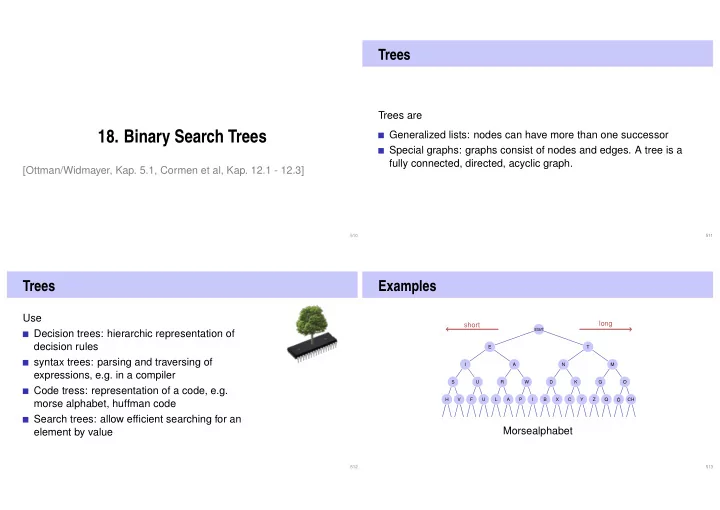
Use Decision trees: hierarchic representation of decision rules syntax trees: parsing and traversing of expressions, e.g. in a compiler Code tress: representation of a code, e.g. morse alphabet, huffman code Search trees: allow efficient searching for an element by value

512

Examples

start E I S H V U F U A R L A W P I T N D B X K C Y M G Z Q O Ö CH

long short

Morsealphabet

513

slide-2
SLIDE 2

Examples

3/5 + 7.0 + / 3 5 7.0

Expression tree

514

Nomenclature

Wurzel

W I E K

parent child inner node leaves

Order of the tree: maximum number of child nodes, here: 3 Height of the tree: maximum path length root – leaf (here: 4)

515

Binary Trees

A binary tree is either either a leaf, i.e. an empty tree,

  • r an inner leaf with two trees Tl (left subtree) and Tr (right

subtree) as left and right successor. In each node v we store a key v.key and two nodes v.left and v.right to the roots of the left and right subtree. a leaf is represented by the null-pointer

key left right

516

Recall: Linked List Node in Java

1 5 6

null

ListNode

key (type int) next (type ListNode)

class ListNode { int key; ListNode next; ListNode (int key, ListNode next){ this .key = key; this .next = next; } }

517

slide-3
SLIDE 3

Now: tree nodes in Java

public class SearchNode { int key; // Schluessel SearchNode left; // linker Teilbaum SearchNode right; // rechter Teilbaum // Konstruktor: Knoten ohne Nachfolger SearchNode(int k){ key = k; left = right = null; } } 5 3 8 2 null null null null null

SearchNode key (type int) left (type SearchNode) right (type SearchNode)

518

Binary search tree

A binary search tree is a binary tree that fulfils the search tree property: Every node v stores a key Keys in left subtree v.left are smaller than v.key Keys in right subtree v.right are greater than v.key

16 7 5 2 10 9 15 18 17 30 99

519

Searching

Input: Binary search tree with root r, key k Output: Node v with v.key = k or null v ← r while v = null do if k = v.key then return v else if k < v.key then v ← v.left else v ← v.right return null

8 4 13 10 9 19

Search (12) → null

520

Search Tree and Searching in Java

public class SearchTree { SearchNode root = null; // Wurzelknoten // Gibt zurueck, ob Knoten mit Schluessel k existiert public boolean contains (int k){ SearchNode n = root; while (n != null && n.key != k){ if (k < n.key) n = n.left; else n = n.right; } return n != null; } ... // Einfuegen, Loeschen }

521

slide-4
SLIDE 4

Height of a tree

The height h(T) of a tree T with root r is given by

h(r) =

  • if r = null

1 + max{h(r.left), h(r.right)}

  • therwise.

The worst case search time is determined by the height of the tree.

522

Insertion of a key

Insertion of the key k Search for k If successful search: output error Of no success: insert the key at the leaf reached Implementation: devil is in the detail

8 4 5 13 10 9 19

Insert (5)

523

Knoten Einf¨ ugen in Java

public boolean add (int k) { if (root == null) {root = new SearchNode(k); return true;} SearchNode t=root; while (k != t.key) { if (k < t.key) { if (t.left == null){ t.left = new SearchNode(k); return true;} else { t = t.left; } } else { // k > t.key if (t.right == null){ t.right = new SearchNode(k); return true;} else { t = t.right; } } } return false; }

524

Remove node

Three cases possible: Node has no children Node has one child Node has two children

[Leaves do not count here] 8 3 5 4 13 10 9 19

525

slide-5
SLIDE 5

Remove node

Node has no children Simple case: replace node by leaf.

8 3 5 4 13 10 9 19

remove(4)

− →

8 3 5 13 10 9 19

526

Remove node

Node has one child Also simple: replace node by single child.

8 3 5 4 13 10 9 19

remove(3)

− →

8 5 4 13 10 9 19

527

Remove node

Node v has two children The following observation helps: the smallest key in the right subtree v.right (the symmetric successor of v) is smaller than all keys in v.right is greater than all keys in v.left and cannot have a left child. Solution: replace v by its symmetric suc- cessor.

8 3 5 4 13 10 9 19

528

By symmetry...

Node v has two children Also possible: replace v by its symmetric predecessor. Implementation: devil is in the detail!

8 3 5 4 13 10 9 19

529

slide-6
SLIDE 6

Algorithm SymmetricSuccessor(v)

Input: Node v of a binary search tree. Output: Symmetric successor of v w ← v.right x ← w.left while x = null do w ← x x ← x.left return w

530

SymmetricDesc in Java

public SearchNode symmetricDesc(SearchNode node) { if (node.left == null) { return node.right; } if (node.right == null) { return node.left; } SearchNode n = node.right; // cannot be null SearchNode parent = null; while (n.left != null) { parent = n; n = n.left; } if (parent != null){ parent.left = n.right; n.right = node.right; } // else n == node.right n.left = node.left; return n; }

This algorithm returns the symmetric

  • descendent. But it does even more: it

handles also all cases with one or no

  • descendent. And it replaces the sym-

metric descendent by its successor.

531

Knoten L¨

  • schen in Java

public boolean remove (int k) { SearchNode n = root; if (n != null && n.key == k) { root = SymmetricDesc(root); return true; } while (n != null) { if (n.left != null && k == n.left.key) { n.left = SymmetricDesc(n.left); return true; } else if (n.right != null && k == n.right.key) { n.right = SymmetricDesc(n.right); return true; } else if (k < n.key) { n = n.left; } else { n = n.right; } } return false; }

532

Traversal possibilities

preorder: v, then Tleft(v), then

Tright(v).

8, 3, 5, 4, 13, 10, 9, 19 postorder: Tleft(v), then Tright(v), then

v.

4, 5, 3, 9, 10, 19, 13, 8 inorder: Tleft(v), then v, then Tright(v). 3, 4, 5, 8, 9, 10, 13, 19

8 3 5 4 13 10 9 19

533

slide-7
SLIDE 7

Degenerated search trees

9 5 4 8 13 10 19

Insert 9,5,13,4,8,10,19

ideally balanced

4 5 8 9 10 13 19

Insert 4,5,8,9,10,13,19

linear list

19 13 10 9 8 5 4

Insert 19,13,10,9,8,5,4

linear list

534

Efficiency Considerations

Obviously the runtime of the algorithms search, insert and delete depend in the worst case on the heigh of the tree. Degenerated trees are in the worst case thus not better than a linked list Balanced trees make sure (e.g. with rotations) during insertion or deletion that the tree stays balanced and provide certain guarantees for the algorithms. The data structures TreeSet and TreeMap in Java are implemented with balanced trees (so called Red-Black-Trees).

535

  • 19. Heaps

[Ottman/Widmayer, Kap. 2.3, Cormen et al, Kap. 6]

536

[Max-]Heap9

Binary tree with the following prop- erties

1 complete up to the lowest

level

2 Gaps (if any) of the tree in

the last level to the right

3 Heap-Condition:

Max-(Min-)Heap: key of a child smaller (greater) thant that of the parent node

Wurzel

22 20 16 3 2 12 8 11 18 15 14 17

parent child leaves

9Heap(data structure), not: as in “heap and stack” (memory allocation) 537

slide-8
SLIDE 8

Heap as Array

Tree → Array: children(i) = {2i + 1, 2i + 2} parent(i) = ⌊(i − 1)/2⌋

22 20 1 18 2 16 3 12 4 15 5 17 6 3 7 2 8 8 9 11 10 14 11

Vater Kinder

22 20 16 3 2 12 8 11 18 15 14 17 [0] [1] [2] [3] [4] [5] [6] [7] [8] [9] [10] [11]

Depends on the starting index10

10For array that start at 1: {2i + 1, 2i + 2} → {2i, 2i + 1}, ⌊(i − 1)/2⌋ → ⌊i/2⌋ 538

Heap in Java

public class Heap { double[] A;// will need to grow int sz; // Heap initialized with 16 elements Heap () { A = new double[16]; sz = 0; } // binary growth of the array void grow(){ ... } // insert element in the heap public void add(double value){...} // extract and return first (maximal) element public double remove() {...} }

539

Insert

Insert new element at the first free

  • position. Potentially violates the heap

property. Reestablish heap property: climb successively

22 20 16 3 2 12 8 11 18 15 14 17 22 20 16 3 2 12 8 11 21 18 14 15 17

540

Algorithm Sift-Up(A, m)

Input: Array A with at least m + 1 and Max-Heap-Structure on A[0, . . . , m − 1] Output: Array A with Max-Heap-Structure on A[0, . . . , m]. v ← A[m] // value c ← m // current position p ← ⌊(c − 1)/2⌋ // parent node while c > 0 and v > A[p] do A[c] ← A[p] // Value parent node → current node c ← p // parent node → current node p ← ⌊(c − 1)/2⌋ A[c] ← v // value → current node

541

slide-9
SLIDE 9

add

// insert element to the heap public void add(double value){ if (sz == A.length){ grow(); } int current = sz; int parent = (current−1)/2; // sift value up while (current > 0 && value > A[parent]) { A[current] = A[parent]; current = parent; parent = (current−1)/2; } A[current] = value; sz++; }

542

Remove the maximum

Replace the maximum by the lower right element Reestablish heap property: sink successively (in the direction of the greater child)

21 20 16 3 2 12 8 11 18 15 14 17 20 16 14 3 2 12 8 11 18 15 17

543

Why this is correct: Recursive heap structure

A heap consists of two heaps:

22 20 16 3 2 12 8 11 18 15 14 17

544

Algorithm Sift-down(A, i, m)

Input: Array A with max-heap structure for the children of i. Last element m. Output: Array A with heap structure for i with last element m. while 2i + 1 ≤ m do j ← 2i + 1; // j left child if j < m and A[j] < A[j + 1] then j ← j + 1; // j right child with greater key if A[i] < A[j] then swap(A[i], A[j]) i ← j; // keep sinking else i ← m; // sinking finished

545

slide-10
SLIDE 10

remove

public double remove() { double max = A[0]; double value = A[sz−−]; int i = 0; int j = 0; // sift value down while (2∗i+1 < sz){ j = 2∗i+1; // left child if (j < sz−1 && A[j] < A[j+1]){ ++j;} // right key greater if (value < A[j]){ // heap condition still violated A[i] = A[j]; i = j; // sift down } else { i = sz; } // finished } A[j] = value; return max; }

546

Sort heap

A[1, ..., n] is a Heap.

While n > 1 swap(A[1], A[n]) Sink(A, 1, n − 1);

n ← n − 1

7 6 4 5 1 2

swap

2 6 4 5 1 7

sink

6 5 4 2 1 7

swap

1 5 4 2 6 7

sink

5 4 2 1 6 7

swap

1 4 2 5 6 7

sink

4 1 2 5 6 7

swap

2 1 4 5 6 7

sink

2 1 4 5 6 7

swap

1 2 4 5 6 7

547

Height of a Heap

What is the height H(n) of Heap with n nodes? On the i-th level of a binary tree there are at most 2i nodes. Up to the last level of a heap all levels are filled with values.

H(n) = min{h ∈ ◆ :

h−1

  • i=0

2i ≥ n}

with h−1

i=0 2i = 2h − 1:

H(n) = min{h ∈ ◆ : 2h ≥ n + 1},

thus

H(n) = ⌈log2(n + 1)⌉ .

548

Runtime of the Heap-Algorithms

H(n) = ⌈log2(n + 1)⌉

The algorithms insert and extrat therefore make about log2(n + 1) ”Steps“.11 That makes the heap a very fast data structure because the logarithm grows only very slowy. It is used for sorting data and to implement priority Queues.

11will be made more precise in Computer Science II. 549