
SLIDE 1
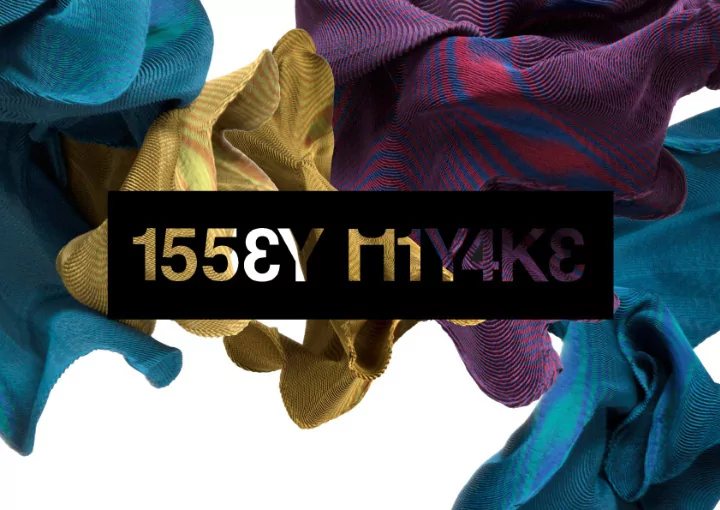
1NTR0DUCT10N Design/develop a creative strategy for Issey Miyakes - - PowerPoint PPT Presentation
1NTR0DUCT10N Design/develop a creative strategy for Issey Miyakes wo- menswear line in the form of a brand magazine. / Researching the brand and unpacking its identity and image. / Find a concept which encapsulates the DNA of Issey
(Steele, 2010; Blanchard, 2016; Issey Miyake Inc., 2017)
(Oxford Dictionary, 2018)
in Anonymous (2017).
24.157.187
FIBONACCI’S SEQUENCE MATH IS FASHION, FASHION IS MATH MATH ARE GAMES, GAMES ARE MATH IN CONVERSATION WITH KELLY DELP PALAIS DE LA DECOUVERTE THE MATHS OF RYOJI IKEDA
Thruston
W.
Unfold the folded, embrace the movement, and lose yourself to dance
PALAIS DE LA DECOUVERTE
I N C O N V E R S A T I O N W I T H
5.702.887KELLY DELP
In what ways do mathematics infjltrate r everyday lives? Mathematics really helps me organize and understand the world I live“I like to think about my clothing as a piecewise euclidean surface, these types of surfaces are well studied by Mathematicians.”
10.946I N C O N V E R S A T I O N W I T H
“No human activity is free from mathematics, from one way or another”.
Guillaume, Palais de la Decouverte Born the 23rd of November and known today by his nickname “Fibonacci”, which approximately means “son of Bonacci”, Leonardo Pisano Bogollo lived between 1170 and 1250 in Italy and he’s contemplated as the author of the “Fibonacci sequence”. but as the matter of fact he was not the first to know and implement the sequence, it was already known hundreds of year before in
was that he helped spread the Arabic numbers (0,1,2,3...) thought Europe in place of Roman Numerals (I,II,III, IV...). The Fibonacci sequence exhibits a numerical pattern which was invented as the answer of a simple mathematical problem. He wrote in the Book of the Abacus, in 1202: “Someone placed a pair of rabbits in a certain place, enclosed on all sides by a wall, to find out how many pairs will be born in the course of one year, it being assumed that every month a pair of rabbits produces another pair, and that rabbits begin to bear young two months after their own birth.” The Fibonacci sequence exhibits a numerical pattern that has a major importance and relevance nowadays, the sequence appear in his book “Liber Abaci,” which taught the Western world the methods of arithmetic that we use today. It can be implemented to display or describe a variety
such as science, art and nature. This sequence is surprisingly related, and not in a preconceived way, with other mathematical ideas, such as self-similar curves, spirals and the golden ratio, all of them appreciated since ancient times for their charm and beauty, but as same as these others their appearance in the world
a mystery. The most common examples can be observed in the number of petals
sunflower or a pineapple which are typically following the Fibonacci sequence. But even more intriguing is the appearance
ratios, in fields far distant from the structure
theories of beauty and proportion. the human body itself has various representations of the Fibonacci Sequence, from the face to the ear, to the hands and more. The Fibonacci Sequence allows to see and to think that Math can be a sign of beauty. It’s a fascinating view of a world that is way far from being full of chaos but instead crowed with wonders.
1,1,2,3
F A S H I O N I S M A T H
Blumer stated in 1969 that “to limit fashion to the field of costume and adornment is to have an inadequate idea of the true scope of its occurrence”. A similar statement can be made about mathematics: to limit the subject to numbers and calculus is to have an inadequate idea of the true scope of its
For a long time, fashion was seen as a trivial subject, focused on appearances and deception, while mathematics has been reserved to the scientific elite, too complex to be understood by the general public. Mathematics can be defined as « the abstract science of number, quantity, and space, either as abstract concepts,
as physics and engineering » (Oxford Dictionary, 2018) and it can be difficult to see a clear link between fashion and mathematics, two seemingly opposed subjects, though they both have been misunderstood by the majority and adopted by the minority of the public. Mathematics can be
everywhere, whether naturally present in our environment, or as a tool to create inorganic elements and explain
Mathematics transcend time and space, not stopping at borders or time-zones, they are an international language. According to Dr Mark Liu, fashion designer and PhD in Non-Euclidean Fashion Patternmaking, mathematics are a « gateway to technology and fashion, a new way of seeing things changing and moving ». Mathematics are primary present in fashion through sizes, dimensions, patterns, lengths, cuts and shapes. Lines and proportions need to be understood by fashion designers. Issey Miyake’s designer Dai Fujiwara explored the boundaries between mathematics and fashion for his Paris collection in 2010. Inspired by William Thurston’s explanation of geometry through the peeling of a clementine, Fujiwara and his team worked with the mathematician
their « “8 Geometry Link Models as Metaphor of the Universe » or also known as « The Poincare Odissey ». The resulting garments, linked to non-euclidean geometry, the branch
fundamental changes to the concept
Dictionary), were gracefully draped, twisted, knotted. Thurston, who bowed at the end of the show, later said: « Many people think of mathematics as austere and self-contained. To the contrary, mathematics is a very rich and very human subject, an art that enables us to see and understand deep interconnections in the world. The best mathematics uses the whole mind, embraces human sensibility, and is not at all limited to the small portion of our brains that calculates and manipulates with
find truth, and where we find truth, we discover incredible beauty. » Mathematics and fashion are intrinsically linked, for they both work towards explaining and reflecting the beauty of things, across time and space.
21
“Beauty is crystal, rationality, precision, simplicity … The sublime is infjnit infjnitesial immense, indescribable. Mathematics is beauty in its purest form”
RYOJI IKEDA .
165.580.141
T H E M A T H S O F
Music and audio have been sources of inspiration for many creatives from different part of the arts industry. In fashion, choreographer William Forsythe asked Issey Miyake to create the costumes for his new production for the Frankfurt Ballet « The Loss of Small Details » in
materials and clothing that would move with the dancers, using a new lightweight knitted material and introduced garments pleating that will later become part of the « Pleats Please » collection. A year later, William Forsythe staged Issey Miyake’s Spring Summer 1994 show in the Caroussel du Louvre in Paris. Musician and plastician Ryoji Ikeda was also influenced by the choreographer for his newest installation at La Grande Halle de La Villette in Paris, “Choreographic Objects”. Using mathematics, the stow artists modify and amplify movements using rapidly changing audio-visual components in Test Pattern, as well as naturally choreographed pendulums in between which the spectator can wander. This installation is not Ikeda’s first experience with mathematics. First DJ in the 1990s, in 2001 he receives the Golden Nica prize at the Ars Electronica Festival in Austria for his highly precise technical skills. His recent installations borrow from mathematical logic, such as Spectra in 2008. This installation, made of beams of sound and lights following geometric patterns
Paris, explored Ikeda’s long-term relationship with mathematics. In fact, the beam of light corresponded to a binary number. “Beauty is crystal, rationality, precision, simplicity … The sublime is infinity: infinitesimal, immense, indescribable. Mathematics is beauty in its purest form,” Ikeda later revealed in an interview with The Guardian (https://www.theguardian.com/ rtanddesign/2008/oct/09/ryoji. ikeda.lelaboratoire.paris). Ikeda has also worked on the
a space challenging the belief that art and science cannot mix and where artists and scientists can
equal to L » was showcased there from 2008 to 2009. His piece was made of two horizontal boards: one was a prime number made of over 7.23 million digits, the second was a random number generated by computer algorithms, also consisting of over 7 million digits. From a distance, the panels are only blurry and grey but when getting closer the audience can see a vast number of small digits, highlighting the aesthetic similarities in the languages of arts and maths. Linking visuals and music to mathematical and physical phenomenas, Ryoji Ikeda is able to immerse the spectator in his creations and closes the gap between arts and sciences.
267.914.296
4.181
G A M E S A R E M A T H S
Natasha has forty-one Issey Miyake dresses in her closet. She put more Miyake dresses in the closet today. There are now fifty-one Miyake dresses in her closet. How many dresses did Natasha put in the closet? There are one hundred and forty pieces of garments at the Issey Miyake Store at Rue Royale in Paris. They are arranged on racks that hold twenty items each. How many racks are in the Issey Miyake store? Carol bought 4 outfits with 6 pieces each. Her friend Rachel borrowed 7 of the items. How many items is Carol left with?
is pleased to invite ___________________ to the launch of «1,1», its brand magazine showacsing the A/W 17 collection. Friday 2nd of March 2018 Issey Miyake store, 11 rue Royale, 75008 Paris. Press Presentation from 5pm to 6pm Cocktail from 6pm onwards. Please have one mathematical element in your
Issey Miyake Store 11 rue Royale, 75008 Paris Ryoji Ikeda
10 20 30 40 50 Location Installation Decoration Invitations Staff Food Music Media Coverage Budget Percentage
Anonymous (2017) ‘Inside the mind of a mathematician’ BBC Future. [Online] 16th February 2017 [Accessed on 18th December 2017] http://www. bbc.com/future/sponsored/story/20170216-inside-the-mind-of-a-mathemati- cian Blanchard, T. (2016) ‘Issey Miyake: 45 years at the forefront of fashion’ The Guardian. [Online] 10th April 2016 [Accessed on 14th December 2017] https://www.theguardian.com/fashion/2016/apr/10/issey-miyake-45-years-at- the-forefront-of-fashion Issey Miyake Inc. (2017) Chronology. Issey Miyake Inc. [Online][Ac- cessed on 14th December 2017] http://mds.isseymiyake.com/im/en/chronolo- gy/ Oxford Dictionary (2018) Mathematics. Oxford Dictionary. [Online] [Accessed on 14th December 2017] https://en.oxforddictionaries.com/defjni- tion/mathematics Steele, V. (2010) «Issey Miyake» in The Berg Companion to Fashion. London: Bloomsbury Academics.
Anonymous (no date) ‘Mathematics Meets Fashion: Thurston’s Concepts Inspire Designer’ American Mathematical Society. [Online][Accessed on 20th December 2017] http://www.ams.org/publicoutreach/ams-news-releases/ thurston-miyake Blanks, T. (2010) ‘The Maths of Miyake’ Wired. [Online] 20th May 2010 [Accessed on 22nd December 2017] http://www.wired.co.uk/article/the-maths-
Crane, D. (1969) ‘Fashion in Science: Does It Exist?’, Social Problems, 16(4) pp. 433-441. [Online][Accessed on 22nd December 2017] http://www. jstor.org/stable/pdf/799952.pdf Delp, K. (2012) ‘High Fashion Meets Higher Mathematics’ Math Horizons, 20(2) pp. 5-10. [Online][Accessed on 22nd December 2017] http://www.jstor.
English, B. (2011). Issey Miyake. In Japanese Fashion Designers: The Work and Infmuence of Issey Miyake, Yohji Yamamoto and Rei Kawakubo,
Giuliana, B. (2003) ‘Pleats of Matter, Folds of the Soul’ Log, 1, pp. 113-
pdf/41764958.pdf Grumbach, D. (2014) History of International Fashion. Northampton: Interlink Books. Hiramistu, C. (2005) ‘Japanese Tradition in Issey Miyake’ Design Discourse, 1(1), pp. 35-43. Hume, L. (2013). The Buddha, the Dharma, the Sangha … and the Robe. In The Religious Life of Dress: Global Fashion and Faith, pp. 104-124. London: Bloomsbury Academic. [Online] [Accessed on December 15th 2017] http:// dx.doi.org/10.2752/9781474290326/RELDRELH0009 Issey Miyake Inc. (2017a) Issey Miyake website. [Online] [Accessed on 14th December 2017] http://mds.isseymiyake.com/mds/en/top/ Issey Miyake, Inc. (2017b) ISSEY MIYAKE Autumn Winter 2017. Directed by Jacob Sutton. [Online video] https://www.youtube.com/ watch?v=LNK3YmDfHaE Issey Miyake, Inc. (2017c) ISSEY MIYAKE Spring Summer 2017. Directed by Jacob Sutton. [Online video] https://www.youtube.com/watch?v=b5- 6gHjss1U Issey Miyake, Inc. (2016a) ISSEY MIYAKE Autumn Winter 2016. Directed by Jacob Sutton. [Online video] https://www.youtube.com/watch?v=UwuiDvfZruk Issey Miyake, Inc. (2016b) ISSEY MIYAKE Spring Summer 2016. Directed by Jacob Sutton. [Online video] https://www.youtube.com/watch?v=C7_ R5SBH5hk Issey Miyake, Inc. (2015a) ISSEY MIYAKE Spring Summer 2015. Directed by Jacob Sutton. [Online video] https://www.youtube.com/watch?v=_ iFI8YOtHRA
Issey Miyake, Inc. (2015b) ISSEY MIYAKE Autumn Winter 2015. Directed by Jacob Sutton. [Online video] https://www.youtube.com/watch?v=zE0yru- DZuA Issey Miyake, Inc. (2014) ISSEY MIYAKE Spring Summer 2014. Directed by Jacob Sutton. [Online video] https://www.youtube.com/ watch?v=XoMhhK__ABY Issey Miyake, Inc. (2013) ISSEY MIYAKE Autumn Winter 2013. Directed by Jacob Sutton. [Online video] https://www.youtube. com/watch?v=AIX3tN3pV6M Lalloo-Morar, S. (2010). «Design Innovation by Japanese Designers Miyake, Kawakubo, and Yamamoto» in J.E. Vollmer (Eds.). Berg Encyclopedia of World Dress and Fashion: East Asia. Oxford: Berg Publishers. [Online][Accessed 15th December 2017] http://dx.doi.org/10.2752/BEWDF/EDch61211 Marra-Alvarez, M. (2010) ‘When the West Wore East: Rei Kawakubo, Yohji Yamamoto and The Rise of the Japanese Avant-Garde in Fashion’ Dresstudy,
dresstudy/pdf/D57_Marra_Alvarez_e_When_the_West_Wore_East.pdf Martin, R. (1995) ‘Our Kimono Mind: Refmections on ‘Japanese Design: A Survey Since 195o’Journal of Design History, 8(3) pp. 215-223. [Online] [Accessed on 11th December 2017] http://www.jstor.org/stable/pdf/1316033. pdf Mears, P. (2010a). «Yamamoto, Yohji». In V. Steele (Ed.). The Berg Companion to Fashion. Oxford: Bloomsbury Academic. Retrieved December 15 2017, from https://www.bloomsburyfashioncentral.com/products/berg- fashion-library/encyclopedia/the-berg-companion-to-fashion/yamamoto-yohji Mears, P. (2010b). «Japonisme». In V. Steele (Ed.). The Berg Companion to
https://www.bloomsburyfashioncentral.com/products/berg-fashion-library/ encyclopedia/the-berg-companion-to-fashion/japonisme Menkes, S. (2010) ‘Designers Outline A New Geometry’ The New York Times [Online] 5th March 2010 [Accessed December 2017] http://www. nytimes.com/2010/03/06/fashion/06iht-rrick.html Miller, C., McIntyre, S. and Mantrala, M. (1993) ‘Towards Formalizing Fashion Theory’, Journal of Marketing Research, 30(2) pp. 142-157. [Online] [Accessed on 15th December 2017] http://www.jstor.org/stable/pdf/3172824. pdf Morcom, J. (no date) ‘Where fashion and mathematics collide’ 2ser 107.3 [Online] [Accessed on 15th December 2017] https://2ser.com/fashion- mathematics-collide/ Orzco, L. (2010) ‘MYSTORYING: EXTOLLING THE POSSIBILITIES OF ELECTRATE COMPOSITION THROUGH AN UNKNOWN BECOMING’ Watermark, 4 pp. 30-39 [Google Books] https://s3.amazonaws. com/academia.edu.documents/27908600/watermark_vol4_2010.pdf?AWS AccessKeyId=AKIAIWOWYYGZ2Y53UL3A&Expires=1513331399&Sig nature=GU9ey%2FZ6lilBRb0wP3dSk%2FWaoks%3D&response-content- disposition=inline%3B%20filename%3DART_VS._NATURE_BEN_ JONSONS_PROTO-ENVIRON.pdf#page=28 Papadopoulos, A. (2016) ‘EULER AND CHEBYSHEV: FROM THE SPHERE TO THE PLANE AND BACKWARDS’ Proceedings in Cybernetics. [Online][Accessed on 22nd December 2017] https://arxiv.org/pdf/1608.02724. pdf
Rehmeyer, J. (2010) ‘The mutual inspiration of art and mathematics’, Science News. [Online] 6th March 2010 [Accessed 22nd December 2017] Steele, V. (2010a) «Activewear» in The Berg Companion to Fashion. London: Bloomsbury Academics. Steele, V. (2010b) «Ethnic Style in Fashion» in The Berg Companion to
Steele, V. (2010c) ‘Fashion Advertising’ in The Berg Companion to
Steele, V. (2010d) «Japanese Fashion» in The Berg Companion to Fashion. London: Bloomsbury Academics. Steele, V. (2010e) «Fashion Photography» in The Berg Companion to
WGSN (2012) Mathematical Curiosities. April 2012. [Online][Accessed on 11th December 2017] https://www.wgsn.com/content/board_viewer/#/19978/ page/16 WGSN (2013) Issey Miyake launches Reality Lab concept in Tokyo. November 2013. [Online][Accessed on 11th December 2017] https://www. wgsn.com/content/board_viewer/#/135790/page/1 WGSN (2015a) Age, Rebranded. February 2015. [Online][Accessed on 12th January 2018] https://www.wgsn.com/content/board_viewer/#/57000/ page/4 WGSN (2015b) Boomers! . September 2015. [Online][Accessed on 12th January 2018] WGSN (2016a) Silver Shoppers: Retail Strategies for Older Consumers. Novembre 2016. [Online][Accessed on 12th January 2018] https://www.wgsn. com/content/board_viewer/#/69096/page/2 WGSN (2016b) Marketing to Generation Z. November 2016. [Online] [Accessed on 12th January 2018]
[Online][Accessed on 29th December 2017] https://www.wgsn.com/content/ board_viewer/#/70382/page/1
[Accessed on 29th December 2017] https://www.wgsn.com/content/board_ viewer/#/73896/page/1
content/board_viewer/#/74165/page/1
content/board_viewer/#/74555/page/1
[Online][Accessed on 29th December 2017] https://www.wgsn.com/content/ board_viewer/#/76051/page/2 WGSN (2017) Gen X: A Guide for Fashion Marketers. November 2017. [Online][Accessed on 12th January 2018]
19 December 2017] https://www.instagram.com/isseymiyake.antwerp/ Issey Miyake. (no date) Issey Miyake Website. [online image][accessed on 19 December 2017] https://www.isseymiyake.com/en/brands/isseymiyake ISO 1200 BTS (no date) Behind the scenes by @paytonruddock. Instagram. [Online Image][Accessed on 18th January 2018] https://www.instagram.com/p/ BcZQvDkDWrI/ Anonymous (no date) 3D. Pinterest. [Online Image][Accessed on 12th Ja- nuary 2018] https://www.pinterest.fr/pin/333055334919949712/ Anonymous (no date) Helicoid. Pinterest. [Online Image][Accessed on 12th January 2018] https://www.pinterest.fr/pin/506373551827322530/ Anonymous (no date) Curves. Pinterest. [Online Image][Accessed on 12th January 2018] https://www.pinterest.fr/pin/313422455311382236/ Anonymous (no date) Perspective. Pinterest. [Online Image][Accessed on 12th January 2018] https://www.pinterest.fr/pin/4081455890831916/ Anonymous (no date) Mobius. Pinterest. [Online Image][Accessed on 12th January 2018] https://www.pinterest.fr/pin/40532465371214043/ Anonymous (no date) Fibonacci. Pinterest. [Online Image][Accessed on 12th January 2018] https://www.pinterest.fr/pin/353180795763639324/ Anonymous (no date) Numbers. Pinterest. [Online Image][Accessed on 12th January 2018] https://www.pinterest.fr/pin/413416440778038269/ Anonymous (no date) Space. Pinterest. [Online Image][Accessed on 12th January 2018] https://www.pinterest.fr/pin/534872893228541765/ Anonymous (no date) Chambord Castle. Pinterest. [Online Image][Accessed
Anonymous (no date) Natural Makeup 2. Pinterest. [Online Image][Accessed
Anonymous (no date) Dark Natural Lip Color. Pinterest. [On- line Image][Accessed on 18th January 2018] https://www.pinterest.fr/ pin/285767538838336843/ Anonymous (no date) Girl with Hair in the Wind. Pinterest. [On- line Image][Accessed on 18th January 2018] https://www.pinterest.fr/ pin/671880838129235421/ Anonymous (no date) Model Posing on White Background. Pinterest. [Online Image][Accessed on 18th January 2018] https://www.pinterest.fr/ pin/64668944630755467/ Anonymous (no date) Studio. Pinterest. [Online Image][Accessed on 18th January 2018] https://www.pinterest.fr/pin/227642956134980717/ Anonymous (no date) Clothes Thrown in the Air 1. [Online Image] [Accessed on 18th January 2018] http://www.dobermanstudio.ru/grape/ upload/2116049487/Color.jp Anonymous (no date) Clothes Thrown in the Air 2. [Online Image] [Accessed on 18th January 2018] http://www.dobermanstudio.ru/grape/ upload/259766242/Brown.jpg Anonymous (no date) Clothes Thrown in the Air 3. BBC.com. [Online Image][Accessed on 18th January 2018] http://www.bbc.com/future/sto-
ry/20120717-why-we-love-to-hoard Anonymous (no date) Red Cloth Flowing. [Online Image][Accessed on 18th January 2018] https://png.pngtree.com/element_origin_min_pic/17/01/01/5cf- 3176cf7b60207dad5a31ff4c58431.jpg Anonymous (no date) 22 Balloons Sky. Pinterest. [Online Image][Accessed
Anonymous (no date) 30 Balloons. Pinterest. [Online Image][Accessed on 18th January 2018] https://www.pinterest.fr/pin/260012578465912822/ Anonymous (no date) Lupita Nyong’o for InStyle. [Online Image][Ac- cessed on 18th January 2018] http://www.screenreview.fr/essentiel-de-la-se- maine-127/ Arvs Brevis (no date) Hokusai Meets Fibonacci, Golden Ratio. Pinte-
pin/295408056792088108/ Feelunique.com (no date) Natural Makeup 1. [Online Image][Accessed on 18th January 2018] http://fr.feelunique.com/thelounge/quel-rouge-a-levres-car- nation Jacob Sutton (2016) Issey Miyake SS16. [Online Image][Accessed 12th January 2018] http://jacobsutton.com/story/issey-miyake-ss16/ Jacob Sutton (2016) Issey Miyake AW17. [Online Image][Accessed 12th January 2018] http://jacobsutton.com/story/issey-miyake-fw17/ Jacob Sutton (2017) Issey Miyake SS17. [Online Image][Accessed on 18th January 2018] http://jacobsutton.com/story/issey-miyake-fw17/ Jewel Street Studio (2009) New York Locations. Production Paradise. [On- line Image][Accessed on 18th January 2018] https://www.productionparadise. com/showcase/new-york-issue-173-260/jewel-street-studios-10261.html#pho- to Lippman, H. (no date) Mathematic drawing. Pinterest. [online image][Ac- cessed on 12th January 2018] https://in.pinterest.com/pin/450148925247373766/ Martin Munkasci (1934) Jumping a Puddle. [Online Image][Accessed on 18th January 2018] https://www.pinterest.fr/pin/395824254732223036/ Mauro Fiorito (no date) Daiane. [Online Image][Accessed 20th January 2018] https://maurofjorito.com/portraits/#!jig[1]/https://maurofjorito.com/wp- content/uploads/Daiane-1-683x1024.jpg Mauro Fiorito (no date) Larissa. [Online Image][Accessed 20th January 2018] https://maurofjorito.com/portraits/#!jig[1]/https://maurofjorito.com/wp- content/uploads/Larissa-16-679x1024.jpg Mauro Fiorito (no date) Cecilie. [Online Image][Accessed 20th January 2018] https://maurofjorito.com/portraits/#!jig[1]/https://maurofjorito.com/wp- content/uploads/Cecilie-01-683x1024.jpg Nane Riehl (2016) Outfjt: Striped Off Shoulder Blouse and Mom Jeans with High Heels Mules. [Online Image][Accessed on 18th January 2018] http:// naneriehl.com/outfjt-striped-off-shoulder-blouse-and-mom-jeans-with-high- heels-mules/ New York Times. (2010) French female. [online image][accessed
2 February 2018] http://graphics8.nytimes.com/images/2010/07/15/ fashion/15FRENCH-E/Z-JP-FRENCH-E-popup.jpg
Philippe Halsman (1954) Marilyn Monroe. [Online Image][Accessed on 18th January 2018] http://www.photogriffon.com/les-maitres-de-la-photogra- phie/Philippe-HALSMAN/Maitre-de-la-photo-Philippe-HALSMAN-10.html Philippe Halsman (1954) Philippe Halsman and Marilyn Monroe. [Online Image][Accessed on 18th January 2018] http://www.laboiteverte.fr/les-sauts- de-philippe-halsman/ Philippe Halsman (1959) Grace Kelly Jump. [Online Image][Accessed on 18th January 2018] https://www.artsy.net/artist/philippe-halsman/works Philippe Halsman (1959) Duke and Duchess of Windsor. [Online Image] [Accessed on 18th January 2018] http://www.laboiteverte.fr/les-sauts-de-phi- lippe-halsman/ Ryoji Ikeda (2008) V≠L. [Online Image][Accessed on 12th January 2018] http://www.ryojiikeda.com/project/VL/ Teller, J. (2015) Joan Didion for Celine. Vogue.com [online image][Ac- cessed on 18th January 2018] https://www.vogue.com/article/joan-didion-ce- line-ad-campaign Teller, J. (2015) Celine. Fashionista.com [online image][Accessed on 18th January 2018] https://fashionista.com/2015/07/celine-fall-2015-campaign Bloomgarden-Smoke, K. (2017) New editor in chief at Vanity Fair. WWD. [online image][accessed on 7 February 2018] http://wwd.com/business-news/ media/no-surprise-radhika-jones-to-replace-graydon-carter-as-vanity-fair-edi- tor-in-chief-11048216/ BBC News. (2017). Cédric Villani, a famous mathematician. [online image] [ accessed on 7 February 2018] http://www.bbc.com/news/world-eu- rope-39881266 Pinterest. (no date) Eva Chen head
fashion at Instagram. [online image][ac- cessed on 7 February 2017] https://in.pinterest.com/pin/119908408808456926/
All images are our own.
All images are our own.
Solene (Interviewer): the fjrst question we have is: who are Issey Miyake’s consumers? How would you describe them? Etienne Ploix (Interviewee): So they are of course higher executives, high revenue in general. We have both customers who come from the art sector, from architecture, design, painters, lots of musicians and also lawyers, lots of doctors, surgeons, psychoanalysts, they are in general people who have a strong well-built personality, from art culture, science, … S: Would you say they are people who know what they want, are sure of their identity? EP: Exactly, at least our regular clients who have been with Issey Miyake for 10, 20 years, we have clients who have come for 30, 35 years. S: So most of the clients are loyal and come back often? EP: Yes, 75% of our clients are loyal. S: Can you tell us how is the store merchandised? Why? How are the visuals organised? EP: So, it is organised following the lines, because we have several lines in the boutique, in general it depends on the season and on the events, that means that when it is the women’s fashion week, we are gonna put forward the women’s line, when it is men’s fashion week, the men, it depends on the events on the calendar. But more generally, in normal periods, you have the women main line, 132 on the side, which is very creative too, men following the women, then the second men line which is called Homme Plisse and the second women’s line which is Pleats Please. And then near the till you are going to have the accessories, and more Bao Bao. This is a general organisation that then varies depending on the events. S: How would you describe the store’s atmosphere? EP: So, I would say that it is a peaceful atmosphere, calm, relaxing and soothing. S: What do customers come looking for the most? What are you most asked for? EP: Most of the clientele is for the women line and the women clientele is gonna go 2/3 for the main line and 1/3 for the second line [Pleats Please]. Then the men clientele represents around 20-25%. You see in the women clientele, there are also some who are going to look for accessories also, or we can have people who come in just for the accessories Bao Bao, which are quite famous so we have people who come especially [for this]. But most of our clientele is essentially for women. S: Approximately how many customers walk in the store per day? EP: « Real clients » we are gonna say between 15 - 20 and we can go up to 40 on sales day or during busy times, when it is calm, around 10, people who come in, to buy, or who come but do not fjnd what they want. And in terms of « wanderers », around 50 or 60 per day. S: Ok, so you would say that most people who come in the store already know the brand EP: I would say 2/3 of people who come in already know the brand, there are still wanderers who see the window displays, who are attracted and who come in to have a look. S: Oh, so despite the fact that the boutique is in a back alley? EP: Yes, it is not at all a handicap, because we work a lot on the visuals
And it depends on days too, for example Saturdays people wander around a lot and go in more often whereas during the week people
speed S: How would you describe the women main line? EP: So, keywords I would say, I do not know if it is the right word, but « design », in the sense that there is formal research both for the design of the garment and the quality of the textile, « high-end » because we have to say it, then « personality », something really marked, a style, then, the idea always with Mister Miyake « movement» and « comfort ». S: What do customers look for when buying the women main line? Why do they buy it? EP: So the women main line, in addition to comfort and functionality, there is also the « exceptional » factor of the garment, the pure style. The fact that it is unique, that it is very, that is reinforces personality, because they are strong garments in their style and colours. We are a brand that works a lot with colours, forms are worked on a lot. And a bit outside of « fashion » at the same time, because we do not follow the trends everyday of the brands on the market, we do it for the design, not for the fashion. S: So someone who comes in the store, to whom would you recommend the main line for? EP: Yes, so we recommend it mainly to people who that a lifestyle that will allow them to be strong about that type of garments, that means that it needs to be someone that is confjdent, that has a lifestyle where she goes out a lot, as many of our clients buy the main line to go out, go to the opera, cocktails, we also have a lot of people of own or go to art galleries, who need garments that give them [confjdence]. S: In terms of age, who are the customers? EP: I would say the average is 50 years old but there are times, for a certain collection, where we attract young people really well and it is a question or geographic origins too. For China, we are going to have younger people than in Europe, in with the same garment. S: Ok, and so in terms of geographic origins? EP: I would say most come from Europe fjrst, France, Italy and then all the North of Europe, then Brazil comes second, and then USA. It gets very international as people travel a lot and we have more and more people who buy at the same time in Japan, New York, Paris, in general, as we do not have a brand that is largely distributed, a part from the Asian market, that there is an exclusive side to it and that is addressed to people who travel a lot and make the efgort to go to Paris to fjnd certain pieces, if they are in New York they will go to the boutique in New York. S: So we have a last question, more related to our project, our theme is mathematics, where do you see the link between mathematics and the main line? EP: Well there is a punctual one, a permanent one, I would think more of the research in terms of design and technology rather than the maths in terms of numbers and calculus. Maths are applied very directly to 132 5 because it calculates the form, on the main line, a part from one time when the artistic director, but I think it was more for men, did reference mathematics, by the way we had organised a conference with a well- known mathematician in the boutique. It is more the technology, the movement, ergonomics, the textile technology things like that. S: Which mathematician was it? EP: The one who became a politician, Cedric Villani, he came to do a conference four years ago. EP: One thing I also want to say is that we are a brand, and with time, with our boutique director, she has been here for 30 years, so she has known clients for 30 years, we establish a relationship almost friendly with the clients, I mean we have clients with whom we go and have lunch, we see outside the boutique, there is a real relationship that is created. Clients identify themselves across time to the brand and we are the brand ambassadors like no one else, we are part of history, which is not true everywhere else.
Strengths Stick to their aesthetics, refmects brand identity and personality. Neat layout and display of the collections. Very minimal; use of a certain colour scheme through the store complementing the colours in the collections. Background music in the store goes well with the Miyake aesthetic. It creates a relaxed atmosphere in the store Customer Journey : Stafg is very friendly, and have in-depth information about every single piece on the racks. Weaknesses Not every customer that walks in the store will know how the product is made. They may be unaware of everything that goes in the produce one piece of garment. In a back alley, uneasy to fjnd. Difgerent lines not clearly indicated Opportunities Awareness about Miyake’s innovations will create more customers. Eg provide pamphlets to customers for a collection and it may comprise info about 3D steam stretch etc. Threats In a back alley, uneasy to fjnd.
Where: Facebook, Linkedin Questions: Age Gender What is your occupation? Country Familiar with the brand? If yes, how did they know the brand? For how long have they know the brand? Purchased brand before? If yes, How many times? Which line? Why this brand? (3 reasons) Words associated with the brand (10 words) Date: from: 27th December to: 7th January Analysis: 76.7% of the people taking the survey were below 30 years of
years with a 7.8%. 4.9% of the survey takers are between 50-60 years and 2.9% above the age of 60 years. 61.4% were women. Most people who took the survey belonged to Asia and Europe. 73.8% were from Asia, and 18.4% from Europe. Out of 103 people who took the survey, we saw that 69 persons were familiar with the brand. 47 are very familiar, and 17 persons are moderately familiar. This implies that many people even be- low the age of 30 are very familiar with Issey Miyake and may go
The most popular way of people getting to know about Issey Miyake is through other people i.e. Word of Mouth( 30.4%). Other sources included Magazines (29%) as well as Stores(26.1%) around the world. As per the survey, 29% have known Issey Miyake for more than ten years which shows that it has been over a decade since people are already aware about it and its establishment. Moreo- ver, 60.9% have known the brand from between one to ten years that further implies it’s growth in popularity in the last ten years. Out of 69 people who know the brand, 46 i.e. 66.7% have pur- chased from Issey Miyake. 26 persons have purchased from Miyake more than 5 times, and 20 persons purchased less than 5 times. Out of 46, 11 prefer the Women’s Main line. We found out that Is- sey Miyake Parfums are the most popular and prefered product line by its consumers(43.5%)! The MAIN reason for people to pick Issey Miyake is for it’s de- sign (42.9%) followed by sustainability and fabrics at 16.7%. Lastly, we asked the consumers to pick the words they asso- ciate the most with Issey Miyake and the top 3 results are : Luxu- ry, Modernity and Mathematics!
Website The website is mainly designed for MAC users, since it is the inter- face most used by Issey Miyake consumers. Its visual is user friendly and very fast and interactive. The theme as part of Miyake’s identity is related to art and movement, aligned with the concepts of the brand. The utilizations of focal points in conjunction with the idea of one piece through the full width of the website and the textures helps to conso- lidate the concepts of transmutation and evolution of the brand in a energetic and active atmosphere. Instagram Their social network has a clean visual that immediately link us to the perception of being fmoating or stopped in time. The atmosphere is connected to the movement. All collections are shown, through an eventual display of three related pictures using frequently white with focal points in colors. The feed includes ads, videos, runway, editorials, in-store and inspiration for each season, with the same criteria of the website. ISSEY MIYAKE Autumn Winter 2017 video (https://www.youtube. com/watch?v=LNK3YmDfHaE) Directed by Jacob Sutton, white/light background, models are moving, like fmoating, play with the fabrics, images follow the rhythm of the mu- sic, electro, very dynamic, fabric is put forward. Brand name appears at the end, very simple and minimalistic. ISSEY MIYAKE Spring Summer 2017 video (https://www.youtube.com/ watch?v=b5-6gHjss1U) Direct by Jacob Sutton too, white, light background, platform, electro music too, lots of movements, background does not change, models like collage, several models, see the fabric moving a lot, fun. ISSEY MIYAKE Autumn Winter 2016 video (https://www.youtube. com/watch?v=UwuiDvfZruk) Directed by Jacob Sutton, grey background, electro music but calm, stop-motion, lots of movement, but background never changes, plays with the music. ISSEY MIYAKE Spring Summer 2016 video (https://www.youtube. com/watch?v=C7_R5SBH5hk) Directed by Jacob Sutton, white background, music calm, mainly see the fabrics moving, a hands and arms of models sometimes but not a lot, never see models’ heads, close ups of fabrics moving. ISSEY MIYAKE Spring Summer 2015 video (https://www.youtube. com/watch?v=_iFI8YOtHRA) Directed by Lisa Paclet, white/grey background, lots of playing with lights (dark/light), strong beats, model dancing, following the rhythm of the music, close up of fabric moving, lots of movement, dancing and fmow, white garments, orange lighting at some point, blue, gets more and more intense, geometric makeup.
ISSEY MIYAKE Autumn Winter 2015 video (https://www.youtube. com/watch?v=zE0yru-DZuA) Directed by Jacob Sutton, black background with mirrors, focus on the fabric, model is dancing, turning, lots of movement, kaleidoscope efgect with images, recalling the textures and forms of the garments ISSEY MIYAKE Spring Summer 2014 video (https://www.youtube. com/watch?v=XoMhhK__ABY) Directed by Lisa Paclet, white room, black background, camera mo- ving, 2 models walking in and out of room, wearing white, lots of mo- vement, minimal hair and makeup. ISSEY MIYAKE Autumn Winter 2013 video (https://www.youtube. com/watch?v=AIX3tN3pV6M) Directed by Lisa Paclet, white background with color overlays, model moving and walking, lots of rhythm in the music, images change follow the music, minimal hair and makeup. Advertising campaign by Jacob Sutton (also did Lacoste, H&M, Nike, Hermes, Adidas) Lots of movement, natural hair and makeup, simple and minimalistic background, clothes are put forward, lots of movement, models rarely look in the direction of the audience (not distracted by model, can fully appreciate the clothes) Image 1: Issey Miyake AW 2017 by Jacob Sutton. Image 2: Issey Miyake SS 2017 by Jacob Sutton.
Image 3,4,5: Issey Miyake SS 2016 by Jacob Sutton.
Kenzo
KENZO Fall-Winter 2017 video (https://www.youtube.com/watch?v=e7Mtzhymj1A) The fjlm’s titled «Cabiria, Charity, Chastity» directed by Orange is the New Black Actor Natasha Lyonne. She has been part of previous Kenzo campaigns, and debut as a director with this fjlm. Maya Rudolph, Fred Armisen, Greta Lee, James Ransone, Matt Lucas, Macaulay Culkin, Waris Ahluwalia and Leslie Odom Jr starred in this fjlm. Chastity played by Maya Rudolph is attempting to fjnd her true self while confronting her past. Name of the brand comes up fjrst. KENZO Spring-Summer 2017 video (https://www.youtube.com/watch?v=KkuIscyA2Eg) The fjlm’s titled «Music is my Mistress» directed by Kahlil Joseph ( di- rector of Beyonce’s lemonade). Combines difgerent arts together like music, photography and cinematography and results in one of the most eccentric works of Kenzo. Garments complement the characters played by Black-ish star and Golden Globe award winner Trace Ellis Ross, sin- ger/musician Kelsey Lu, and lastly actor and also activist Jesse Wil-
space by Djibril Diop Mambéty. KENZO fall 2016 video (https://www.youtube.com/watch?v=VbfSRa5BRhk) Directed by Carrie Brownstein(creator of Portlandia), the fall 2016 fjlm is called «The Realest Real» and explores the fjeld of the social media sys-
Focus wasn’t the clothes but to put forth a beautiful narrative with clo- thes complementing it. Six minutes long which is a good duration for the audience. KENZO Fall-Winter 2015 video (https://www.youtube.com/watch?v=6cLW5aMd3nQ) The movie “Here Now” directed by Greg Araki. Cast included Avan Jo- gia, Grace Victoria Cox and Jacob Arist. Set design is that of a diner and shows two difgerent sides to a relationship, one with intimacy and the other with coldness. KENZO Spring-Summer 2015 Campaign (https://www.youtube. com/watch?v=YDULxlo__Rg) Collaboration with Toiletpaper Magazine. Created a futuristic scenario, and used hyperbole fjgure of speech as a semiotic function. It puts people in surreal or unusual situations, in this case, uses geometric patterns and contrasting colours to refmect Kenzo’s vibe. KENZO Advertising Campaigns Kenzo Paris often tap creatives from various fjelds to cast in their cam- paigns. F/W 2017 (http://hufmagazine.com/kenzo-fall-2017-advertising-campaign/) The advertising campaign pictures are taken by photographer Casper
fall 2017. The models exhibit stifg frames in the campaign series. S/S 2017 (http://www.elle.com/fashion/news/a42557/kenzo-spring-2017- campaign/) Photographed by L.A. Based twins - Jalan and Jibril Durimel, the cam- paign stars Black-ish star and Golden Globe winner Tracee Ellis Ross, actor or activist Jesse Williams, and singer or cellist Kelsey Lu. Gives a brief description of what the fjlm is about in a sentence (like a tease). Mostly wooden colour (honey oak-ish/brown) backgrounds. Very ec- centric. F/W 2016 (http://wwd.com/fashion-news/fashion-scoops/kenzo-fall-cam-
paign-fjlm-carrie-brownstein-10485809/) Kenzo casts “Orange is the New Black” actor Natasha Lyonne, Lau- ra Harrier, and Mahershala Ali in the 2016 fall campaign. Pictures are taken by Mark Peckmezian (Shot Steve McQueen, the cover of Fan- tastic Man, Pedro Almodóvar for The New Yorker and Léa Seydoux for the cover of Dazed). Images are like posters of the upcoming campaign fjlm“The Realest Real,” and display the actors shifting between an busy environment and hyper real landscapes. S/S 2016 (https://www.fashiongonerogue.com/kenzo-spring-2016-cam- paign/) Based on the campaign fjlm title “Snow Bird”. The pictures are pho- tographed by Sean Baker, also directed the fjlm (director of ‘Tange- rine’). The campaigns stars australian fashion model, actress and mu- sician Abbey Lee Kershaw. Shot outdoors in Slab City, California, at a snowbird campsite in the Sonoran Desert. Abbey is shot against a background of bushes, trailers, and abandoned cars, wearing graphical prints and gladiator style fmats. Creative direction by Framework, Styling by Fran Burns. Makeup by Fara Homidi and Holli Smith worked on hair. The name of the fjlm “Snow Bird” written as if by hand on the poster.
Y-3
Y-3 | Spring/Summer 2017 Campaign Video (https://www.youtube.com/watch?v=0dCB0yaisPE) Directed by Robert Broadhurst. Creative Direction by Blackrose NYC. Dystopian feeling, tech, sci-fj, minimal colours, garments shown in ac- tion, highlighted the idea of ‘clothing as armor’, the sound created am- plifjed the concept of the fjlm. Y-3 | Autumn/Winter 2016 Campaign Video (https://www.youtube.com/watch?v=MzNzRUZVu4s) Directed by Robert Broadhurst. Following the futuristic, sci-fj, horror aesthetic of the brand. Visuals with the glass breaking, and the sound mix play a vital role to give the video an edgy impact. Use of minima- lism, and the rave culture of the 90s to present the sports items. Pre- sents brand name fjrst. Y-3 Spring/Summer 2016 Campaign Video (https://www.youtube.com/watch?v=5ejBPLzEinE) Directed by Gregory Harris starring Flint Louis Hignett and Irina Liss. Styled by Jodie Barnes. Yamamoto has a constant style of chasing the
cribe the collection. Brand name comes at the end. Y-3 Advertising Campaigns F/W 2017 (https://www.designscene.net/2017/09/discover-y-3-aw17-cam- paign.html) Creative Direction: Lloyd & Co. Photographer: Benjamin Alexander Huseby Styling: Jodie Barnes Hair: Ward Makeup: Maki Ryoke Models: Otto Valter Vainaste (@ VNY Models) Lameka Fox (@ IMG) Casting Agency: AM Casting Director: Jason Evans DOP: Matthew Schroeder Editors: Brendan Beecy The campaign is called “ Reclaimed by Nature”. Relationship between technology, fashion, function and nature. Captured intense movements, colour palette of mostly black, navy and moss green. F/W 2016 (https://www.thefashionisto.com/y-3-2016-fall-winter-campaign/) Photographed by Takay in collaboration with Blackrose NYC. Minimal colour palette, mostly black and white with tint of shadows. Black on black, inclined to a more sporty style yet chic. Plain backdrops. S/S 2016 (http://www.essentialhommemag.com/y-3-springsummer-2016- campaign/)
Photographed by Gregory Harris. Used difgerent perspectives to highlight the fmuidity of the collection. Mostly captured when in motion. Styled by Jodie Barnes. Vivienne Westwood AW 17/18 campaign “A lucky young woman, she comes from a privileged part of the world where she’s been well cared for by loving parents. She’s intellectual, artistic, and adventurous. Let’s hope the bloke had the same chance in
less, choose well, make it last’ limits the exploitation of the planet’s natural resources. He and she have joined Intellectuals Unite (IOU) and are becoming ever more scared of Climate Change. Our hair stands on
rule of the million, we want people power / democratic rule. We want a responsible government, responsible to people, not only responsible to banks and conglomerate monopolies. Stop Climate Change.” (Vivienne Westwood, 2018) Minimalist background, piles of old mattresses (climate change, waste, …) with models posing on them. Models move a lot, lot of upside-down poses. Andreas Kronthaler for AW17/18 Campaign “Our inspiration behind the sets was a marvellous girl that is fjshing the muddy waters of the river Danube. Besides catching many trea- sures, she fjnally manages to pull herself out from the ditch and joins her family members for a picnic on the Mexican border. Together they enjoy countless roasted delicacies that fall from the brickwall onto their royal porcelain plates. Luckily the Buddha with the fjshy smile and the colonial nurse from Thailand are watching the party doesn’t get out of hand.” (Vivienne Westwood, 2018) Very colourful, parts of models are cut sometimes, very fun, playful, childish sometimes. Maison Margiela Maison Margiela x H&M https://www.youtube.com/watch?v=LzPNTmmYmmQ = ad cam- paign, calm music, can hear the wind and the steps of the models on the street, in Paris, models dancing and moving Maison Martin Margiela with H&M - The Silent Manifesto 2012 https://www.youtube.com/watch?v=fAgmmf3yS98 = in Paris, looks like
Shot by Sam Taylor Johnson http://samtaylorjohnson.com/photogra- phy/commercial Numbers on Margiela garments: http://www.vogue.co.uk/gallery/ the-meaning-of-margiela Refer to difgerent collections, although not all of them are in use. Of the
0 – Garments remodelled by hand for women; 0 10 – garments remo- delled by hand for men; 1 – the collection for women; 10 - the collection for men; 4 – a wardrobe for women; 14 – a wardrobe for men; 11- a collection of accessories for women and men; 22 – a collection of shoes for women and men; 13 – objects and publications; 6 – garments for women and men.
In what ways do mathematics infjltrate our everyday lives? Mathematics really helps me organize and understand the world I live
Here’s a nice relevant example on how mathematical thinking can infjl- trate our everyday lives. https://blogs.scientifjcamerican.com/roots-of-unity/understanding-di- mension-with-sewing/ How are mathematics and fashion linked? One clear connection is the geometry of surfaces. Clothing is made from fmat material that is cut into shapes to fjt our 3-dimensional curved
face—these types of surfaces are well studied by Mathematicians. Questions likes where to we put the seams in our clothing, to get the best fjt? What lengths are most important to measure? Also, much of fashion is about pattern. Mathematics is about unders- tanding and explaining patterns. I can think of many examples where simply the visualization of a mathematical object was incorporated into the design. Here’s just one example: https://knityak.com/ How do you think mathematics wills infmuence fashion in the future? I think technology will greatly infmuence fashion in the future. One exa- mple is 3D scanners. As these become more prevalent, large data sets
data, clothing manufactures could use this information to both make better fjtting clothing for their customers, and help them fjnd the correct size. Another technological advance is making products that are made to
customers to fjddle with parameters, and become involved in the de- sign of the product they make. Here one of my favorite examples of this. https://n-e-r-v-o-u-s.com/shop/search_tags.php?search=custom
Solene: We are in a fashion school and we are doing a Master in fashion promotion communication and media and for this trimester we are doing a project with the Japanese designer Issey Miyake to do a magazine for his brand and a photo-shoot with clothes pro- vided by Issey Miyake, so we had to fjnd a theme to represent the fashion line we are shooting and while doing research we found out there were several links with the mathematics and that he investi- gated the mathematics and all that is related to computers to fjnd inspiration to do his creations, so this is the subject we chose, but as we all come from difgerent backgrounds, I come from business, Maria from the architecture a bit of math but not a big thing, we had some questions about this link between math and fashion. We visited a month ago the museum to see the Pi room, see around the expositions and we saw some visuals of mathematical models that we liked and reminded us some of the creations of Issey Miyake, so this is the reason why we send a mail to propose some questions to know more and to develop our project Guillaume: Personally I don’t know about the subject, I have only seen a small article, I don’t know if you have seen it, it’s a bit short but it talk- ed about a robe… S: that could be folded. Well, this is G: That is a fmat square and we could pull it to unfolded S: That’s what we have seen, it was about that we were going to work in at the beginning, he has worked with an engineer with whom he has worked about the modulation from fmat to 3D, at the end we had to change the line completely so we are not doing that anymore, but the line we are working with now, which is the women main line, they have done a collaboration with Xavier Thurston, in 2010 who is a mathemati- cian specialized in topology Romain: William? Laure: oh yes! It’s William R,L: Yes, it’s William S: Oh I said Xavier, oh no, the mistake is that we have a Xavier Thurston in our class and that’s it. But it’s William. R: So it’s ok S: We have seen an article where is Thurston, it was in 2010, it’s a bit the kind of clothes weare talking about, he talks a little bit of the colla- boration and then it’s a lot of mathematics, the conjecture of Poincare, things a bit more complicated R: That’s ok, that’s classic G: That we understand S: I’m at the level math terminal (laugh) it’s in this that we based, all the modulation like this. G: And this is an article from which year? S: It’s from 2012 and it’s done with the American Association of Mathe-
what Issey Miyake does in a bit difgerent way is… I will show the pho-
to the Poincare Institute that was a lot more scientifjc more rigorous,
we had some diffjculties. It was easier here, more accessible to our research. R: I have to say, thankfully (laugh) S: So this is the collection we have to shoot, what interest us are the curves (shows the pictures) like this R: like this (laugh) R: It’s here that we see that one of the objectives of the math is to fjnd words to describe L: This is it! R: The things we see, that we don’t and we know exactly how to des- cribe and gives us the idea a notion that allows us to talk about this things G: But do you have any idea of inspiration? S: what do you mean? R: Do you have any details of how he reaches these patterns? S: No, no L: But these he has done with Thurston? S: Yes what he has done are mostly these scarfs that cross but when we saw the collection, it was more with the mathematical visuals that we could see some references and links with the collection that he did. On this one there’s no real link with the math R: But you can see it’s something that inspires him S: Yes. It’s something that inspired the line we are studying and some
R: It’s true that he makes a lot of things with small triangles S: Yes. That’s it. It’s mostly for small bags that he designs with small
we did some research we just saw it, that the math it was all over and also got our attention because when we visited the Issey Mikaye store we also talked about how his designs aims to transcend the time and the space and that’s a bit everywhere and in fact with the math we rea- lize that it was kind of the same thing. We fjnd the math everywhere is what we are trying to say in our magazine, that Issey Miyake it’s a bit like the math it touches everything and transcend the time and the space L: Ok, something timeless then? S: Yes, timeless. And when we did the interview in the Issey Miyake store, we have been told that they did a conference, also in 2010, for the collection we showed you in the article with William Thurston and Cedric Villani R: Ummm S: So. That’s it, it’s something that interest and inspires the designs and that’s why we were also attracted. For the photo-shoot in general it’s mathematics and for the magazine the name and the title we are going to use it’s the Fibonacci’s series R: The Fibonacci’s sequence S: Yes the Fibonacci’s sequence, so it’s about this that we are getting inspired but in terms of design and layout, the details of the photos, the numbers of the pages instead of 1,2,3 will follow the sequence and the number of the magazine will be 1,1 so the next editions will be 1,1,2 etcetera All: Ummm
S: But then, we only know things we see on internet, we try to unders- tand deeply but we have some troubles to really comprehend G: It’s normal R: Fibonacci has a huge relation with the gold number S: Yes exactly R: There are a lot of things to read around it S: Yes, that’s what we saw, and we were (impressed sound) and then
sources for those who have no math background are not exactly re- liable in internet, so that’s why we go to the museum. G: Especially about Fibonacci L: Because it’s a subject that people, even If they are not mathemati- cians they just take ownership about it R: Yes with a pseudo, and they do their own content G: If you have specifjc questions, we are hearing them S: Well, we have fjve questions, the fjrst one is in which way you think the mathematics infjltrates in our daily life? Or every day or where is that we fjnd the math? R: I have to distinguish two things; the math can have practical applica- tions that’s one version of the things and the other version of my point
it everywhere, that does not mean they are everywhere, saying that they are everywhere is to say nothing for me, the same way a musician will hear much more music than the others, we have the extreme of Pierre Schaefger that says that every sound is music, ok agreed, so he hears music all the time, that his thing… L: The same way that does the architecture, we see the life difgerent R: Exactly, in that case, when we do math… The great thing about the math is that we can almost see anything and fjnd a mathematical and interesting thing over it. To give you an example I was contacted by a guy who does skate to write an article because they had done some skater things that were inspired in mathematical theories. So there’s a nice point where you can say that an split or something like that is linked with the math, you can do it with plenty plenty plenty of stufg but it’s a deformation of the brain because in fact the math in this aspect tries to describe the world, a model of the world, I mean create models to describe the world, as a result we see everything around us and we try to describe it and to fjnd how to describe it. We fjll interested for anything and the tools you can apply them to many difgerent things, we have some concepts that allow us to talk about lot of stufg. For example the concept of curvature that is something well known in mathematics since long time ago, in which point we defjned something as curved, how do we do to describe that, how do we do to describe… Every time I speak about tailoring I think the difgerence between this (points at his t-shirt) here we are in a sphere and here we talk about something com- pletely difgerent. How do we describe this? Well we have this notion of curvature that is exactly the word used for this, positive curvature and negative curvature and all that. But this can be applied to biology or… For example the seaweeds or see the salad there’s a side hyperbolic, I don’t know if that tells you a hyperbolic surface and things like this. S: No (laugh) M: Well for me yes (laugh) R: Of course, for her it’s clear, architecture. In general there are three types of world, on a very resumed way, the fmat world, which is not strictly fmat, because for example (grabs a paper) I can turn this without breaking the sheet and we still say that it happens in a fmat world, then
the spherical world which works absolutely difgerent, if we try to place the sheet into a sphere you’ll see it won’t be nice and the hyperbolic world which could be like a horse seat. So like I said if you try to put the sheet into the sphere it won’t fjt you’ll have to fold it because there’s not enough space for it, in the hyperbole there’s too many space so the sheet it’s going to break, it’s another type of geometric. And I have to say when I saw the collection I can only think in this last one, well ok, I thing in some other things but mostly this one. In the end, what I want to say is that there’s no hyperbolic geometry in the salad but I can see it, I really feel angry when someone says that the math are everywhere, no, I see math everywhere. It’s normal I am deformed. S: Ok R: After we have all the applications, which we can talk for two hours, the mathematics can be applied to many domains. We start from abs- traction and we have some tools that allow the math to be applied to many things, to describe many things. We make some work with the abstraction and then naturally we can apply it to many subjects. I don’t know if you want concrete examples of this L: Me, in relation to the story of the model, I fjnd that the one that help us design a model of the life etcetera, for me is like the world of physics and I think that math is more to fjnd the word for describing the objects around us and then establish properties to this objects and efgectively… R: I agree with you that the fact of doing the model is not exactly mathe- matics but fjnd the right model is an interaction between the world and the math so it’s probably a symbiosis but the math is part of it, the mo- del comes from it L: Yes, I fjnd that… R: After. We must forget the world around us and work only with the mathematical things and objects otherwise we’ll work with inclusions and not with proofs L: We agree G: I think there’s that, but it also works in other ways, Issey Miyake it’s an example but there’s the fact that we can see an object that a priori has nothing in his conception with math or we can see it in a mathema- tical way that was not planned in the beginning but there’s also people don’t know about math and they use it to fjnd things, this in architecture it happens a lot, there’s also that case. I think there’s a very interesting question in chemistry, it starts its expositions why the chemistry starts with what? And someone begins to explain that with the materia etce- tera etcetera and if we try to refmect of what’s math about? The subject is really complicated because there are mathematics extra ordinaries, in any case the only point we have in common for all of this and it’s Jean- Pierre Bourgingon who said it and it really goes along with me, he says that mathematics is the science of structure, is to fjnd something that is the most universal of all. A point in common between things that are completely difgerent, so if we say we can fjnd a bit of math everywhere it’s should not be a surprise because the nature of math it’s to fjnd the most general structure, a mathematical object that gives properties and makes relation between two difgerent things and as it has to be in the most universal way is logic that it comes from mathematics and that can be applied to things of the common life, that’s how I see it, the math are absolutely universal and that’s why they’re everywhere. R: For example the equations, when we include letters, we include X, it’s an example extremely simple but it makes us comprehend the idea
the historians of math disagree on what the Algebra is, we fjnd that is a thing where we receive an equation it doesn’t matter where it comes from geometry or from the antique numbers, the method and the struc- ture to resolve it are the same, so we have something that looks for a relation, we look for an unknown and fjnally it doesn’t matter where the problem comes from the methodology is general. L: Me, who started with the link of math and architecture (laugh) I fjnd
that in the mat exercises we are in an abstract world and we forget completely of the world around us where we live. In architecture we mix everything, we read books, we see things, we talk about the project while we are there etcetera is something that is there all the time, but with the math is difgerent when we do math we do it in a sheet we talk about abstract objects we try to make links between this objects from their properties etcetera, and this is a bit far of our everyday life, when we talk with other mathematicians, when we discuss a concept, we put them in order we make links between each other we have learned as an habitude to make things like this and then when you do that we have found new objects and new things and forms that can actually inspire the artist but I see two quite difgerent worlds here S: The other question we have is, how do you see the public per- ceive the math? G: It’s complicated, there’s a place that run statistics I can’t remember the name, they have done a survey about the perception of the scien- tifjc disciplines of the students, and one of the questions was which
second it was History and third it was Math, I found that super funny, because we usually say that the students hate the math etcetera, and when we see that it’s ultra-contradictory, and physics for example it was number 10 something like this (laugh) L: What was the age of the students? G: I can’t remember, but I think it was elementary school L: Oh ok R: That’s why (laugh) L: Well but they had physics G: Yes, you’re right. If there was physics they should have been older I think it’s ambiguous. There are obviously people that hate the math, we see it every day but what is exactly what they hate about math, my question is, can we ever know? And is reconciliation so diffjcult? Be- cause we have the school math which is what we know and we have a perception of and then we have what is math in the reality and as we have an abysm between these two, love the math and love the school math is not exactly the same. R: Even in the math in general, we don’t love the same kind of math. G: Yes, yes R: We can have things we like in common but that doesn’t mean we have the same taste over the entire math. G: There are some mathematicians that can hate some disciplines of the math R: Yes G: When I hear I don’t love the math and I suck at math, I’m tempted to say “It’s not possible” Because there’s a lot a difgerent math and so many difgerent versions of mathematics that is not possible to suck in all of them. At least there’s one part of math that we can do it and where we have more abilities R: For me, it’s a lot like the music, for me is as absurd as someone saying I don’t love the music, with the number of the many difgerent kind
can’t fjnd one type that you like, it means you have a problem (laugh) L: And it allows also at one point to stay on this before going on to ano- ther concept. Then the idea is that, the chance we have here is that we do a demonstration a fjrst time, then a second time and then it evolves depending on the audience’s reaction. A demonstration is good after 10 trials.
G: We have some people that come often and ask us « how many times have you done that demonstration, I’ll come back » and we don’t dare saying the truth (laugh) Yes and they [the demonstration] are in a perpe- tual state of evolution. R: One of the big advantages we have here is that we are part of a long tradition of oral transmission, it took me a long time to realise it, none of
someone else’s demonstration, we take notes, we try to understand, we do it ourselves, someone comes to see us and tells us what needs
tion here. I mean, two people who will do an demonstration on the same topic will explain it difgerently, with who we are. We all have difgerent tastes, like I focus on music, which Guillaume does not, so I sometimes have ideas about it. So because we have difgerent personalities and difgerent tastes we explain things difgerently and how he does things might work for certain audiences. There is no one way of explaining things. L: Yes, I also noticed that sometimes I go to Guillaume’s demonstration and think « Oh that is great » because it is something I did not think about before but then if I try to replicate that idea for me, it does not work the same. It is true, we talk about things you like. You need to show you are passionate, there is a huge work of trying to fjnd what we want to communicate to the audience. R: It also depends on the demonstrations, we constantly have to renew
tion is more on how do we make it interesting for the audience, how do we motivate. Because make it accessible, we know we have to re- move technical words, huge demonstrations. What we transmit is the big pictures, the arguments to a demonstration, this is how it works, we are not going to demonstrate it, I swear someone did it already and it works, we just show the big ideas. So sometimes there are subject we can’t talk about. I also think that we do not cumulate the ideas. When you are a kid at school, you learn about a theory, your have a learning effjciency, you have to be here and understand that theory and the you use it in many difgerent examples, it is your job as a student. Here we are making maths easy, we have people who are on holidays, classes, we see them once, so here we talk about a theory and we don’t expect people to know it right away and use it no, they just discovered so, we just go over and over again and build on that theory. I like how we can make people interested, like showing a garment and saying « you need mathematics to do this » that is interesting, it can work with some and not others. History works to. L: When people come and ask me questions , before I would think « Oh no I absolutely need an answer » but now I think « I have succeeded, they are asking questions » and that is important, I got them interested. G: Yes and I also think that it is all about playing and solving cases, so when you give people challenges, they will want to solve it and work
particular to mathematics. R: When you talk about maths being universal, I think that challenges and solving cases are things that concern not everyone but that are everywhere, in every culture, that is a strength. S: So our next question is a bit more technical, so the Fibonacci sequence, what is it exactly? R: Well we can defjne it very simply, you take 1, 1 and then to fjnd the next one you add the last two. It is very simple. S: Where does it come from? All: There, that is the real question (all laugh). G: So the idea is that at fjrst it is a mathematical game, Fibonacci wants to spread the decimal way of writing numbers because at the time in Europe we used Roman numbers and in Arabic countries that used the Indo-Arabic system that we now all know and use. So Fibonacci wants
to promote that system, which he thinks is far more superior to the Roman system so he writes a book « Liber Abaci » in which he writes mathematical games and in all these games he invents a mathematical problem about rabbits reproduction. He sets rules like they cannot re- produce before a month and each couple produces a couple each mon- th, they can never die, no issues. And the question he asked is, after 12 months, how many rabbits are there? And the answer is 1,1,2,3,5,8, which is what we explained before, so that sequence, maybe because it is very simple can be found it many difgerent mathematical subjects. It is linked to geometry, to the Golden Ratio, … Fibonacci is merely a mathematical game book. R: Fibonacci was the son of a merchant, so what he wants to do is po- pularise mathematics, he wants people and other merchants to use the Indo-Arabic system which is far more easy than other systems. G: And what is funny is that it did not work, they had to wait many years later for it to work. We almost forgot about Fibonacci until Edouard Lu- cas, who was a mathematician of the 19th Century, talked about him. It is very common in mathematics, except for that case, to know exactly who invented the concept, we have few written proof. R: Fibonacci’s sequence is a way to get close to the Golden Ration but with whole numbers. The Golden ratio has decimals. That is why Fibonacci’s sequence can be found in nature, the spirals in pine cones, pineapples, it is all true. G: Yes it can all be scientifjcally explained. R: I sometimes make the parallel with Pi, nobody is excited about Pi being everywhere and yet whenever you see a tree trunk, there it is. The Golden Ratio is in nature. G: 2 is in nature too. R: Yes there are many things in nature, and that is normal. That again, we, can see. But then when we go into architecture, especially ancient
few traces of texts that say that Greeks used it. G: Marguerite Neveu’s work is a good example, during her all scho- larship she heard about the Golden Ratio so when she had to do her thesis she studied it saying that she’s heard about it a lot but does not know if it is true. So she did a hug academic work of going to the Parthenon, taking dimensions, seeing paintings, and she realised the Golden Ratio is not everywhere. You know the link between Fibonacci and the Golden Ratio? (no) So the idea is that if you take two conse- cutive numbers in the sequence and that you divide the biggest by the smallest, the result is close to being the Golden Ratio, so 8 by 5, close but not yet, 13 by 8, closer but not yet and the further you go in the se- quence, the closer you get to the Golden Ratio. So you can’t talk about Fibonacci without talking about the Golden Ratio. What Neveu says that is very interesting is that a painter is going to di- vide its painting, fjrst in half, then each half in half, then again and again. So naturally, you are going to have an eighth of the painting. You paint someone in that eighth and you have the Golden Ratio in the painting. So what Neveu says is that the presence of the Golden Ratio in pain- tings is very simple and linked to the fact that they use whole numbers, 5, 8. Her hypothesis is this. The fact that the Golden Ratio can be de- fjned approximately by whole numbers, is what makes it present in eve- rything, because we know that painters use whole numbers, it is a fact. G: I also think that at one point we put the Golden Ratio everywhere, at fjrst to assert the superiority of Europeans, so it was a racist concept at fjrst, so at one point you don’t wan to talk about it anymore. R: They basically said that if you are part of the « superior » race, your height divided by the distance between your belly button and the ground, the result needs to be close to the Golden Ratio. G: So the Golden Ratio was used for the wrong reasons and then you had artists, like the surrealists, like Dali who used those numbers in their paintings and voluntarily put the Golden Ratio in their paintings.
And where it all come together, with someone who knows the technical but also racist uses of the Number, is with Le Corbusier, who based his measuring system on the Golden Number. R: Yes you can talk a lot about the Golden Ratio (laughs). G: At Pompidou you had a piece which as called Crocodilus Fibonacci, it is a big room, with the Fibonacci numbers in neon lights, with a spa- cing bigger and bigger between each numbers and at the end you have a fake crocodile. It inspires people defjnitely. R: Mathematically speaking you can do many things with Fibonacci, what happens if you don’t begin with 1, what if you add the last 3 num- bers instead of the last 2, etc. G: Well the thing that I like because you don’t see it at fjrst but as soon as you know you are like « Why didn’t I see it before? ». There are two evens, one odd, two evens, one odd, and that through out the se- quence, and it is easy to show that it will be always the case. And we keep fjnding proprieties of the sequence. R: You can link everything to anything. G: We really are in this idea of universality, you can link it to many things in mathematics, like Pi, it transcends mathematics. S: We have VERY vague question, how do you think mathematics will evolve in the future? All: (laugh) G: We already don’t know how they are evolving now so … One ques- tion we asked ourselves because the Palais de la Decouverte just cele- brated its 80 years anniversary, so each discipline was asked to make a new demonstration on those questions, what changed in 80 years and what will it become in 80 years? It is a general evolution, it is an
been dead for years even centuries so yes you think maths are a bit like a dead language, like greek or latin. But there have never been that many active, working mathematicians then today. We also see a mix in disciplines, like biology and mathematics. It becomes more and more complicated to map out mathematics, they are everywhere, in every discipline and I don’t see how it can stop spreading. R: What I was saying is it is amazing, the issue of the shape of lenses, for progressive glasses, there are still unsolved mathematical issues. So companies hire mathematicians to work on this. G: It is like Pixar hires a lot of mathematics PhDs, to work on fjlms and work out the modelisation of certain characters. They do theses on those issues, and are then published. They make most of their money from the selling of the programs that helped create those fjlms, so they promote theses. No human activity is free from mathematics, from one way or another. R: What could happen is that it become so diverse and vast that, well there are already sub-disciplines in mathematics, but there is a unity
sub-disciplines that are sometimes very far apart. Some people want to keep THE mathematic, to show the unity, but maybe people will think that there are very difgerent domains in mathematics, it will show. There are crossings between disciplines, a algebra problem and a geometric problem that seem difgerent but in the end talk about the same subject. G: That can make mathematics interesting I think, showing people two very difgerent mathematical objects and show them it is the same fun- damentally thing. R: Yes, like the Riemann hypothesis, which is one of the biggest pro- blem nowadays, it aims at showing the link between the world of func- tions, and prime numbers, two things that have nothing in common. So it says that apparently to understand prime numbers you need to solve
a function. Just look at the chapters in mathematics books, before it was, geometry, algebra, … Now you can fjnd algebraic geometry, topo- logic algebra, … Everything exists. G: It makes me of Fibonacci, he didn’t understand a thing, about the
and helps calculate pricey the number of ascendents of a male bee. Be- cause, well I am not a biologist, but a male bee comes from an non-fer- tilised egg and the female bee from a fertilised egg. So a male bee only has one ascendent and a female has two ascendents, a mon and a dad. So if you take a male bee, he has one ascendent which is female, which has two ascendents, one male, one female and if you do the graph, the number of ascendents at the n generation is exactly the Fibonacci
that is perfectly mathematical. Even when you are wrong you can fjnd something right. R: Yes, you don’t take much risk in thinking, you can always fjnd so- mething one day, one day it might serve. S: Thank you very much!