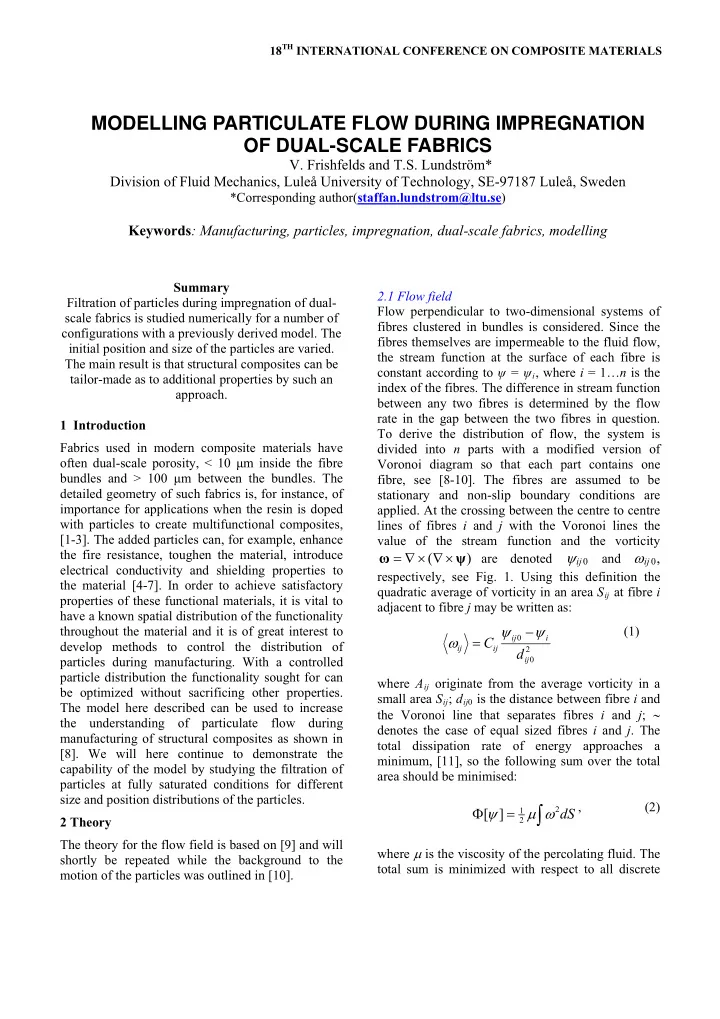

SLIDE 1
18TH INTERNATIONAL CONFERENCE ON COMPOSITE MATERIALS
PSummaryFiltration of particles during impregnation of dual- scale fabrics is studied numerically for a number of configurations with a previously derived model. The initial position and size of the particles are varied. The main result is that structural composites can be tailor-made as to additional properties by such an approach. 1 Introduction Fabrics used in modern composite materials have
- ften dual-scale porosity, < 10 μm inside the fibre
bundles and > 100 μm between the bundles. The detailed geometry of such fabrics is, for instance, of importance for applications when the resin is doped with particles to create multifunctional composites, [1-3]. The added particles can, for example, enhance the fire resistance, toughen the material, introduce electrical conductivity and shielding properties to the material [4-7]. In order to achieve satisfactory properties of these functional materials, it is vital to have a known spatial distribution of the functionality throughout the material and it is of great interest to develop methods to control the distribution of particles during manufacturing. With a controlled particle distribution the functionality sought for can be optimized without sacrificing other properties. The model here described can be used to increase the understanding of particulate flow during manufacturing of structural composites as shown in [8]. We will here continue to demonstrate the capability of the model by studying the filtration of particles at fully saturated conditions for different size and position distributions of the particles. 2 Theory The theory for the flow field is based on [9] and will shortly be repeated while the background to the motion of the particles was outlined in [10]. 2.1 Flow field Flow perpendicular to two-dimensional systems of fibres clustered in bundles is considered. Since the fibres themselves are impermeable to the fluid flow, the stream function at the surface of each fibre is constant according to ψ = ψRi
R, where i = 1…n is theindex of the fibres. The difference in stream function between any two fibres is determined by the flow rate in the gap between the two fibres in question. To derive the distribution of flow, the system is divided into n parts with a modified version of Voronoi diagram so that each part contains one fibre, see [8-10]. The fibres are assumed to be stationary and non-slip boundary conditions are
- applied. At the crossing between the centre to centre
lines of fibres i and j with the Voronoi lines the value of the stream function and the vorticity
) ( ψ ω
are denoted Rij
RR0 R and Rij RR0 R,respectively, see Fig. 1. Using this definition the quadratic average of vorticity in an area SRij
R at fibre iadjacent to fibre j may be written as:
2 ij i ij ij ij
d C
(1) where ARij
R originate from the average vorticity in asmall area SRij
R; dRij0 R is the distance between fibre i andthe Voronoi line that separates fibres i and j; denotes the case of equal sized fibres i and j. The total dissipation rate of energy approaches a minimum, [11], so the following sum over the total area should be minimised:
dS
2 2 1
] [
, (2) where is the viscosity of the percolating fluid. The total sum is minimized with respect to all discrete
MODELLING PARTICULATE FLOW DURING IMPREGNATION OF DUAL-SCALE FABRICS
- V. Frishfelds and T.S. Lundström*