2 Dependence of Standardized Uptake Value (SUV) Instrument-related - - PDF document

2
SMART_READER_LITE
LIVE PREVIEW

2 Dependence of Standardized Uptake Value (SUV) Instrument-related - - PDF document

Quantification of 3-D PET/CT Imaging Role of PET/CT Imaging In oncology, imaging studies playing an Janet R. Saffer 1,2 , Joshua S. Scheuermann 1,2 , increasingly important role in assessing patients Joel S. Karp 1,2 , Amy Perkins 3


slide-1
SLIDE 1

1

AAPM CE: Multimodality Imaging II July 29, 2008

Quantification of 3-D PET/CT Imaging Janet R. Saffer1,2, Joshua S. Scheuermann1,2, Joel S. Karp1,2, Amy Perkins3

  • 1. Department of Radiology, University of Pennsylvania
  • 2. PET Core Lab, American College of Radiology

Imaging Network (ACRIN)

  • 3. Philips Medical Systems

July 29, 2008 Quantification in 3-D PET/CT Imaging

  • In oncology, imaging studies playing an

increasingly important role in assessing patient’s response to treatment

– Serial CT scans are evaluated for changes in number and size of tumors – Serial PET scans are assessed for changes in metabolic activity of the lesions

  • Advent of combined PET/CT systems streamlines

the fusion of these anatomic and functional images Role of PET/CT Imaging

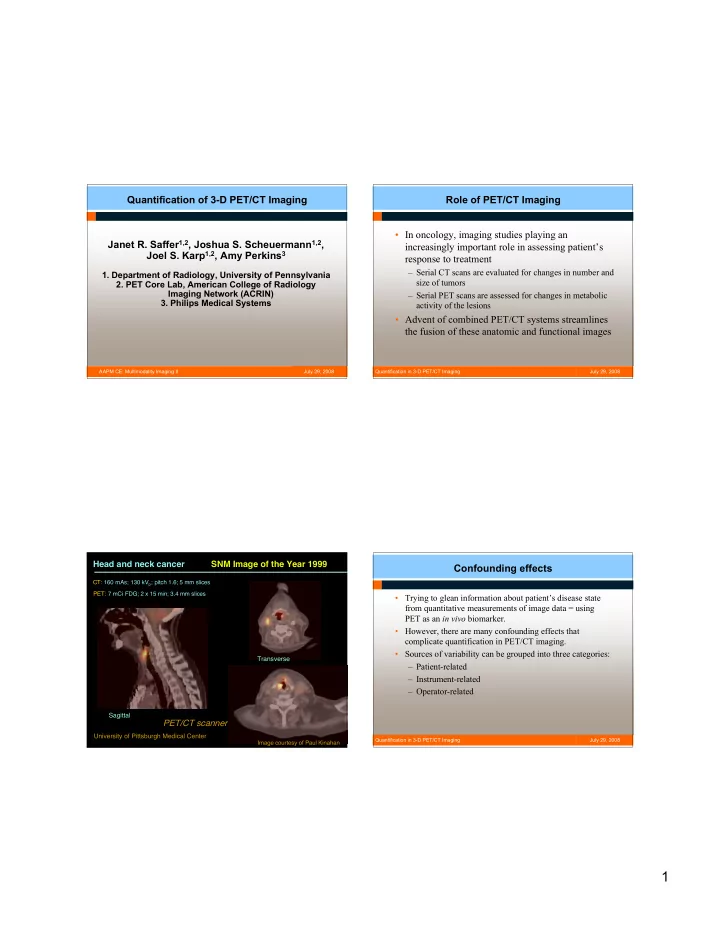
Head and neck cancer SNM Image of the Year 1999 PET/CT scanner

University of Pittsburgh Medical Center CT: 160 mAs; 130 kVp; pitch 1.6; 5 mm slices PET: 7 mCi FDG; 2 x 15 min; 3.4 mm slices Sagittal Transverse Image courtesy of Paul Kinahan

July 29, 2008 Quantification in 3-D PET/CT Imaging

Confounding effects

  • Trying to glean information about patient’s disease state

from quantitative measurements of image data = using PET as an in vivo biomarker.

  • However, there are many confounding effects that

complicate quantification in PET/CT imaging.

  • Sources of variability can be grouped into three categories:

– Patient-related – Instrument-related – Operator-related

slide-2
SLIDE 2

2

July 29, 2008 Quantification in 3-D PET/CT Imaging

Patient-related factors affecting quantification x body habitus (affects attenuation and scatter) x patient’s flexibility (ability to hold arms over head) x patient’s ability to hold still (pain, cognitive impairment) x patient’s individual physiology (affects tracer distribution within patient) x for FDG imaging, blood glucose level (4 to 6 hr fast)

<=200 mg/dL or re-schedule (other thresholds 180 or even 150)

Factors we can’t control: The heavy patient problem

Slim 58 kg “Normal” 89 kg

Heavy 127 kg

Object diameter Equivalent

  • pt. wt.

Relative attenuation Peak NEC ratio Peak NEC density ratio 20 cm 41 kg 1 6 18 27 cm 71 kg 2.2 2.7 4.5 35 cm 106 kg 4.3 1 1

Can’t compensate simply by increasing scan time!

July 29, 2008 Quantification in 3-D PET/CT Imaging

Patient-related factors affecting quantification x body habitus (affects attenuation and scatter) x patient’s flexibility (ability to hold arms over head) x patient’s ability to hold still (pain, cognitive impairment) x patient’s individual physiology (affects tracer distribution within patient) x for FDG imaging, blood glucose level (4 to 6 hr fast)

<=200 mg/dL or re-schedule (other thresholds 180 or even 150)

Factors we can’t control:

July 29, 2008 Quantification in 3-D PET/CT Imaging

More patient-related factors Factors we CAN control:

  • dose administered

– weight-based or does one dose fit all? – what about CT dose -- adjust mAs of attenuation-correction CT?

  • imaging time per bed position
  • for FDG, uptake time before imaging

– standardization, e.g. 50-70 minute window, then +/- 5 minutes of that

  • n return visit

– coping with unusual delays – match on return visit? (at UPenn if previous scan was positive, we match whatever that previous uptake time was +/- 5 minutes)

slide-3
SLIDE 3

3

Slim 58 kg “Normal” 89 kg

Heavy 127 kg

Dependence of Standardized Uptake Value (SUV)

  • n FDG uptake time

Reference: Lowe VJ, Delong DM, Hoffman JM, Coleman RE. Optimum scanning protocol for FDG-PET evaluation of pulmonary malignancy. J Nucl Med (1995);36:883-87. The increase in SUVs with increasing uptake time motivates: 1) Some sites using 90-minute uptake periods instead of 60 (higher tumor to background contrast and flatter part of curve). 2) Sites performing second timepoint images of lesions to see by how much the SUV has changed (establishing slope of increase).

July 29, 2008 Quantification in 3-D PET/CT Imaging

Instrument-related factors affecting quantification x spatial and energy resolution

– partial volume effect – discriminate against scattered events

x sensitivity: higher sensitivity => lower Poisson noise x data acquisition mode for PET (2-D vs 3-D)

– 2-D reduces scatter and randoms but at cost of sensitivity

x attenuation compensation method

– using measured AC (MAC) vs. CTAC

July 29, 2008 Quantification in 3-D PET/CT Imaging

Transmission Source

  • Source rotates around patient

Measured AC: Rotating rod/point source

  • Ratio of Transmission to Blank scans gives

correction factors: T/B=exp(-µd)

Point or rod source: Ge-68, Cs-137

July 29, 2008 Quantification in 3-D PET/CT Imaging

Nakamoto Y, Osman M, Cohade C, Marshall LT, Links JM, Kohlmyer S, Wahl RL. PET/CT: comparison of quantitative tracer uptake between germanium and CT transmission attenuation-corrected images. J Nucl Med (2002);43(9):1137-43.

  • “…CT-based attenuation correction produced radioactivity

concentration values significantly higher than the germanium-based corrected values. These effects, especially in radiodense tissues, should be noted when using and comparing quantitative PET analyses from PET and PET/CT systems.”

Switch to CTAC has effect on quantification

slide-4
SLIDE 4

4

Issues with CT-based attenuation correction

Respiratory motion CT truncated FOV CT beam hardening CT contrast media

Slide courtesy of Paul Kinahan

July 29, 2008 Quantification in 3-D PET/CT Imaging

Instrument-related factors continued

  • scatter correction method

– background subtraction method – single-scatter simulation (model-based)

  • additional instrument capabilities

– respiratory/cardiac gating – motion correction – partial volume correction – Time of Flight (TOF)

Comparison of TOF and nonTOF images: heavy patient 56 year old male with a history of NHL 237 lbs, 37.2 BMI , 15 mCi FDG, 1 hr post-injection TOF lesion uptake to nonTOF = 1.6

p202s4

Standard clinical TOF protocol Retrospective nonTOF protocol

Same patient data reconstructed differently.

1.7cm

  • A. Perkins et al, “Clinical optimization of the acquisition time of FDG time-of-flight PET”, SNM 2007.

July 29, 2008 Quantification in 3-D PET/CT Imaging

Operator-related factors affecting quantification

  • acquisition and reconstruction protocols

– arms up/down, imaging time per bed position – reconstruction protocol can make a difference in SUVs

  • Westerterp, M et al. Quantification of FDG PET studies using standardized uptake

values in multicentre trials: effects of image reconstruction, resolution and ROI definition parameters, Eur J Nucl Med Mol Imaging (2007) 34:392-404.

  • instrument quality control

– daily QC: air cal, evaluate scan of CT phantom, full PET system initialization, baseline collection, PMT gain cal, emission sinogram, check of energy resolution, timing resolution

  • instrument calibrations

– normalization, SUV cal, timing cal

  • slow drifts over time characteristic of PMT-based systems
slide-5
SLIDE 5

5

July 29, 2008 Quantification in 3-D PET/CT Imaging

Operator-related factors continued

  • method of image analysis - How to characterize patient’s disease?

– What to measure? How to measure?

  • size of lesion? (2-D or 3-D)?
  • max SUV? average SUV within a region of particular size?

– Vendor-specific SUVs due to limitation in current PET DICOM standard

  • non-uniform uptake within tumor (e.g. necrotic center)

– Important if using image for treatment planning – CT not as helpful in determining size of PET lesion as you might think – image interpretation – Setting a semi-quantitative threshold for malignancy is difficult (e.g. SUV =>2.5) – Image display/analysis tools not optimized for measurement of change

  • ver time

– Intra- and Inter-Reader variability – Need “harmonization” of interpretation (Juweid et al, 2007)

Slim 58 kg “Normal” 89 kg

Heavy 127 kg

From talk by Larry Clark of NIH’s CIP at RSNA 2006 “Imaging as a Biomarker: Importance of Technique.” July 29, 2008 Quantification in 3-D PET/CT Imaging

Operator-related factors continued

  • method of image analysis - How to characterize patient’s disease?

– What to measure? How to measure?

  • size of lesion? (2-D or 3-D)?
  • max SUV? average SUV within a region?

– Vendor-specific SUVs -- limitations in current DICOM standard

  • non-uniform uptake within tumor (e.g. necrotic center)

– Important if using image for treatment planning – CT not as helpful in determining size of PET lesion as you might think

  • image interpretation

– Setting a semi-quantitative threshold for malignancy is difficult (e.g. SUV =>2.5) – Image display/analysis tools not optimized for measurement of change

  • ver time

– Intra- and Inter-Reader variability – Need “harmonization” of interpretation (Juweid et al, 2007)

July 29, 2008 Quantification in 3-D PET/CT Imaging

Future Challenges

  • Increasing pressure for earlier feedback on treatment efficacy
  • Expansion from diagnosis/staging to individualized treatment
  • New tracers that reveal how fast a tumor is growing (FLT), how much
  • xygen it is using (FMISO, EF-5), whether it is resistant to drugs (FES),

and how much blood supply it has (by tracing angiogenesis). Also markers for amyloid plaques (PIB, AV-45), apoptosis (Annexin V), phospholipid precursors to track lipid synthesis (choline analogs).

  • Desire for fusion with additional modalities: MR, US, optical
slide-6
SLIDE 6

6

July 29, 2008 Quantification in 3-D PET/CT Imaging

Take Home Messages

1) Reduce variability in factors you can control by standardizing everything as much as possible 2) Ensure consistency by creating Standard Operating Procedures (SOPs)

– ACRIN PET SOPs online: http://www.acrin.org – Shankar et al, Consensus Recommendations for the Use of 18F-FDG PET as an Indicator of Therapeutic Response in NCI Trials. J Nucl Med (2006);47(6):1059- 1006.

3) If make changes in acquisition and processing protocols, characterize the effect on quantification and communicate info to clinicians 4) Clearly label images to denote any differences in acquisition and/or processing 5) Communication is vital: between technologist and reader of study, also with referring physicians, other sections within Radiology and other departments within your institution.

July 29, 2008 Quantification in 3-D PET/CT Imaging

Complexities inherent in multicenter trials

  • Tension between local protocol and desire for uniformity

across sites

– How to handle non-standard acquisition/processing: uptake time, use of contrast, respiratory/cardiac gating, motion correction, partial volume correction, time of flight

  • Multiple readers

– Core lab “over”-reads

  • Multiple analysis tools

– Makes it difficult to specify a uniform measurement that all participants can accomplish – RIDER initiative (Reference Image Database to Evaluate Response)

  • Standardized, open-source tools

July 29, 2008 Quantification in 3-D PET/CT Imaging

Additional complexities in multicenter trials

  • Multiple instruments: Difference in performance characteristics

(resolution, sensitivity, scatter fraction, count rate performance)

  • Westerterp et al (2007): “Small unavoidable differences in methodology can be

accommodated by performing a phantom study to assess inter-institute correction factors.”

– ACRIN PET credentialing program - uniform cylinder

  • 11% failure rate from faulty SUV and normalization calibrations

– ADNI - 2 acquisition of 3D Hoffman Brain Phantom – SNM Validation Phantom exercise

  • NEMA NU-2 Image Quality (IEC) phantom (without lung insert) made of

Ge-68

– AAPM Task Group 145

  • ACR phantom with Ge-68 in 4 of the cylinders in the lid
  • Sent to 9 Pediatric Brain Tumor Consortium sites

– The Netherlands protocol

  • Presented at June 2008 SNM, paper in print

Data from cylinders submitted to ACRIN for PET credentialing. Indicates that can’t assume interchangeability of quantification even between cameras of same make and model.

slide-7
SLIDE 7

7

July 29, 2008 Quantification in 3-D PET/CT Imaging

The Netherlands Protocol

  • Protocol for standardization of quantitative FDG whole body PET

studies

  • Based on standardization of:

1. patient preparation 2. matching of scan statistics by prescribing dosage as function of patient weight, scan time per bed position, percentage of bed overlap and image acquisition mode (2D or 3D) 3. matching of image resolution by prescribing reconstruction settings for each type of scanner 4. matching of data analysis procedure by defining volume of interest methods and SUV calculations 5. a multi-center QC procedure using a 20 cm diameter phantom for verification of scanner calibration and the NEMA NU 2 2001 Image Quality phantom for verification of activity concentration recoveries (i.e. verification of image resolution and reconstruction convergence).

Boellaard R, Oyen W, Hoekstra C, et al. The Netherlands protocol for standardization of FDG whole body PET studies in multi-center trials (NEDPAS), J Nucl Med (2008); 49 (Supplement 1):106P. July 29, 2008 Quantification in 3-D PET/CT Imaging

AAPM Task Groups on Related Topics

  • AAPM Task Group 126 – “PET/CT Acceptance Testing and Quality

Assurance”, Chair: Osama Mawlawi (MD Anderson Cancer Ctr).

  • AAPM Task Group 145 - “Quantitative Imaging Initiative: Quantitative

PET/CT Imaging Joint AAPM/SNM Committee”, Chair: Paul Kinahan (U Wash). Goal: to develop procedures and tools that allow proper pooling of results from multicenter trials to achieve/increase statistical and clinical significance.

  • AAPM Task Group 174 - “Utilization of 18F-Fluorodeoxyglucose

Positron Emission Tomography (FDG-PET) in Radiation Therapy”, Chair: Shiva Das (Duke). Goal: to recommend guidelines/protocols for consistent imaging, consistent treatment planning and consistent treatment assessment using FDG-PET in radiotherapy.

July 29, 2008 Quantification in 3-D PET/CT Imaging

Acknowledgements ACRIN PET Core Lab Key Personnel:

  • PET/Nuclear Medicine Steering Committee

Chair/Medical Director: Barry Siegel, MD, Washington University

  • Technical Supervisor: Anthony Levering, RT

July 29, 2008 Quantification in 3-D PET/CT Imaging

References (in chronological order)

1) Lowe VJ, Delong DM, Hoffman JM, Coleman RE. Optimum scanning protocol for FDG-PET evaluation of pulmonary malignancy. J Nucl Med (1995); 36:883-87. 2) Young H, Baum R, Cremerius U, et al. Measurement of clinical and subclinical tumour response using [18F]-fluorodeoxyglucose and Positron Emission Tomography: review and 1999 EORTC recommendations. Eur J Cancer (1999); 35(13):1773-1782. 3) Therasse P, Arbuck SG, Eisenhauer EA, et al. New Guidelines to Evaluate Response to Treatment in Solid Tumors. J NCI (2000); 92(3):205-216. 4) Nakamoto Y, Osman M, Cohade C, Marshall LT, Links JM, Kohlmyer S, Wahl RL. PET/CT: comparison of quantitative tracer uptake between germanium and CT transmission attenuation-corrected images. J Nucl Med (2002); 43(9):1137-43. 5) Weber WA. Use of PET for monitoring cancer therapy and for predicting outcome. J Nucl Med (2005); 46(6):983-995. 6) Coleman RE, Delbeke D, Guiberteau MJ, et al. Concurrent PET/CT with an integrated imaging system: Intersociety dialogue from the joint working group of the American College of Radiology, the Society of Nuclear Medicine, and the Society of Computed Body Tomography and Magnetic Resonance. J Nucl Med (2005); 46(7):1225-1239. 7) Delbeke D, Coleman RE, Guiberteau MJ, et al. Procedure guideline for tumor imaging with 18F-FDG PET/CT 1.0, J Nucl Med (2006); 47(5):885-95. Page 1 of 2
slide-8
SLIDE 8

8

July 29, 2008 Quantification in 3-D PET/CT Imaging

References (cont’d)

8) Shankar LK, Hoffman JM, Bacharach S, Graham MM, Karp JS, Lammertsma AA, Larson S, Mankoff DA, Siegel BA, Van den Abbeele A, Yap J, Sullivan D. Consensus Recommendations for the Use of 18F-FDG PET as an Indicator of Therapeutic Response in NCI Trials. J Nucl Med (2006); 47(6):1059-1006. 9) Westerterp M, Pruim J, Oyen W, et al. Quantification of FDG PET studies using standardized uptake values in multicentre trials: effects of image reconstruction, resolution and ROI definition parameters. Eur J Nucl Med Mol Imaging (2007); 34(3):392-404. 10) Juweid ME, Stroobants S, Hoekstra OS, et al. Use of positron emission tomography for response assessment of lymphoma: consensus of the Imaging Subcommittee of International Harmonization Project in Lymphoma. J Clin Oncol (2007); 25(5):571- 578. 11) International Atomic Energy Agency (IAEA) Report: “Quality Assurance for PET and PET/CT Systems”, 2008. [Poster: SU-GG-I-74] http://www.iaea.org 12) Boellaard R, Oyen W, Hoekstra C et al. The Netherlands Protocol for Standardisation and Quantification of FDG Whole Body PET Studies in Multi-Centre Trials. Eur J Nucl Med Mol Imaging (in press). 13) Scheuermann J, Saffer JR, Karp JS et al. Qualification of PET Scanners for Use in Multi-Center Cancer Clinical Trials: The American College of Radiology Imaging Network Experience (submitting to JNM).