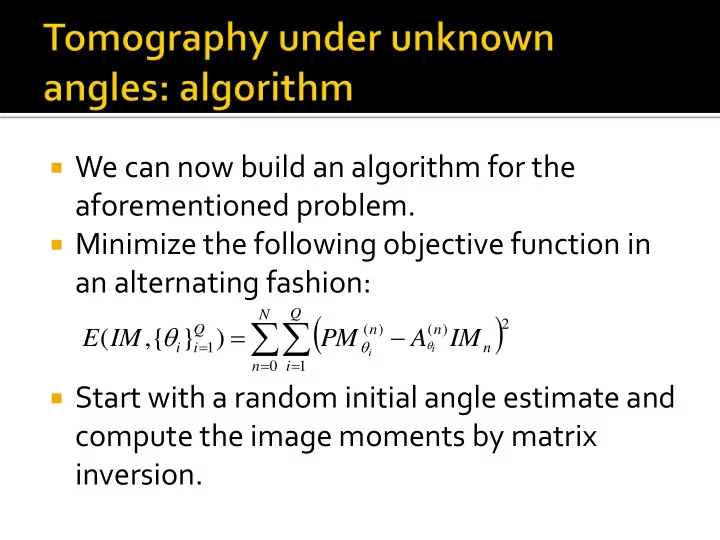
SLIDE 1 We can now build an algorithm for the
aforementioned problem.
Minimize the following objective function in
an alternating fashion:
Start with a random initial angle estimate and
compute the image moments by matrix inversion.
N n Q i n n n Q i i
IM A PM IM E
i i
1 2 ) ( ) ( 1)
} { , (
SLIDE 2 In other words, systems of equations of the
following form have a unique solution in the angles and the image moments, but modulo the rotation ambiguity:
n n l l n i l n l i l n n
IM A M l n C PM
i i
) ( , ) (
sin cos ) , (
Image moments Projection moments Column vector of image moments of
This is the n-th row of a matrix and it represents the linear combination coefficients for moments of
SLIDE 3 Image source: Malhotra and Rajwade, “Tomographic reconstruction with unknown view angles exploiting moment-based relationships”
https://www.cse.iitb.ac.i n/~ajitvr/eeshan_icip201 6.pdf
SLIDE 4
Advantage: simple, makes direct use of the
consistency conditions and works even if the number of angles is small
Disadvantage: moments are highly sensitive
to noise
SLIDE 5
SLIDE 6
In this approach, the tomographic projections
are “sorted” – i.e. arranged in order of increasing angles.
The method relies on the availability of a
large number of tomographic projections – all under unknown angles – but sampled independently from a uniform distribution on a unit circle.
Given sufficiently many projections, the
angles can be assumed to be equi-spaced.
SLIDE 7 The problem reduces to projection
association – i.e. matching each projection to
- ne of the angles, sampled evenly from the
unit circle.
If the angles are spaced sufficiently closely,
and the variation of the projections w.r.t. angle, is smooth, then we can employ a nearest neighbour type of heuristic.
This algorithm is summarized on the next
slide.
SLIDE 8 Let us denote the list of available projections as L. Let qi be the i-th tomographic projection and si be
the i-th tomographic projection in the sorted list.
WLOG, define the orientation of q1 to be 0 and set
s1=q1.
Find the nearest neighbour of q1 in L as follows: Repeat the earlier two steps with s2. Continue these steps until L is empty.
) from (delete
) , min( min arg
2 2 1 2 1
L q q L L q q s s q s q r
reverse reverse L q
SLIDE 9 At the end of this algorithm, each projection
will be associated with an angle at a grid point on the even sampling pattern from 0 to π.
Remember: these angles can be estimated
- nly up to a global angular offset which is
indeterminate.
Following the angle estimates, the underlying
image can be reconstructed using FBP.
SLIDE 10
Note that essentially, each projection is being
assigned an angle ranging from 0 to π in steps of π /Q where Q is the number of projections.
The aforementioned algorithm is an approximate
solution for the well-known travelling salesman problem in computer science.
The role of qreverse is to flip projections whose angles
would have been in [π,2π] because g(s,θ+ π)=g(-s,θ) as per the definition of the Radon transform.
SLIDE 11 The accuracy of the angle estimate increases as the
number of angles increases.
Consider the k-th order statistic θ(k), i.e. the k-th
largest angle in the sorted sequence.
The mean value of this order statistic is 2πk/Q where
Q is the number of angles, assuming uniform distribution of the angles.
The variance of this order statistic can be proved to be
O(1/Q2).
This method also relies on the fact that the angles
were uniformly distributed, otherwise the angle grid points will need to be chosen differently – as per the
- rder statistics of the other distribution.
SLIDE 12
Usually, the projection angles are unknown, but
so are the projection shifts – due to uncontrolled translation of the object being imaged.
However the unknown shifts can be solved for
using a pre-processing step that assumes that the object is surrounded by vacuum.
The tomographic projections can be normalized
such that their centroid lies at the origin.
The projection ordering step is performed later.
SLIDE 13 Given tomographic projections of a 2D image in 8 or more
distinct and unknown angles, the image moments of order 1 and 2, as well as the angles can be uniquely recovered – but up to the aforementioned rotation ambiguity.
This result is true for almost any 2D image (i.e. barring a set of
very rare “corner case” images).
This result was proved in 2000 by Basu and Bresler at UIUC in a
classic paper called “Uniqueness of tomography with unknown view angles”.
In an accompanying paper called “Feasibility of tomography
with unknown view angles”, they also proved that these estimates are stable under noise.
The proof of the theorem and the discussion of the corner cases
is outside the scope of our course.
SLIDE 14
The order n moment of a tomographic
projection at angle θ is defined as follows:
Substituting the definition of Pθ(s) into Mθ(n):
SLIDE 15 In principle, this method is similar to the
However instead of doing pairwise searches, a
dimensionality reduction step is applied.
Each tomographic projection qi (under unknown
angles) can be regarded as a high-dimensional vector.
A dimensionality reduction method is applied to
reduce their dimensionality to two (details later), i.e. qi is mapped to yi=(1i, 2i).
SLIDE 16 Consequently the tomographic projection qi
will get mapped to the angle:
These angles are then used as estimates of
the true angles, prior to FBP-based reconstruction.
i i i 2 1 1
tan
SLIDE 17 We need a method of dimensionality reduction which
“preserves the neighbourhood structure” of the
- riginal high dimensional points.
In order words, if qi and qj were close, their lower-
dimensional projections yi and yj should also be close.
To define “closeness” mathematically, consider the
following proximity matrix W:
2 exp
2 j i
q q
ij
W
Higher values for Wij means qi and qj are nearby in the Euclidean sense. Lower values means qi and qj are far apart.
SLIDE 18 Let the lower-dimensional projections be in 1D for
now, i.e. each yi is a scalar.
To determine the projections, we now optimize the
following:
ij j j i i ij j i j ij j i i j i Q j i ij Q i i
W y y W y W y y y W y E
, , 2 , 2 2 , 1
2 ) ( ) } ({ W D L , Define
j ij ii
W D Ly yt
Q i i
y E 2 ) } ({
1
SLIDE 19 So this becomes a constrained minimization problem: The constraint is to prevent the trivial solution. The trivial solution can also be prevented by imposing
a unit norm constraint on y, however the one used in the equation above assigns greater importance to points which are “popular”, i.e. for which the D value is high.
1 such that min arg * Dy y Ly y y
y t t
SLIDE 20 So this becomes a constrained minimization problem: The solution to this problem is obtained as follows: This is a generalized eigenvalue problem, and we are
interested in the generalized eigenvector y with the smallest generalized eigenvalue (why?).
y D Ly y D y Ly y y y E
t t
~ ) 1 ( ) ( ~ 1 such that min arg * Dy y Ly y y
y t t
SLIDE 21 Now consider that the lower-dimensional points were
no longer just in 1D.
In such a case, we seek to minimize:
) | ... | | ( where 2 ) } ({
, , , 2 , 1 N 2 1 j i j j i i j i i
y y y Y Y L Y y y y y y y y y y
T ij j i t ij j i t ij j i t Q j i ij Q i
trace W W W W E I Y D Y : constraint ion Normalizat
T
SLIDE 22
This reduces to a generalized eigenvalue problem, i.e.
to finding generalized eigenvectors of the following form, with the lowest eigenvalues:
This technique is called “Laplacian Eigenmaps” since
the matrix L is called the (graph) Laplacian matrix, which is commonly used in spectral graph theory.
This technique is due to Belkin and Niyogi – their NIPS
2003 paper “Laplacian Eigenmaps for Dimensionality Reduction and Data Representation”.
Dy Ly
SLIDE 23 Image source: https://people.cs.pitt.edu/~milos/co urses/cs3750/lectures/class17.pdf
SLIDE 24 On this slide, N refers to the number of nearest neighbors per point (the other distances are set to infinity). The parameter for the Gaussian kernel needs to be selected carefully, especially if N is high.
Image source: https://people.cs.pitt.edu/ ~milos/courses/cs3750/lect ures/class17.pdf