
SLIDE 1
INDABA PRESENTATION CAPE TOWN | FEBRUARY 2017 AIM:SAV
WHAT IS MINERAL EXPLORATION ?
AIM:SAV
2 What is mineral exploration? Exploration is the term used to - - PowerPoint PPT Presentation
INDABA PRESENTATION CAPE TOWN | FEBRUARY 2017 AIM:SAV W HAT IS M INERAL E XPLORATION ? AIM:SAV 2 What is mineral exploration? Exploration is the term used to describe a wide range of activities aimed at searching for minerals or
INDABA PRESENTATION CAPE TOWN | FEBRUARY 2017 AIM:SAV
AIM:SAV
is the term used to describe a wide range of activities aimed at searching for minerals or determining the extent of a mineral discovery or deposit
rock chip sampling, ground-based and airborne geophysical surveys, and drilling
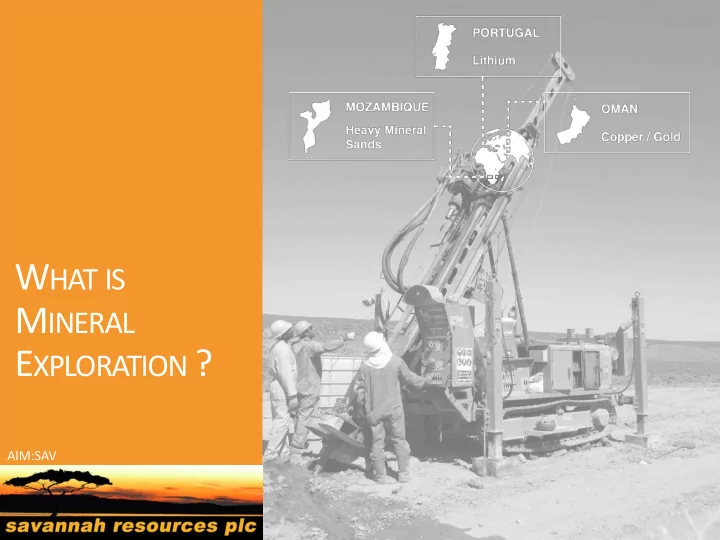
Diamond Drilling at dusk
companies are seeking to find a mineral deposit worth mining and generally have no income (other than interest earned on previously discovered mineral deposits,
proceeds from the sale of a project)
generally fund their search efforts by raising funds to conduct mineral exploration (e.g. shareholder investment)
important role in the development of a country’s mineral resources
selling the product must pay a royalty to the government (or crown)
at a level that will encourage others to risk their capital in finding and developing these minerals, rather than the government risking taxpayer’s money
mineral resources without risking funds required for key everyday services to the community
The start of the process comes from the generation of ideas, which are based on the geology of a region, company exploration models and the broad scoping of potential resources that might suit a current commodity market Geologists will look at other known deposits to determine how and what geological process formed them They will then use these models to find conditions that are similar in different regions of the state and other countries These models and concepts continually change as more is known about the area they are exploring The market defines the resources that are of interest and may be profitable and hence drives much of the exploration being undertaken
Markets for mineral commodities are always changing (based on supply and demand) and can significantly impact on the process of exploration
is often referred to, generally results in minimal ground disturbance with limited rehabilitation requirements
areas for further, more detailed assessment
mineral targets and increase their knowledge base, and generate a target for advanced exploration
activities include reconnaissance work to:
Geologists and other scientists visit locations to look at the rocks and take measurements to assess whether the area may have potential for minerals
geological mapping, mapping of landforms and the general environment
involves walking and/or driving across the land to map relevant features (e.g. the geology of the area)
hammer to collect 1-3kg of rock sample
have any minerals in them
stream sediment or soils are collected and sent to the laboratories for assaying to identify if minerals are located in the area
work is usually completed
foot using vehicles to access an area
magnetic, conductivity, radiological properties)
helicopter)
Ground based geophysics – Ground EM common copper exploration method Airborne Geophysics – VTEM common copper exploration method Example of targets generated by geophysical testing
exploration conducted and any land access requirements
exploration methods involving earthworks (small costean or trenches) and seismic activities
exploration activities to be conducted safely. If the exploration is not successful then the earth works are rehabilitated
These are typically drawn
cross sections, together with the
any mineralisation defined
by crushing the rock and using compressed air to blow the sample to the surface, where it is collected for sampling
core drilling uses a diamond drill bit to core rock, which is then split into 1m samples and assayed for copper
construction of a road and a drill pad to provide a safe working environment to drill the hole may be required, which is usually constructed using a front end loader, which builds a pad about 20m long and 15m wide
undertake more intensive exploration activities and commence various studies (e.g. environmental studies) to determine if they have a viable mineral resource
drill out, resource definition, scoping study, pre-feasibility study, and bankable feasibility study (each of these stages is explained in the following sections)
concepts (including deposit size, location and infrastructure requirements) may change significantly as more information is obtained about the deposit, suitable mining methods, processing requirements and infrastructure needs
feasibility study is underway or completed. This is also the stage in which the majority of companies will submit mining applications to the government for assessment
Resource Drill-out
resource drill-out is undertaken
and tonnes of the potential mineral resource by defining the extent of the mineral deposit, and to provide enough information to be able to make a confident estimate of the total resource Resource Definition
program is then used to calculate the volume, quality and shape of the mineral resource.
produced to better define the shape and volume of the resource, along with information on chemical assays and mineral concentrations.
type of mine required in the studies below
A scoping study is undertaken to develop a broader picture
the value and potential of the mineral resource and the requirements for successfully mining it. This is a high level assessment
determine whether it is viable to progress towards a more rigorous assessment
Scoping Study The scoping study includes (but is not limited to) the assessment of:
based on varying market prices for the product
transport to market, including distance and infrastructure required (e.g. water, power)
the community and environment based on the proposed mining activities
processes required to extract the resource, whether to use open cut (pit) or underground mining
resource from the host mineral and costs of extraction options
The pre-feasibility study assesses all the options presented in the scoping study and identifies the preferred option for each component (e.g. mining type and infrastructure
best case
Pre-feasibility Study
The pre-feasibility study includes (but is not limited to) the assessment of:
intensive community consultation generally starts at this stage. This will depend on the environmental sensitivity of the area, for example, more intensive consultation may start at the resource definition stage and through the scoping study stage
include environmental assessments, groundwater studies and the impact of mining
infrastructure requirements, including roads, rail, water supply, ports, availability of mine workers in the region, housing, airstrips, mine planning and mine closure
feasibility study is to indicate the overall cost of the project to within ±25%
The bankable feasibility study is a comprehensive technical and economic study of the development
for a mineral project. The confidence level of the study will be higher than that
a prefeasibility study and may serve as the basis for the final decision to proceed with, or finance, the development of the project
Bankable Feasibility Study
The bankable feasibility study includes (but is not limited to) the assessment of:
bankable feasibility study is to indicate the
financial modelling takes into account various aspects
the project, including projected demand for the minerals and anticipated market price, the capital costs of setting up the mine, processing plant and equipment needed, costs
mining and processing, costs of labour, running costs of the mining equipment, and the effect of taxes, royalties and compensation
to financiers to demonstrate that the project may be profitable and to assist in securing financial support
About 1 in 1,000 exploration targets have sufficient mineral to extract through mining either from an open pit or underground, so the chances of any area becoming a mine are very low
project is put on hold until more favourable market conditions exist (e.g. the value of the product goes up faster than the cost of production)
the proponent. Larger, more established mining companies will usually have access to large debt facilities, whereas smaller (exploration) companies will
finance
commodity prices, market conditions, environmental concerns or any other relevant factor
until market conditions and commodity prices are more favourable, appropriate funding has been
and methods to address environmental concerns have been developed
Investment decision
Company Presentation at a Community Meeting
the proposed mine site
government that the deposit can be mined efficiently and effectively taking into consideration environmental, economic and social factors
company to commence mining are an approved Mining License/Concession and Environmental Impact Assessment/Study.
What rights are required to conduct mining?
Project Benefits Legislative Context Existing Environment Project Description Alternatives Considered Stakeholder Consultation Environmental and Social Impact Assessment Monitoring and Reporting Mine Closure and Rehabilitation Management Systems
including local and peripheral communities, local and Federal governments, special interest groups, general public, potential suppliers and contractors.
Stakeholder consultation
Stakeholders are included in the impact assessment and permitting process Stakeholders are well informed about the project and its potential impacts Issues or concerns are addressed as early as possible The appropriate regulatory requirements are met Positive stakeholder relationships are established and maintained throughout the project life (i.e., from permitting through to construction,
School Education Project University Study Collaboration Local Sports Team Sponsorship School Sponsorship Mining provides substantial benefit to the local community through employment opportunity and economic investment
Following approvals from all state and federal regulatory bodies, construction of the mine can begin followed by mining and production of their product
Mine rehabilitation aims to minimise and mitigate the environmental effects of modern mining, which may in the case of open pit mining involve movement of significant volumes of rock.
An example of this type of rehabilitation is The Municipal Stadium
located in Braga, Portugal. The Stadium has been carved out of a rock at the site of a former quarry and consists of two lateral stands, which are connected to each other by a number of steel strings. For underground mines, rehabilitation is not always a significant problem or
grade of the ore and lower volumes of waste rock and tailings. In some situations, stopes are backfilled with concrete slurry using waste, so that minimal waste is left at surface.
For further information on Savannah’s corporate social responsibility programme, please email: community@savannahresources.com