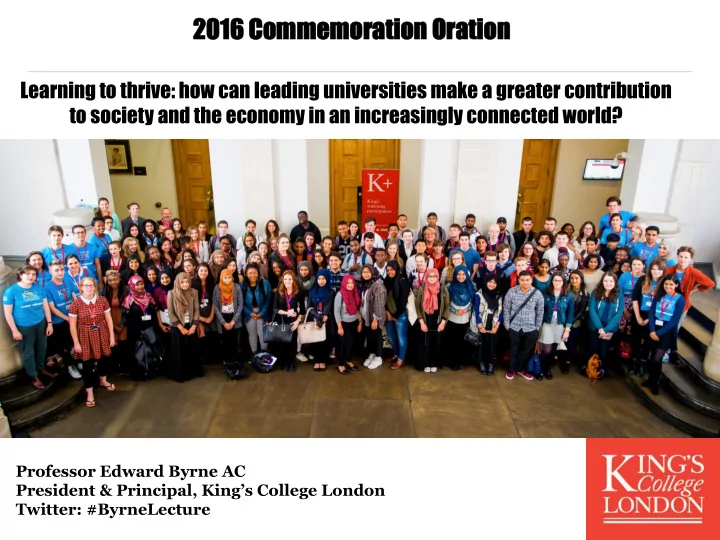
SLIDE 1
Learning to thrive: how can leading universities make a greater contribution to society and the economy in an increasingly connected world?
Professor Edward Byrne AC President & Principal, King’s College London Twitter: #ByrneLecture
20 2016 Comme mmemo moration Oration
SLIDE 2
Great universities have endured because they’ve evolved
v Leading research universities very much embody Steven Johnson’s contention that institutions are the giant redwoods of modern civic life. We’ve endured and evolved as en-vogue ideologies, fashions, industries and technologies have sprung up and disappeared. v There’s no automatic right for King’s or UCL or any other university to enjoy the same level of success, or even exist in the next century. We’ve thrived because we’ve evolved. v Yet the underpinning notion of a university’s mission and the operating culture of universities hasn’t changed that much fundamentally since the period after the second world war, despite massification of student populations. v That’s about to change significantly...
SLIDE 3
Universities face rising societal expectations, more scrutiny and significant headwinds that necessitate deeper engagement
v Universities are extremely expensive places to run. Accordingly the level of political and societal expectation on us to demonstrate the added value of our teaching, research and knowledge exchange activities has grown significantly. v The drivers of interdisciplinarity, the information revolution and globalisation all present significant headwinds which will lastingly reshape the way universities, teach, research and engage with society. v There’s also an increasingly crowded global knowledge- producing landscape. Think tanks, national and international scientific institutes, consultancies and the RSAs and Nestas of this world are all on the march. v This is welcome, but it should also spur us to deepen our engagement with society and learn from others as we look to generate impact.
SLIDE 4
Universities face rising societal expectations, more scrutiny and rising headwinds that necessitate deeper engagement
v Research is a continuum as Pasteur’s Quadrant shows: v All forms have intrinsic value, and universities and governments must continue to protect the “Bohr quadrant” of curiosity-driven research. v There’s a world going on outside and rapidly changing around us. Universities are rightly expected to do more to address the great societal, scientific, environmental and economic challenges facing the world. v We must marshal our expertise and data to take interdisciplinarity to the next level in addressing these challenges. This necessitates closer engagement and strategic collaborations with public, private and third sector stakeholders.
SLIDE 5 We must embrace technology in our pedagogy and also redouble efforts to broaden the diversity of our community
v The information revolution is transforming the ways in which we research, generate impact and educate students. v As Michael M. Crow argues, E-Education offers enormous potential to enrich learning and flexibly provide rigorous education to much greater numbers of talented people across a wider spectrum of backgrounds. v Great research universities should be ladders of
- pportunity helping advance social mobility
and diversity. v We have to continue to up our game on outreach and lifecycle support for students from disadvantaged and under-represented backgrounds. We must also tackle unconscious bias and under- representation in our workforce.
SLIDE 6
In an increasingly connected yet ever more complex world, we must be bridge builders
v British universities have a great tradition of educating the world. This tradition must continue to thrive. v Beyond the education of international students, we must do more to strengthen civil society around the world. v Universities should aspire to be bridge builders between cultures, governments and civil society institutions. v A key example is the role Liam Byrne has argued universities in this country can play in spearheading better links between cities and innovation precincts and clusters in China and the UK.
SLIDE 7
Conclusions – We must move out of our comfort zones and engage more flexibly and widely to continue to thrive
v We have a responsibility to play a constructive role in working with a wider range of businesses and civil society partners beyond ‘the usual suspects’. v We must inspire our students and graduates to become the change-makers, problem-solvers and entrepreneurs of tomorrow. v Sometimes this will take us outside of our academic and institutional comfort zones. But... v The prize of enduring and making an even bigger difference to humanity in this century, than in the last is worth the struggle.