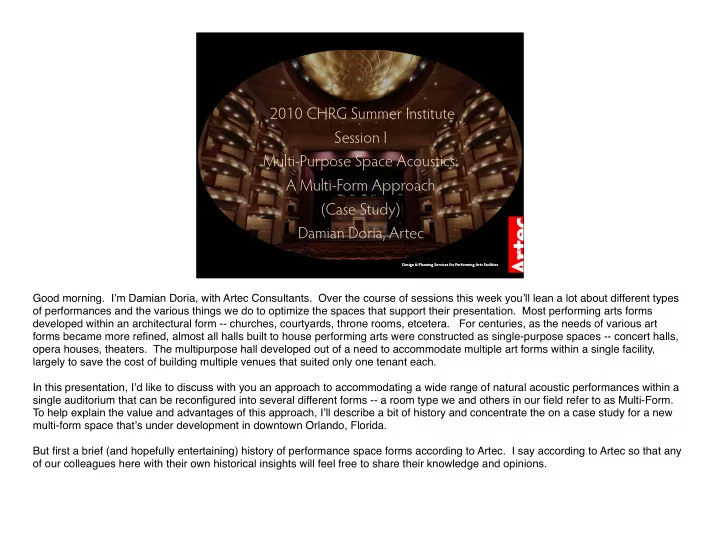
2010 CHRG Summer Institute Session I Multi-Purpose Space Acoustics: - - PowerPoint PPT Presentation

2010 chrg summer institute session i multi purpose space
SMART_READER_LITE
LIVE PREVIEW

2010 CHRG Summer Institute Session I Multi-Purpose Space Acoustics: - - PowerPoint PPT Presentation

2010 CHRG Summer Institute Session I Multi-Purpose Space Acoustics: A Multi-Form Approach (Case Study) Damian Doria, Artec Design & Planning Services for Performing Arts Facilities Design & Planning Services for Performing Arts


slide-1
SLIDE 1

Design & Planning Services for Performing Arts Facilities

2010 CHRG Summer Institute Session I Multi-Purpose Space Acoustics: A Multi-Form Approach (Case Study) Damian Doria, Artec

Design & Planning Services for Performing Arts Facilities

Good morning. Iʼm Damian Doria, with Artec Consultants. Over the course of sessions this week youʼll lean a lot about different types

  • f performances and the various things we do to optimize the spaces that support their presentation. Most performing arts forms

developed within an architectural form -- churches, courtyards, throne rooms, etcetera. For centuries, as the needs of various art forms became more refined, almost all halls built to house performing arts were constructed as single-purpose spaces -- concert halls,

  • pera houses, theaters. The multipurpose hall developed out of a need to accommodate multiple art forms within a single facility,

largely to save the cost of building multiple venues that suited only one tenant each. In this presentation, Iʼd like to discuss with you an approach to accommodating a wide range of natural acoustic performances within a single auditorium that can be reconfigured into several different forms -- a room type we and others in our field refer to as Multi-Form. To help explain the value and advantages of this approach, Iʼll describe a bit of history and concentrate the on a case study for a new multi-form space thatʼs under development in downtown Orlando, Florida. But first a brief (and hopefully entertaining) history of performance space forms according to Artec. I say according to Artec so that any

  • f our colleagues here with their own historical insights will feel free to share their knowledge and opinions.
slide-2
SLIDE 2

Design & Planning Services for Performing Arts Facilities

Te “Classic” Concert Space

Both Concert Halls and Opera Houses originated as long, narrow, high, parallel-sided spaces. Chairs were setup on one end of a room and the performance took place on temporary raised platforms on the other end. Concert Halls never changed much in shape (until more recent decades) although shallow balconies were added along the sides and rear of the hall. Mostly, the musicians were setup in the same space as the audience -- a single volume. (Nilla Androvandi)

slide-3
SLIDE 3

Design & Planning Services for Performing Arts Facilities

Te “Classic” Operatic Space

The opera house evolved along with the vogue for ever more elaborate scenery for court masques and operas. The original portable, temporary stage platform was gradually transformed into the fully-equipped scenic machine of the stagehouse weʼre familiar with today.

slide-4
SLIDE 4

Design & Planning Services for Performing Arts Facilities

Te “Classic” Opera Space

And increasingly, the stagehouse was a separate volume (often larger than the auditorium). Though, the orchestra remained more or less in the same volume as the audience.

slide-5
SLIDE 5

Design & Planning Services for Performing Arts Facilities

Te Basic Multipurpose Teater

In North America prior to WWII, arts institutions served a rather narrow segment of the population. However, as the population became more affluent and mobile focus on the Arts became more integral with American Life and at the same time growing expenses led existing Arts institutions to seek out broader bases of support. By the end of the 1950s, there was burgeoning growth in amateur activity in the performing arts. By the mid-1960s, professional organizations in theatre, music, and dance had developed and many communities needed to house these organizations in one facility due to the high cost of providing multiple venues for tenants that wouldnʼt fill a year with performances. Inherent in these early multipurpose halls were compromises which meant that these facilities were never able to provide the best possible acoustics for each arts discipline. In these examples (one in Oregon and one in Michigan), the orchestra is located in a shell to cut of the stagehouse upper volume, but theyʼre also upstage of a proscenium, essential in a separate volume from the audience. So, the theatrical form, which was generally optimized for manipulation of scenery and audience sightlines to see that stage set and performers, led to the orchestra playing in a condition where the acousticians needed to design complex shells to project the orchestra to the audience and try to maintain good communication among musicians, while the orchestra and audience were largely in separate spaces.

slide-6
SLIDE 6

Design & Planning Services for Performing Arts Facilities

Morsani Hall, David A. Straz, Jr. Center for the Performing Arts, Tampa Bay, Florida

Architects: D. Fred Lebensold, ARCOP

However, as Artec and other acoustics consultants studied the competing needs of symphonic acoustics and performance types that need a full stage and proscenium, a number of “improvements” were explored. This example, the Morsani Hall in Tampa Florida, has a 4 inch thick wooden wall that drops into place to block the entire stagehouse. The orchestra then sets up entirely in front of the wood wall, in a single volume of space that remains. Of course, there are still trade-offs. The orchestra here is pushed much farther out into the room than the stage for opera and other proscenium presentations, meaning that in order to see the downstage edge row of musicians on the extended stage in symphony mode the sightlines must be steeper or the balconies moved farther away from the

  • proscenium. Steeper sightlines mean more absorption from audience exposed to the sound field for orchestra, while more distance

from the proscenium moves the entire audience in upper tiers farther from the stage than they would be in a pure theater. So, to some extent, no matter how well the balance is struck between these parameters of steepness and distance from the action, both concert and theatrical modes still suffer some compromises.

slide-7
SLIDE 7

Design & Planning Services for Performing Arts Facilities

Prudential Hall, New Jersey Performing Arts Center, Newark, New Jersey, USA

Architects: Barton Myers Associates

Other rooms, like this more recent multi-purpose theatre used a ceiling system that capped off the stage plus extended into the auditorium for concerts, allowing the orchestra to straddle the proscenium, at least getting the strings into the same volume as audience and providing support from an overhead reflector. The sightlines can tolerate this projection of the orchestra several seating rows into the auditorium because you donʼt generally need to see the foot of a musician playing at the forestage. (Tough, you might put a solo cellist on a small riser box) Here in Newarkʼs NJPAC, a series of re-arrangeable towers can adjust the size and location of the enclosure for symphony or recitals, adding a degree of variability. The proscenium is still present, but quite wide and nearly 40 feet

  • high. In theatrical mode the forestage element of the ceiling tips up and retracts into the ceiling and the proscenium is narrowed and

lowered with flown elements.

slide-8
SLIDE 8

Design & Planning Services for Performing Arts Facilities

Prudential Hall, New Jersey Performing Arts Center, Newark, New Jersey, USA

Architects: Barton Myers Associates

Another photo of NJPAC courtesy of the Architect (they were too nice to squeeze onto one slide).

slide-9
SLIDE 9

Design & Planning Services for Performing Arts Facilities

Notingham Royal Concert Hall, Te Royal Centre, Notingham, UK

Architects: RHWL (Renton Howard Wood Levin Partnership)

Artec and Theatre Projects Consultants have both together and separately developed halls we refer to as Multi-form spaces that take the flexible theatre idea a step further and make a large-scale conversion from a proscenium theatre format to a single volume concert space (and sometimes other formats as well). This is an early facility developed with TPC and Artec in the UK. It similar to a second space In the UK at Derngate in Northampton. The entire upstage element that creates the vertical wall behind the orchestra and seating for choir or audience can be removed and stored. So, the room appears and behaves like one volume when itʼs setup for symphony and has a set of flown elements that provide a proscenium in theatrical use. Here again, both symphony and theatrical works can enjoy a good sightline.

slide-10
SLIDE 10

Design & Planning Services for Performing Arts Facilities

Cerritos Center for the Performing Arts, Cerritos, California, USA

Architects: Barton Myers Associates

This extremely flexible space in Cerritos was developed with TPC and Kirkegaard Associates. Here Iʼm showing only two of the formats

  • - concert and proscenium theatre modes. This takes the ideas of Nottingham and Northamptonʼs Halls a bit further, having a rigorously

rectangular geometry (at least at the stage end) with quite heavy and solid looking architectural elements that tip down to form a more solid look and feel for theatre.

slide-11
SLIDE 11

Design & Planning Services for Performing Arts Facilities

Cerritos Center for the Performing Arts, Cerritos, California, USA

Architects: Barton Myers Associates

In fact a number of returning guests are fooled to believe that there is more than one room purpose built in the Center. One very nice element of this room is how tall the space is for symphony since the proscenium literally goes away in that mode. Itʼs especially remarkable when you consider the fact that its located in a seismic zone and the towers are extremely tall and would be potentially unstable in an earthquake particularly when loaded with the weight of audience members -- they lock down for safety once theyʼre in position.

slide-12
SLIDE 12

Design & Planning Services for Performing Arts Facilities

Cerritos Center for the Performing Arts, Cerritos, California, USA

Architects: Barton Myers Associates

This is a photo of a segment of the stage towers in motion. The usually use a crew of 12 for major changeover operations and some take up to 8 hours. Still, given Cerritos programming and relatively moderate labor costs, this solution has been very successful for them functionally and economically. And from the few performances Iʼve heard there it manages well acoustically, too.

slide-13
SLIDE 13

Design & Planning Services for Performing Arts Facilities

Rose Teater, Frederick P. Rose Hall, New York, USA

Architects: Rafael Viñoly Architects

This theatre for Jazz at Lincoln Center, located Columbus Circle in NY, was developed by Artec and uses a series of towers and elements to create the proscenium format within a larger single volume space. The upper stage tower is closed-off by a retractable ceiling on a gantry and the enclosure walls are formed (in a variety of sizes) using a series of towers with seating.

slide-14
SLIDE 14

Design & Planning Services for Performing Arts Facilities

And now, on to the case study... Artec has participated in Orlandoʼs planning and development of this parcel since the mid-1990s. The project began with a survey (not by Artec) of the resident arts groups that were performing in the Bob Carr (also not by anyone in this room), which is shown here in its opera setting.

slide-15
SLIDE 15

Design & Planning Services for Performing Arts Facilities

A Survey of the Arts in Orlando, Florida

  • Review Existing Constituent Arts Groups

Opera, Ballet, Philharmonic Orchestra Festival of Orchestras, Broadway, Pop

The 3 largest constituent arts groups who were performing in the Carr were The Orlando Opera, the Ballet, and The Philharmonic

  • Orchestra. Smaller presenters included the Festival of Orchestras, Broadway Across America (then a local arm of Clear Channel) and

various pop music presenters.

slide-16
SLIDE 16

Design & Planning Services for Performing Arts Facilities

A Survey of the Arts in Orlando, Florida

  • Review Existing Constituent Arts Groups

Opera, Ballet, Philharmonic Orchestra Festival of Orchestras, Broadway, Pop

  • Mission for Arts Center

The Cityʼs study led to development of the Dr Phillips Center for the Arts as a 501c3 (not for profit) foundation whose mission was to develop and operate the arts center that would be a showcase for local arts groups, a multicultural center, provide education to the public at all age groups, offer a destination for residents and tourists, foster community pride and offer new experiences within the existing range of activities within the Orange County region.

slide-17
SLIDE 17

Design & Planning Services for Performing Arts Facilities

A Survey of the Arts in Orlando, Florida

  • Review Existing Constituent Arts Groups

Opera, Ballet, Philharmonic Orchestra Festival of Orchestras, Broadway, Pop

  • Mission for Arts Center
  • Recommended Facilities

1500 -1800 seats for opera, dance, symphony 2800 seats for commercial presentation

The present program is most appealing and offers far more to the community than earlier iterations. It also has much more context as a space that can and will bring together the community to interact in public areas.

slide-18
SLIDE 18

Design & Planning Services for Performing Arts Facilities

Predicted Use of N Resident Organization e of New Arts Center enter by Resident Org nt Organizations 1800-seats 2800-seats Total Orlando Phil Orlando Ballet Orlando Opera Festival of Orchestras Broadway Across America 50 50 24 6 30 12 12 10 10 24 72 96 Totals 110 88 198

The anticipated use for a new arts center was predicted based on historical utilization of the Bob Carr. There are a reasonably high number of activities slated for the 1800-seat space, but less in the larger space. Of course, The Center would expect bookings for corporate events and their own productions, bringing the totals over 250 per year. This, along with the types of resident companies for each seat count, led the DPAC foundation to the decision to make the larger venue more of a commercial space and to shoot for the highest level of acoustic quality in their smaller venue. So, this projectʼs set count and space program is very much driven from an economic standpoint rather than an acoustic or visual intimacy desire. This is further demonstrated by their preference to locate the Festival of Orchestras in the larger venue. (describe the FoO a bit.)

slide-19
SLIDE 19

Design & Planning Services for Performing Arts Facilities

  • Dr. Phillips Center for the Performing Arts, Orlando, Florida

Architects: Barton Myers Associates

The combination of outdoor plaza, education and performance spaces had broad appeal and supports programming that can grow and adapt with the community. BMAʼs design is inviting and gathers the public in the great public plaza when weather permits but sill offers shelter from rain on arrival.

slide-20
SLIDE 20

Design & Planning Services for Performing Arts Facilities

  • Dr. Phillips Center for the Performing Arts, Orlando, Florida

Architects: Barton Myers Associates

Te Dr. Phillips Center for the Arts, Orlando, FL

  • 2700-seat Broadway Teater

The final program addressed the earlier recommendations of the study by providing a 2700-seat commercial entertainment space, with Broadway Across America as the primary tenant.

slide-21
SLIDE 21

Design & Planning Services for Performing Arts Facilities

  • Dr. Phillips Center for the Performing Arts, Orlando, Florida

Architects: Barton Myers Associates

Te Dr. Phillips Center for the Arts, Orlando, FL

  • 2700-seat Broadway Teater
  • 1600-seat Convertible Concert Teater

A 1600-seat convertible concert theatre is under development for the philharmonic orchestra and ballet (along with smaller constituents that present music. The opera company has folded in the last year under economic strain, but the PO is continuing to present opera in concert for now and hopes to hand the library and other assets over to a future opera company in Orlando.

slide-22
SLIDE 22

Design & Planning Services for Performing Arts Facilities

  • Dr. Phillips Center for the Performing Arts, Orlando, Florida

Architects: Barton Myers Associates

Te Dr. Phillips Center for the Arts, Orlando, FL

  • 2700-seat Broadway Teater
  • 1600-seat Convertible Concert Teater
  • 300-seat Multi-purpose Hall

A 300-seat multipurpose hall will present the full gamut of small-scale arts from drama and dance to recitals and chamber music.

slide-23
SLIDE 23

Design & Planning Services for Performing Arts Facilities

  • Dr. Phillips Center for the Performing Arts, Orlando, Florida

Architects: Barton Myers Associates

Te Dr. Phillips Center for the Arts, Orlando, FL

  • 2700-seat Broadway Teater
  • 1600-seat Convertible Concert Teater
  • 300-seat Multi-purpose Hall
  • Rehearsal and Education Spaces

Also included on the site are two rehearsal spaces and a number of classrooms to fulfill DPCʼs educational mission.

slide-24
SLIDE 24

Design & Planning Services for Performing Arts Facilities

  • Dr. Phillips Center for the Performing Arts, Orlando, Florida

Architects: Barton Myers Associates

Te Dr. Phillips Center for the Arts, Orlando, FL

  • 2700-seat Broadway Teater
  • 1600-seat Convertible Concert Teater
  • 300-seat Multi-purpose Hall
  • Rehearsal and Education Spaces
  • Outdoor Plaza

Lastly, and outdoor plaza provides additional performance and community gathering opportunities.

slide-25
SLIDE 25

Design & Planning Services for Performing Arts Facilities

  • Dr. P. Phillips Orlando Performing Arts Center, Orlando, Florida

Architects: Barton Myers Associates

Point out the spaces....Broadway,

slide-26
SLIDE 26

Design & Planning Services for Performing Arts Facilities

  • Dr. P. Phillips Orlando Performing Arts Center, Orlando, Florida

Architects: Barton Myers Associates

This is an artistʼs rendering of the Broadway Theater

slide-27
SLIDE 27

Design & Planning Services for Performing Arts Facilities

  • Dr. P. Phillips Orlando Performing Arts Center, Orlando, Florida

Architects: Barton Myers Associates

Point out the spaces....Community Theatre one level up

slide-28
SLIDE 28

Design & Planning Services for Performing Arts Facilities

  • Dr. P. Phillips Orlando Performing Arts Center, Orlando, Florida

Architects: Barton Myers Associates

This is an artistʼs concept of the community theater in use for a dance performance. This space is accessible to a variety of community

  • groups. The acoustic flexibility, small seat count and high intimacy (will) make it a great place to experience performance both as

audience and performers.

slide-29
SLIDE 29

Design & Planning Services for Performing Arts Facilities

  • Dr. P. Phillips Orlando Performing Arts Center, Orlando, Florida

Architects: Barton Myers Associates

Point out the spaces....Multiform Hall. Also orient the other spaces...relearhsal, classrooms, banquet, plaza.

slide-30
SLIDE 30

Design & Planning Services for Performing Arts Facilities

  • Dr. P. Phillips Orlando Performing Arts Center, Orlando, Florida

Architects: Barton Myers Associates

The big challenge -- dance theatre one day and symphony another in this multi-form theatre

slide-31
SLIDE 31

Design & Planning Services for Performing Arts Facilities

  • Dr. P. Phillips Orlando Performing Arts Center, Orlando, Florida

Architects: Barton Myers Associates

This series of slides, generously provided by Theatre Projects Consultants, demonstrate the changeover bits and pieces. Here the large stage end shell (referred to as the “Cassette”) is stored in a garage upstage with two tall towers nested into the storage ares with

  • it. Iʼm not quite sure why itʼs called the cassette, except perhaps that cassette is loosely synonymous with container - any object that

can be used to hold things (especially a large metal boxlike object of standardized dimensions that can be loaded from one form of transport to another)

slide-32
SLIDE 32

Design & Planning Services for Performing Arts Facilities

  • Dr. P. Phillips Orlando Performing Arts Center, Orlando, Florida

Architects: Barton Myers Associates

Here the cassette is shown in its downstage position for symphony. Notice that the intent is to locate the strings downstage of the proscenium line and that the prosc virtually disappears.

slide-33
SLIDE 33

Design & Planning Services for Performing Arts Facilities

  • Dr. P. Phillips Orlando Performing Arts Center, Orlando, Florida

Architects: Barton Myers Associates

In the section we can see that the opening for the proscenium is also quite tall -- 50 feet.

slide-34
SLIDE 34

Design & Planning Services for Performing Arts Facilities

  • Dr. P. Phillips Orlando Performing Arts Center, Orlando, Florida

Architects: Barton Myers Associates

Thees early renderings show the changeover from one to other

slide-35
SLIDE 35

Design & Planning Services for Performing Arts Facilities

  • Dr. P. Phillips Orlando Performing Arts Center, Orlando, Florida

Architects: Barton Myers Associates

Hereʼs a concert setting. At this point, the shell included an organ.

slide-36
SLIDE 36

Design & Planning Services for Performing Arts Facilities

  • Dr. P. Phillips Orlando Performing Arts Center, Orlando, Florida

Architects: Barton Myers Associates

This room also has a “flat floor mode” where the entire audience seating magically disappears (actually done with a complex system of lifts and seating that pivots under the lift deck row by row). This offers DPC the opportunity to use the room for big banquets, proms both in the high school prom and British sense of “Promenade Concert”, and whatever else they dream up for the space. This mode has been hugely successful in places like The Schemmerhorn Concert Hall in Nashville (David Schwarz, Fisher Dachs, and Akustiks).

slide-37
SLIDE 37

Design & Planning Services for Performing Arts Facilities

  • Dr. P. Phillips Orlando Performing Arts Center, Orlando, Florida

Architects: Barton Myers Associates

An Artist rendering in concert mode...which incidentally is the way we intend the stage to be used, but is quite possibly the way the client will use it to presever as many sellable seats in the orchestra level.

slide-38
SLIDE 38

Design & Planning Services for Performing Arts Facilities

Common Acoustical qualities of Opera Houses and Concert Halls

  • Low Background Noise
  • Strong Sound from the Stage
  • Excellent Balance between Singers on Stage and

Instruments in Pit (some modern concert halls have pits)

  • Clarity and Intelligibility of Vocal Sound from the Stage
  • Appropriate Low-Frequency Strength and Warmth -- Tonal

Balance across Spectrum

  • Reverberance (appropriate)
  • Performer Communication
  • Performer Support

Concert Halls and Opera Houses have a lot in common acoustically. Hereʼs brief list of qualities they typically share.

slide-39
SLIDE 39

Design & Planning Services for Performing Arts Facilities

Acoustical Differences between Concert Halls and Opera Houses

  • Opera Houses usually require less reverberation and more

clarity for intelligibility of libreto

  • Opera Houses require great acoustics despite substantial

difference in location of the sources in the pit and in the stagehouse

  • Scenery and choreography in Opera can substantially

change the acoustic conditions of the stage, and therefore how singers project into the auditorium

And a list of qualities the typically donʼt.

slide-40
SLIDE 40

Design & Planning Services for Performing Arts Facilities

  • Dr. P. Phillips Orlando Performing Arts Center, Orlando, Florida

Architects: Barton Myers Associates

Acoustic computer model developed in CATT with the assistance of Amanda Lind upper left shows positions of receivers in hall Right side shows level distribution at 50% diffusion for 1KHz source Series of rays traces at the bottom show development of roomʼs early impulse response characteristics used in auralization (sound simulation) I have some auralizations I can share with the group.

slide-41
SLIDE 41

Design & Planning Services for Performing Arts Facilities

View of the Multi-form CATT Model

Model constructed by Amanda Lind

This CATT model perspective view shows the seating levels, the shell in place and glimpses into the partly coupled ceiling volume in the hall and extent of the stagehouse behind the shell.

slide-42
SLIDE 42

Design & Planning Services for Performing Arts Facilities

Reverberation Times in the Multi-form Hall

Number designates concert or opera mode, Leter designates Absorptive or Hard walls

Hereʼs a CATT-generated reverberation time for the multiform. As a point of reference, Beranek quotes mid-frequency occupied reverberation times as generally around 2 seconds in the better halls, with some more and some less. In this multi-form we are using a portion of the volume above the ceiling to increase reverberant volume, but our experience tells us that we wonʼt get full efficacy of that

  • space. So, weʼre happy with better than 2 seconds at mid-frequencies. We also have the ability to reduce the reverberation quite

dramatically with the available area of fabrics, and a lot of that is out of areas that support early reflections. In relation to reverberation times for Opera Houses, Beranek quotes 1.25 to 1.6 in most of those he ranks good or better. So, here again, we believe thereʼs a range of reverberation for opera that is serviceable. One note on the opera reverberation is that CATT is very sensitive to what sort of sets you use on the stage and to what extent they are absorptive or the extremities of the stagehouse volume are included and their

  • finishes. This model got progressively more complex as we explored the variability of the stagehouse in opera mode.
slide-43
SLIDE 43

Design & Planning Services for Performing Arts Facilities

Early Decay Times in the Multi-form Hall

Number designates concert or opera mode, Leter designates Absorptive or Hard walls

Hereʼs a CATT-generated EDT for the multiform. As a point of reference, Beranek quotes mid-frequency UN-occupied EDT times as generally around 2.25 seconds in the better halls, with occupied EDT reported for a small subset of the halls he surveyed. EDT at low frequencies in Beranek are ranging from 1 to 2 seconds, mid hober around 1.5, and highs between 1.25 and 1.5 seconds. In relation to EDT for Opera Houses, Beranek quotes 1 to 1.5s UNoccupied in most of those he ranks good or better.

slide-44
SLIDE 44

Design & Planning Services for Performing Arts Facilities

Clarity in the Multi-form Hall (Occupied)

Number designates concert or opera mode, Leter designates Absorptive or Hard walls

Hereʼs a CATT-generated C80 for the multiform. (Iʼm not sure I believe the data from CATT, but Iʼll share it anyway.) With the concert enclosure in concert setting, mid-frequency C80 varies from 1.4 to 3.5 dB, increasing with the introduction of curtains into the space. These high values of C80 correlate to a high clarity within the room. For an orchestral performance with sufficient reverberance, it is typically expected that clarity will be within -2 to 0 dB, but these results show that a high clarity will be maintained with proper reverberance, which is a highly desirable attribute for a room. These results can be explained by the fact that the EDT values are much lower than the T30 values, meaning that there will be a lot of early energy with continued reverberance—allowing for fast passages to come through clearly but stop-chords to ring out within the space. With the concert enclosure in storage and a cyclorama in front of it, C80 varies from 6.1 to 9.1 dB in mid-frequencies. These high values of clarity come from the lower reverberance of the space for these

  • settings. As a general rule, C80 increases with a

decrease in T30.

slide-45
SLIDE 45

Design & Planning Services for Performing Arts Facilities

Lateral Fraction in the Multi-form Hall (Occupied)

Number designates concert or opera mode, Leter designates Absorptive or Hard walls

Hereʼs a CATT-generated Lateral Fraction for the multiform. Measured values of LF averaged from 125 Hz to 1 kHz in some highly regarded concert venues (Musikverein, Boston Symphony Hall, Concertgebouw) are in the range of 16% to 24% in seats that are centrally located. Lateral Energy Fraction for setting 1B (concert enclosure in place, no curtains deployed in room) is shown for each receiver position. LF is especially important for orchestral events, which is why this setting in particular was analyzed. The highest value

  • f LF occurred at receivers very close to a sidewall (positions 6 and 11, LF=42%) and the lowest value of LF occurred at the receiver on

the main floor, near the stage (position 2, LF=14%). Most positions have LF above 20%, with an average over all positions of 27%. This is considered excellent and appropriate for a hall designed for symphonic music. Extending curtains in the room was found to reduce LF to a receiver position average of 24%, since it reduces reflections arriving from the sides.

slide-46
SLIDE 46

Design & Planning Services for Performing Arts Facilities

Auralization of Hall using CATT

Number of Receiver location shown in 3D Perspective. Only one Source Position Simulated

We did run a number of Auralization sets for the Multiform and I have some of them here with me. Iʼd be happy to play them for some

  • f you during the gaps in other activities. Feel free to bring your own headphones, but I do have a set I can share. The source program

was from the Music for Archimedes disk and the source position was located centrally on the stage a bit off centerline.

slide-47
SLIDE 47

Design & Planning Services for Performing Arts Facilities Design & Planning Services for Performing Arts Facilities

Performing Arts facilities are an unique building type that is fun, exciting and challenging to design and build Iʼd like to present a bit about Artec and what weʼre currently working on around the world and some of the similarities and unique aspects of The Dr. Phillips Orlando Performing Arts Center Project Of course, this hall is the Prudential Theater at NJPAC.