
SLIDE 1
2017 Fall Convocation Program
Thursday, August 17, 2017 8:00 a.m. – 1:00 p.m. L-105
Master of Ceremonies: Steve Quis
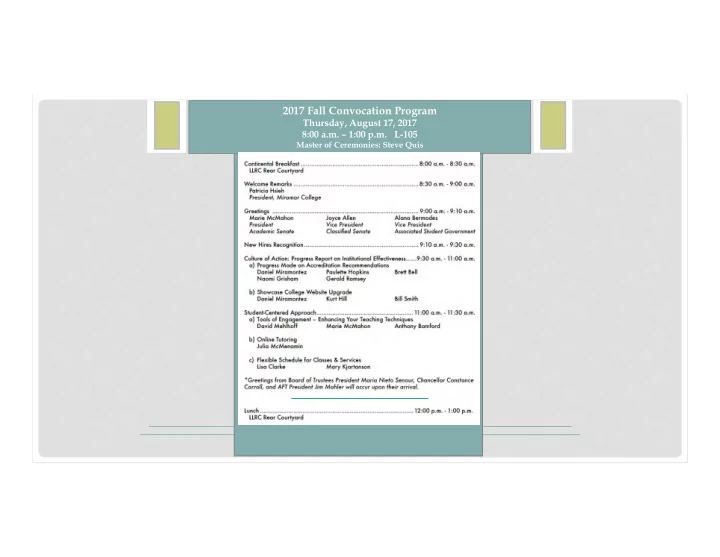
2017 Fall Convocation Program Thursday, August 17, 2017 8:00 a.m. - - PowerPoint PPT Presentation
2017 Fall Convocation Program Thursday, August 17, 2017 8:00 a.m. 1:00 p.m. L-105 Master of Ceremonies: Steve Quis 2017 2018 The Year of San Diego Miramar College 2 Our Mission 3 4 5 6 Enrollment Growth 7 8 Enrollment
2017 Fall Convocation Program
Thursday, August 17, 2017 8:00 a.m. – 1:00 p.m. L-105
Master of Ceremonies: Steve Quis
2
3
4
5
6
7
8
New Faculty : Total 53
New Classified Staff: Total 55
New Managers : 3
9
10
11
12
13
Jack Kent Cooke Foundation recipients
14
Christopher Patrick 2013 JKC Recipient Mehrdad Yazdanibiouki Trinh Nguyen 2014 JKC Recipients Colin Skinner 2015 JKC Recipient Thaimae Le 2016 JKC Recipient Ishak Mahamoud 2017 JKC Recipient
15
16
17
18
19
20
21
22
23
24
25
26
27
F A L L 2 0 17 CO N V O C A T I O N
Drum roll
Miramar College has been reaffirmed for 7 years
Miramar College Planning Framework
Student Success Framework for Long-term Integrated Planning
Eight Principles of Redesign
Eight recommendations for improvement- Why are these important? What action plans were already in place that address the
recommendations?
What new action plans were developed? How can you get involved?
Recommendation 1
In order to increase effectiveness and better determine whether its mission directs institutional priorities, the ACCJC team recommends that the College engage Administrative, Instructional Support, and Student Services programs in program review to address how well program missions align with the College mission. (Student Services, Administrative Services, Instructional Support Services)
External Evaluation Team Report
Instructional Services served as a best practice for using prompts in program review
to analyze data on enrollment, course success, course retention, and learning
additional resources as it relates to the college’s mission statement
The following divisions/ areas need to incorporate program review prompts to
demonstrate how their respective mission supports the institutional mission:
Student Services Administrative Services Instructional Support Services
Student Services
Where are we now?
Student Services Leaders have mapped their respective program mission
statements to the campus statement
Incorporated mission statements into program review – will be using to guide
and inform activities to achieve outcomes based on the scorecard and 6 Factors of Student Success
Leads:
Student Services Leaders – check with your department for new mission
statement
Review program review
Administrative Services
Where are we now?
Administrative Services Program Review Committee met on 4/ 7/ 17 and: Decomposed College Mission Statement Decomposed Unit Mission Statements Performed Gap Analysis Revised Unit Mission Statements to align with College Mission Statement
Leads:
Denise Kapitzke, Elaine Vega, Stephen Um, Josh Beall, Virgil Afan, Anna Liza
Soriano, Brett Bell
Instructional Support Services
Where are we now?
Instructional support units include Library, AV, ICS, Academic Support Center,
and ILC
Plans to have all instructional support units meet in the 2017-18 academic year to
develop prompts in Taskstream for implementation in the 2018-19 academic year (next full program review)
Leads:
Daniel Miramontez, Lou Ascione, Donnie Tran, Francine McCorkell, Glenn
Magpuri, Kurt Hill
In order to increase effectiveness, the ACCJC team recommends that the College analyze learning outcomes assessment results by meaningful disaggregation of data by subpopulations of students, instructional and tutorial delivery methods, learning support services, and locations to enhance dialogue and prompt appropriate action. (Instructional Services and Student Services)
Instructional Services
Where are we now?
Pilot project for course SLO disaggregation in progress Investigating purchase and implementation of improved tutorial tracking systems
Leads:
Laura Murphy, Alex Sanchez, Wai-Ling Rubic, Laura Pecenco, Mary Kjartanson,
IPR/ SLOAC Committee Members, Xi Zhang, Paulette Hopkins, Donnie Tran, Reylyn Cabrera, & Lou Ascione
Student Services
Where are we now?
Continue to address Student Equity/ monthly SSSP data
African American American Indian Latino Pacific Islander DSPS Using RFP Proposals
PR/ SLOAC for Student Services has met with Research Analyst and looking to bring
discussion to larger Student Services Leaders meeting for further discussion on meaningful disaggregation
Academic Success Center - Tutor Trac
Leads:
Adela Jacobson, MaryAnn Guevarra, Kandice Brandt, Dana Stack, Donnie Tran
Recommendation 3
In order to increase effectiveness, the ACCJC team recommends that the College develop a procedure for evaluating its program review processes for student services, administrative services, and instructional services to assure their effectiveness in supporting academic quality and accomplishment of the mission.
(Instructional Services, Student Services, Administrative Services)
Instructional Services
Where are we now?
IPR/ SLOAC Committee to assist in evaluation of PRs by providing feedback “as
Approved by Academic Affairs (April 2017) Approved by Academic Senate (May 2017) Deans participated in Taskstream PR training
Leads:
IPR/ SLOAC Committee Members (Julia McMenamin, Laura Murphy, John
Salinsky, Dan Wilke, Patricia Manley, Alex Sanchez, Cheryl Vallejo, Xi Zhang, Paulette Hopkins, & Margarita Sanchez), Instructional Deans
Student Services
Where are we now?
Evaluation form to review Program Review has been developed and reviewed by the
Student Services Leaders (including, but not limited to the following examples)
Improve program planning Improve services to students Results are thoroughly reviewed and discussed Evaluation to be incorporated on an annual basis to make informed changes (serve as
a mid-cycle review)
Summary report to be provided at end of 3-year cycle
Leads:
Adela Jacobson, MaryAnn Guevarra, Kandice Brandt, Dana Stack, Donnie Tran
Administrative Services
Where are we now?
Administrative Services Program Review Committee is currently defining how
each unit in the division supports academic quality
Administrative Services will align its service goals with this definition of academic
quality where appropriate
Administrative Services will assess its Program Review process on a regular cycle
to ensure its effectiveness in supporting this definition of academic quality
Leads:
Denise Kapitzke, Elaine Vega, Stephen Um, Josh Beall, Virgil Afan, Anna Liza Soriano, Brett
Bell
Recommendation 4
In order to increase effectiveness, the ACCJC team recommends that the College identifies and regularly assesses learning outcomes for all courses, programs, certificates and degrees using established institutional procedures. (Instructional Services)
Instructional Services
Where are we now?
Outcomes Assessment Coordinator provides leadership to SLOAC process Increased reassigned time for department chairs “SLOlapalooza” FLEX activity IPR/ SLOAC Committee faculty members provide assistance to other faculty Degree & Certificate achievement reports analyzed and discussed
Leads:
Laura Murphy, Department Chairs, IPR/ SLOAC Committee Members
Recommendation 5
In order to increase effectiveness, the ACCJC team recommends the College publish two-year course sequence charts in the College catalog.
(Instructional Services)
Instructional Services
Where are we now?
Two-Year Course Sequences for all degrees & certificates posted to college
website.
Leads:
Department Chairs, Counselors, Deans, Mara Palma-Sanft, & Margarita Sanchez
Recommendation 6
In order to increase effectiveness, the team recommends that the College improve assessment for all Student Support Services and implement annual assessment tools in addition to the three-year student feedback surveys to document support of student learning for demonstrating continuous quality improvement. (Student Services)
Student Services
Where are we now?
Alignment of mission statements allowed for Student Services to assess each area’s
activities, goals, and objectives, for a more comprehensive review towards continuous quality improvement
Will be working to collect feedback on an ongoing basis and conduct an annual review Data: Center data around the scorecard and Six Factors of student success Are the interventions being offered having an impact on student success? Working with Research Analyst’s Office for data collection methodology and analysis PR/ SLOAC met with Research Analyst and plan to have meeting with larger Student
Services group
GOAL: Develop tools for assessment to be implemented fully in spring 2018
Leads:
Student Services leaders
Recommendation 7
In order to improve effectiveness, the ACCJC team recommends that the College aligns its plans for technology support staffing needs with its capital improvement projects.
(School of Planning, Research & Institutional Effectiveness, Library and Technology)
External Evaluation Team Report
The District IT staff is appropriately represented at the college planning level Stronger coordination is needed between the District and Colleges for integrating the
District Technology Master Plan 2016-2018 (Draft) with the Colleges Technology Operational Plan
The District needs to convene a districtwide Technology Committee consisting of
individuals with the appropriate technology skills from the three colleges and Continuing Education
This Technology Committee will provide a mechanism by which broad based
communication related to districtwide technology support and services may be addressed
School of PRIELT
Where are we now?
San Diego Miramar College Technology Plan 2.0 Fall 2017-Spring 2020 Plans to develop and implement Districtwide Technology Committee
Leads:
College Technology Committee, Daniel Miramontez (PRIELT Dean), Kurt Hill
(ICS Supervisor), Glenn Magpuri (AV Supervisor), Bonnie Dowd (Executive Vice Chancellor of Business and Technology), Todd Williams (ACS), Don Bertram (Acting Director of Information Technology Services)
Recommendation 8
In order to increase effectiveness, the ACCJC team recommends that the College follow through on its Actionable Improvement Plans and Action Project to better assess and improve its shared governance procedures and practices as delineated in the Quality Focus Essay (QFE). (Planning and Institutional Effectiveness Committee)
PIEC
Where are we now?
Governance evaluation tools were collected in May 2017 from all committees and
subcommittees
Analysis of results are taking place and will continue in fall 2017 to inform
actionable improvements
PIEC will continue to monitor the progress of all Action Projects stated in the
QFE
Leads:
College Governance Committee (CGC), CGC Chair, Planning and Institutional
Effectiveness Committee (PIEC), College Executive Committee (CEC)
Culture of Action…
Not just to address recommendations Continue what we do well Collaboration! Improve our operations in better serving students
Roadmap
Crosswalk Improvement Recommendations to Redesign Principles
Accelerate entry into coherent programs of study
Recommendation 5
Minimize time required to get college ready
Recommendation 6
Ensure students know requirements to success
Recommendation 5
Customize and contextualize instruction
Recommendations 2 and 4
Integrate student support with instruction
Recommendations 1 and 3
Continually monitor student progress and proactively provide feedback
Recommendation 2
Reward behaviors that contribute to completion-N/ A
Leverage technology to improve learning and service delivery
Recommendation 7
Planning Framework
This year…
Recap: Planning Summit 2017 - Miramar ACTx
Introduced how some faculty/ services are demonstrating culture of action Showcased best practices
Address gaps (Best practices and eight accreditation improvement
recommendations)
How can you contribute to addressing the gaps through your work?
One way to address gap (Collaboration)
Website Redesign Project
The college website redesign was the most collaborative effort to date First time the College employed a “Discovery” process as follows: Basic quantitative data analysis through Google Analytics Focus group meetings with all constituent groups (faculty, classified staff, administration, and
students)
Conducted theme analyses based on focus group input Worked with consultant to redesign website based upon Discovery process using quantitative
and qualitative data
Performed review sessions of redesign templates opened to entire college in which a final
design was selected based on feedback
Web Designer (Bill Smith) and support (Kurt Hill) worked diligently with consultant to
develop, produce, and implement new website redesign
Also worked with the various units, departments, schools, and divisions on the migration of top-
level content
Collaboration is Key
Ongoing collaboration
Feedback is ongoing and incorporated into “polishing” the new site Collaboration not always public or visible (e.g., open discussion and public review).
Collaboration happens internally among staff. Such as having tighter collaboration between PIO and Web Designer for graphic needs.
Have we achieved perfection? No – but we’ve improved both the
process and the product
Website Redesign-Student Focus
Based on campus collaboration it was clear that the website needed to
be student focused
The College’s Integrated Planning Framework served as a backdrop
regarding student pathways (connection, entry, progress, and completion) for the website redesign via simple steps outlined for “Future”, “Current”, and “Graduating” student pathways
Captive audiences (i.e., Faculty, Staff, Administration) have their own
respective pathways, but majority of home page real-estate is devoted to student use
How so?
San Diego Miramar College New Website
Link to video here
Additional Information
Moving Forward:
Content authors will have accounts on new website to update their content (as identified
through respective vice presidents)
Training resources will be available to content authors on new website (forthcoming fall 2017) Focus during fall 2017 is to have lower level content fully migrated over to new website by end
Old web server will be decommissioned January 2018 In collaboration with Web office, all old content will need to be updated on the new site by content
authors by December 8, 2017
Feedback:
Please continue to email Kurt Hill and cc Daniel Miramontez There will be an online feedback form implemented during fall 2017
Collegewide Priorities
To increase transfer volume To increase the number of Associate Degrees and Certificates awarded To increase the success rate for CTE students To increase the number of course sections to reach the goal of 10,000 FTES To increase course completion rates for disproportionately impacted
populations of students as identified in the Student Equity Plan
To increase the number of outreach activities and programs
Planning Summit 2018
Guided Pathways Initiative
Nationwide trend Statewide implementation
TO O LS O F ENG A G EM ENT – ENHA NC ING YO UR TEA C HING TEC HNIQ UES
MY PROJECT
Using my ve ry o wn little ha nds…
O NLINE TUTO RING
ONLINE TUTORING THROUGH THE ACADEMIC SUCCESS CENTER
thro ug h Bla c kb o a rd a nd Co nfe r Zo o m.
b o x, sha re sc re e ns, use a white b o a rd, e tc .
inc re a se stude nt a tte nda nc e .
nstruc to rs c a n me e t with the o nline tuto r to disc uss tuto ring te c hniq ue s, g uide line s, rub ric s, e tc .
DURING SPRING 2017, WE OFFERED ONLINE TUTORING FOR:
ng lish 101
ng lish 43
ng lish 49
DURING SUMMER 2017, WE OFFERED ONLINE TUTORING FOR:
1. Ac c o unting 116A 2. Ac c o unting 116B 3. Ac c o unting 150 4. Bio lo g y 107 5. Bio lo g y 210B 6. Busine ss 100 7. Busine ss 101 8. Che mistry 100 9. Che mistry 152
De ve lo pme nt 101
De ve lo pme nt 103
ng lish 048
ng lish 049
ng lish 101
ng lish 205
FOR FALL 2017, WE PLAN TO OFFER ONLINE TUTORING FOR:
1. Ac c o unting 116A 2. Ac c o unting 116B 3. Ac c o unting 150 4. Bio lo g y 107 5. Bio lo g y 210A 6. Che mistry 100 7. Che mistry 111 8. Che mistry 130 9. Che mistry 152 10. Che mistry 200 11. Che mistry 201 12. Che mistry 231 13. Che mistry 233 14. Child De ve lo pme nt 101 15. Child De ve lo pme nt 141 16. Child De ve lo pme nt 162 17. Child De ve lo pme nt 215 18. Co mmunic a tio ns 135 19. E ng lish 042 20. E ng lish 043 21. E ng lish 048 22. E ng lish 049 23. E ng lish 101 24. E ng lish 105 25. E ng lish 205 26. E SOL 19 27. Histo ry 100 28. Histo ry 105 29. Histo ry 106 30. Histo ry 109 31. Histo ry 110 32. Ma th 038 33. Ma th 046 34. Ma th 096 35. Ma th 104 36. Ma th 116 37. Ma th 119 38. Ma th 121 39. Ma th 141 40. Ma th 150 41. Ma th 151 42. Physic s 125 43. Physic s 195 44. Physic s 196 45. T a g a lo g 101 46. T a g a lo g 201
WE NEED YOUR HELP
nc o ura g e stude nts to a tte nd o nline tuto ring . Yo u c a n a nno unc e in c la ss o r inc lude in yo ur sylla b us. We c a n visit yo ur c la ss.
f yo u use Bla c kb o a rd, I c a n e nro ll yo ur stude nts.
f yo u do n’ t use Bla c kb o a rd, ple a se se nd me yo ur stude nt ro ste r using F a c ulty We b Se rvic e s.
Julia McMenamin 619-388-7690 jmcmenam@sdccd.edu
FLEX IBLE SC HED ULE FO R C LA SSES & SERV IC ES: STREN G THEN IN G THE BRID G E BETW EEN STUD EN T SERV IC ES & IN STRUC TIO N
OBJECTIVES
xplo ring o ptio ns to : Ma ximize se rvic e s I nc re a se e nro llme nt I mpro ve re te ntio n Co mpre ss time to c o mple tio n o f stude nt-c e nte re d g o a ls
STUDENT DEMOGRAPHICS
17.7% 31.9% 35.5% 14.9%
STUDENT DEMOGRAPHICS BETWEEN FALL 2012 AND FALL 2016
HOW CAN WE ACHIEVE THIS?
nvo lve stude nts to e nsure stude nt-c e nte re d instruc tio n
PLEASE JOIN US
2017 Fall Convocation Program
Thursday, August 17, 2017 8:00 a.m. – 1:00 p.m. L-105
Master of Ceremonies: Steve Quis