2017 saw the 35 th Anniversary of the Falkland Islands conflict. In - - PDF document

2017 saw the 35 th anniversary of the falkland islands
SMART_READER_LITE
LIVE PREVIEW

2017 saw the 35 th Anniversary of the Falkland Islands conflict. In - - PDF document

2017 saw the 35 th Anniversary of the Falkland Islands conflict. In January 2017, Sandra and I visited the Falkland Islands and took the battlefield tour from San Carlos to Goose Green. The personal recollection of that tour forms the basis of


slide-1
SLIDE 1

2017 saw the 35th Anniversary of the Falkland Islands conflict. In January 2017, Sandra and I visited the Falkland Islands and took the battlefield tour from San Carlos to Goose

  • Green. The personal recollection of that tour forms the

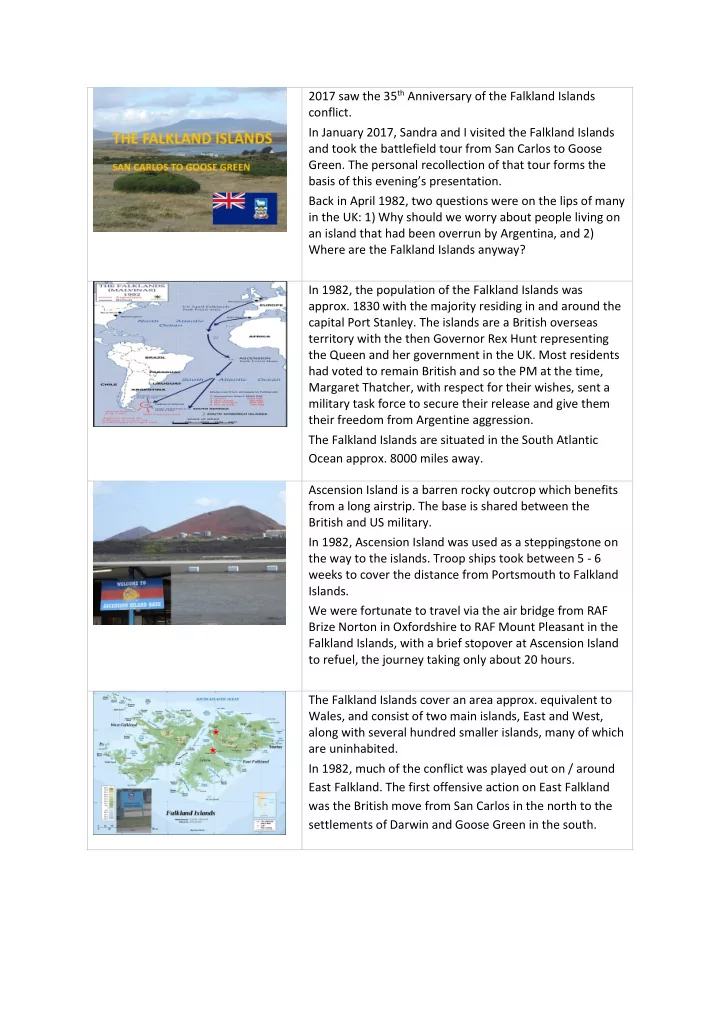
basis of this evening’s presentation. Back in April 1982, two questions were on the lips of many in the UK: 1) Why should we worry about people living on an island that had been overrun by Argentina, and 2) Where are the Falkland Islands anyway? In 1982, the population of the Falkland Islands was

  • approx. 1830 with the majority residing in and around the

capital Port Stanley. The islands are a British overseas territory with the then Governor Rex Hunt representing the Queen and her government in the UK. Most residents had voted to remain British and so the PM at the time, Margaret Thatcher, with respect for their wishes, sent a military task force to secure their release and give them their freedom from Argentine aggression. The Falkland Islands are situated in the South Atlantic Ocean approx. 8000 miles away. Ascension Island is a barren rocky outcrop which benefits from a long airstrip. The base is shared between the British and US military. In 1982, Ascension Island was used as a steppingstone on the way to the islands. Troop ships took between 5 - 6 weeks to cover the distance from Portsmouth to Falkland Islands. We were fortunate to travel via the air bridge from RAF Brize Norton in Oxfordshire to RAF Mount Pleasant in the Falkland Islands, with a brief stopover at Ascension Island to refuel, the journey taking only about 20 hours. The Falkland Islands cover an area approx. equivalent to Wales, and consist of two main islands, East and West, along with several hundred smaller islands, many of which are uninhabited. In 1982, much of the conflict was played out on / around East Falkland. The first offensive action on East Falkland was the British move from San Carlos in the north to the settlements of Darwin and Goose Green in the south.

slide-2
SLIDE 2

Both British and Argentinian commanders knew that the British would have to retake Stanley before they could run the occupiers out of the Falklands and finish the conflict, so why San Carlos? San Carlos is approx. 20 miles away to the north of Goose Green and a lot further than that from Stanley. The thinking was that it was too far for any sane defender to put any substance behind the landings regarding GG. The report of the landing being ignored by the Argentinians seems to bear this out. With heavy lift helicopters available to the British, 20 miles was no real obstacle to accomplishing their goal of regaining control of the settlements of Darwin and GG. The mountainous terrain surrounding San Carlos water creates a natural bowl which provides great protection for the ships being off-loaded in the bay. The adverse side of this is that it can also act as a trap for shipping when attacked from the air. This shows us the terrain over which the British troops were going to ‘yomp’. The going would be tough with peat bogs and tufty grasses making the most sure-footed soldier weary of where he was putting his feet. The whole area was pockmarked with ponds and streams, making progress slow and potentially dangerous. This is a photo of a diagram displayed in the small ‘museum’ at San Carlos and indicates the 4 main beaches which were used in the landings:

  • Red – Ajax Bay
  • Blue 1 - San Carlos settlement
  • Blue 2 – Bonner’s Bay where 2 Para were landed
  • Green – Port San Carlos

We can overlay a picture of the area with this detail to give a better understanding of the task ahead of our forces. Fanning Head was an observation position situated high above San Carlos water, occupied by a well-trained Special Forces unit - Eagle Troop. These troops were forced to flee under extreme bombardment from the guns of HMS Antrim anchored out in the sound, but not before they were able to notify the senior commanders at Goose Green and Port Stanley of the British troop landings at San

  • Carlos. The reported landings were ignored, and no

reinforcement was sent to the area.

slide-3
SLIDE 3

2nd Battalion of the Parachute Regiment under the command of Lt. Col. H Jones landed on Blue 2 beach on 21st May 1982, having left the relative safety of their transport, the MV Norland, a North Sea ferry more used to sailing between Hull and Rotterdam than the South Atlantic. Embarkation of troops from the Norland in to landing craft sent from HMS Intrepid did not go smoothly, or as quickly as planned. The Norland was still a civilian ferry which had been modified for transporting the soldiers across the Atlantic and not much else. It was definitely not fitted out for the purpose of disembarking soldiers in full kit at any great speed. The SBS went in ahead of the landing to clear any

  • bstacles and to secure the beach.

Needless to say, a soldier being landed from the sea is not a comfortable feeling for any of those concerned. Dumped unceremoniously into the sea from the landing craft, probably into waist deep water, and then expected to take a hostile beach with a heavy soaking wet Bergen on his back into the bargain. At odds with their surroundings and the situation, 2 Para moved towards the beach. The master of the landing craft let down the ramp and gave 2 Para the order to

  • disembark. 2 Para did not move. Looking again at his

‘cargo’, the penny dropped and he changed the order to………..”Green on. Go”, and 2 Para were off on the next leg of their operation, which was to secure Sussex Mountain. The summit of Sussex Mountain stands at 800 feet above sea level and dominates the high ground overlooking San Carlos so is the obvious start position for any Argentine attempt to drive the British troops back into the sea. The summit was seen as ‘vital ground’ and paramount to maintaining the British assault and therefore a position to be denied to the enemy at all costs. Unbeknown to the British commanders at that time was that the Argentinian Military Commander-in-Chief Brigadier-General Mario Menendez would pay little interest in the landings, and no counterattack was ever planned. So, wet and disorientated, 2 Para assembled on the beach at San Carlos under the command once again of H Jones who took back control of the operation. Each man was grossly overloaded for the 5-mile trek up a mountain over

slide-4
SLIDE 4

the most inhospitable terrain of tussock grass, boulders and peat-bog outcrops. Each man would carry his own kit, immediate rations and personal weapon, as well some of the equipment required by the battalion, be it a general purpose machine gun and ammunition or rounds for other weapons systems like the Blowpipe air defence system or 81mm mortar bombs. All told, each man would carry about 110lbs in weight, much

  • f which would have been soaking wet from the landing.

The entire battalion was exhausted by the time it reached its goal at the summit of the mountain and started on preparing their defensive positions. ‘Digging-in’ would be arduous as a trench just one foot deep would soon fill with water due to the nature of the surrounding ground and vegetation, so 2 Para would have to build upwards by constructing sangars of peat and stone. These barricades would provide protection from both air and ground attack and shield the men from the wind which cuts across the top of the mountain all the time. They could not alleviate the symptoms of trench foot suffered by many of the men bought on by the saturation

  • f their footwear during the landings. The standard issue

boot at that time allowed water to enter the boot through the lace holes but the sealed rubber sole would not let the water back out, a bit like getting water down the top of your wellies. Those worse affected were taken back to San Carlos for treatment. Note: Our tour guide advised that we would not be safe

  • ut of the vehicle on top of the mountain for more than

five minutes as hyperthermia would soon take hold in the

  • wind. 2 Para would stay on the mountain for six days,

losing the equivalent of one platoon to exposure and trench foot before moving off the mountain. The period of inactivity that followed the landings was frustrating for the troops and a nightmare for the UK

  • Government. The man given the role of Commander Land

Forces for the operations on the Falklands, Major-General Jeremy Moore, was still several days away from the Falklands on the QE2 and out of communication with his commanders.

slide-5
SLIDE 5

This was the first major conflict where reporters from Press organisations were taken into the field to follow closely the machinations of the commanders and their

  • troops. Media footage and radio transmissions were

reaching the UK as the action happened. The reports and graphic footage of ships being hit by missiles and sinking in the South Atlantic made chilling viewing for people back home and started well before 2 Para landed at San Carlos. Do you remember HMS Sheffield, hit by an Exocet missile while patrolling to the south of the islands at the start of the conflict? Or,

  • Lt. Nick Taylor, the first Sea Harrier pilot to die in the

conflict following a raid on Goose Green? He is buried where he was found still strapped into the wreckage of his aircraft at the edge of the racecourse. Each incident nibbled away at the support the general public gave to the war. But it was not all bad news. Support was bolstered again by the successful night-time raid at the airfield on Pebble Island, where the SAS destroyed 11 Argentinian aircraft, including this Pucara, which had been hampering preparations for the landing. This small cairn and plaque are the memorial to that attack and is located at the end of the landing strip on Pebble Island today. Relief at the ‘easy’ landings in San Carlos Bay was short lived and replaced with anxiety at the continued mounting losses in men and equipment, and lack of any subsequent

  • progress. The bad news kept on coming.
slide-6
SLIDE 6

HMS Antelope, struck by two large 1000 lb bombs, being torn apart in the subsequent explosion, provided this devastating image that was beamed around the world from the front line. May 25th is Argentina’s National Day, and the ruling Junta in Buenos Aires specifically requested their aircraft target the Coventry and HMS Broadsword on this day, to give the people of Argentina a special prize on their National Day. One out of Two was a very good result. Remember HMS Coventry destroyed by Argentine bombs whilst protecting the landing beaches? The tragic loss of the Atlantic Conveyor, which was sunk with nearly its full cargo of heavy lifts helicopters, was not factored into the British planning. Only one Chinook managed to fly from the ship before she was hit. All the

  • thers, three Chinooks and six Wessex, went to the

bottom and played no part in the conflict. That single chinook has flown throughout the last 35 years and was

  • nly pensioned off at the end of 2017.

The loss of HMS Coventry and the Atlantic Conveyor compounded the pressure building on the landing troops. It was thought at one point that the troops would have to be taken off the landing beaches back to their transports and the whole operation moved nearer to the main target

  • f Stanley. This would have been a major setback for the

UK Government and the military, and a real boost to the Argentinian military Junta and occupation forces. The Joint Chiefs- of-Staff at the MOD in London were therefore put under intense pressure by the Government to come up with a ‘quick win’ solution to getting the conflict back on track without recourse to General Moore. With no direct means of communication between the commanders in the Falklands and those planning the

  • perations at the MOD in the UK things were slowly put in

place for an attack to retake and hold the settlements of Darwin and Goose Green.

slide-7
SLIDE 7

The SAS were sent forward to set up an observation post in the wreck of the Garland (a Chilean Iron Barque out of Hamburg wrecked in 1900) which lay across the water from Goose Green. From here they were able to send information concerning troop numbers and movements in the target area back to 2 Para who would spearhead the

  • peration, ecstatic at being able to leave the in-

hospitability of their miserable mountain. However, some

  • f the reports and intelligence sent back to by the SAS,

allegedly predicting an ‘easy ride’ for the paras, may have badly misled Jones. During the period of SAS occupation of the wreck, the Argentinians warned the inhabitants of Goose Green that they were going to use the Garland for gunnery practice. The islanders were aware that the SAS were observing the settlement from within the wreck so managed to convince the Argentinians that the wreck was part of island heritage and they would not therefore be popular if they were to destroy it. Jones was to be given only three 105 mm guns as he would have support from the 4.5-inch gun on HMS Arrow during the hours of darkness. The lack of helicopters meant that there would be no resupply of guns or

  • ammunition. He would also have no support from light

armour as it was believed that the tracked Scorpion and Scimitar tanks would sink in the peaty soil. Overnight on 26th / 27th May 2 Para left Sussex Mountain and made their way to Camilla Creek House which was a large, derelict farmhouse halfway between the Mountain and Goose Green at the northern end of the Darwin and Goose Green isthmus, out of sight of both settlements. Secrecy at such times is paramount to the safety of the troops on the ground. As 2 Para settled down in the old farmhouse, the Regimental Signals Officer tuned into the BBC World Service and was stunned to hear the reporter telling the world that the parachute battalion was on the move to re-capture GG. All the advantage of surprise was stripped away by that one innocent radio transmission. Colonel Jones immediately ordered everyone to disperse and postponed his orders. Contrary to British belief, the Argentinian commander Lt.

  • Col. Italo Piaggi took the attitude that it was purely a

psychological action by the British and decided not to take the transmission seriously, as he thought it crazy to announce an actual move on his positions over the radio for all to hear. However, an Argentine patrol inadvertently stumbled into the area held by the Paras at Camilla Creek House. A Spanish speaking, British officer was on hand to ensure

slide-8
SLIDE 8

that a swift interrogation of the captured soldiers took place, which provided Jones with an updated view of the situation awaiting the Paras at GG. This intelligence put the Argentinian strength confronting the Paras as 554 infantrymen. These were, overall, poorly equipped conscripts. There were also 100 support staff and an air force anti-aircraft detachment of 550 personnel garrisoned at GG, making 1200 military personnel in total. There were 102 inhabitants of Darwin and GOOSE GREEN who were being held captive in the Community Centre – a single lavatory and wash basin was all they had for

  • sanitation. Dysentery had set in within a couple of days.

2 Para Company Commanders were apprised of the plan developed by Jones. It was very prescriptive, would be conducted in six phases, and did not allow many

  • pportunities for the commanders to use their own
  • initiative. The intention was to re-take the two

settlements in day light to guard against islanders becoming inadvertently embroiled in the action. Therefore 2 Para had to trek from Camilla Creek House to Darwin settlement overnight, by covering the 14 km in just 14 hours. 2 Para consisted of 6 companies, and Jones gave each Company commander his detailed tasks: B Company, Major Johnny Crossland, was to take a route up the right side of the isthmus. They were to eradicate the enemy around the ruins of Boca House, destroying any enemy positions on the way. They would then support the capture of GG. D Company, Major Phil Neame, was to follow the two leading companies up the centreline of the isthmus. They would be held in reserve to assist only if necessary as they would spearhead the final action to take the airfield and capture GOOSE GREEN in phase 6. A Company, Major Dair Farrar-Hockley, was to take a route up the left side of the isthmus. They were to capture Burntside House in Phase 2 and destroy any enemy positions found at Coronation Point in Phase 3. They were then to advance to the outskirts of Darwin in phase 5 and re-take Darwin in phase 6. We will be following A Company as they move up the isthmus. The other three companies would each undertake a specialist role as the battle progressed. Jones’s own Tactical HQ unit (Tac 1) consisted of a dozen men and included his second in command, Major Chris Keeble, his Battery (artillery) Commander, Major Tony Rice RA and his Mortar Officer, Captain Mal Worseley-Tonks. It also included the CO’s bodyguard, Sergeant Barry Norman.

slide-9
SLIDE 9

The night of the 27th May was just as 2 Para would have wished for - black, cold and windy. Harriers had softened up the target at last light and the artillery had been flown into position. The 550 paras covered the 7 km from Camilla Creek House to the start line without incident and by 22.30 both A and B Companies were ready to push on up the isthmus. However, things did not start well. The 4.5-inch gun on HMS Arrow jammed and proved not to be a quick fix issue. The planned simultaneous attack up the isthmus by both A and B Companies now had to be sequential, with A taking the lead followed by B, each being covered by the artillery troop. This delayed the start of the assault until 02.50 First objective was Burntside House which appeared to be

  • ccupied by the Argentinians. This turned out to be

unfounded as the perceived return fire was only ricochets from the British rounds fired at the buildings. There is nothing left of Burntside House today, but this is what the building would have looked like in 1982. A Company began their move across Coronation Point towards Darwin settlement where intelligence had warned of enemy entrenchments. The approach was cautious but found no enemy activity. The Argentinian troops had moved to the defensive feature at Darwin Ridge about 1.5 km further up the isthmus. Coronation Point secured 05.20 A Company continued their advance, working their way around Darwin Inlet over the open ground towards Darwin. The artillery was running short of ammunition and was not proving effective in the high winds. The recoil of the guns had the effect of sinking the base plates into the soft ground, which further impacted on their accuracy. On top

  • f this, early morning fog meant that the pre-arranged

harrier raids could not proceed as they could not take off from their carrier base. Argentinian aircraft, however, could take off in Argentina and were not hampered by the weather over the islands, and were able to attack the British as they advanced.

slide-10
SLIDE 10

A Company soon came across the Argentinian forward positions, abandoned during the night. Reporter Max Hastings was to report that the Argentinians were on the run having seen the British forces moving towards them. This was far from true as the Argentinian troops were positioned in the field for the very purpose of spotting the British advance and then returning to their battle lines with the intelligence gained. The paras were able to set up mortars in the abandoned Argentinian fox holes and fire on the enemy positions on the ridge without having to dig in first. We can see here some of the shell cases left by the Argentine troops as well as scraps of blanket. A Company continued towards Darwin across the low- lying ground along the edge of Darwin Inlet, coming under fire as dawn broke. Two sections were able to skirmish forward and gain protection in a gorse filled gully which ran up the side of the enemy positions. Using the gully and cover from the gorse, they engaged the Argentine forces and tried to dislodge them from their trenches. The paras suffered several casualties in the assault and had to withdraw to the relative safety of the gully. Sniper fire from the Argentinian positions had A Company pinned down and stuck. Farrah-Hockley reported back to say that A Company “had hit a brick wall and could not go through it”. B Company was being held up at Boca House by dogged resistance of the Argentinian forces there, so both flanks were effectively blocked to further advance. A frontal attack was the only option. Jones was typically direct in his response. Turning to his bodyguard he said, “Right – I’m not having this. Come on – we’re going!” Under cover of smoke grenades, Jones and his Tac 1-unit team traversed the ground around Darwin Inlet and made it safely into the gully. By 08.30, things were becoming desperate for the paras. Several more attempts at using the gully to mount attacks

  • n the Argentinian positions were made but each ended

the same way. Captain Chris Dent, 2IC A Company, was killed during these attempts to rejuvenate the assault on the ridge.

slide-11
SLIDE 11

Jones made an assessment based on what he had

  • witnessed. A Company was not going to take Darwin
  • Ridge. Without Darwin Ridge, 2 Para would fail in their
  • bjective. Without that objective (the settlements at

Darwin and Goose Green) being taken, the first land battle

  • f the campaign would fail, with the potential to impact

the whole endeavour. With this in mind, he took command of the situation. Turning to his bodyguard again, all Jones said was “Follow me, we’re going right”. They dropped down into the lee of the hill and Jones started to run. Jones was aware of what he would face when he got out into the open, but he was more afraid of failure than he was of dying. He ran towards an enemy trench situated to his left and above him, firing as he ran. He rolled down a slope and changed his magazine and then ran at the trench again. As he continued up the slope, he ran into the arc of fire of a further trench to his right, of which he was

  • unaware. Shouted warnings from those running behind

him were too late. A bullet struck Jones, and mortally wounded, he collapsed right at the edge of the trench he had been running towards. When Jones fell, his radio operator sent out the message “Sunray is down”, while Major Rice dashed back round the spur of land to inform Farrah-Hockley. It was around 09.00

  • n Friday 28 May.

We will never know whether Jones’ sacrifice and personal bravery were the catalyst for regenerating the remainder

  • f A Company, but what we can be sure of is that the end
  • f the action came swiftly thereafter. Corporal Dave Abols

fired a shoulder-held high explosive grenade at the trench nearest to the gully and scored a hit. He then fired at a second trench and hit that also. The Argentinians began to run, abandoning their positions and either putting their hands up in surrender or fleeing towards Darwin and GG. Farrah-Hockley, Rice and Norman managed to get to Jones twenty minutes or so after he was shot. He was still alive but slipped into unconsciousness before he could be airlifted from the field.

slide-12
SLIDE 12

Casualty evacuation was ordered but tragically the Scout helicopter flown by Lt. Richard Nunn was attacked and destroyed by a Pucara before it reached the scene. A second helicopter was despatched, but Jones died before it arrived. Cynically, the signal sent back to HMS Hermes announcing the death of Jones read, “Sunray killed doing an Audy Murphy”. The battle to retake the settlements would last for another 24 hours. Major Chris Keeble had taken over command of the operation and immediately sent D Company to assist B Company at Boca House. With both flanks cleared, all 4 Companies now turned their focus on the capture of the two settlements. Stiff local resistance, anti-aircraft guns used like canons, a minefield and strong enemy positions dug in around GG, impeded their progress. The Paras also came under attack from the air. As dusk approached, 3 RAF Harriers struck Goose Green with cluster bombs completely devastating the area and so demoralising the Argentinian forces that they never fired another shot. The following day, 29th May 1982, the Argentinian forces surrendered to Major Keeble. When the Paras finally entered Goose Green, they were able to release the residents from the Community Centre, where they had been held during their captivity. Today, Goose Green is home to about 30 islanders and the Community Centre is still the hub of the settlement. The schoolhouse was used as a medical centre throughout the conflict. Today the school has two teachers and two pupils, who spend 4 hrs a day in the school building. The remainder of their studies are conducted over the internet along with children from other settlements.

slide-13
SLIDE 13

At the far end of the settlement are the sheep shearing

  • sheds. In May 1982 they were used as make-shift

detention areas for the Argentinian troops following their surrender. As you can see, there is plenty of room in the sheds for the 1150 or so Argentines who survived the battle at Darwin Ridge and the final assault on Goose Green. 47 of their compatriots died. Today, there are approx. 80,000 sheep on the islands, of which 90% are kept for their wool. A combination of the harsh weather and poor pasture makes for excellent wool. The sheep shearers usually make their round of the farms between October and February which enables the flock to grow a new coat in time for the autumn / winter weather to come. The journey from San Carlos to Goose Green would not be complete without a mention of the war graves which mark the passing of so many. Here we see the British Cemetery which was unveiled in 1983. Designed and constructed by the Commonwealth War Graves Commission, the memorial is dedicated to the 255 British military personnel who gave their lives for the islands in 1982.

slide-14
SLIDE 14

This was the first time in history of war that relatives of British soldiers who died in conflict overseas were given the opportunity to have their next of kin repatriated to the

  • UK. Everyone looked to Sarah Jones, widow of the most

senior soldier to be killed in the conflict, for a lead on what to do. She knew that Jones would want to stay in the Falklands alongside his fallen comrades so agreed for his body to be buried at San Carlos. 12 others agreed likewise. H’s grave is the one on the left of the front row. The British cemetery is located near to Blue beach in San Carlos and looks out over the water to Ajax Bay where there was an old meat packing factory which was turned into a medical centre during the conflict. Those of the British forces killed in action were taken to Ajax Bay where they were buried in temporary graves. This white gate was erected as the cemetery was being

  • finished. The bodies of those now buried in the cemetery

were exhumed from the temporary plot at Ajax Bay and ferried across the water to be landed on the shore just in front of the gate. Each body was ‘piped’ through the gate

  • n its way to the new burial site as a sign of gratitude and

respect. After the conflict ended, the Argentine Government was asked if it would like the bodies of its fallen soldiers repatriated to Argentina. Their response was that their soldiers had died on Argentinian sovereign soil, so they should remain where they were. The Falkland Islanders constructed the cemetery out of respect for the fallen. The Argentine war graves are located across Choiseul Sound near Darwin settlement. There are 237 graves of which 123 graves are marked as “Argentine Soldier Known Only By God”. Of the 649 Argentine soldiers killed in the conflict, only 412 are named on the memorial wall.

slide-15
SLIDE 15

The Argentine soldier was issued with only one set of dog

  • tags. If he fell in battle, the dog tags were taken, and the

body could not always thereafter be identified. The British soldier always wore two sets of dog tags for that reason. The Argentine Government is currently working with the UK Gov and FIG to DNA test the remains of the unknown soldiers, in an attempt to identify the bodies so that families can lay their loved ones to rest. The work is being conducted by the International Red Cross. Finally, on the hill overlooking Darwin and Goose Green is the 2nd Battalion Parachute Regiment memorial. 22 soldiers died, including their commanding officer, during the battle to secure the release of the residents of the two settlements. I will leave you with one parting quote which does sum up rather nicely, if perhaps a little crudely, the landscape across the Falkland Islands. The PM, Margaret Thatcher, visited the islands in January 1983 when her husband, Sir Denis, was heard to say, “We sure as hell didn't go there for the real estate; its miles and miles of bugger-all.”