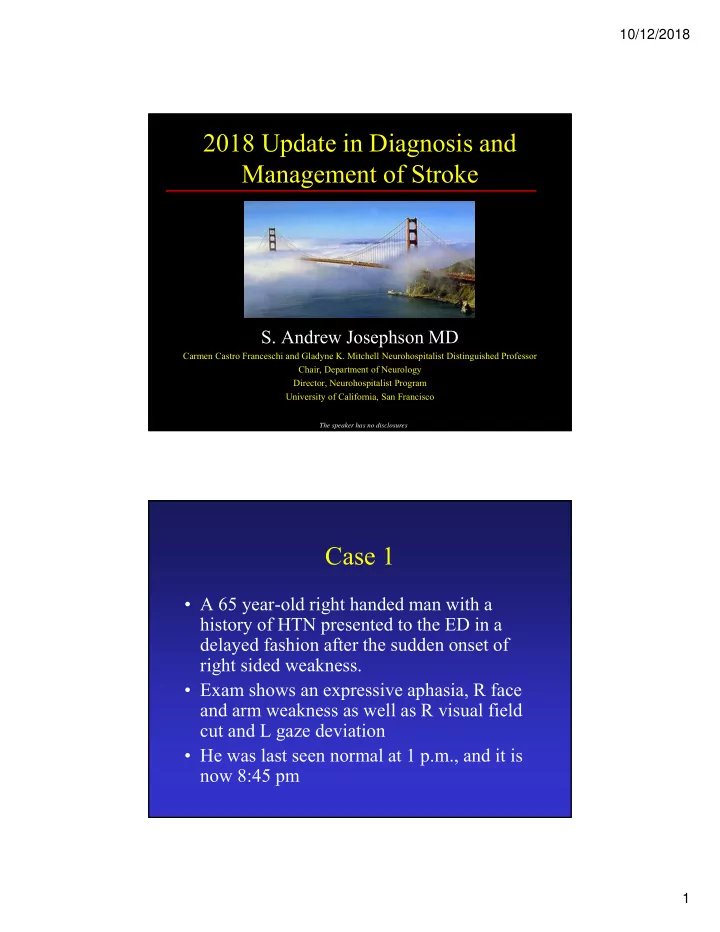
2018 Update in Diagnosis and Management of Stroke S. Andrew - - PDF document

2018 update in diagnosis and management of stroke
SMART_READER_LITE
LIVE PREVIEW

2018 Update in Diagnosis and Management of Stroke S. Andrew - - PDF document

10/12/2018 2018 Update in Diagnosis and Management of Stroke S. Andrew Josephson MD Carmen Castro Franceschi and Gladyne K. Mitchell Neurohospitalist Distinguished Professor Chair, Department of Neurology Director, Neurohospitalist Program


slide-1
SLIDE 1

10/12/2018 1

2018 Update in Diagnosis and Management of Stroke

  • S. Andrew Josephson MD

Carmen Castro Franceschi and Gladyne K. Mitchell Neurohospitalist Distinguished Professor Chair, Department of Neurology Director, Neurohospitalist Program University of California, San Francisco

The speaker has no disclosures

Case 1

  • A 65 year-old right handed man with a

history of HTN presented to the ED in a delayed fashion after the sudden onset of right sided weakness.

  • Exam shows an expressive aphasia, R face

and arm weakness as well as R visual field cut and L gaze deviation

  • He was last seen normal at 1 p.m., and it is

now 8:45 pm

slide-2
SLIDE 2

10/12/2018 2

UCSF “Stroke Protocol” CT

  • Obtained at UCSF in suspected acute stroke

and TIA patients hours from onset

  • 1. Non-contrast CT of the head
  • 2. CT Angiography from aortic arch to the top
  • f the head
  • 3. CT Perfusion study
  • 4. Post-contrast CT of the head

What treatment should this patient likely receive?

  • A. IV t-PA alone
  • B. IV t-PA followed by embolectomy
  • C. Embolectomy alone
  • D. IV heparin
  • E. Antiplatelets
slide-3
SLIDE 3

10/12/2018 3

The 2018 Acute Stroke Timeline

  • Time of onset= last time seen normal

0-4.5 Hours IV-tPA 0-6 Hours Mechanical Embolectomy for all 6-24 Hours Mechanical Embolectomy for some

Speed Matters: Time is Brain

  • Examination of the Get With the Guideline

Registry in the U.S. over the last decade

– 1400 hospitals, nearly 59,000 patients – Mean time to treatment was 144 minutes

  • Earlier on weekdays, more severe stroke, arrival in ambulance
  • For every 15 min earlier administration…

– Significantly lower in-house mortality – Significantly lower rates of ICH – Significantly more independent ambulation at d/c – Significantly higher rate of d/c to home

Saver J et al: JAMA 309:2480, 2013

slide-4
SLIDE 4

10/12/2018 4

The 2015 Endovascular Revolution

  • Five major positive trials of endovascular

therapy all published in 2015 in NEJM

  • Trial design somewhat differed, but

common to each:

– 1. Used newer-generation devices – 2. Selected patients who were eligible via CTA – 3. IV t-PA in those who were eligible followed by embolectomy – 4. Typically a 6 hour time window

The 2018 Second Revolution

  • DAWN and DEFUSE3 Trials
  • Select patients with LVO treated up to 24

hours based on CT perfusion selection

– Automated CT software widely available

  • Has led to major reexamination of triage

and ED/hospital protocols

Nogueira R et al: N Engl J Med 378:11, 2018 Albers GW, et al: N Engl J Med 378:708, 2018

slide-5
SLIDE 5

10/12/2018 5

What do we do given this data?

  • 1. All patients eligible for IV t-PA should

receive it (quickly)

  • 2. Patients within 6 hours should receive a

CTA to look for a large vessel occlusion (LVO)

  • 3. If LVO present, endovascular therapy

should occur, even following IV t-PA regardless of perfusion data

What do we do given this data?

  • 4. If the patient has a LVO and presents

between 6-24 hours, CT perfusion is required and selects patients who should receive endovascular therapy

  • 5. Consider IV tPA for some outside of the

4.5 hour window with MRI selection

slide-6
SLIDE 6

10/12/2018 6

Wait! What about tPA Out of the Window?

  • A substantial number of patients wake up

with a stroke or can’t tell us their time of

  • nset
  • Some will have had a stroke in the last few

hours and therefore IV tPA may work

  • Important positive trial used MRI to select

these patients (+DWI but –FLAIR)

Thomalla et al: N Engl J Med 379:611, 2018

Case 2

  • A 65 year-old man with a history of HTN

presents with 3 days of R arm weakness

  • Examination shows a R pronator drift and

mild weakness in the extensors of the R hand and arm

  • The patient takes aspirin 81mg daily as well

as HCTZ

slide-7
SLIDE 7

10/12/2018 7

Which of the following is not part of the standard embolic stroke workup?

  • A. Echocardiogram
  • B. Extended cardiac telemetry
  • C. Lipid panel
  • D. B12, TSH, RPR, ESR
  • E. Carotid evaluation

Standard Large-Vessel Stroke Workup

  • Cardioembolic: afib, clot in heart,

paradoxical embolus

  • 1. Telemetry
  • 2. TEE with bubble study
  • Aortic Arch
  • 2. TEE with bubble study
  • Carotids
  • 3. Carotid Imaging (CTA, US, MRA, angio)
  • Intracranial Vessels
  • 4. Intracranial Imaging (CTA, MRA, angio)

And evaluate stroke risk factors

slide-8
SLIDE 8

10/12/2018 8

TEE vs. TTE

  • 231 consecutive TIA and stroke patients of

unknown etiology underwent TTE and TEE

  • 127 found to have a cardiac cause of emboli, 90 of

which (71 percent) only seen on TEE

  • TEE superior to TTE for: LA appendage, R to L

shunt, examination of aortic arch

  • Recent study: TEE found additional findings in

52% and changed management in 10%

De Bruijn S et al: Stroke 37:2531, 2006 Katsanos AH, et al: Neurology 87:988, 2016

Atrial Fibrillation Detection

  • EKG
  • 48 Hours of Telemetry
  • Long-term cardiac event monitor (>21d)

– 15-20% of patients with cryptogenic stroke

  • therwise unexplained had afib detected

– Clearly changes management – Probably cost effective

Gladstone D et al: N Engl J Med 370:2467, 2014

slide-9
SLIDE 9

10/12/2018 9

Approach to Stroke Treatment

Acute Stroke Therapy? Anticoagulants? Antiplatelets

No No

Shrinking Indications for Anticoagulation in Stroke

  • 1. Atrial Fibrillation
  • 2. Some other cardioembolic sources

– Thrombus seen in heart – ?EF<35 – ?PFO with associated Atrial Septal Aneurysm

  • 3. Vertebral or Carotid dissection
  • 4. Rare hypercoagulable states: APLS
slide-10
SLIDE 10

10/12/2018 10

The “Absolute Mess”

  • f PFO in Stroke
  • Around 20-25% of all patients have a PFO
  • PFO alone is not necessarily associated with

higher risk of recurrent stroke

– Higher risk: Larger PFO, associated atrial septal aneurysm, perhaps younger age

  • Three previous negative trials of closure

devices but cardiologists pre-2017 were still performing these procedures widely

Meier B and Lock JE Circulation. 107:5, 2003

RESPECT Gore REDUCE CLOSE Inclusion Criteria Cryptogenic stroke within past 270 days + PFO Cryptogenic stroke within past 180 days + PFO Stroke attributed to PFO + atrial septal aneurysm OR large PFO Participants 980 participants 644 participants 663 participants Intervention Arm PFO closure PFO closure + antiplatelet PFO closure + antiplatelet Medical Rx Arm Antiplatelet or anticoagulation Antiplatelet Arm 1: antiplatelet Arm 2: anticoagulation Results Less recurrent stroke with PFO closure (NNT 42) Less recurrent clinical and clinical+radiographic stroke with PFO closure (NNT 28) Less recurrent stroke with PFO closure (NNT 20)

New Data: N Engl J Med 2017

slide-11
SLIDE 11

10/12/2018 11

What now? “Let’s close all these PFOs!”

  • DO NOT close all these PFOs
  • DO screen patients for PFO (?how)
  • It is sensible to discuss with your

cardiologists some “Rules of the Road”

  • At the end of the day, this is an exciting

advance for some (young) people with stroke that can make a substantial impact on recurrence rates

Rules of the Road

  • Consider PFO closure if:

– The patient is younger than 60 years old – AND you can be sure the PFO is the most likely etiology after a thorough workup – AND the qualifying event is a stroke (not TIA) that appears embolic (not lacunar) – Likely concentrate on large PFOs or those with an atrial septal defect

  • Cardiologists new task: start counting bubbles
slide-12
SLIDE 12

10/12/2018 12

Risks to Discuss With Your Patients

  • Atrial Fibrillation rates higher
  • No great data beyond 5-10 years
  • Antiplatelet regimens variable but most

include duals for some time and then monotherapy

– And what if AF develops?

  • Major risk for stroke is up front rather than

spread throughout subsequent years

  • Medical management: Options appear equal

Heparin in Acute Stroke

  • Study examined the largest trials of heparin,

heparinoids, LMWH in acute stroke

  • Could find no benefit even in those patients

with highest risk of recurrent ischemia and lowest risk of hemorrhage

  • Considering use of heparin for “selected

patients” therefore seems unwise

Whiteley WN et al: Lancet Neurol 12:539, 2013

slide-13
SLIDE 13

10/12/2018 13

Case 3

  • A 70 year-old woman with a history of DM,

smoking presents 10 hours after the onset of slurred speech and right arm and leg weakness.

  • The patient is taking ASA 81mg daily

Stroke workup is unrevealing. your Treatment?

  • A. Increase ASA to 325mg daily
  • B. Add Plavix to ASA
  • C. Stop ASA, start Plavix
  • D. Stop ASA, start Aggrenox
  • E. Anticoagulate
slide-14
SLIDE 14

10/12/2018 14

Approach to Stroke Treatment

Acute Stroke Therapy? Anticoagulants? Antiplatelets

No No

Antiplatelet Options

  • 1. ASA

– 50mg to 1.5g equal efficacy long-term

  • 2. Aggrenox

– 25mg ASA/200mg ER Dipyridamole

  • 3. Clopidogrel (Plavix)

– Multiple secondary prevention studies (CHARISMA, SPS3) show no long-term benefit in combination with ASA

slide-15
SLIDE 15

10/12/2018 15

Antiplatelet Options

  • If on no antiplatelet medication

– Plavix vs. Aggrenox (or ASA)

  • If already on ASA

– Switch to Plavix vs. Aggrenox

  • If already on Plavix or Aggrenox

– ???

Clopidogrel + ASA: Ever A Winning Combination?

  • POINT trial
  • Select those with only minor or no deficits

(NIHSS 3 or less or ABCD2 of 4 or more)

  • Nearly 5000 TIA or Minor Stroke patients

assigned to 90d of daily ASA + Placebo versus daily ASA + Clopidogrel following 600mg load

  • Modestly improved efficacy (1.5%)
  • Minimally (0.5%) more hemorrhage

Johnston SC et al: N Engl J Med 379:215, 2018

slide-16
SLIDE 16

10/12/2018 16

When to use Dual Antiplatelets

  • NOT all the time!
  • After minor stroke or TIA for only 90 days
  • After a fresh carotid or coronary stent
  • With severe intracranial atherosclerosis (>70%)

and stroke/TIA in that territory for only 90 days

Other Acute Stroke Management

  • Statins for (almost) all patients with stroke or TIA

– 80mg atorvastatin if LDL>100 for at least 5 years

  • Tight Glucose and Fever control in acute period
  • Enoxaparin for DVT prophylaxis (better than

compression stockings or UFH)

slide-17
SLIDE 17

10/12/2018 17

Permissive Hypertension

  • National Guidelines

– To at least 220/120 – After IV tPA: less than 185 systolic for 24 hours

  • We typically stop all meds except half-dose

β-blockers and maybe clonidine

Permissive Hypertension

  • When to stop remains controversial
  • Situations where more important

– Large Vessel Occlusion – Fluctuating Symptoms

  • We begin a medicine before discharge

(~72h) and aim for normotension over a matter of weeks

– Choose thiazides and ACEI first

slide-18
SLIDE 18

10/12/2018 18

Case 4

  • A 73 year-old woman with HTN comes to

the ED after a 5 minute episode of right arm weakness that has since resolved.

  • Exam is normal except blood pressure is

elevated at 176/97

Other than TIA, what is the most common neurologic diagnosis here?

  • A. Conversion disorder
  • B. Migraine
  • C. Focal Seizure
  • D. UTI
  • E. Cervical spine lesion
slide-19
SLIDE 19

10/12/2018 19

TIA versus Stroke

  • Up to 30-50% of TIA have infarct on MRI
  • Conceptually the same disorder

– Same workup, same treatment

  • Pendulum swing

– Pre-2001: Much more aggressive with stroke – 2002-2007: TIA and stroke equally aggressive – 2008-present: A more aggressive approach with TIA outside of the acute treatment window

Risk of Future Stroke with TIA: ABCD2 Score

  • 7-day risk overall 8.6-10.5 percent
  • Age

– >60 =1 point

  • Blood Pressure

– SBP>140 or DBP>90 =1 point

  • Clinical Features

– Unilateral weakness =2 points – Speech disturbance without weakness =1 point

  • Duration

– >60 minutes =2 points – 10-59 minutes =1 point

  • Diabetes=1 point

Johnston SC et al: Lancet 369:283, 2007

slide-20
SLIDE 20

10/12/2018 20

Aggressive Therapy for TIA

  • 1. SOS-TIA trial

– 1085 patients with TIA admitted to a 24-hour center – All treated with standard therapy

  • 74 percent discharged on same day, stroke risk reduced 80

percent from ABCD2 prediction

  • 2. EXPRESS study

– 80 percent reduction in risk with urgent TIA clinic visit versus usual primary care visit in 1278 patients

Lavallee PC et al: Lancet Neurology 6:953, 2007 Rothwell PM et al: Lancet 370:1432, 2007

TIA Aggressive Therapy: A Modern Look

  • 2009-2011 TIA registry of nearly 5000 patients
  • Population at baseline was high risk as with

historical cohorts

  • 78% saw a stroke specialist within 24 hours

– Hospitalists not mentioned in this European study

  • 1-year stroke rate was 5.1%
  • Rates at 2d, 7d, 30d, 90d, 1y were all less than

half of that in historical cohorts

Amarenco P, et al: N Engl J Med 374:1533, 2016

slide-21
SLIDE 21

10/12/2018 21

When to Fix the Carotid?

  • NASCET in early 1990s

– Benefit of endarterectomy in patients with symptoms ipsilateral to 70-99% stenosis

  • Comparison: best medical management at the time

– 50-69% symptomatic stenosis revascularization has limited benefit, especially in women

  • In stroke management don’t miss carotid

disease or atrial fibrillation

How to Fix the Carotid?

  • Stenting vs. CEA: CREST Trial
  • 4-year study of 1321 symptomatic and 1181

asymptomatic patients randomized to CEA

  • vs. carotid stenting
  • Combined endpoint of stroke, MI, death not

significantly different

– More strokes in first 90 days in stenting group, more MIs in surgical group – After 90 days, similar endpoints

Brott TG et al: N Engl J Med 363:11, 2010

slide-22
SLIDE 22

10/12/2018 22

Brott TG et al: N Engl J Med 2010 Bonati LH et al: Lancet 2015

Result confirmed over 5 years in a 2015 trial