2020 Applicant Webinar Small Watershed Grants Accelerating local - - PowerPoint PPT Presentation

2020 applicant webinar small watershed grants
SMART_READER_LITE
LIVE PREVIEW

2020 Applicant Webinar Small Watershed Grants Accelerating local - - PowerPoint PPT Presentation

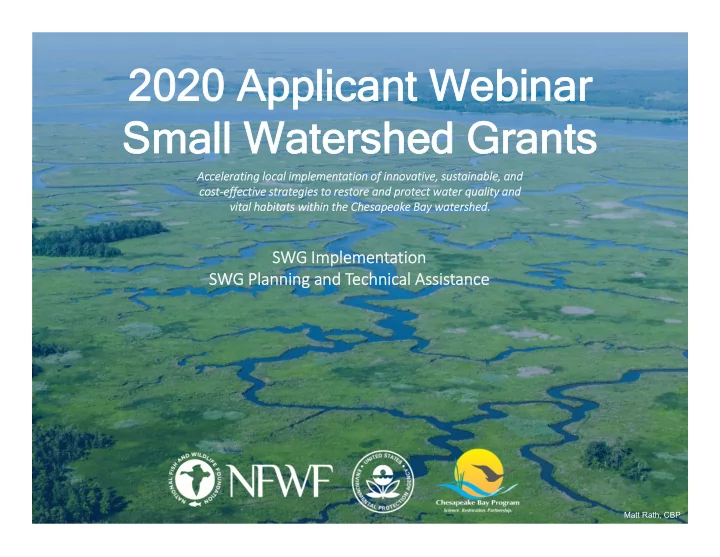
2020 Applicant Webinar Small Watershed Grants Accelerating local implementation of innovative, sustainable, and costeffective strategies to restore and protect water quality and vital habitats within the Chesapeake Bay watershed. SWG


slide-1
SLIDE 1

Accelerating local implementation of innovative, sustainable, and cost‐effective strategies to restore and protect water quality and vital habitats within the Chesapeake Bay watershed.

SWG Implementation SWG Planning and Technical Assistance

2020 Applicant Webinar Small Watershed Grants

Matt Rath, CBP

slide-2
SLIDE 2

1. Webinar Instructions 2. Overview of Chesapeake Bay Stewardship Fund 3. Review of 2020 Small Watershed Grants RFP 4. How to Submit a Proposal Using Easygrants

slide-3
SLIDE 3
  • To improve sound quality, all participants will be

muted for the duration of the webinar. If you want to ask a question you have two options: 1. Enter your query where it says “Enter a question for staff” and click send. Syd will type a response or read your question aloud when we pause for Q&A. 2. Write it down and contact us after the

  • webinar. We have a lot of material to cover, so

you may prefer to have a more in‐depth discussion later.

  • We may ask you to raise your “hand” in the webinar

dialogue box to confirm participants can hear us.

  • If you experience a technical glitch, please type it

into the question box, since we can’t hear you. (We may not know about the glitch unless you say something!)

slide-4
SLIDE 4

Purpose and History

  • Accelerate local restoration actions and

spur innovation in watershed restoration

  • Delivered in partnership with EPA and the

Chesapeake Bay Program

  • 1,200+ grants totaling roughly $158M

and leveraging $238M in additional local matching funds since 1999

Outcomes, 1999‐2019

  • Applied 830,000 acres of best

management practices for nutrient and sediment reduction

  • Removed 1.7 million square feet of

impervious surfaces

  • Engaged over 3 million citizens in

conservation efforts

  • Reduced annual nutrient and sediment

pollution by 26 million pounds and 892 million pounds respectively

slide-5
SLIDE 5

Chesapeake Bay Business Plan

  • Provides a concise blueprint of NFWF’s

targeted conservation outcomes for the Chesapeake Bay

  • Articulates NFWF’s measurable

contributions to goals and outcomes of the Chesapeake Bay Program partnership

2018 Update

  • Improved alignment with 2014

Watershed Agreement goals and

  • utcomes
  • Accounts for existing progress to data
  • Incorporate new data and science to

refine outcomes, strategies, and geographic focus

  • Incorporated into 2019 INSR/SWG RFPs
slide-6
SLIDE 6

Geographic Focus

  • Water Quality: Priority subwatersheds

with significant opportunity to reduce nutrient and sediment loading, specifically from agricultural and urban sources

  • Species and Habitat: Areas where species‐

specific interventions can help to improve habitat and restore populations

  • f Eastern brook trout, Eastern oysters,

American black duck, and river herring, especially within priority subwatersheds

  • NFWF will continue to support activities

in strategic locations that may be outside

  • f priority subwatersheds
  • Visit NFWF mapping portal for more info
slide-7
SLIDE 7

2

slide-8
SLIDE 8

1. Webinar Instructions 2. Overview of Chesapeake Bay Stewardship Fund 3. Review of 2020 Small Watershed Grants RFP 4. How to Submit a Proposal Using EasyGrants

slide-9
SLIDE 9

SWG – Implementation

SWG – Planning & Technical Assistance

(previously Technical Capacity Grants Program)

Grant Size: Between $20,000 and $500,000 Grant Size: Maximum of $50,000 Matching Funds: Non‐federal matching contribution equal to one‐third of grant request required Matching Funds: No match contribution required Eligibility:

Non‐profits, local governments, municipal governments, Indian tribes, and K‐12 educational institutions

Eligibility:

Non‐profits, local governments, municipal governments, Indian tribes, and educational institutions

Duration: 2 years Duration: 1 year Outcome: CBSF on‐the‐ground conservation implementation tied to 2014 Chesapeake Bay Watershed Agreement and NFWF Chesapeake Bay Business Plan Outcome: CBSF conservation objectives and planning tied to 2014 Chesapeake Bay Watershed Agreement and NFWF Chesapeake Bay Business Plan

slide-10
SLIDE 10

Focus Outcome Activity Geographic Focus Water Quality Reduce nitrogen, phosphorus, and sediment pollution to the Chesapeake Bay and its tributary rivers and streams ‐ Improve water quality in agricultural areas by implementing best management practices to reduce polluted runoff Priority Subwatersheds for Water Quality Improvement ‐ Improve water quality in urban and suburban areas by implementing green stormwater infrastructure practices to treat, capture, and/or store stormwater runoff ‐ Restore riparian forest buffer and associated riparian habitat in order to continually increase the capacity of forest buffers to provide water quality and habitat benefits throughout the watershed ‐ Improving the health and function tributary rivers and streams Eastern Brook Trout Maintain and increase Eastern brook trout populations in stronghold patches ‐ Increase habitat integrity in stronghold patches through protection and restoration of riparian areas, stream restoration, nonpoint source pollution controls and land use protections Eastern Brook Trout Patches (Tier I and II) American Black Duck Increase wetland habitat and available food to support wintering black duck populations ‐ Create, restore, or enhance the function of tidal and non‐tidal wetlands to increase black duck carrying capacity through improved food resources Black Duck Priority Subwatersheds (Tier I and II) ‐ Increase available food resources River Herring Restore access and use of high quality migratory river and stream habitat ‐ Implement high priority, cost‐effective connectivity enhancement projects through culvert replacement, fish passage improvements, and dam removal Priority Culverts for River Herring Eastern Oyster Restore oyster populations in priority Chesapeake Bay tributaries ‐ Restore native oyster reefs in targeted tributaries through spat production and reef construction Oyster Restoration Tributaries Capacity and Planning Motivate individuals in the watershed to adopt behaviors that benefit water quality, species, and habitats ‐ Enlist individuals in local volunteer events to restore local natural resources and providing hands‐on education and skill‐building for individual action N/A ‐ Develop or improve conservation, watershed, or habitat management plans that provide guidance to landowners, organizations, or local governments on how to manage properties and communities for improved conservation outcomes

slide-11
SLIDE 11

Steve Droter, CBP

slide-12
SLIDE 12
  • Managing upland

agricultural runoff through farm‐scale conservation systems and solutions.

  • Managing upland urban

runoff through Green Stormwater Infrastructure Improvements (GSI).

  • Accelerating innovation in

watershed management.

Matt Rath, CBP

slide-13
SLIDE 13
  • Restoring riparian habitats through forested buffers,

floodplain and wetland reconnection, and stream restoration and habitat improvements

  • Increasing habitat integrity for eastern brook trout
  • Improving riparian management via livestock exclusion
  • Conserving high‐quality riparian corridors

Steve Droter, CBP

slide-14
SLIDE 14
  • Restoring large‐scale oyster reefs
  • Restoring River Herring habitat connectivity
  • Restoring and conserving wetland and tidal marsh

habitat for American Black Duck

  • Managing shoreline erosion and marsh loss

Leslie Boorhem-Stephenson, CBP

slide-15
SLIDE 15
  • Regional‐Scale Partnership Development
  • Improving delivery of outreach and technical assistance

Chesapeake Bay Program

slide-16
SLIDE 16
  • Assessing local watershed and habitat restoration

needs and opportunities

  • Designing and permitting watershed and habitat

improvements

Will Parson, CBP

slide-17
SLIDE 17

Strategy Recommended Metric

Managing Agricultural and Urban Runoff (all applicable projects)  CBSF ‐ BMP implementation for nutrient or sediment reduction ‐ Lbs N avoided (annually)*  CBSF ‐ BMP implementation for nutrient or sediment reduction ‐ Lbs P avoided (annually)*  CBSF ‐ BMP implementation for nutrient or sediment reduction ‐ Lbs sediment avoided (annually)* Managing Agricultural and Urban Runoff  CBSF ‐ BMP implementation for nutrient or sediment reduction ‐ Acres with BMPs*  CBSF ‐ BMP implementation for stormwater runoff ‐ Acres with BMPs*  CBSF ‐ BMP implementation for stormwater runoff ‐ Volume stormwater prevented Riparian and Freshwater Habitat Restoration, Conservation, and Management  CBSF ‐ Riparian restoration ‐ Miles restored*  CBSF ‐ Instream restoration ‐ Miles restored*  CBSF ‐ Erosion control ‐ Miles restored*  CBSF ‐ BMP implementation for livestock fencing ‐ Miles of fencing installed*  CBSF ‐ Stream restoration ‐ Miles restored*  CBSF ‐ Floodplain restoration ‐ Acres restored  CBSF ‐ Wetland restoration ‐ Acres restored* Estuarine and Tidal Habitat Restoration, Conservation, and Management  CBSF ‐ American oyster ‐ Marine habitat restoration ‐ Acres restored  CBSF ‐ Fish passage improvements ‐ Miles of stream opened  CBSF ‐ Wetland restoration ‐ Acres restored*  CBSF ‐ Erosion control ‐ Miles restored* Building Capacity for Landscape‐Scale Watershed and Habitat Outcomes  CBSF ‐ Outreach/ Education/ Technical Assistance ‐ # people reached  CBSF ‐ Outreach/ Education/ Technical Assistance ‐ # people with changed behavior  CBSF ‐ Volunteer participation ‐ # volunteers participating Watershed and Habitat Planning, Prioritization, Design, and Permitting  CBSF ‐ Management or Governance Planning ‐ # plans developed  CBSF ‐ Outreach/ Education/ Technical Assistance ‐ # people reached  CBSF ‐ Outreach/ Education/ Technical Assistance ‐ # people with changed behavior

* Selected Easygrants metrics should be consistent with data entered into and/or derived from FieldDoc.org.

slide-18
SLIDE 18

To assist applicants in generating credible nutrient and sediment load estimates, NFWF has partnered with Chesapeake Commons and Maryland Department of Natural Resources to develop FieldDoc, a user‐friendly tool that allows consistent planning, tracking, and reporting of selected water quality improvement activities and associated nutrient and sediment load reductions from proposed grant projects. NFWF is hosting a demonstration webinar for FieldDoc on Thurs, March 5th at 10:30 AM EST. Registration for the webinar can be found on NFWF’s RFP page at: nfwf.org/chesapeake

slide-19
SLIDE 19
  • All applicants with active grants from NFWF must be in good standing in terms of

reporting requirements, expenditure of funds, and QAPPs (if required).

  • Applicants will be required to indicate the status of all permits required to

comply with federal, state or local requirements.

  • If projects involve significant environmental monitoring or data

collection/generation, applicants will be asked to develop Quality Assurance Project Plans (QAPPs) as part of their grant. Applicants should budget time and resources to complete this task if appropriate. Budget for it!

  • When procuring goods and services, NFWF recipients must follow documented

procurement procedures which reflect applicable laws and regulations.

Will Parson, CBP

slide-20
SLIDE 20

Small Watershed Grants – Implementation  Eligible applicants include non‐profits, local governments, municipal governments, Indian tribes, and K‐12 educational institutions. × Ineligible applicants include U.S. federal government agencies, state government agencies, institutions of higher education, businesses, unincorporated individuals, and international

  • rganizations.

Small Watershed Grants – Planning and Technical Assistance  Eligible applicants include non‐profits, state government agencies, local governments, municipal governments, Indian tribes, and educational institutions.  Applications submitted by state governments agencies, and post‐secondary educational institutions must document support and/or request for proposed activities by appropriate non‐profit organizations, local and municipal governments, Indian tribes and K‐12 education institutions.  Non‐profit organizations, local and municipal governments, Indian tribes and K‐12 education institutions seeking potential service providers may visit https://www.nfwf.org/programs/chesapeake-bay-stewardship-fund/small- watershed-grants for a listing of technical service providers. × Ineligible applicants include U.S. federal government agencies, unincorporated individuals, for‐profit entities, and international organizations.

slide-21
SLIDE 21

x Projects that seek funding for land or easement acquisition, political advocacy, lobbying or litigation are eligible. x Ongoing efforts to comply with legal requirements (except to improve on baseline compliance, or develop cost‐effective programs to implement MS4 permit requirements). Note regarding policy on indirect: Grantees may only use grant funds for indirect costs if: 1) The grantee organization has a federally‐approved indirect rate; OR 2) They can take the de minimus 10% indirect cost rate without an approved NICRA Direct administrative expenses are allowed.

slide-22
SLIDE 22

SWG‐Implementation proposals will be reviewed, evaluated, and scored based on the extent to which they meet the following criteria:

  • Environmental Results
  • Priority Strategies and Goals
  • Partnership and Community

Engagement

  • Transferability and

Dissemination Plans

  • Technical Merit, Work Plan, and

Budget

Will Parson, CBP

slide-23
SLIDE 23

SWG‐Planning and Technical Assistance proposals will be reviewed, evaluated, and scored based on the extent to which they meet the following criteria:

  • Priority and Overall Context
  • Demonstrated Need
  • Commitment to Implementation
  • Partnership and Community

Engagement

  • Technical Merit, Work Plan, and

Budget

Will Parson, CBP

slide-24
SLIDE 24
  • Proposals Due………………….…………….…….…11:59 PM, April 14th, 2020

(Committee Reviews, Congressional/Board Notification through July)

  • Grants Announced…………………….…………………………………..September
  • Grant Agreements Issued …………………... Likely starting in November

Skyler Ballard, CBP

slide-25
SLIDE 25
slide-26
SLIDE 26

Focus

Chesapeake Bay Innovative Nutrient and Sediment Reduction Chesapeake Bay Small Watershed Grants – Implementation Chesapeake Bay Small Watershed Grants – Planning Pennsylvania Local Government Implementation

Project Focus

Regional‐scale programs, partnerships, and collaboratives capable of scaling up water quality improvements On‐the‐ground actions to protect and restore water quality, species, and habitats in the Bay watershed Enhancing local capacity through assessment, planning, design, and other technical assistance‐oriented activities Rapid implementation of high‐ priority nutrient and sediment load reduction practices in selected Pennsylvania communities

Award Size

$500,000 – 1,000,000 $50,000 – 500,000 Up to $50,000 $20,000 – 200,000

Match Requirements

1:1 One‐third of grant request None 15 percent of grant request

Eligible Applicants

State agencies, post‐secondary institutions, local governments, nonprofits, tribes Local governments, nonprofits, tribes Local governments, nonprofits, tribes Local governments*; state agencies, post‐secondary institutions, nonprofits**

Geographic Focus

Chesapeake Bay Watershed and priority subwatersheds Chesapeake Bay Watershed and priority subwatersheds Chesapeake Bay Watershed and priority subwatersheds Adams, Bedford, Centre, Cumberland, Franklin, Lancaster, Lebanon and York counties

Annual Program Timeline (est.)

  • Jan. – RFP released
  • Feb. – Pre‐proposals due
  • Mar. – Full proposals invited

May – Full proposals due

  • Aug. – Awards announced

Fall – Grants issued

  • Feb. – RFP released
  • Apr. – Proposals due
  • Aug. – Awards announced

Fall – Grants issued

  • Feb. – RFP released
  • Apr. – Proposals due
  • Aug. – Awards announced

Fall – Grants issued

  • Feb. – RFP released
  • Apr. – Proposals due
  • Aug. – Awards announced

Fall – Grants issued * Include counties, municipalities, cities, towns, townships, and boroughs as well as local public authorities or districts (including conservation districts or regional planning commissions/districts ** Working on behalf of local governments
slide-27
SLIDE 27

Jake.Reilly@nfwf.org Sydney.Godbey@nfwf.org Stephanie.Heidbreder@nfwf.org Easygrants@nfwf.org

(202) 857‐0166 | www.nfwf.org/chesapeake

QUESTIONS?

Field Liaison Contact Email Phone Sector Expertise Kristen Saacke Blunk kristen@headwaters-llc.org (814) 360-9766  All Sectors Kristen Hughes Evans kristen@susches.org (804) 544-3457  Agricultural Conservation Liz Feinberg liz.feinberg63@gmail.com (610) 212-2345  All Sectors David Hirschman dave@hirschmanwater.com (434) 409-0993  Stormwater/Urban Sector Katie Ombalski katie@woodswaters.com (814) 574-7281  Agricultural Conservation  Habitat Restoration

slide-28
SLIDE 28

1. Webinar Instructions 2. Overview of Chesapeake Bay Stewardship Fund 3. Review of 2020 Small Watershed Grants RFP 4. How to Submit a Proposal Using Easygrants

slide-29
SLIDE 29
slide-30
SLIDE 30

Please Add a Phone Number!

  • Once you have created your Easygrants

log‐in and or you log‐in as an existing user, please visit review your contact details and make sure that you provide a phone number.

slide-31
SLIDE 31
  • Claire Question -
Question, Claire Chesapeake Bay Small Watershed Grants Implementation 2018 9/4/2018
slide-32
SLIDE 32

Budget Tips

  • Concise Budget Narrative must be included for every line item.
  • Budget should only include the grant amount requested from NFWF
  • Must comply with OMB’s Uniform Guidance:
  • Itemize all costs in appropriate budget categories.
  • Avoid lumping costs i.e., All Materials and Supplies: $10,000.
  • Total Amount Requested in Project Information section must equal the Budget Grand Total in Budget

section

Will Parson, CBP

slide-33
SLIDE 33

Financial and Other Documents

All financial documentation must:

  • Represent the same fiscal

year period

  • be the most recent financial

information available and less than two years old Further details on document requirements and for FAQs visit

  • ur website:

https://www.nfwf.org/apply‐ grant/application‐information

Will Parson, CBP

slide-34
SLIDE 34

Questions?

Jake.Reilly@nfwf.org Stephanie.Heidbreder@nfwf.org Sydney.Godbey@nfwf.org

Chesapeake Bay Program

Carly Siege, CBP