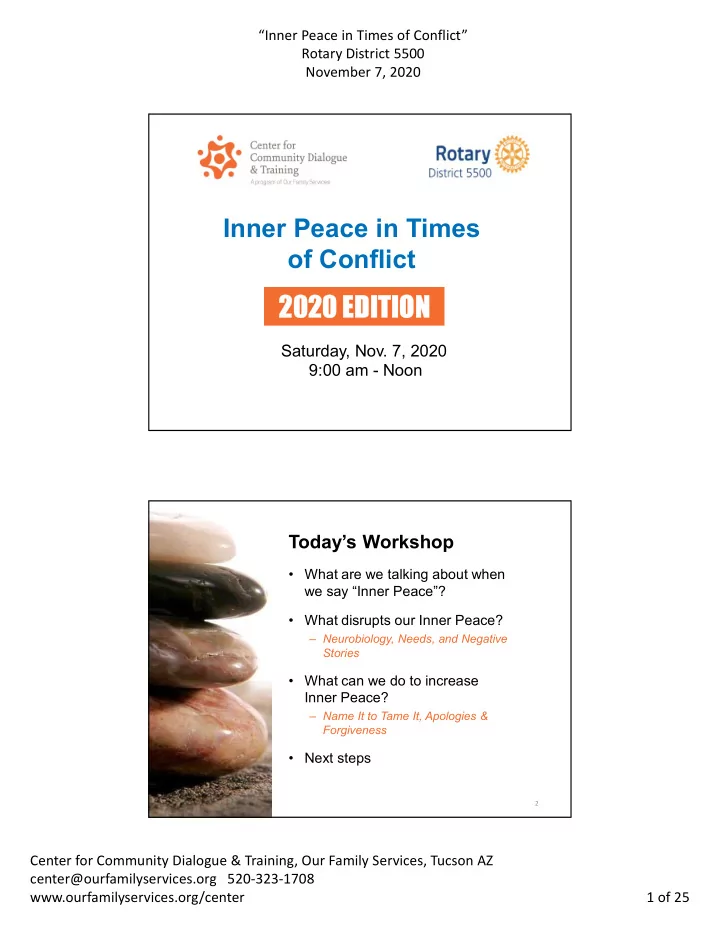
2020 EDITION Saturday, Nov. 7, 2020 9:00 am - Noon Todays Workshop - - PDF document

2020 edition
SMART_READER_LITE
LIVE PREVIEW

2020 EDITION Saturday, Nov. 7, 2020 9:00 am - Noon Todays Workshop - - PDF document

Inner Peace in Times of Conflict Rotary District 5500 November 7, 2020 Inner Peace in Times of Conflict 2020 EDITION Saturday, Nov. 7, 2020 9:00 am - Noon Todays Workshop What are we talking about when we say Inner


slide-1
SLIDE 1

“Inner Peace in Times of Conflict” Rotary District 5500 November 7, 2020 Center for Community Dialogue & Training, Our Family Services, Tucson AZ center@ourfamilyservices.org 520-323-1708 www.ourfamilyservices.org/center 1 of 25

Inner Peace in Times

  • f Conflict

Saturday, Nov. 7, 2020 9:00 am - Noon

2020 EDITION

2

  • What are we talking about when

we say “Inner Peace”?

  • What disrupts our Inner Peace?

– Neurobiology, Needs, and Negative Stories

  • What can we do to increase

Inner Peace?

– Name It to Tame It, Apologies & Forgiveness

  • Next steps

Today’s Workshop

slide-2
SLIDE 2

“Inner Peace in Times of Conflict” Rotary District 5500 November 7, 2020 Center for Community Dialogue & Training, Our Family Services, Tucson AZ center@ourfamilyservices.org 520-323-1708 www.ourfamilyservices.org/center 2 of 25

The Neurobiology of Conflictof

Conflict

Why is it so hard to control my reactions?

slide-3
SLIDE 3

“Inner Peace in Times of Conflict” Rotary District 5500 November 7, 2020 Center for Community Dialogue & Training, Our Family Services, Tucson AZ center@ourfamilyservices.org 520-323-1708 www.ourfamilyservices.org/center 3 of 25

“Reptilian Brain” Humans are wired for survival

The amygdala guards the gate

The Negativity Bias is part

  • f our survival mechanism

Rule #1 in the wild: Eat lunch — don’t BE lunch

6

Your brain is like Velcro for negative experiences but Teflon for positive ones.

Rick Hanson - Hardwiring Happiness

slide-4
SLIDE 4

“Inner Peace in Times of Conflict” Rotary District 5500 November 7, 2020 Center for Community Dialogue & Training, Our Family Services, Tucson AZ center@ourfamilyservices.org 520-323-1708 www.ourfamilyservices.org/center 4 of 25

Triggers to safety

FIGHT

8

FREEZE Flight

When the amygdala senses a threat, it has only a few possible responses:

FAWN

slide-5
SLIDE 5

“Inner Peace in Times of Conflict” Rotary District 5500 November 7, 2020 Center for Community Dialogue & Training, Our Family Services, Tucson AZ center@ourfamilyservices.org 520-323-1708 www.ourfamilyservices.org/center 5 of 25

The amygdala has the emotional maturity of a 9-to-18- month-old.

IQ goes down

slide-6
SLIDE 6

“Inner Peace in Times of Conflict” Rotary District 5500 November 7, 2020 Center for Community Dialogue & Training, Our Family Services, Tucson AZ center@ourfamilyservices.org 520-323-1708 www.ourfamilyservices.org/center 6 of 25

90

Some good news… The neurobiological response passes in about 90 seconds.

Opening Activity

12

THREE. BREATHS. DEEP.

slide-7
SLIDE 7

“Inner Peace in Times of Conflict” Rotary District 5500 November 7, 2020 Center for Community Dialogue & Training, Our Family Services, Tucson AZ center@ourfamilyservices.org 520-323-1708 www.ourfamilyservices.org/center 7 of 25

What Triggers Us?

Sometimes it’s a threat to our physical survival…

…but often it’s a threat to our sense of self. The amygdala treats threats to identity as threats to survival.

“The strengths that have helped you to succeed are also your greatest emotional triggers when you feel someone is not honoring what makes you special.”

Marcia Reynolds, Ph.D. www.outsmartyourbrain.com

Threats to Identity

slide-8
SLIDE 8

“Inner Peace in Times of Conflict” Rotary District 5500 November 7, 2020 Center for Community Dialogue & Training, Our Family Services, Tucson AZ center@ourfamilyservices.org 520-323-1708 www.ourfamilyservices.org/center 8 of 25

Six Core Identities

  • Competence
  • Autonomy
  • Fellowship
  • Status
  • Reliability
  • Integrity

Stella Ting-Toomey

Triggering Behaviors

“What are you

getting so upset about?“

Adapted from Mathew McKay, Ph.D., Peter

  • D. Rogers, Ph.D., Judith McKay, R.N
slide-9
SLIDE 9

“Inner Peace in Times of Conflict” Rotary District 5500 November 7, 2020 Center for Community Dialogue & Training, Our Family Services, Tucson AZ center@ourfamilyservices.org 520-323-1708 www.ourfamilyservices.org/center 9 of 25

Verbal Behaviors

Accusations Advice Blame Complaining Criticism

Silence Stereotyping Teasing Threats Ultimatums

Guilt trips “Innocent comments” Profanity Sarcasm

  • Groaning
  • Sighing
  • Tsk-ing
  • Snickering
  • Snorting
  • Flat
  • Cold
  • Loud
  • Tense
  • Whining

TONE of VOICE

SOUNDS

  • Mocking
  • Patronizing
  • Mumbling
  • Sarcastic
slide-10
SLIDE 10

“Inner Peace in Times of Conflict” Rotary District 5500 November 7, 2020 Center for Community Dialogue & Training, Our Family Services, Tucson AZ center@ourfamilyservices.org 520-323-1708 www.ourfamilyservices.org/center 10 of 25

Body Language

  • Pointing finger
  • Shaking fist
  • Waving hands
  • Obscene gestures
  • Crossed arms
  • Shaking head
  • Shrugging
  • Tapping foot
  • Pacing
  • Turning away

Gestures Movements

Facial Expressions

Eyes

  • Rolled
  • Narrowed
  • Wide
  • Closed
  • Side
  • Raised eyebrows

Mouth

  • Sneer
  • Grimace
  • Tight lips
  • Pursed lips
  • Scowl
slide-11
SLIDE 11

“Inner Peace in Times of Conflict” Rotary District 5500 November 7, 2020 Center for Community Dialogue & Training, Our Family Services, Tucson AZ center@ourfamilyservices.org 520-323-1708 www.ourfamilyservices.org/center 11 of 25

FIGHT

21

FREEZE Flight

When the amygdala is triggered by a perceived threat to identity, here’s what it does:

BLAME

Leave, avoid

People pleasing

Shut down, check out

FAWN

Why do we sometimes STAY triggered – even after 90 seconds?

When a person has a reaction to something in their environment, there is a 90-second chemical process that happens in the body; after that, any remaining emotional response is just the person choosing to stay in that emotional loop. Jill Bolte Taylor

slide-12
SLIDE 12

“Inner Peace in Times of Conflict” Rotary District 5500 November 7, 2020 Center for Community Dialogue & Training, Our Family Services, Tucson AZ center@ourfamilyservices.org 520-323-1708 www.ourfamilyservices.org/center 12 of 25

Three Negative Stories Everybody Tells

And the THEORIES that explain them

Attribution Theory Assigning only the best and most pure motives for

  • urselves, while being

suspicious and distrustful of the motives of others.

AKA “The Fundamental Error of Attribution”

#1 The Blame Story

slide-13
SLIDE 13

“Inner Peace in Times of Conflict” Rotary District 5500 November 7, 2020 Center for Community Dialogue & Training, Our Family Services, Tucson AZ center@ourfamilyservices.org 520-323-1708 www.ourfamilyservices.org/center 13 of 25

Projection Theory

Because of our pure motives, we can’t tolerate our shortcomings. We project them out onto others and accuse them of the very things we do or think.

#2 The Judgment Story

Justification Theory

Creating the correct and right story that best fits our perspective. Gathering facts, evidence, & sympathizers to justify our side of the story. Telling the story over and over to solidify the neural pathways.

#3 The ‘I’m Right’ Story

slide-14
SLIDE 14

“Inner Peace in Times of Conflict” Rotary District 5500 November 7, 2020 Center for Community Dialogue & Training, Our Family Services, Tucson AZ center@ourfamilyservices.org 520-323-1708 www.ourfamilyservices.org/center 14 of 25

Stop telling negative stories

Noticing & Changing Our Negative Stories

  • Three. Deep. Breaths.
  • Acknowledge the story but turn it off

until you’re calmer

  • “I’m telling myself that…”
  • Name your feelings and needs
slide-15
SLIDE 15

“Inner Peace in Times of Conflict” Rotary District 5500 November 7, 2020 Center for Community Dialogue & Training, Our Family Services, Tucson AZ center@ourfamilyservices.org 520-323-1708 www.ourfamilyservices.org/center 15 of 25

Feelings & Needs

FEELING NEED

Identifying Feelings and Needs

Marshall Rosenberg

Center for Nonviolent Communication

Website: www.cnvc.org Email: cnvc@cnvc.org

slide-16
SLIDE 16

“Inner Peace in Times of Conflict” Rotary District 5500 November 7, 2020 Center for Community Dialogue & Training, Our Family Services, Tucson AZ center@ourfamilyservices.org 520-323-1708 www.ourfamilyservices.org/center 16 of 25

Afraid Angry Annoyed Anxious Ashamed Awkward Bitter Bored Calm Conflicted Confused Content Curious Depressed Disappointed Discouraged Disgusted Distant Embarrassed Empathetic Exhausted Foolish Frustrated Grief Guilty Hopeless Hurt Impatient Insecure Isolated Jealous Lonely Lost Miserable Numb Overwhelmed Reflective Regret Restless Sad Sensitive Surprised Tense Tired Uncomfortable Unhappy Vulnerable Worried

FEELING WORDS

(See your Feelings- Needs Handout) NEED WORDS

32

Physiological Safety Social Belonging Esteem Self- Actualization Newness Patience Peace Positivity Realness Recognition Resolution Respect Rest Safety Security Sharing Space Support Time To feel heard Trust Understanding Validation Affection Appreciation Balance Beauty Belonging Boundaries Care Challenge Choice Comfort Community Compassion Confidence Connection Consideration Consistency Dependability Excitement Expression Fairness Freedom Growth Honesty Independence Inspiration Joy Kindness Knowledge Love Meaning Motivation

slide-17
SLIDE 17

“Inner Peace in Times of Conflict” Rotary District 5500 November 7, 2020 Center for Community Dialogue & Training, Our Family Services, Tucson AZ center@ourfamilyservices.org 520-323-1708 www.ourfamilyservices.org/center 17 of 25

When You – or Someone Else – Is Triggered: Name It to Tame It

  • Denying our feelings keeps us triggered.
  • Naming our feelings engages the pre-frontal

cortex – the “thinking brain”

  • Naming emotions gives us greater control and

understanding.

  • Compassionately naming another’s emotions

helps them feel heard and understood, which is calming.

  • Go beyond feelings and identify needs to get to

the root of the problem.

Name It to Tame It

  • Recognize intense

emotional response

  • Gently name it
  • Wait
  • Guess at the needs

that may underlie the emotion

34

slide-18
SLIDE 18

“Inner Peace in Times of Conflict” Rotary District 5500 November 7, 2020 Center for Community Dialogue & Training, Our Family Services, Tucson AZ center@ourfamilyservices.org 520-323-1708 www.ourfamilyservices.org/center 18 of 25

Apology & Forgiveness

35

Danger of a Partial Apology

A study on apologies offered test subjects a cash settlement in a hypothetical automobile

  • accident. They found that if the driver gave:
  • A full apology: 73% accepted offer
  • "The accident was all my fault. I was

going too fast and not watching where I was going.”

  • A partial apology: 35% accepted
  • ffer
  • "I am so sorry that you were hurt. I

hope you feel better soon.”

  • No apology: 52% accepted offer

36

slide-19
SLIDE 19

“Inner Peace in Times of Conflict” Rotary District 5500 November 7, 2020 Center for Community Dialogue & Training, Our Family Services, Tucson AZ center@ourfamilyservices.org 520-323-1708 www.ourfamilyservices.org/center 19 of 25

Botched Apologies

  • Offering a vague
  • r incomplete

apology: “I apologize for whatever I did.”

  • Use of the passive

voice: “Mistakes were made.”

37

Botched Apologies

  • Conditional

apology: “I’m sorry if mistakes were made.”

  • Questioning

whether the victim was actually harmed: “I’m sorry if anyone was hurt.”

38

slide-20
SLIDE 20

“Inner Peace in Times of Conflict” Rotary District 5500 November 7, 2020 Center for Community Dialogue & Training, Our Family Services, Tucson AZ center@ourfamilyservices.org 520-323-1708 www.ourfamilyservices.org/center 20 of 25

Botched Apologies

  • Minimizing the offense: “There is

really nothing (or very little) to apologize for.”

  • Using an empathic apology: “I’m sorry

if you are upset with me.”

  • Apologizing for the wrong offense or

to the wrong party. “Hey Joe, I’m really sorry about what happened with Dave.”

39

How Apologies Heal

  • Restoration of self

respect and dignity

  • Assurance that

both parties have shared values

40

  • Assurance that the offenses

were not their fault

slide-21
SLIDE 21

“Inner Peace in Times of Conflict” Rotary District 5500 November 7, 2020 Center for Community Dialogue & Training, Our Family Services, Tucson AZ center@ourfamilyservices.org 520-323-1708 www.ourfamilyservices.org/center 21 of 25

How Apologies Heal

  • Assurance that the

party is safe from a repeat offense

  • Seeing the offender

repent

  • Reparation for the

harm done

  • Having meaningful

dialogue with the

  • ffender

41

Apology: Four Elements

  • 1. Acknowledgement of the offense
  • 2. Communicating remorse, shame,

and guilt

  • 3. Offering reparation
  • 4. Offering an explanation

On Apology, Aaron Lazare

42

slide-22
SLIDE 22

“Inner Peace in Times of Conflict” Rotary District 5500 November 7, 2020 Center for Community Dialogue & Training, Our Family Services, Tucson AZ center@ourfamilyservices.org 520-323-1708 www.ourfamilyservices.org/center 22 of 25

Example of an Effective Apology

I’m sorry that I snapped at you during dinner preparations. I’m frustrated with my boss and I directed some of that frustration toward you, which you didn’t deserve. It wasn’t fair. I’m really sorry I hurt you. You’re important to me and I appreciate all you do to enrich

  • ur lives -- including making meals.

How can I make it up to you?

slide-23
SLIDE 23

“Inner Peace in Times of Conflict” Rotary District 5500 November 7, 2020 Center for Community Dialogue & Training, Our Family Services, Tucson AZ center@ourfamilyservices.org 520-323-1708 www.ourfamilyservices.org/center 23 of 25

Forgiveness

“Giving up rage,

the desire for vengeance, and a grudge

toward those who have inflicted grievous harm on you, your loved ones, or the groups with whom you identify.”

Morton Deutsch

Forgiveness

  • Healthier relationships
  • Improved mental health
  • Less anxiety, stress and

hostility

  • Lower blood pressure

MayoClinic.org

  • Fewer symptoms of

depression

  • A stronger immune

system

  • Improved heart health
  • Improved self-esteem

Letting go of grudges and bitterness can make way for improved health and peace of mind. Forgiveness can lead to:

slide-24
SLIDE 24

“Inner Peace in Times of Conflict” Rotary District 5500 November 7, 2020 Center for Community Dialogue & Training, Our Family Services, Tucson AZ center@ourfamilyservices.org 520-323-1708 www.ourfamilyservices.org/center 24 of 25

How do I reach a state of forgiveness?

  • Acknowledge your

emotions about the harm done to you and how these feelings affect your behavior.

MayoClinic.org

  • Identify what needs healing

and who needs to be forgiven and for what.

  • Choose to forgive the

person who's offended you.

  • Get support from someone

you trust.

Forgiveness is a personalized process of change. To move from suffering to forgiveness, you might:

Opening Activity

48

THREE. BREATHS. DEEP.

slide-25
SLIDE 25

“Inner Peace in Times of Conflict” Rotary District 5500 November 7, 2020 Center for Community Dialogue & Training, Our Family Services, Tucson AZ center@ourfamilyservices.org 520-323-1708 www.ourfamilyservices.org/center 25 of 25

The Center for Community Dialogue & Training

  • Facilitation
  • Training
  • Community

Forums

49

  • General

Mediation

  • Eldercare &

Family Mediation

  • Dialogue Circles

center@ourfamilyservices.org 520.323.1708 ext. 422