3/1/16 February 29, 2016 How do we get the biological signal - - PDF document

3 1 16
SMART_READER_LITE
LIVE PREVIEW

3/1/16 February 29, 2016 How do we get the biological signal - - PDF document

3/1/16 February 29, 2016 How do we get the biological signal to the electronics? Resting membrane potential Electrical noise Resting Potential Intracellular Extracellular direct


slide-1
SLIDE 1

3/1/16 1

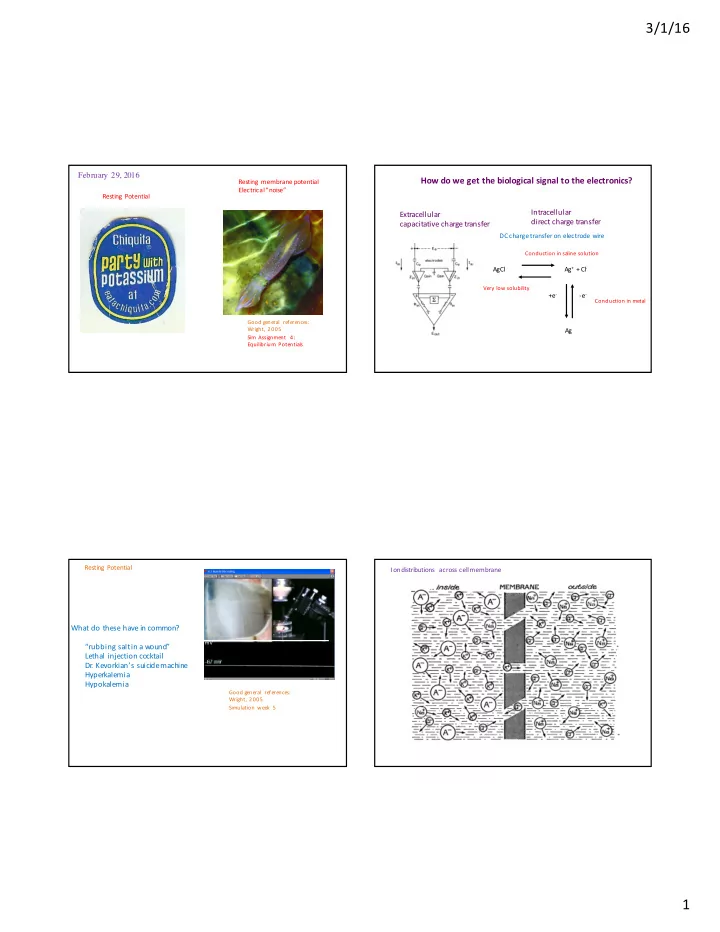
Resting ¡membrane ¡potential Electrical ¡“noise”

February 29, 2016

Resting ¡Potential

Good ¡general ¡ references: Wright, ¡ 2005 Sim Assignment ¡ 4: ¡ Equilibrium ¡ Potentials ¡

AgCl Ag+ + ¡Cl-­‑ Ag +e-­‑

  • ­‑e-­‑

Conduction ¡in ¡metal Conduction ¡in ¡saline ¡ solution

DC ¡charge ¡transfer ¡on ¡electrode ¡wire

Extracellular capacitative charge ¡transfer Intracellular direct ¡charge ¡transfer

Very ¡ low ¡solubility

How ¡do ¡we ¡get ¡the ¡biological ¡signal ¡to ¡the ¡electronics?

What ¡do ¡these ¡have ¡in ¡common? “rubbing ¡salt ¡in ¡a ¡wound” Lethal ¡injection ¡cocktail Dr . ¡Kevorkian’s ¡suicide ¡machine Hyperkalemia Hypokalemia

Resting ¡Potential

O ¡ mV Good ¡general ¡ references: Wright, ¡ 2005 Simulation ¡ week ¡ 5

Ion ¡distributions ¡ across ¡cell ¡membrane ¡

slide-2
SLIDE 2

3/1/16 2

Ionic ¡basis ¡ of ¡the ¡resting ¡ potential 1) ¡Unequal ¡ distribution ¡ of ¡ion ¡species ¡across ¡membrane Donnan Equilibrium

What ¡happens ¡if ¡we ¡open ¡pores ¡in ¡the ¡membrane permeable ¡to ¡K+? See ¡tutorials ¡below

https://www.youtube.com/watch?v=hLAS-­‑ jK6Ekc http://www.youtube.com/watch?v=MhSfQio8 mp0 https://www.youtube.com/watch?v=t7Gr_tmS hm4&ebc=ANyPxKrG-­‑ b6qFYIeDlb4TOqIx1Q8eGnSWWVaszHXCZiTLcH A2gGJklrkKzvrHDvvs924gIZaXrs5PY9yYyCb2nH VWgAXMr_CFA https://www.youtube.com/watch?v=ei__S8gM raU&ebc=ANyPxKrG-­‑ b6qFYIeDlb4TOqIx1Q8eGnSWWVaszHXCZiTLcH A2gGJklrkKzvrHDvvs924gIZaXrs5PY9yYyCb2nH VWgAXMr_CFA Donnan Equilibrium

What ¡happens ¡to ¡the ¡relative ¡voltage ¡differences ¡between ¡outside ¡and ¡inside when ¡K+ ¡goes ¡out? 2) ¡Selective ¡permeability ¡of ¡ion ¡species through ¡membrane

Donnan Equilibrium

When ¡will ¡the ¡voltage ¡change ¡stop?

slide-3
SLIDE 3

3/1/16 3

At ¡Nernst ¡Potential: ¡ K+ ¡experiment

Why ¡does ¡the ¡line ¡deviate ¡from ¡the ¡K theoretical ¡values ¡at ¡lower ¡[K]? ¡

Squid ¡giant ¡axon-­‑ a ¡model ¡prep

slide-4
SLIDE 4

3/1/16 4

Squid ¡giant ¡axon-­‑ RP ¡experiment Squid ¡giant ¡axon-­‑ membrane ¡prep

40,000 ¡APs ¡can ¡fire!

Squid ¡giant ¡axon-­‑ experimental ¡chamber Results-­‑ K: ¡RP ¡relationship “normal”

slide-5
SLIDE 5

3/1/16 5

Most ¡neurons ¡have ¡a ¡resting ¡potential ¡more ¡depolarized ¡ than ¡ Keq Potential. ¡ ¡Why ¡is ¡that? At ¡Rest: ¡gK50X ¡> ¡gNA At ¡Rest: ¡ ¡INa = ¡IK? At ¡Rest: ¡ ¡INa = ¡IK? V=IR IK ¡= ¡gK (Vm-­‑EK) ¡ ¡ ¡ ¡ ¡ ¡ ¡ ¡ ¡ ¡INa = ¡gNa (Vm-­‑ENa) gK(Vm-­‑EK) ¡= ¡gNa (Vm-­‑ENa) Other ¡contributions ¡ to ¡RP? Membrane ¡Model ¡ at ¡Rest Dynamic ¡membrane ¡conductancesmanipulate the ¡RP . ¡ ¡ ¡Better ¡described ¡by ¡this ¡equation.

slide-6
SLIDE 6

3/1/16 6

Example ¡of ¡Changes ¡in ¡“ ¡RP” ¡by ¡changing ¡ionic ¡conductances

g3 g4 s3 s3 s4 s4 sw sw sw sw sf sf

n3 n3 n1 n1 n2 n2 n1 n2 n2 n1 n3 n3 n3 n3

ma ma vnc g3 g4 s3 s3 s4 s4 sw sw sw sw sf sf

n3 n3 n1 n1 n2 n2 n1 n2 n2 n1 n3 n3 n3 n3

ma ma vnc

Methylene bluestain: ventral nerve cord, vnc; ganglionic nerves (n1, n2, n3);sf muscle

Crayfish superficial flexor muscle