3/22/18 Decreasing Barriers to Education and Employment for - - PDF document

3 22 18
SMART_READER_LITE
LIVE PREVIEW

3/22/18 Decreasing Barriers to Education and Employment for - - PDF document

3/22/18 Decreasing Barriers to Education and Employment for Adults with Autism Spectrum Disorder Lynn Kern Koegel, PHD Robert L. Koegel, PHD Kristen Ashbaugh, PHD Autism on Autism is a continuum/spectrum the Rise disorder


slide-1
SLIDE 1

3/22/18 ¡ 1 ¡

Lynn Kern Koegel, PHD Robert L. Koegel, PHD Kristen Ashbaugh, PHD

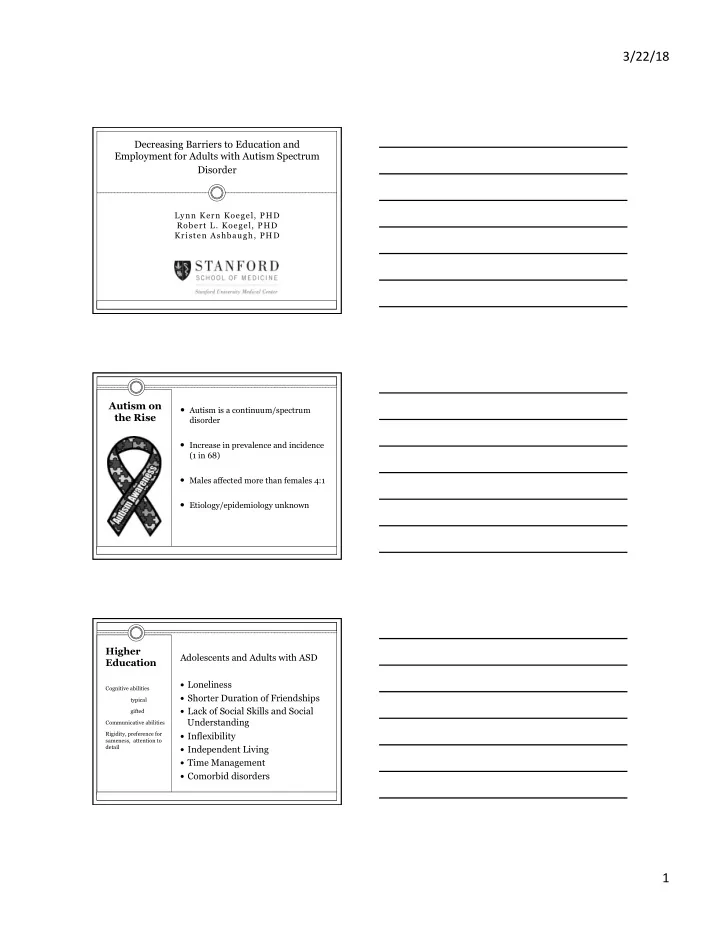
Decreasing Barriers to Education and Employment for Adults with Autism Spectrum Disorder Autism on the Rise

  • Autism is a continuum/spectrum

disorder

  • Increase in prevalence and incidence

(1 in 68)

  • Males affected more than females 4:1
  • Etiology/epidemiology unknown

Higher Education

Cognitive abilities typical gifted Communicative abilities Rigidity, preference for sameness, attention to detail

Adolescents and Adults with ASD

— Loneliness — Shorter Duration of Friendships — Lack of Social Skills and Social

Understanding

— Inflexibility — Independent Living — Time Management — Comorbid disorders

slide-2
SLIDE 2

3/22/18 ¡ 2 ¡

Why is support for employment important?

l Individuals with autism tend to work fewer hours

and earned lower wages per week than nearly all

  • ther groups (Cimera & Cowan, 2009)

l Currently, few support systems exist to assist

individuals with ASD in finding employment

l Employment leads to increases in cognition

unemployment leads to decreases

l Employment leads to improvements in Mental

Health and Socialization

Pre-Employment Targets and Interventions

Communication Skills

— Conversation Skills

¡ Question-asking ¡ Greetings/Goodbyes ¡ Appropriate detail ¡ Topics of mutual interest ¡ Empathy

— Nonverbal communication

¡ Eye contact ¡ Posture ¡ Facial expression

slide-3
SLIDE 3

3/22/18 ¡ 3 ¡

Techniques for improving communication

— Video based interventions — Visual framework — Self management — Clinician modeling

Video Feedback Intervention

¡ Video Feedback: view and evaluate previous performance

(Mechling, 2005; Maione & Mirenda, 2006; Rayner, Denholm, & Sigafoos, 2009)

÷ Good Examples ÷ “Needs Improvement” Examples

¡ Combination of one or more of these models with other

interventions, i.e. self-management

Visual framework for appropriate detail — Possible strength in visual perception (Grandin, 1995;

Boucher & Lewis, 1989; Quill, 1995).

¡ Visual method of thinking

— Visual components combined with other

interventions, i.e. self-management

slide-4
SLIDE 4

3/22/18 ¡ 4 ¡

Sample visual framework: Appropriate detail

Respond ¡

Add ¡ ¡ ¡1-­‑2 ¡ pieces ¡of ¡ ¡ ¡ ¡ ¡ ¡ ¡ ¡ ¡ Information

Question ¡

Positive Reframing

— Intervention

¡ Video Feedback ¡ Self-Management

Example: “I had a terrible weekend, I didn’t do anything.” Reframed: “I didn’t do much over the weekend, but got to relax.” Example: “I hate it when my brother leaves after the holidays and I can’t see him anymore.” Reframed: “I love seeing my brother and look forward to the holidays when we get to spend time together.”

slide-5
SLIDE 5

3/22/18 ¡ 5 ¡

Independent Living Skills:

Daily Living Checklist — Weekly checklist - Self management

¡ Professional Skills ¡ Independent Living Skills ¡ Social Behavior

— Individualized for each client — Flexible and adaptable for ability levels and target

behaviors

Sample weekly checklist

slide-6
SLIDE 6

3/22/18 ¡ 6 ¡

Sample weekly checklist

Structured Social Planning to Increase Socialization with Peers

1.

Social Planning

1.

Motivational interests are identified

2.

Clinician creates a menu of at least three social activities based

  • n participant’s interests

3.

Client selects activity

4.

Clinician assists in planning of the activity 2.

Organizational skills

1.

Use of daily planner to document time, place, and activity for the week 3.

Social Support

1.

Clients given the option to have a similar age peer attend the activity with them for additional support

2.

Peer mentor will model and provide feedback on client’s socialization during activity

jc ballroom dance.mov

slide-7
SLIDE 7

3/22/18 ¡ 7 ¡

Structured Social Activities Improved Socialization with Peers Employment Improved GPA Dating Mental Health Reported Confidence Decreased Anxiety & Depression

slide-8
SLIDE 8

3/22/18 ¡ 8 ¡

Collateral benefits of employment

Quality of life Contribution to society Independence Co-morbid disorders Long-term cost of services Parental stress

slide-9
SLIDE 9

3/22/18 ¡ 9 ¡

Summary

— Multi-Component interventions for improving

Socialization and success at work or college

— Interventions such as Self-Management, Video-

Modeling, and Feedback are effective

— Positive Collateral Gains when targeting social

Thank you!

— Department of Rehabilitation — Eli and Edythe L. Broad

Foundation

— Graduate Students — Undergraduate Research

Assistants

— Families who participate in our

research

Lynnk@Stanford.edu