SLIDE 1 NOTE: These slides contain both Sections 3.1 and 3.2.
3.3 Cramer’s Rule, Volume, and Linear Transformations
McDonald Fall 2018, MATH 2210Q, 3.3 Slides 3.3 Homework: Read section and do the reading quiz. Start with practice problems. ❼ Hand in: TBD. ❼ Recommended: TBD.
3.3.1 Cramer’s rule
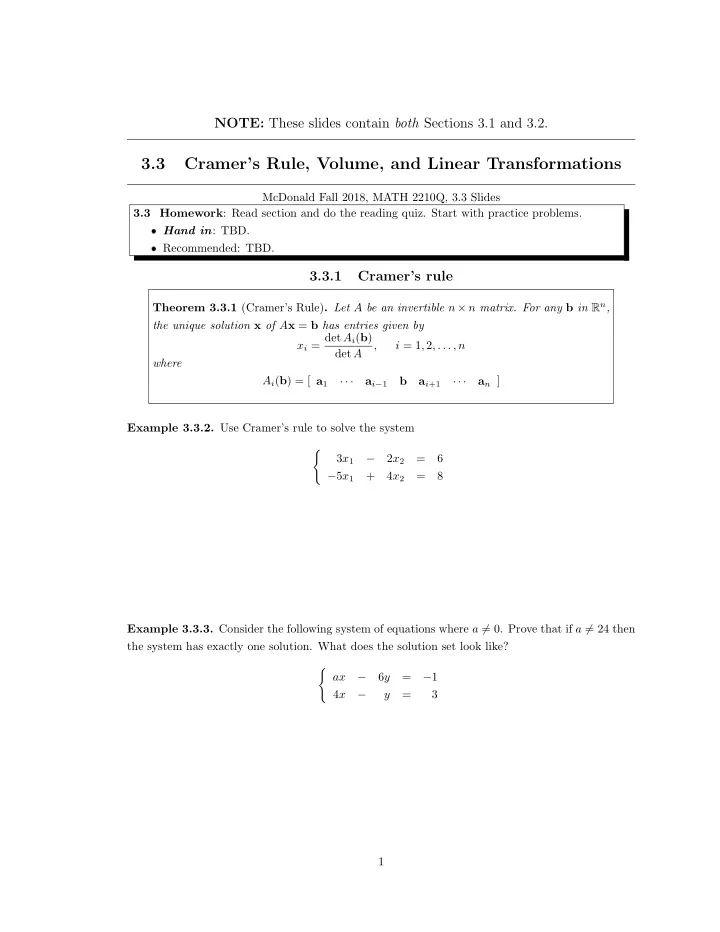
Theorem 3.3.1 (Cramer’s Rule). Let A be an invertible n × n matrix. For any b in Rn, the unique solution x of Ax = b has entries given by xi = det Ai(b) det A , i = 1, 2, . . . , n where Ai(b) = [ a1 · · · ai−1 b ai+1 · · · an ] Example 3.3.2. Use Cramer’s rule to solve the system
− 2x2 = 6 −5x1 + 4x2 = 8 Example 3.3.3. Consider the following system of equations where a = 0. Prove that if a = 24 then the system has exactly one solution. What does the solution set look like?
− 6y = −1 4x − y = 3 1
SLIDE 2 Definition 3.3.4. The adjugate (or classical adjoint) of A, is adj(A) = C11 C12 · · · C1n C21 C22 · · · C2n . . . . . . . . . Cn1 Cn2 · · · Cnn
T
= C11 C21 · · · Cn1 C12 C22 · · · Cn2 . . . . . . . . . C1n C2n · · · Cnn . Where Cij = (−1)i+j det Aij. Theorem 3.3.5 (Inverse Formula). Let A be an invertible n × n matrix. Then A−1 = 1 det A adj A. Example 3.3.6. Find the inverse of the matrix A = 2 1 3 1 −1 1 1 4 −2 Remark 3.3.7. This formula for the inverse is really useful for theoretical calculations, but in almost all cases, our algorithm of reducing to the identity is much more efficient. 2
SLIDE 3
3.3.2 Determinants as Area or Volume
Theorem 3.3.8. If A is a 2 × 2 matrix, then the area of the parallelogram determined by the columns of A is | det A|. If A is a 3 × 3 matrix, then the volume of the parallelepiped determined by the columns of A is | det A|. Example 3.3.9. Calculate the area of the parallelogram with vertices (0, 0), (1, 2), (2, 3) and (3, 5). Example 3.3.10. Find the area of the parallelogram with vertices (−2, −2), (0, 3), (4, −1) and (6, 4). 3
SLIDE 4
Example 3.3.11. Find the area of the parallelepiped with one vertex at the origin, and adjacent vertices (1, 0, −1), (4, 5, 6), (7, 3, 9). Example 3.3.12. Find the area of the triangle with vertices (1, 2), (4, 3), and (3, 5). 4
SLIDE 5 3.3.3 Linear Transformations
Theorem 3.3.13. Let T : R2 → R2 be the linear transformation determined by a 2 × 2 matrix A. If S is a parallelogram in R2, then {area of T(S)} = | det A| · {area of S} If T : R3 → R3 is a linear transformation determined by a 3 × 3 matrix A, and S is a parallelepiped in R3, then {volume of T(S)} = | det A| · {volume of S} Let S be the parallelogram determined by the vectors b1 =
3
1
be a linear transformation with standard matrix A =
2 5
5
SLIDE 6
3.3.4 Additional Notes and Problems
6