SLIDE 1 #3: Satellites
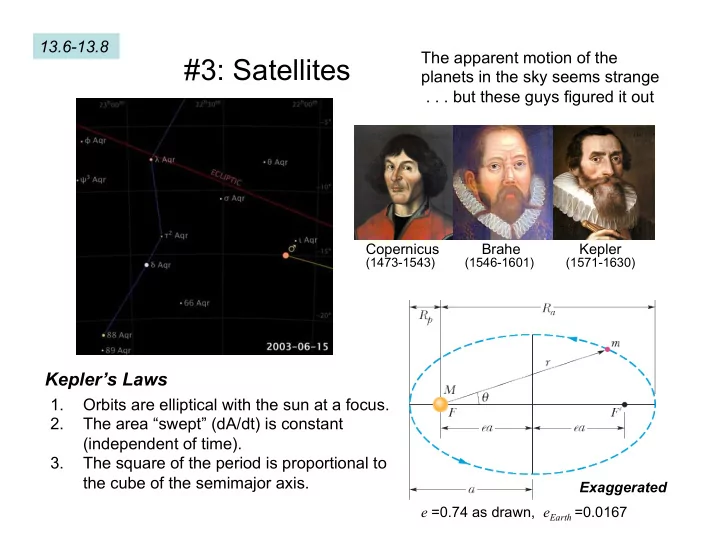
13.6-13.8 The apparent motion of the planets in the sky seems strange . . . but these guys figured it out
Brahe Kepler
(1571-1630) (1546-1601)
Kepler’s Laws
1. Orbits are elliptical with the sun at a focus. 2. The area “swept” (dA/dt) is constant (independent of time). 3. The square of the period is proportional to the cube of the semimajor axis.
Copernicus
(1473-1543)
Exaggerated e =0.74 as drawn, eEarth =0.0167
SLIDE 2 Newton showed that Kepler’s Laws all follow from:
Newton
(1642-1727)
F = G Mm r2 ˆ r
F = m a
and
ΔA = 1 2 r rΔθ
( )
dA dt = 1 2 r2 dθ dt = 1 2 r2ω Kepler’s 2nd Law is equivalent to conservation of angular momentum 2. The area “swept” (dA/dt) is constant (independent of time).
L = rp⊥ = rmv⊥ = rmωr = mr2ω dA dt = L 2m
SLIDE 3 Newton
(1642-1727)
3. The square of the period is proportional to the cube of the semimajor axis.
G M r2 = 2π
( )
2
T 2 r
For a circular orbit: Recall that ω = 2π
T
T 2 = 4π 2 GM r3
The same results if found for an ellipse with r → a
T 2 = 4π 2 GM a3 G M r2 =ω 2r
SLIDE 4
Energy conservation
U = − gMm r
Circular orbit: r, U, v, K are constant But Only E is constant
r↓ U ↓ K ↑ v↑
G M r2 =ω 2r = 2K mr K = GMm 2r E = K +U = −K = U 2 = −GMm 2r
(circular orbit)
E = −GMm 2a
For eliptic orbit
r↑ U ↑ K ↓ v↓
SLIDE 5 F
g = G Mm
r2 ˆ r
F = m a
and
ag = G M r2 ˆ r
Einstein’s General Theory of Relativity is based on this Principle of Equivalence Why are the m’s in these equations the same? Gravity and accleration are fundamentally equivalent This implies that even
are influenced by gravity, e.g. deflecting light Einstein’s Theory also predicted the gravitational waves, just observed this year with LIGO
SLIDE 6
But there is still much we don’t understand about gravity A unified theory (“Standard Model”) describes all other forces in terms of particles (quantum mechanics), but there is no successful quantum theory of gravity.
Dark Matter: 21% of the gravity that is observed
comes from an unknown kind of matter Experiments like the Large Underground Xenon (LUX) detector are searching for dark matter The universe is expanding at a rapid rate not explained by general relativity. Unknown source of “dark” energy pushing expansion? General Theory of Relativity wrong?
SLIDE 7
A satellite, moving in an elliptical orbit, is 360 km above Earth's surface at its farthest point and 180 km above at its closest point. Calculate (a) the semimajor axis and (b) the eccentricity of the orbit.
SLIDE 8
A satellite is in a circular Earth orbit of radius r. The area A enclosed by the orbit depends on r2 because A=πr2. Determine how the following properties of the satellite depend on r: (a) period (b) kinetic energy, (c) angular momentum, and (d) speed.