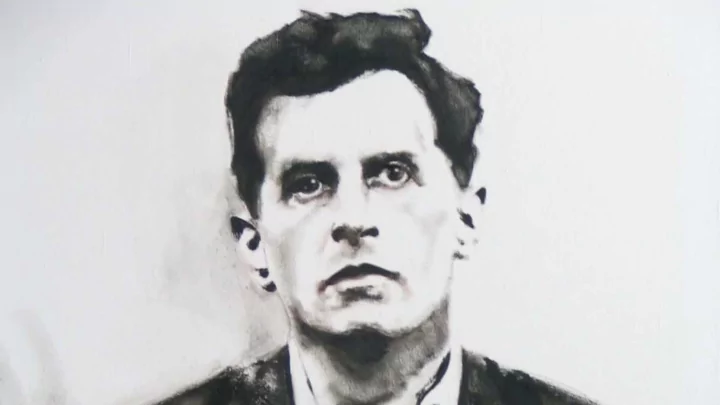
SLIDE 1
SLIDE 2
SLIDE 3
- 309. What is your aim in philosophy?
a To show the fly the way out of the fly-bottle.
—Wittgenstein, Philosophical Investigations, §309
SLIDE 4
There is not a single philosophical method, though there are indeed methods, different therapies, as it were.
—Wittgenstein, Philosophical Investigations, §133d
SLIDE 5
…philosophical problems arise when language goes on holiday.
—Wittgenstein, Philosophical Investigations, §39
SLIDE 6 Augustine on Learning Language When grown-ups named some object and at the same time turned towards it, I perceived this, and I grasped that the thing was signified by the sound they uttered, since they meant to point it out. This, however, I gathered from their gestures, the natural language of all peoples, the language that by means of facial expression and the play of eyes, of the movements of the limbs and the tone of voice, indicates the affections of the soul when it desires, or clings to, or rejects, or recoils from,
- something. In this way, little by little, I learnt to understand what
things the words, which I heard uttered in their respective places in various sentences, signified. And once I got my tongue around these signs, I used them to express my wishes. —Augustine, Confessions
SLIDE 7 The narrowness of the “philosophical conception of meaning”
§2: "That philosophical concept of meaning has its place in a primitive idea of the way language
- functions. But we can also say that it is the idea
- f a language more primitive than ours."
SLIDE 8 The narrowness of the “philosophical conception of meaning”
§23: It is interesting to compare the multiplicity of the tools in language and of the ways they are used, the multiplicity
- f kinds of word and sentence, with what logicians have
said about the structure of language. (Including the author
- f the Tractatus Logico-Philosophicus.)
SLIDE 9 Linguistic expressions are superficially similar but serve radically different kinds of functions. §4: "Imagine a script in which the letters were used to stand for sounds, and also as signs of emphasis and
- punctuation. (A script can be conceived as a language
for describing sound-patterns.) Now imagine someone interpreting that script as if there were simply a correspondence of letters to sounds and as if the letters had not also completely different functions. Augustine's conception of language is like such an
- ver-simple conception of the script."
SLIDE 10 Linguistic expressions are superficially similar but serve radically different kinds of functions.
§12: "It is like looking into the cabin of a locomotive. We see handles all looking more or less alike. (Naturally, since they are all supposed to be handled.) But one is the handle of a crank which can be moved continuously (it regulates the opening of a valve); another is the handle of a switch, which has only two effective positions, it is either off or on; a third is the handle of a brake-lever, the harder one pulls on it, the harder it brakes; a fourth, the handle of a pump: it has an effect
- nly so long as it is moved to and fro. "
SLIDE 11
Meaning as Use
§1: [following a description of sending someone shopping with a slip marked "five red apples"] "But what is the meaning of the word "five"?—No such thing was in question here, only how the word "five" is used."
SLIDE 12
Meaning as Use
§10: "Now what do the words of this language signify?—What is supposed to shew what they signify, if not the kind of use they have?"
SLIDE 13 Forms of Life
§19: "It is easy to imagine a language consisting only of
- rders and reports in battle.—Or a language consisting
- nly of questions and expressions for answering yes and
- no. And innumerable others.—— And to imagine a
language means to imagine a form of life."
SLIDE 14
Language Games
§7: "We can also think of the whole process of using words in (2) as one of those games by means of which children learn their native language. I will call these games "language-games" and will some- times speak of a primitive language as a language-game. And the processes of naming the stones and of repeating words after someone might also be called language-games. Think of much of the use of words in games like ring-a-ring-a-roses. I shall also call the whole, consisting of language and the actions into which it is woven, the "language-game". "
SLIDE 15 Language Games
§21: “Imagine a language-game in which A asks and B reports the number of slabs or blocks in a pile, or the colours and shapes of the building- stones that are stacked in such-and-such a place.—Such a report might run: "Five slabs". Now what is the difference between the report
- r statement "Five slabs" and the order "Five
slabs!"?— Well, it is the part which uttering these words plays in the language-game.”
SLIDE 16 §18: “Do not be troubled by the fact that languages (2) and (8) consist only of orders. If you want to say that this shews them to be incomplete, ask yourself whether our language is complete;—whether it was so before the symbolism of chemistry and the notation of the infinitesimal calculus were incorporated in it; for these are, so to speak, suburbs
- f our language. (And how many houses or streets does it
take before a town begins to be a town?) Our language can be seen as an ancient city: a maze of little streets and squares, of old and new houses, and of houses with additions from various periods; and this surrounded by a multitude of new boroughs with straight regular streets and uniform houses.”
Language Games
SLIDE 17 §21: “Imagine a language-game in which A asks and B reports the number of slabs or blocks in a pile, or the colours and shapes of the building- stones that are stacked in such-and-such a place.—Such a report might run: "Five slabs". Now what is the difference between the report
- r statement "Five slabs" and the order "Five
slabs!"?— Well, it is the part which uttering these words plays in the language-game.”
Language Games
SLIDE 18
§23: “Here the term "language-game" is meant to bring into prominence the fact that the speaking of language is part of an activity, or of a form of life. Review the multiplicity of language-games in the following examples, and in others: Giving orders, and obeying them—
Describing the appearance of an object, or giving its measurements—
Constructing an object from a description (a drawing)—
Reporting an event—
Speculating about an event—
Language Games
SLIDE 19
§23: Forming and testing a hypothesis—
Presenting the results of an experiment in tables and diagrams—
Making up a story; and reading it—
Play-acting—
Singing catches—
Guessing riddles—
Making a joke; telling it—
Solving a problem in practical arithmetic—
Translating from one language into another—
Asking, thanking, cursing, greeting, praying.
Language Games
SLIDE 20
Saul Kripke Wittgenstein on Rules and Private Language
SLIDE 21
- 243. A human being can encourage himself, give himself
- rders, obey, blame and punish himself; he can ask
himself a question and answer it. So one could imagine human beings who spoke only in monologue, who accompanied their activities by talking to themselves. a An explorer who watched them and listened to their talk might succeed in translating their language into ours. (This would enable him to predict these people’s actions correctly, for he also hears them making resolu- tions and decisions.)
Private Language
SLIDE 22
But is it also conceivable that there be a language in which a person could write down or give voice to his inner experiences a his feelings, moods, and so on a for his own use? —– Well, can’t we do so in our ordinary language? a But that is not what I mean. The words of this language are to refer to what only the speaker can know a to his immediate private sensations. So another person cannot understand the language.
Private Language
SLIDE 23
- 272. The essential thing about private experience is really
not that each person possesses his own specimen, but that nobody knows whether other people also have this
- r something else. The assumption would thus be
possible a though unverifiable a that one section of mankind had one visual impression of red, and another section another.
Private Language
SLIDE 24
- 293. If I say of myself that it is only from my own case that
I know what the word “pain” means a must I not say that
- f other people too? And how can I generalize the one
case so irresponsibly?
Private Language
SLIDE 25 293.… Well, everyone tells me that he knows what pain is only from his own case! —– Suppose that everyone had a box with something in it which we call a “beetle”. No one can ever look into anyone else’s box, and everyone says he knows what a beetle is only by looking at his beetle. a Here it would be quite possible for everyone to have some- thing different in his box. One might even imagine such a thing constantly changing. — But what if these people’s word “beetle” had a use nonetheless? a If so, it would not be as the name of a thing. The thing in the box doesn’t belong to the language-game at all; not even as a Something: for the box might even be empty. — No, one can ‘divide through’ by the thing in the box; it cancels out, whatever it is. That is to say, if we construe the grammar of the expression of sensation
- n the model of ‘object and name’, the object drops out of consideration as
irrelevant.
Private Language
SLIDE 26
- 201. This was our paradox: no course of action
could be determined by a rule, because every course of action can be brought into accord with the rule. …
The Rule-Following Paradox
SLIDE 27
- 201. This was our paradox: no course of action
could be determined by a rule, because every course of action can be brought into accord with the rule. …
- 202. That’s why ‘following a rule’ is a practice. And
to think one is following a rule is not to follow a rule. And that’s why it’s not possible to follow a rule ‘privately’; otherwise, thinking one was following a rule would be the same thing as following it.
The Rule-Following Paradox
SLIDE 28 The basic structure of Wittgenstein's approach can be presented briefly as follows: A certain problem,
- r in Humean terminology, a 'sceptical paradox', is
presented concerning the notion of a rule. Following this, what Hume would have called a 'sceptical solution' to the problem is presented.
Kripke, pp.524–5
The Rule-Following Paradox
SLIDE 29
questions What is Wittgenstein’s “skeptical paradox”, according to Kripke? What is the analogy to Hume’s skeptical paradox about induction?
SLIDE 30 I, like almost all English speakers, use the word "plus" and the symbol '+' to denote a well-known mathematical function, addition. The function is defined for all pairs of positive integers. By means of my external symbolic representation and my internal mental representation, I 'grasp' the rule for addition. One point is crucial to my 'grasp' of this rule. Although I myself have computed only finitely many sums in the past, the rule determines my answer for indefinitely many new sums that I have never previously consid- ered. This is the whole point of the notion that in learning to add I grasp a rule: my past intentions regarding addition determine a unique answer for indefinitely many new cases in the future.
Kripke, p.526
The Rule-Following Paradox
SLIDE 31 Let me suppose, for example, that '68 +57' is a computation that I have never performed before. …
Kripke, p.526
The Rule-Following Paradox
SLIDE 32 Let me suppose, for example, that '68 +57' is a computation that I have never performed before. … I perform the computation, obtaining, of course, the answer '125'. I am confident, perhaps after checking my work, that '125' is the correct answer. It is correct both in the arithmetical sense that 125 is the sum of 68 and 57, and in the metalinguistic sense that "plus," as I intended to use that word in the past, denoted a function which, when applied to the numbers I called "68" and "57," yields the value 125.
Kripke, p.526
The Rule-Following Paradox
SLIDE 33 Now suppose I encounter a bizarre sceptic. This sceptic questions my certainty about my answer, in what I just called the 'metalinguistic' sense. Perhaps, he suggests, as I used the term "plus" in the past, the answer I intended for '68 + 57' should have been '5'! Of course the sceptic's suggestion is
- bviously insane. My initial response to such a sugges- tion
might be that the challenger should go back to school and learn to add. Let the challenger, however, continue.
Kripke, p.526
The Rule-Following Paradox
SLIDE 34 But of course the idea is that, in this new instance, I should apply the very same function or rule that I applied so many times in the
- past. But who is to say what function this was? In the past I gave
myself only a finite number of examples instantiating this function. All, we have supposed, involved numbers smaller than 57. So perhaps in the past I used “plus” and ‘+’ to denote a function which I will call ‘quus’ and symbolize by '⊕'. It is defined by: x⊕y = x+y if x, y < 57 = 5 otherwise Who is to say that this is not the function I previously meant by '+'?
Kripke, p.526
The Rule-Following Paradox
SLIDE 35 Ordinarily, I suppose that, in computing '68 + 57' as I do, I do not simply make an unjustified leap in the dark. I follow directions I previously gave myself that uniquely determine that in this new instance I should say '125'. What are these directions? By hypothesis, I never explicitly told myself that I should say '125' in this very instance. Nor can I say that I should simply 'do the same thing I always did,' if this means 'compute according to the rule exhibited by my previous examples.' That rule could just as well have been the rule for quaddition (the quus function) as for
- addition. The idea that in fact quaddition is what I meant, that in a
sudden frenzy I have changed my previous usage, dramatizes the problem.
Kripke, p.526
The Rule-Following Paradox
SLIDE 36 Wittgenstein also states a sceptical paradox. Like Hume, he accepts his own sceptical argument and offers a 'sceptical solution' to overcome the appearance of paradox. His solution involves a sceptical interpretation of what is involved in such ordinary assertions as “Jones means addition by `+’. “The impossibility of private language emerges as a corollary of his sceptical solution of his own paradox, as does the impossibility of ‘private causation’ in
- Hume. It turns out that the sceptical solution does not allow us to
speak of a single individual, considered by himself and in isolation, as ever meaning anything.
Kripke, p.532
The Rule-Following Paradox