
SLIDE 1
3D computation of surface perturbations evolution in plasma cloud during its expansion in magnetic field. E.S. Gavrilova, E.V. Gubkov, V.A. Zhmailo, Yu.V. Yanilkin RFNC-VNIIEF, 607190, Sarov, Nizhni Novgorod region E-mail: vaz@vniief.ru Paper presented at the 8th International Workshop on the Physics of Compressible Turbulent Mixing (8th IWPCTM, Pasadena, 2001)
Previously, refs. [1-3] considered a 2D problem of initially spherical plasma cloud expansion in axial magnetic field. The papers indicated, in particular, that the cloud surface was nonresistant to “chute” type instability evolution and estimated the instability growth increments. The objective of the paper is tracking the evolution of the above instabilities with account for their actual, i.e. three-dimensional, nature. Two approaches are used for this purpose:
- the initial stage of the perturbation growth is considered analytically under the
assumption of the perturbation smallness,
- the nonlinear stage is computed with 3D numerical code TREK [4].
- 1. Unperturbed plasma cloud dynamics in magnetic field.
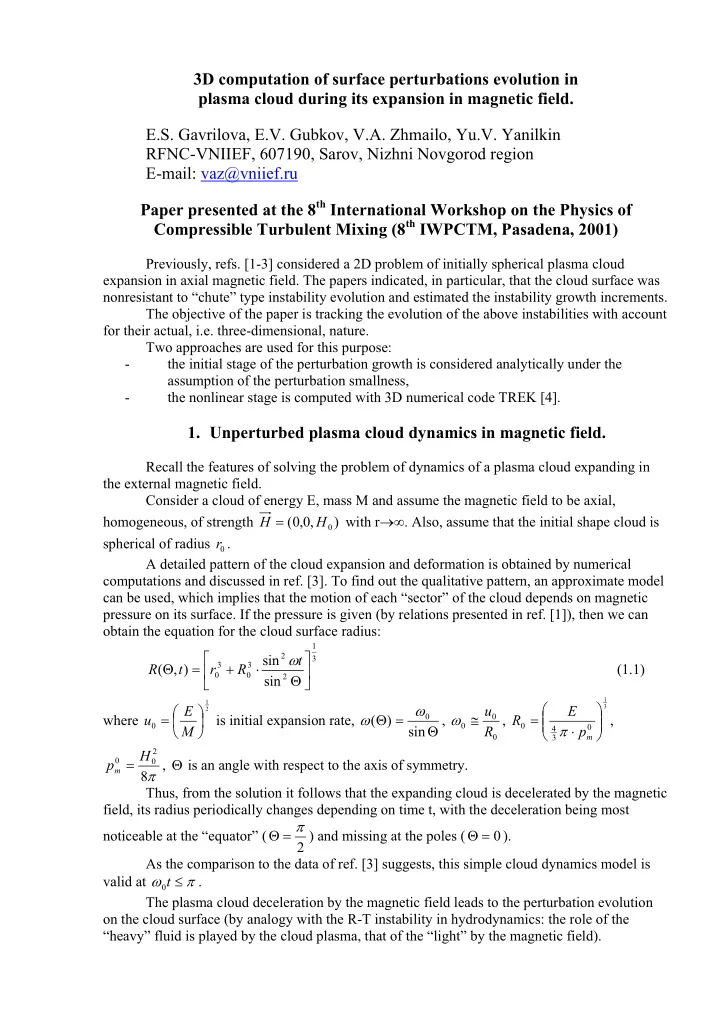
Recall the features of solving the problem of dynamics of a plasma cloud expanding in the external magnetic field. Consider a cloud of energy E, mass M and assume the magnetic field to be axial, homogeneous, of strength ) , , ( H H = with r→∞. Also, assume that the initial shape cloud is spherical of radius . r A detailed pattern of the cloud expansion and deformation is obtained by numerical computations and discussed in ref. [3]. To find out the qualitative pattern, an approximate model can be used, which implies that the motion of each “sector” of the cloud depends on magnetic pressure on its surface. If the pressure is given (by relations presented in ref. [1]), then we can
- btain the equation for the cloud surface radius:
3 1 2 2 3 3
sin sin ) , ( Θ ⋅ + = Θ t R r t R ω (1.1) where
2 1
= M E u is initial expansion rate, Θ = Θ sin ) ( ω ω , R u ≅ ω ,
3 1
3 4
⋅ =
m
p E R π , π 8
2
H pm = , Θ is an angle with respect to the axis of symmetry. Thus, from the solution it follows that the expanding cloud is decelerated by the magnetic field, its radius periodically changes depending on time t, with the deceleration being most noticeable at the “equator” ( 2 π = Θ ) and missing at the poles ( = Θ ). As the comparison to the data of ref. [3] suggests, this simple cloud dynamics model is valid at π ω ≤ t . The plasma cloud deceleration by the magnetic field leads to the perturbation evolution
- n the cloud surface (by analogy with the R-T instability in hydrodynamics: the role of the