4.3. External data representation and marshalling At language-level - - PowerPoint PPT Presentation

4 3 external data representation and marshalling
SMART_READER_LITE
LIVE PREVIEW

4.3. External data representation and marshalling At language-level - - PowerPoint PPT Presentation

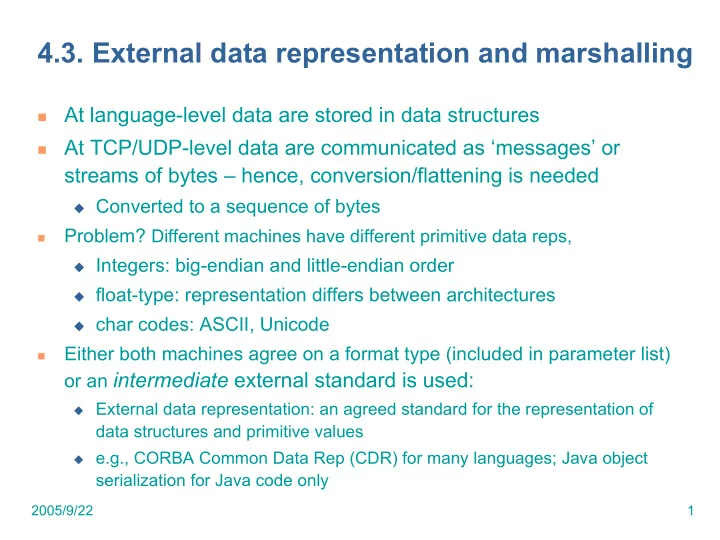
4.3. External data representation and marshalling At language-level data are stored in data structures At TCP/UDP-level data are communicated as messages or streams of bytes hence, conversion/flattening is needed Converted


slide-1
SLIDE 1

2005/9/22 1

4.3. External data representation and marshalling

  • At language-level data are stored in data structures
  • At TCP/UDP-level data are communicated as ‘messages’ or

streams of bytes – hence, conversion/flattening is needed

Converted to a sequence of bytes

  • Problem? Different machines have different primitive data reps,

Integers: big-endian and little-endian order float-type: representation differs between architectures char codes: ASCII, Unicode

  • Either both machines agree on a format type (included in parameter list)
  • r an intermediate external standard is used:

External data representation: an agreed standard for the representation of

data structures and primitive values

e.g., CORBA Common Data Rep (CDR) for many languages; Java object

serialization for Java code only

slide-2
SLIDE 2

2005/9/22 2

4.3. External data representation and marshalling

  • Marshalling: process of taking a collection of data items and assembling

them into a form suitable for transmission

  • Unmarshalling: disassembling (restoring) to original on arrival
  • Three alter. approaches to external data representation and marshelling:
  • CORBA’s common data representation (CDR)
  • Java’s object serialization
  • XML (Extensible Markup Language) : defines a textual format for rep. structured data
  • First two: marshalling & unmarshalling carried out by middleware layer

XML: software available

  • First two: primitive data types are marshalled into a binary form

XML: represented texually

  • Whether the marshalled data include info concerning type of its contents?
  • CDR: no, just the values of the objects transmitted
  • Java: yes, type info in the serialized form
  • XML: yes, type info refer to externally defined sets of names (with types), namespaces
slide-3
SLIDE 3

2005/9/22 3

4.3. External data representation and marshalling

Although we are interested in the use of external data

representation for the arguments and results of RMIs and RPCs, it has a more general use for representing data structures, objects, or structured documents in a form suitable for transmission or storing in files

slide-4
SLIDE 4

2005/9/22 4

4.3. External data representation and marshalling

CORBA CDR 15 primitive types: short, long, unsigned short, unsigned long,

float, double, char, boolean, octet, any

Constructed types: sequence, string, array, struct, enum and

union

note that it does not deal with objects (only Java does: objects

and tree of objects)

Type Representation sequence length (unsigned long) followed by elements in order string length (unsigned long) followed by characters in order (can also can have wide characters) array array elements in order (no length specified because it is fixed) struct in the order of declaration of the components enumerated unsigned long (the values are specified by the order declared) union type tag followed by the selected member

slide-5
SLIDE 5

2005/9/22 5

4.3. External data representation and marshalling

The flattened form represents a Person struct with value: {‘Smith’, ‘London’, 1934}

0–3 4–7 8–11 12–15 16–19 20-23 24–27 5 "Sm i t " "h___" 6 "Lond" "on__" 1934 index in sequence of bytes 4 bytes notes

  • n representation

length of string ‘Smith’ length of string ‘London’ unsigned long

slide-6
SLIDE 6

2005/9/22 6

4.3. External data representation and marshalling

Type of a data item not given: assumed sender and recipient

have common knowledge of the order and types of data items

Types of data structures and types of basic data items are

described in CORBA IDL

Provides a notation for describing the types of arguments

and results of RMI methods Struct Person { string name; string place; unsigned long year; };

slide-7
SLIDE 7

2005/9/22 7

4.3. External data representation and marshalling

Java object serialization

Both objects and primitive data values may be passed as arguments

and results of method invocations

The following Java class is equivalent to Person struct

public class Person implements Serializable { private String name; private String place; private int year; public Person(String aName, String aPlace, int aYear) { name = aName; place = aPlace; year = aYear; } // followed by methods for accessing the instance variables }

  • Serializable interface (provided in java.io package) allows its

instances to be serialized

slide-8
SLIDE 8

2005/9/22 8

4.3. External data representation and marshalling

Serialization: flattening objects into a serial form

for storing on disk or transmitting in a message

Deserialization: restoring the state of objects from

serialized form

Assumed has no prior knowledge of the types of the

  • bjects in the serialized form

Some information about the class of each object is

included in the serialized form

slide-9
SLIDE 9

2005/9/22 9

4.3. External data representation and marshalling

Java objects can contain references to other

  • bjects

All objects it references are serialized References are serialized as handles

A handle is a reference to an object within the

serialized form

Each object is written once only Handle is written in subsequent occurrences

slide-10
SLIDE 10

2005/9/22 10

4.3. External data representation and marshalling

  • To serialize an object:

(1) its class info is written out: name, version number (2) types and names of instance variables If an instance variable belong to a new class, then new class info must be

written out, recursively

Each class is given a handle (3) values of instance variables

Example: Person p = new Person(“Smith”, “London”, 1934);

The true serialized form contains additional type markers; h0 and h1 are handles

Serialized values

Person 3 1934 8-byte version number int year 5 Smith java.lang.String name 6 London h0 java.lang.String place h1

Explanation

class name, version number number, type and name of instance variables values of instance variables

slide-11
SLIDE 11

2005/9/22 11

4.3. External data representation and marshalling

To make use of Java serialization: To serialize: create an instance of ObjectOutputStream Invoke writeObject method passing Person object as argument To deserialize: create an instance of ObjectInputStream Invoke readObject method to reconstruct the original object

ObjectOutputStream out = new ObjectOutputStream(… );

  • ut.writeObject(originalPerson);

ObjectInputStream in = new ObjectInputStream(…); Person thePerson = in.readObject();

slide-12
SLIDE 12

2005/9/22 12

4.3. External data representation and marshalling

  • Use of reflection

Reflection: inquiring about class properties, e.g., names, types

  • f methods and variables, of objects

Allows to do serialization and deserialization in a generic

manner, unlike in CORBA, which needs IDL specifications

For serialization, use reflection to find out (1) class name of

the object to be serialized and (2) the names, types and (3) values of its instance variables

For deserialization, (1) class name in the serialized form is

used to create a class, (2) it is then used to create a constructor with arguments types corresponding to those specified in the serialized form. (3) the new constructor is used to create a new object with instance variables whose values are read from the serialized form

slide-13
SLIDE 13

2005/9/22 13

4.3. External data representation and marshalling

Each process contains objects, some of which can receive remote

invocations, others only local invocations

Those that can receive remote invocations are called remote objects Java and CORBA support distributed object model Objects need to know the remote object reference of an object in another

process in order to invoke its methods

The remote interface specifies which methods can be invoked remotely Remote object references are passed as arguments and compared to

ensure uniqueness

invocation invocation remote invocation remote local local local invocation invocation A B C D E F

slide-14
SLIDE 14

2005/9/22 14

4.3. External data representation and marshalling

A remote object reference must be unique over space and time

Over space: there may be many processes hosting remote objects Over time: It should not be reused after the object is deleted. Why not? its potential invoker may retain obsolete references

(IP address + port #) + (time of creation + local object number)

local object number is incremented each time an object is created in that process

identifies the object within the process in case objects live only in the process that created them, the reference

can be used as an address of the remote object

to allow remote objects to be relocated in a different process on a

different computer, the reference cannot be used as address

Its interface tells the receiver what methods it has (e.g. class Method)

Internet address port number time

  • bject number

interface of remote object 32 bits 32 bits 32 bits 32 bits

slide-15
SLIDE 15

2005/9/22 15

4.4. Client-Server communication

Designed to support typical client-server interactions Request-reply: usually synchronous (why?) Request-reply protocol: built over UDP or TCP (unnece. overheads) ack redundant (why?) connection establishing overhead flow control overhead, redundant for majority of invocations,

which pass only small arguments and results

Request

Server Client doOperation (wait) (continuation)

Reply message

getRequest execute method

message

select object sendReply

slide-16
SLIDE 16

2005/9/22 16

4.4. Client-Server communication

Request-reply protocol: 3 primitives

public byte[] doOperation (RemoteObjectRef o, int methodId, byte[] arguments) sends a request message to the remote object and returns the reply. The arguments specify the remote object, the method to be invoked and the arguments of that method. public byte[] getRequest (); acquires a client request via the server port. public void sendReply (byte[] reply, InetAddress clientHost, int clientPort); sends the reply message reply to the client at its Internet address and port.

Request

Server Client doOperation (wait) (continuation)

Reply message

getRequest execute method

message

select object sendReply

slide-17
SLIDE 17

2005/9/22 17

4.4. Client-Server communication

Request-reply message structure:

messageType requestId

  • bjectReference

methodId arguments

int (0=Request, 1= Reply)

int

RemoteObjectRef int or Method array of bytes

Internet address port number time

  • bject number

interface of remote object 32 bits 32 bits 32 bits 32 bits

Marshalled RemoteObjectRef:

slide-18
SLIDE 18

2005/9/22 18

4.4. Client-Server communication

Message identifiers may be required by some schemes: duplicate request handling requestId: taken from an increasing sequence of

integers by the sending process

identifier for the sender process: IP address + port # Duplicate request handling: (scenario?) if reply not sent: make sure only execute once if reply sent: need to re-execute, two cases a server whose operations are all idempotent, ok idempotent operation: can be performed repeatedly with the

same effect as if only performed exactly once (e.g.?)

  • therwise, use a “history”, record of transmitted messages
slide-19
SLIDE 19

2005/9/22 19

Summary

  • Heterogeneity is an important challenge to designers:
  • Distributed systems must be constructed from a variety of different networks,
  • perating systems, computer hardware and programming languages
  • The Internet communication protocols mask the difference in networks

and middleware can deal with the other differences

  • External data representation and marshalling
  • CORBA marshals data for use by recipients that have prior knowledge of the

types of its components. It uses an IDL specification of the data types

  • Java serializes data to include information about the types of its contents,

allowing the recipient to reconstruct it. It uses reflection to do this

  • RMI
  • each object has a (global) remote object reference and a remote interface that

specifies which of its operations can be invoked remotely

  • local method invocations provide exactly-once semantics; the best RMI can

guarantee is at-most-once

  • Middleware components (proxies, skeletons and dispatchers) hide details of

marshalling, message passing and object location from programmers

slide-20
SLIDE 20

2005/9/22 20

4.4. Client-Server communication

  • HTTP: an example of a request-reply protocol (TCP based)
  • Self-read
  • Projects?

http://www.ida.liu.se/~TDDB37/labs/