4-connected shift residual networks ICCV 2019 Neural Architects - PowerPoint PPT Presentation
4-connected shift residual networks ICCV 2019 Neural Architects Workshop Andrew Brown, Pascal Mettes, Marcel Worring, University of Amsterdam Network costs increasing! Increasing accuracy on ImageNet has come at increasing cost Popular
4-connected shift residual networks ICCV 2019 – Neural Architects Workshop Andrew Brown, Pascal Mettes, Marcel Worring, University of Amsterdam
Network costs increasing! • Increasing accuracy on ImageNet has come at increasing cost • Popular metrics: FLOPs and parameters • Can we reduce cost without reducing accuracy?
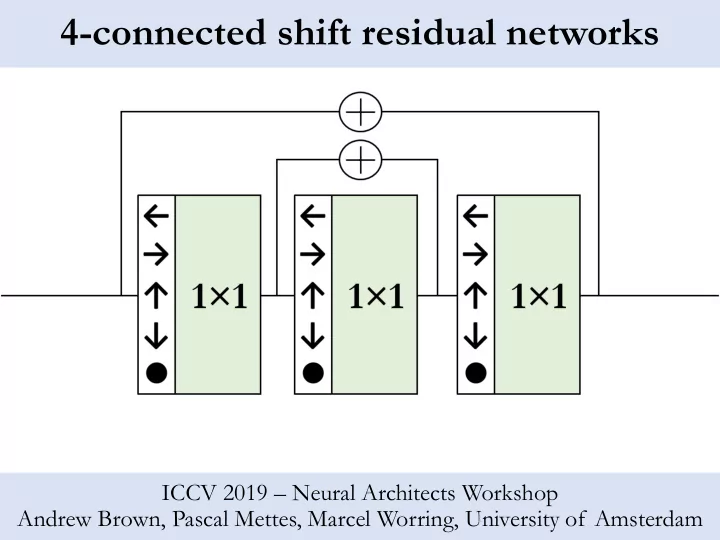
Shift operation • Shifts – operations move input channels spatially • Different channels move in different directions • Shifts are possible spatial convolution replacements • Spatial conv. → shift + pointwise conv. (i.e. simple matrix multiplication) • Shifts themselves are zero parameter, zero FLOP operations
Do shifts improve network cost? • Shifts have shown improvements to compact networks • Picture not clear for higher FLOP/accuracy networks
Which shift neighbourhood to use? 8-Connected 4-Connected Neighbourhood Neighbourhood • Shifts move inputs – but in which directions? • 8-connected shift: Left, right, up, down and diagonals • 4-connected shift: Left, right, up and down only
Applying shifts to ResNet Operation structure of residual block Receptive field spatial extent of residual block • First expt: replacement of spatial convolutions in ResNet residual blocks • ‘Bottleneck’ residual block design • 3 × 3 spatial convolution → shift + point -wise convolution
Single shift results • Shifts give a large cost reduction • More than 40% in both parameters and FLOPs • Single shift networks gives accuracy penalty BUT • Better than reducing network length
Single shift results: shift comparison • 4-connected shift performs as well as 8-connected on ImageNet
No shift results • No shift networks – only one spatial convolution in very first layer • Accuracy penalty suffered – but surprisingly not so much!
Even more shifts! Operation structure of residual block Receptive field spatial extent of residual block • Add shifts to down- and up- sampling bottleneck convolutions • Idea is to allow larger receptive field within each block
Removing the bottleneck Operation structure of residual block Receptive field spatial extent of residual block • Now the spatial convolutions are gone, why use a bottleneck? • No longer a need to down-sample in each residual block • Flatten the channel structure • Need to reduce length to reduce cost: 101 layers → 35 layers
Multi-shift results: with bottleneck • Multi-shift networks match ResNet in accuracy! • …but only for 4-connected shifts, not 8-connected shifts • Maintains >40% parameters and FLOPs reductions
Multi-shift results: without bottleneck • Multi-shift networks without bottleneck: beats ResNet in accuracy • Again best performance (+0.8%) is for 4-connected shifts
Results in context Multi-shift without bottlenecks (35 layers) Multi-shift with bottlenecks (50 and 100 layers) • Shifts can improve high accuracy CNNs!
Summary • Studied variants of the shift operation • Compare 8- and 4- connected shift neighbourhoods • Modified ResNet bottleneck residual blocks to include shifts • Consider both single and multiple shifts in each block • Multi-4-connected shift variants can improve ResNet • 1 st case: Improve costs by more than 40% at same accuracy • 2 nd case: Improves ImageNet accuracy by +0.8% for ~same costs
Recommend
More recommend
Explore More Topics
Stay informed with curated content and fresh updates.