
SLIDE 1
4 Language Models 2: Log-linear Language Models
This chapter will discuss another set of language models: log-linear language models [9, 4], which take a very different approach than the count-based n-grams described above.11
4.1 Model Formulation
Like n-gram language models, log-linear language models still calculate the probability of a particular word et given a particular context et1
tn+1. However, their method for doing so is
quite different from count-based language models, based on the following procedure. Calculating features: Log-linear language models revolve around the concept of fea-
- tures. In short, features are basically, “something about the context that will be useful in
predicting the next word”. More formally, we define a feature function φ(et1
tn+1) that takes a
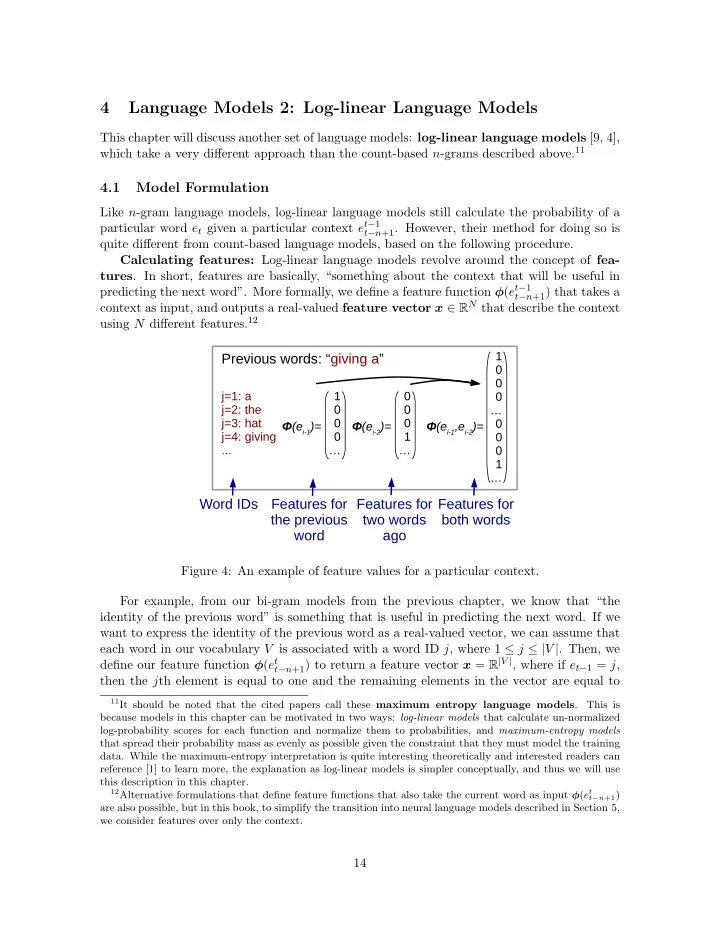
context as input, and outputs a real-valued feature vector x ∈ RN that describe the context using N different features.12
j=1: a j=2: the j=3: hat j=4: giving ... 1 … Φ(ei-1)=
Previous words: “giving a” Word IDs Features for the previous word Features for both words
1 … Φ(ei-2)= Φ(ei-1,ei-2)= 1 … 1 …
Features for two words ago
Figure 4: An example of feature values for a particular context. For example, from our bi-gram models from the previous chapter, we know that “the identity of the previous word” is something that is useful in predicting the next word. If we want to express the identity of the previous word as a real-valued vector, we can assume that each word in our vocabulary V is associated with a word ID j, where 1 ≤ j ≤ |V |. Then, we define our feature function φ(et
tn+1) to return a feature vector x = R|V |, where if et1 = j,
then the jth element is equal to one and the remaining elements in the vector are equal to
11It should be noted that the cited papers call these maximum entropy language models.
This is because models in this chapter can be motivated in two ways: log-linear models that calculate un-normalized log-probability scores for each function and normalize them to probabilities, and maximum-entropy models that spread their probability mass as evenly as possible given the constraint that they must model the training
- data. While the maximum-entropy interpretation is quite interesting theoretically and interested readers can
reference [1] to learn more, the explanation as log-linear models is simpler conceptually, and thus we will use this description in this chapter.
12Alternative formulations that define feature functions that also take the current word as input φ(et t−n+1)