501: Successful FDA Inspections Richelle Little & Kara - - PDF document

501 successful fda inspections richelle little amp kara
SMART_READER_LITE
LIVE PREVIEW

501: Successful FDA Inspections Richelle Little & Kara - - PDF document

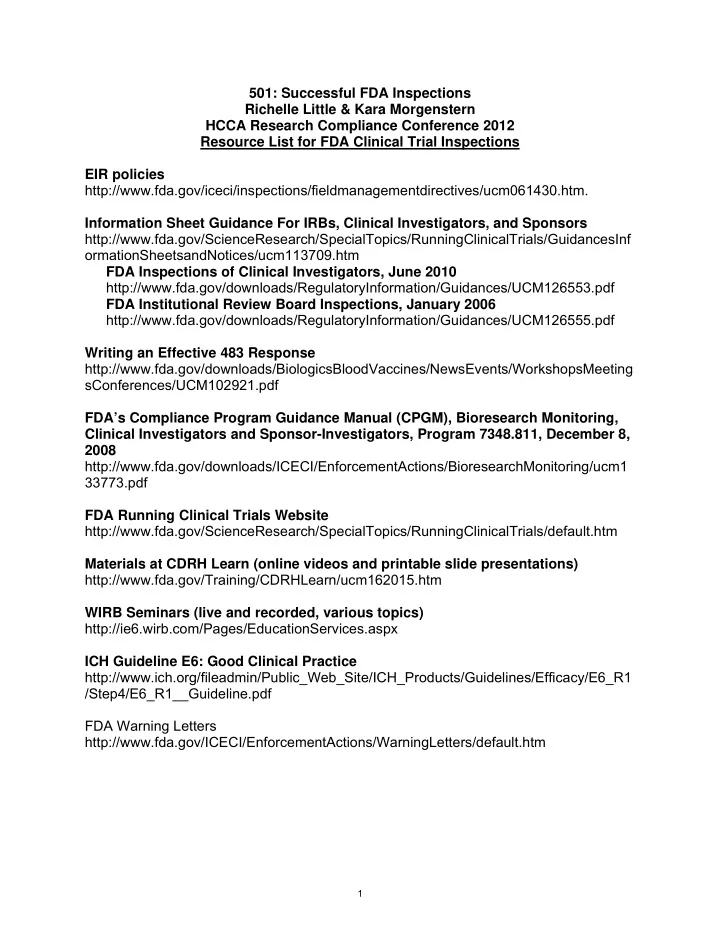
501: Successful FDA Inspections Richelle Little & Kara Morgenstern HCCA Research Compliance Conference 2012 Resource List for FDA Clinical Trial Inspections EIR policies


slide-1
SLIDE 1

501: Successful FDA Inspections Richelle Little & Kara Morgenstern HCCA Research Compliance Conference 2012 Resource List for FDA Clinical Trial Inspections EIR policies http://www.fda.gov/iceci/inspections/fieldmanagementdirectives/ucm061430.htm. Information Sheet Guidance For IRBs, Clinical Investigators, and Sponsors http://www.fda.gov/ScienceResearch/SpecialTopics/RunningClinicalTrials/GuidancesInf

  • rmationSheetsandNotices/ucm113709.htm

FDA Inspections of Clinical Investigators, June 2010 http://www.fda.gov/downloads/RegulatoryInformation/Guidances/UCM126553.pdf FDA Institutional Review Board Inspections, January 2006 http://www.fda.gov/downloads/RegulatoryInformation/Guidances/UCM126555.pdf Writing an Effective 483 Response http://www.fda.gov/downloads/BiologicsBloodVaccines/NewsEvents/WorkshopsMeeting sConferences/UCM102921.pdf FDA’s Compliance Program Guidance Manual (CPGM), Bioresearch Monitoring, Clinical Investigators and Sponsor-Investigators, Program 7348.811, December 8, 2008 http://www.fda.gov/downloads/ICECI/EnforcementActions/BioresearchMonitoring/ucm1 33773.pdf FDA Running Clinical Trials Website http://www.fda.gov/ScienceResearch/SpecialTopics/RunningClinicalTrials/default.htm Materials at CDRH Learn (online videos and printable slide presentations) http://www.fda.gov/Training/CDRHLearn/ucm162015.htm WIRB Seminars (live and recorded, various topics) http://ie6.wirb.com/Pages/EducationServices.aspx ICH Guideline E6: Good Clinical Practice http://www.ich.org/fileadmin/Public_Web_Site/ICH_Products/Guidelines/Efficacy/E6_R1 /Step4/E6_R1__Guideline.pdf FDA Warning Letters http://www.fda.gov/ICECI/EnforcementActions/WarningLetters/default.htm

1

slide-2
SLIDE 2

Page 1 of 2

Top Ten Tips for Surviving an FDA Inspection

1 – DO respond promptly when the FDA contacts you to schedule an inspection. DON’T ever ignore or otherwise disregard any communication (written or telephone) from the FDA. DON’T get so nervous when the FDA calls that you agree to a schedule that will not allow you time to prepare or the opportunity to be readily available during the inspection. The FDA is usually willing to allow a matter of several days in order to accommodate the study team’s needs and schedules. DON’T try to otherwise delay or drag out the inspection. Doing so may arouse suspicion and inspire the inspector to dig deeper. 2 -- DO alert key institutional offices that the FDA has scheduled an inspection of your study. DON’T try to handle the inspection in a vacuum. There is good institutional support for you from the IRB and Regulatory Affairs and others. (Note that the IRB requires that it be notified of inspections of IRB- approved studies). 3 -- DO review and organize all of the documents associated with the study in order to be re-familiarized with the details and prepare to address any anticipated questions. Also make sure that memories of the study team are refreshed regarding each member’s roles and responsibilities on the study. DON’T try to manipulate or obfuscate the written records associated with the study under inspection. DON’T try to orchestrate any approach to the inspection that would represent anything other than how the study was actually conducted. 4 -- DO make adequate time to attend to the inspection before, during, and after the actual days when the inspector is on site. DON’T try to squeeze it into your normal schedule, and DON’T depend on someone else to represent you and your role/activities on the study. 5 -- DO arrange for a convenient, quiet, secure, neutral space for the inspector to review records and interview

  • personnel. Include arrangements to carefully photocopy records as requested (make three (3) copies of

any document the inspector will take - one for the inspector, one for the study team, and one for institutional offices). DON’T host the inspection in the midst of your study conduct operations (think: front parlor, not laundry room).

2

slide-3
SLIDE 3

Page 2 of 2

6 – DO answer the inspector’s questions in an honest and forthright manner. DO provide information responsive to the question, and then stop talking in a natural manner. DO feel comfortable answering “I don’t know off the top of my head – let me check it out” when you are not sure. DO explain or defend your position in a polite and respectful manner a limited number of times. DON’T offer speculation on what you think you would have done in place of factual recollection of what you did do. DON’T give the FDA inspector the answer you think they want to hear if you cannot support your

  • responses. DON’T succumb to the urge to fill any silence by providing study-related information that has

not yet been asked about by the inspector. DON’T become overly or repeatedly defensive or argumentative. 7 -- DO take careful notes of the inspector’s "observations" (citations) and non-citation suggestions during the inspection and exit interview. Ask questions to ensure a solid understanding of each deficiency and why the inspector has identified it as being worth pointing out. Even if it's not written on the inspection form you will receive, it will factor into the FDA report file and the eventual FDA decision about the outcome of your inspection. DON’T assume that anything you discuss with the inspector is “off the record.” 8 -- DO prepare to respond to cited "observations" within 15 days of the end of your inspection (even if the inspector tells you that it’s optional). A follow-up report in 2-3 months may also be appropriate. DO take great care in responding to the FDA. Vague, sloppy, inaccurate, defensive, or argumentative responses may result in additional scrutiny and sanctions. DO review your copies of records that the inspector took away – these will be used to support the inspector’s citations, and what they show should be considered in your response. DON’T expect that this will not take a significant amount of your time, effort, and detailed attention – as well as that of the “village” that will rally to support you. 9 -- DO take a deep breath, remember that yours is not the only study to undergo FDA inspection and realize that everyone (study team, institution, and FDA) is on the same side - working toward better, safer medical treatments through the safe, ethical, responsible conduct of clinical research. DON’T panic or agonize. Consider the occasional FDA inspection to be just another “cost of doing business” in the business of conducting clinical research. 10 -- DO focus on continuous quality improvement going forward. Do make a commitment to ensure any past mistakes are not repeated. DON’T dwell on the past. You cannot alter what has happened, sometimes “it is what it is”

3

slide-4
SLIDE 4

EXAMPLE

CORRECTIVE/PREVENTATIVE ACTION FORM

CAPA Date: October 13, 2011

Page 1 of 3

Issued to: Director of area that has the issue Copies to: As required by policy – Distribution is limited CAPA File Requested by: External - Western Institutional Review Board Response needed by: November 14, 2011 Observation: Potential Issue: On October 10, 2011 our site received an email from WIRB indicating that the signed consent form that we sent to them was not the correct version of the IRB approved consent

  • form. WIRB has asked for more details as to why the wrong version of the consent form was signed

by the subject. Objectives:

  • 1. Determine the scope of the problem and assess how many subjects may have signed the

wrong version of the consent form.

  • 2. Compare the two documents to determine if information that is included only in Version 2

would affect a subject’s willingness to continue participation in the clinical trial. .

  • 3. Confirm the roles and responsibilities of all research staff related to the management of

clinical trial documents.

  • 4. Assure that systems are in place to effectively manage clinical trial documents in the future

and throughout the remainder of the clinical trial. Background: There are three study coordinators involved in this clinical trial. Each coordinator keeps a file with the currently approved consent documents at their work stations. The current versions of the consents are downloaded and copied by the regulatory coordinator who puts a stack

  • n his desk and the coordinators pick up the new current versions from the stack off the regulatory

coordinator’s desk and replace the consents at their workstations. The regulatory coordinator tells the coordinators when there is a new version either in person or email depending on which is convenient. Summary: The clinical trial started June 1, 2011. Version one of the consent form was IRB approved June 1, 2011. There were 35 subjects enrolled who signed version one. Version two of the consent form was approved by the IRB on September 1, 2011 and 5 subjects were enrolled after this date. Those five subjects signed version one of the consent form. Therefore, five subjects signed the wrong version of the consent form. Version one and version two of the consent forms were compared and it was determined the following differences:

  • Version two indicates that the subject will receive $25.00 for each office visit while version
  • ne dord not include any compensation the subjects.

4

slide-5
SLIDE 5

EXAMPLE

CORRECTIVE/PREVENTATIVE ACTION FORM

CAPA Date: October 13, 2011

Page 2 of 3

  • Version one of the consent form indicates one of the risks of the study drug is vomiting.

Version two does not include this risk.

  • Three words were misspelled in version one and have been corrected in version two.

Since the revised from does not include information that will affect a subject’s willingness to continue participation on the research, there is no need for immediate notification to subjects and subjects. The standard operating procedures for the study coordinators and regulatory coordinator do not address who maintains the consent documents or how the consent documents are to be maintained. Findings: It was discovered that one of the study coordinators was out of the office on the day that version two of the consent form was downloaded and stacked on the regulatory coordinator’s desk. The regulatory coordinator verbally told the coordinators in the office that day that there was a new version of the consent form. The two coordinators in the office that day replaced version one with version two at their individual workstations. The third coordinator returned two days later, was not told about the updated version of the consent and went on to obtain consent from five subjects using version one. In the assessment of this situation it was determined that:

  • The process for communicating information about consent form revisions was not sufficient.

There was not a system in place to confirm that subjects are signing the most current version

  • f the consent form be
  • There is a much higher risk of the wrong version of the consent form being used when copies
  • f consents are maintained at four different locations in the clinic

Recommendation: Short term (remedial) corrective & preventive action already taken:

  • Since Version 2 of the consent form does not include information that will affect a subject’s

willingness to continue participation on the research, there is no need for immediate notification to subjects and subjects and the five subjects who signed the wrong version of the form can sign the correct version at their next study visit. Three subjects have already signed the correct version and the remaining two are scheduled to come into the office the week of October 17th and will sign version two of the consent form.

  • Printed copies of the consent form are no longer maintained in the research clinic except in

the regulatory binder.

  • Each morning, the study coordinators will check the schedule of subjects and the IRB’s

website to see if a consent form revision has been approved for a particular subject. For each existing subjects, the study coordinator will determine whether there is a revised consent form and whether the IRB requires subjects to sign the revision. If the IRB requires existing subjects to sign the revision, the coordinator will print a copy of the revised consent form and place the copy in the subject’s study file. For new subjects, the coordinator will print a copy of the latest version of the consent form and place a copy of the document in the file being prepared for the new subject. The coordinator will alert the regulatory coordinator by email whenever a revised consent form has been approved and the regulatory coordinator will place a printed copy of the revised consent form and approval document in the regulatory

5

slide-6
SLIDE 6

EXAMPLE

CORRECTIVE/PREVENTATIVE ACTION FORM

CAPA Date: October 13, 2011

Page 3 of 3

  • binder. All research staff were trained on the new management of consent form copies at

the next staff meeting which was held October 11, 2011. Long term (corrective and preventative) action planned:

  • In the future the Supervisor will be required to send out an email notifying all the coordinators

when there is a new version of the consent form.

  • All standard operating procedures will be updated to include these new procedures. The

desk helps will be updated by January 15, 2012.

  • All future new staff will be trained on this process prior to being allowed to consent subjects.
  • Once every six months a spot check will be completed to confirm compliance with this

corrective action plan. Expected timeline for completion: January 15, 2012 Comments: Person completed form: ____________________________________________ Signature/Position Date Management Authority: ____________________________________________ Signature/Position Date

6

slide-7
SLIDE 7

Corrective and Preventive Actions Plan

Description Status Com pletion Date

Education and Training

PI to review updated FDA final guidance: Protecting the Rights, Safety, and Welfare of Study Subjects – Supervisory Responsibilities of Investigators http://www.fda.gov/downloads/Drugs/ GuidanceComplianceRegulatoryInformation/Guidances/UCM187772.pdf PI to review FDA draft guidance: Protecting the Rights, Safety, and Welfare of Study Subjects – Supervisory Responsibilities of Investigators (http://www.fda.gov/RegulatoryInformation/Guidances/ucm127697.htm) PI and all staff to review FDA draft guidance: Statement of Investigator (Form FDA 1572) (http://tinyurl.com/FDA-1572-DraftGuidance) PI and all staff to review FDA guidance: Screening Tests Prior to Study Enrollment PI and all staff to review FDA guidance: A Guide to Informed Consent – Information Sheet (http://www.fda.gov/RegulatoryInformation/Guidances/ucm126431.htm) PI and all staff to review FDA guidance: Adverse Event Reporting to IRBs: Improving Human Subject Protection (http://tinyurl.com/FDA-AE- 2009) PI and all staff to review ICH Guidance for Industry E6 Good Clinical Practice: Consolidated Guidance (http://tinyurl.com/ICH-Consolidated) PI to complete FDA Clinical Investigator Training Course (PI) PI and all staff to review current IRB guidance on childhood assent IRB Education Tailored to 483 Observations (PI and All Staff) PI to become Certified Principal Investigator (“CPI”) through the Association of Clinical Research Professionals Education of study team to new SOPs

Reports

Deviation Reports to IRB Form FDA-483 to IRB 483 Response Letter to IRB

SOPs

Identifying Appropriate and Qualified Study Personnel Obtaining Informed Consent Adverse and Serious Adverse Events Protocol Deviations Managing Investigational Materials and Supplies Patient Completion/Early Termination/Screen Failure Essential Regulatory Document Management and Storage External Monitoring Study Subject Visits and Interventions

Staff Changes

Study [A] coordinator relieved of clinical research duties New coordinator [B] hired Addition of Part-time Quality Assurance function Addition of Departmental Research Program Manager

Other

Implementation of new informed consent template to be approved by IRB that moves opt-in for correlative studies to signature page Voluntary deferral of new enrollment on approved FDA regulated studies Voluntary moratorium on initiating new FDA regulated studies

7

slide-8
SLIDE 8

[Personalize SOP Header to unit]

CAPA Assessment Tracking Log

Sponsor Protocol Number List and Describe Document, System, or Facility Inspection Performed Clinical Research Team Member Performing Review Date(s) of Review

8

slide-9
SLIDE 9

[Personalize SOP Header to unit]

CAPA Assessment Plan

Protocol Number: Assessment Plan Issued Date: Sponsor: Issuer’s Initials: Date(s) of Review: Reviewer(s): Overall Purpose of the Assessment: Describe the System, Documents, and/or Facility to Be Assessed: List Study Team Members to be Involved: Lead Reviewer: Additional Comments: Expected Initial Preliminary Timeline: Initial Update: Expected Completion: Principal Investigator Signature Date of Signature

9

slide-10
SLIDE 10

[Personalize SOP Header to unit]

CORRECTIVE and PREVENTIVE ACTIONS (CAPA) FORM

Section I - Identified Issue: Section II - Causal Analysis: Section III - Proposed Resolution(s): Section IV - Final Root Causal Analysis:

Issued Resolved On: Next Planned Assessment: Continuing to be Reviewed:

10

slide-11
SLIDE 11

[Personalize SOP Header to unit]

CORRECTIVE and PREVENTIVE ACTIONS (CAPA) FORM

Section V Members Required to Attend Retraining Attach Attendance Sheet with Minutes Documentation of Staff Retraining: Section VI - Continual Process Improvement: Event Reoccurrence: Address reoccurrences and further preventive measures and retraining and process improvements. Section VII - Investigator’s Review or Corrective Action Plan and Acknowledgement of Continual Improvement:

Corrective Action Plan Preparer’s Signature Date of Signature Clinical Investigator’s Signature Date of Review and Approval

11

slide-12
SLIDE 12

[Personalize SOP Header to unit]

Issue Completion Tracking Log

Assessment Date: Reviewer(s):

Investigator: Prepared By: Date: Protocol Number(s): Corrective Action Review: Principal Investigator: Date: Observation(s) Recommendation Corrective Action Completion Target Date Responsible Person(s) Completion Date

12

slide-13
SLIDE 13

[Personalize SOP Header to unit]

Version Number: 1.2 Implementation Date: Page 1 of 5 Revision Date: June 2, 2010 Review Date: June 2, 2010 Approval Signature: Date:

Corrective and Preventive Action

Procedure Overview To establish Corrective and Preventive Actions (CAPA) for conducting and documenting internal activities for continual assessment of compliance with clinical trial protocols, established regulations, ICH GCP guidelines, internal standard operating procedures, and policies to actively seek quality process improvements. Responsible Individuals Investigators, Study Coordinator, Regulatory Administrative Assistant Background The Principal Investigator shall maintain the CAPA Plan for continual systems evaluations and process improvements for overall clinical operations. The Investigator is responsible for the

  • verall conduct of a research study, however; delegation allows staff members to perform

‘defined’ study activities and procedures under the direct supervision of the Principal Investigator in the implementation and conduct of a clinical trial. Study staff can not perform medical and protocol procedures above their clinical or research qualifications. Procedure This procedure is conducted in accordance with: 21 CFR Parts 11(if applicable), 50, 54, 56, 312, and 314 FDA Compliance Programs 7348.809, 7348.810 and 7348.811 ICH Guideline E6: Good Clinical Practice Selected State laws, additional Federal laws (OSHA), and local regulations for the protection of human research subjects

  • 1. The Principal Investigator is responsible for planning, coordinating, managing, and
  • verseeing the CAPA Plan for all clinical trials. The Principal Investigator has ultimate

responsibility to ensure CAPA operations are conducted in accordance to this procedure.

13

slide-14
SLIDE 14

[Personalize SOP Header to unit]

Version Number: 1.2 Implementation Date: Page 2 of 5 Revision Date: June 2, 2010 Review Date: June 2, 2010 Approval Signature: Date:

  • 2. The Principal Investigator is responsible for communicating or delegating the

communication of issues to study staff, as well as, developing, approving, and implementing a Corrective and Preventive Actions (CAPA) Plan.

  • 3. All study staff can be delegated various aspects in concert with their education,

experience, training, and qualifications to achieve ultimate compliance outcomes.

  • 4. All CAPA records are maintained and kept confidential and as internal systems

improvements and are made available only for external review by Food and Drug Administration (FDA), and/or other government officials upon request. Documentation

  • f all on-going assessments is available for each clinical trial upon request. All files are

maintained by the Regulatory Administrative Assistant (“RAA”). The RAA or Study Coordinator (“SC”) is responsible for maintaining the CAPA Assessment Tracking Log.

  • 5. Under the daily operational direction of the Principal Investigator a systematic and

independent examination of trial-related activities including Essential Regulatory Document reviews to determine whether the evaluated trial-related activities were conducted, and the data recorded, analyzed, and accurately reported will be conducted on a determined and approved schedule.

  • 6. The Principal Investigator will prepare a written description of a CAPA Assessment Plan

including internal checklists used to assess research functions. A CAPA Assessment Plan form is attached.

  • 7. If deficiencies are noted, a CAPA Form will be completed. A Corrective and Preventive

Action Form is attached.

  • 8. All monitoring letters received from Sponsors or Contract Research Organizations that

identify issue(s) that need to have corrective actions will need to have a CAPA Form completed and issues resolved prior to the next monitoring visit. When issues are on- going or potentially incorrectly reported in the monitoring letter, the CAPA Form should reflect that the issue(s) continues to be open and is still being resolved.

  • 9. All monitoring letters should be signed and dated by the Principal Investigator following

his/her receipt, review and acknowledgment of identified issues and progress of the study.

14

slide-15
SLIDE 15

[Personalize SOP Header to unit]

Version Number: 1.2 Implementation Date: Page 3 of 5 Revision Date: June 2, 2010 Review Date: June 2, 2010 Approval Signature: Date:

  • 10. Occasionally, there may be issues that require “Directed Assessments” by the Principal
  • Investigator. A directed assessment is defined as a non-random, “for cause” assessment

conducted by the Institution, Principal Investigator or at times an outside consultant to evaluate a clinical trial to determine the level of compliance with the protocol based on monitoring statements, internal reviews, or overall increased study enrollment. Directed audits are performed as needed.

  • 11. The Principal Investigator will consider many different priorities when selecting which

Quality Systems to assess. The following may be used during the selection process as metrics:

  • Priority of the regulatory submission data
  • Previous observations of clinical research team members
  • Infrequent, abbreviated, or delayed monitoring visits
  • Limited monitoring comments or data queries during visits
  • Follow-up to monitoring letters
  • Data trending analysis
  • Subject enrollment numbers
  • Rate of subject accrual
  • Volume and type of adverse events reported
  • Number of subject withdrawals and/or premature terminations
  • Number and type of protocol deviations, if any
  • Requests from clinical research team members
  • Follow-up to external audit recommendations

15

slide-16
SLIDE 16

[Personalize SOP Header to unit]

Version Number: 1.2 Implementation Date: Page 4 of 5 Revision Date: June 2, 2010 Review Date: June 2, 2010 Approval Signature: Date:

  • 12. The Principal Investigator develops a CAPA Assessment Plan including, but not limited

to, the following criteria:

  • Applicable regulations and guidelines to be followed
  • The percentage of clinic charts to be verified
  • The percentage of case report forms to be verified
  • A review of internal Essential Regulatory Documents
  • Facility Inspections
  • Monitoring Visit Letters
  • Pending or completed external audits
  • Received complaints including concerns detailed in monitoring reports
  • 13. The Principal Investigator performs or delegates to a designee the following activities:
  • Requests the Essential Regulatory Documents, and other relevant documentation

from the Clinical Research Coordinator assigned to the specified protocol to be assessed

  • Reviews or delegates the review of all requested documents upon receipt
  • Identifies and notifies the clinical research team members involved
  • Schedules the assessment and details a completion timeline
  • 14. The SC or RAA communicates the CAPA Assessment Plan to the Principal Investigator

and acquires signature of the PI which indicates acceptance and review of the CAPA Assessment Plan

  • 15. All CAPA Forms are reviewed, signed, and dated by the individual preparing the form

and signed and approved by the Principal Investigator. All identified issues entered formally into the CAPA Program will be tracked until completion on the Issue Completion Tracking Form.

  • 16. The Principal Investigator is responsible for ensuring the study team members receive on-

going training in ICH GCP incorporating CAPA skills and techniques as outlined in the Training and Supervising of Study Personnel.

16

slide-17
SLIDE 17

[Personalize SOP Header to unit]

Version Number: 1.2 Implementation Date: Page 5 of 5 Revision Date: June 2, 2010 Review Date: June 2, 2010 Approval Signature: Date: Documentation Corrective and Preventive (CAPA) Form, CAPA Assessment Plan, Issue Completion Tracking Log, and CAPA Assessment Tracking Log

17

slide-18
SLIDE 18

[Personalize SOP Header to unit]

Version Number: 1.0 Implementation Date: Page 1 of 2 Revision Date: March 26, 2010 Review Date: Approval Signature: Date:

External Monitoring

Procedure Overview This procedure describes the necessary activities performed by the study team prior to, during, and after an external monitoring visit. Responsible Individuals Investigators, Study Coordinators, Regulatory Administrative Assistant Procedure Sponsors delegate a representative from their organization or a Contract Research Organization (“CRO”) to monitor the site for activity regarding the trial. When the monitoring visit has been completed, the monitor will generate a letter/report of any findings regarding the trial.

  • 1. Prior to the scheduled monitoring visit, the Study Coordinator or Regulatory

Administrative Assistant shall:

  • Review all regulatory documents and individual subject research binders to determine

whether the evaluated trial-related activities were conducted, and the data recorded, analyzed, and accurately reported.

  • If deficiencies are noted, a CAPA Form will be completed as noted in the Corrective

and Preventive Action policy. When issues are on-going, the CAPA Form should reflect that the issue(s) continues to be open and is still being resolved.

  • 2. During the monitoring visit, the Study Coordinator or Regulatory Administrative

Assistant shall:

  • Verify that the inspecting individual has signed and dated the Site Visit Log
  • Ensure that all documents needed by the inspecting party are made available on the

day of inspection.

  • Personally chaperone any individual who is not a member of the study when they are

accessing electronic medical records and visiting study-related facilities at the site.

  • 3. After the monitoring visit, all monitoring letters/reports received from Sponsors or

Contract Research Organizations that identify issue(s) that need to have corrective actions will need to have a CAPA Form completed and issues resolved prior to the next monitoring visit. When issues are on-going or potentially incorrectly reported in the

18

slide-19
SLIDE 19

[Personalize SOP Header to unit]

Version Number: 1.0 Implementation Date: Page 2 of 2 Revision Date: March 26, 2010 Review Date: Approval Signature: Date: monitoring letter, the CAPA Form should reflect that the issue(s) continues to be open and is still being resolved.

  • 4. All monitoring letters/reports should be signed and dated by the Principal Investigator

upon receipt indicating his/her review and acknowledgment of identified issues and progress of the study.

  • 5. All observations noted in the monitoring letter/report shall be reviewed by the study staff

and discussed at the weekly study team meeting. If deficiencies are noted, the study team shall fully investigate as to root cause and take any corrective and preventive action as described in the CAPA policy.

  • 6. Any issues that need to be reported to the IRB will be done in a timely manner. IRB

applications are created and submitted as outlined in the Completing IRB Applications policy.

  • 7. All monitoring letters/reports will be submitted to the IRB for review according to the

ORIO or AE Timetable. Documentation Documentation for this procedure includes the monitoring report, IRB application (ORIO or AE’s), IRB approval, and ORIO/AE Timetable.

19

slide-20
SLIDE 20

Model Risk Evaluation What is the impact of the problem? The greater the impact the greater the need for a CAPA plan

  • Risk is greater if issue could impact subject safety or if issued could result in non-

compliance with regulations, protocol, SOPs or IRB requirements

  • Risk is less if issue could result in non-compliance with guidance or other directive,

rate the risk less critical

  • Also consider financial, subject recruitment or retention, and other impacts that

might affect your site’s performance How severe is the impact?

  • As illustrated above failure to comply with regulations would be considered more

severe impact than failure to comply with guidelines.

  • If the impact is financial or other performance measure – the resulting amount of

the impact could be used to evaluate severity What is the probability that the problem will repeat itself?

  • Once you find the root cause or causes of the issue, you should be able to

determine whether the issue can be repeated.

  • If your current system allows problem to be repeated then the need for a CAPA

plan increases Analysis should result in one of the following decisions: (1) No action (2) Remedial action – fix the identified issue only (3) CAPA – fix the immediate issue and develop a plan to prevent the issue from repeating Example: The study monitor notes that there is no evidence that the PI was notified about a critical lab value. The investigation reveals that appropriate actions were taken to protect the subject in response to the lab value, but the value was not reported as an adverse event, the result was not signed off by the PI per the site’s standard operating procedures and there is nothing in the record indicating that the value was reviewed or evaluated. The SOP requires all lab results to be placed in a folder for review and the PI or a delegated sub-investigator must initial and date the document after review. Lab results on research subjects is placed in one folder and lab results from patients who not research subjects are placed in another folder. According to the SOP, review of abnormal lab must occur on the day the value is

  • received. Thus, the impact of the problem was failure to comply with the protocol’s requirements for

reporting adverse events, the regulatory requirement for reporting adverse events, and the SOPs for reviewing abnormal lab values. If this type of incident happens again, the impact could be very severe for the PI during an audit. The root cause seems to be (1) the result was placed in the incorrect folder; and/or (2) the PI’s failure to document the review and identify the issue as an adverse event. You determine that there is a moderate probability that this issue will be repeated in the future and a CAPA plan is needed.

20