6.2. An abstract datatype for stacks Stacks of objects of type : - - PDF document

6 2 an abstract datatype for stacks
SMART_READER_LITE
LIVE PREVIEW

6.2. An abstract datatype for stacks Stacks of objects of type : - - PDF document

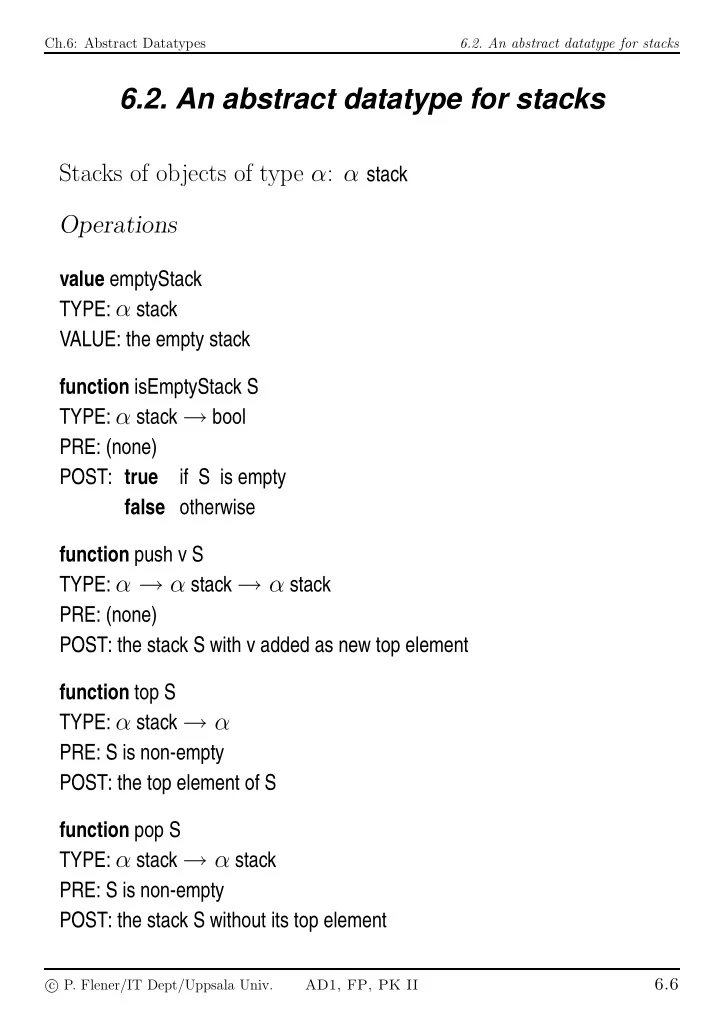
Ch.6: Abstract Datatypes 6.2. An abstract datatype for stacks 6.2. An abstract datatype for stacks Stacks of objects of type : stack Operations value emptyStack TYPE: stack VALUE: the empty stack function isEmptyStack S TYPE: stack


slide-1
SLIDE 1

Ch.6: Abstract Datatypes 6.2. An abstract datatype for stacks

6.2. An abstract datatype for stacks

Stacks of objects of type α: α stack Operations

value emptyStack TYPE: α stack VALUE: the empty stack function isEmptyStack S TYPE: α stack → bool PRE: (none) POST: true if S is empty false otherwise function push v S TYPE: α → α stack → α stack PRE: (none) POST: the stack S with v added as new top element function top S TYPE: α stack → α PRE: S is non-empty POST: the top element of S function pop S TYPE: α stack → α stack PRE: S is non-empty POST: the stack S without its top element

c

  • P. Flener/IT Dept/Uppsala Univ.

AD1, FP, PK II

6.6

slide-2
SLIDE 2

Ch.6: Abstract Datatypes 6.3. Realisation of the stack abstract datatype

6.3. Realisation of the stack abstract datatype

Version 1

Representation of a stack by a list:

type α stack = α list REPRESENTATION CONVENTION: the head of the list is the top of the stack, the 2nd element of the list is the element below the top, etc

Realisation of the operations (stack1.sml)

val emptyStack = [ ] fun isEmptyStack S = (S = [ ]) fun push v S = v::S fun top [ ] = error "top: empty stack" | top (x::xs) = x fun pop [ ] = error "pop: empty stack" | pop (x::xs) = xs

  • This realisation does not force the usage of the stack type
  • The operations can also be used with objects of type α list,

even if they do not represent stacks!

  • It is possible to access the elements of the stack

without using the operations specified above: no encapsulation!

c

  • P. Flener/IT Dept/Uppsala Univ.

AD1, FP, PK II

6.8

slide-3
SLIDE 3

Ch.6: Abstract Datatypes 6.3. Realisation of the stack abstract datatype

Version 2

Definition of a new constructed type using the list type:

datatype α stack = Stack of α list REPRESENTATION CONVENTION: the head of the list is the top of the stack, the 2nd element of the list is the element below the top, etc

Realisation of the operations

val emptyStack = Stack [ ] fun isEmptyStack (Stack S) = (S = [ ]) fun push v (Stack S) = Stack (v::S) fun top (Stack [ ]) = error "top: empty stack" | top (Stack (x::xs)) = x fun pop (Stack [ ]) = error "pop: empty stack" | pop (Stack (x::xs)) = Stack xs

  • The operations are now only defined for stacks
  • It is still possible to access the elements of the stack

without using the operations specified above, namely by pattern matching

c

  • P. Flener/IT Dept/Uppsala Univ.

AD1, FP, PK II

6.9

slide-4
SLIDE 4

Ch.6: Abstract Datatypes 6.3. Realisation of the stack abstract datatype

An abstract datatype (stack2.sml) Objective: encapsulate the definition of the stack type and its operations in a parameterised abstract datatype

abstype ’a stack = Stack of ’a list with val emptyStack = Stack [ ] fun isEmptyStack (Stack S) = (S = [ ]) fun push v (Stack S) = Stack (v::S) fun top (Stack [ ]) = error "top: empty stack" | top (Stack (x::xs)) = x fun pop (Stack [ ]) = error "pop: empty stack" | pop (Stack (x::xs)) = Stack xs end

  • The stack type is an abstract datatype (ADT)
  • The concrete representation of a stack is hidden
  • An object of the stack type can only be manipulated

via the functions defined in its ADT declaration

  • The Stack constructor is invisible outside the ADT
  • It is now impossible to access the representation of a stack
  • utside the declarations of the functions of the ADT
  • The parameterisation allows the usage of stacks of integers,

reals, strings, integer functions, etc, from a single definition!

c

  • P. Flener/IT Dept/Uppsala Univ.

AD1, FP, PK II

6.10

slide-5
SLIDE 5

Ch.6: Abstract Datatypes 6.3. Realisation of the stack abstract datatype

  • abstype ’a stack = Stack of ’a list with . . . ;

type ’a stack val ’a emptyStack = - : ’a stack val ’’a isEmptyStack = fn : ’’a stack -> bool ...

  • push 1 (Stack [ ]) ;

Error: unbound variable or constructor: Stack

  • push 1 emptyStack ;

val it = - : int stack

It is impossible to compare two stacks:

  • emptyStack = emptyStack ;

Error: operator and operand don’t agree [equality type required]

It is impossible to see the contents of a stack without popping its elements, so let us add a visualisation function:

function showStack S TYPE: α stack → α list PRE: (none) POST: the representation of S in list form, with the top of S as head, etc abstype ’a stack = Stack of ’a list with . . . fun showStack (Stack S) = S end

  • The result of showStack is not of the stack type
  • One can thus not apply the stack operations to it

c

  • P. Flener/IT Dept/Uppsala Univ.

AD1, FP, PK II

6.11

slide-6
SLIDE 6

Ch.6: Abstract Datatypes 6.3. Realisation of the stack abstract datatype

Version 3

Definition of a recursive new constructed type:

datatype α stack = EmptyStack | >> of α stack ∗ α infix >> EXAMPLE: EmptyStack >> 3 >> 5 >> 2 represents the stack with top 2 REPRESENTATION CONVENTION: the right-most value is the top of the stack, its left neighbour is the element below the top, etc

An abstract datatype (stack3.sml)

abstype ’a stack = EmptyStack | >> of ’a stack ∗ ’a with infix >> val emptyStack = EmptyStack fun isEmptyStack EmptyStack = true | isEmptyStack (S>>v) = false fun push v S = S>>v fun top EmptyStack = error "top: empty stack" | top (S>>v) = v fun pop EmptyStack = error "pop: empty stack" | pop (S>>v) = S fun showStack EmptyStack = [ ] | showStack (S>>v) = v :: (showStack S) end

We have thus defined a new list constructor, but with access to the elements from the right!

c

  • P. Flener/IT Dept/Uppsala Univ.

AD1, FP, PK II

6.12

slide-7
SLIDE 7

Ch.6: Abstract Datatypes 6.4. An abstract datatype for FIFO queues

6.4. An abstract datatype for FIFO queues

First-in first-out (FIFO) queues of objects of type α: α queue

  • Addition of elements to the rear (tail)
  • Deletion of elements from the front (head)

Operations

value emptyQueue TYPE: α queue VALUE: the empty queue function isEmptyQueue Q TYPE: α queue → bool PRE: (none) POST: true if Q is empty false otherwise function enqueue v Q TYPE: α → α queue → α queue PRE: (none) POST: the queue Q with v added as new tail element function head Q TYPE: α queue → α PRE: Q is non-empty POST: the head element of Q

c

  • P. Flener/IT Dept/Uppsala Univ.

AD1, FP, PK II

6.13

slide-8
SLIDE 8

Ch.6: Abstract Datatypes 6.4. An abstract datatype for FIFO queues

function dequeue Q TYPE: α queue → α queue PRE: Q is non-empty POST: the queue Q without its head element function showQueue Q TYPE: α queue → α list PRE: (none) POST: the representation of Q in list form, with the head of Q as head, etc

‘Formal’ semantics

isEmptyQueue emptyQueue = true

∀v,Q : isEmptyQueue (enqueue v Q) = false

head emptyQueue = ... error ...

∀v,Q : head (enqueue v Q) =

if isEmptyQueue Q then v else head Q dequeue emptyQueue = ... error ...

∀v,Q : dequeue (enqueue v Q) =

if isEmptyQueue Q then emptyQueue else enqueue v (dequeue Q)

c

  • P. Flener/IT Dept/Uppsala Univ.

AD1, FP, PK II

6.14

slide-9
SLIDE 9

Ch.6: Abstract Datatypes 6.5. Realisation of the queue abstract datatype

6.5. Realisation of the queue abstract datatype

Version 1

Representation of a FIFO queue by a list:

type α queue = α list REPRESENTATION CONVENTION: the head of the list is the head of the queue, the 2nd element of the list is behind the head of the queue, and so on, and the last element of the list is the tail of the queue

Example: the queue

8 7 2 5 3 head tail

is represented by the list [3,8,7,5,0,2] Exercises

  • Realise the queue ADT using this representation
  • What is the time complexity of enqueuing an element?
  • What is the time complexity of dequeuing an element?

c

  • P. Flener/IT Dept/Uppsala Univ.

AD1, FP, PK II

6.15

slide-10
SLIDE 10

Ch.6: Abstract Datatypes 6.5. Realisation of the queue abstract datatype

Version 2

Representation of a FIFO queue by a pair of lists:

datatype α queue = Queue of α list ∗ α list REPRESENTATION CONVENTION: the term Queue ([x1, x2, . . . , xn], [y1, y2, . . . , ym]) represents the queue

head tail

x1 xn ym y1

. . .

x2

. . .

y2

REPRESENTATION INVARIANT: (see next slide)

  • It is now possible to enqueue in Θ(1) time
  • It is still possible to dequeue in Θ(1) time,

but only if n ≥ 1

  • What if n = 0 while m > 0?!
  • The same queue can thus be represented in different ways
  • How to test the equality of two queues?

c

  • P. Flener/IT Dept/Uppsala Univ.

AD1, FP, PK II

6.16

slide-11
SLIDE 11

Ch.6: Abstract Datatypes 6.5. Realisation of the queue abstract datatype

Normalisation Objective: avoid the case where n = 0 while m > 0 When this case appears, transform (or: normalise) the representation of the queue: transform Queue ([ ], [y1, . . . , ym]) with m > 0 into Queue ([ym, . . . , y1], [ ]), which indeed represents the same queue We thus have:

REPRESENTATION INVARIANT: a non-empty queue is never represented by Queue ([ ], [y1, . . . , ym]) function normalise Q TYPE: α queue → α queue PRE: (none) POST: if Q is of the form Queue ([ ], [y1, . . . , ym]) then Queue ([ym, . . . , y1], [ ]) else Q

Realisation of the operations (queue2.sml) Construction of an abstract datatype: the normalise function may be local to the ADT, as it is only used for realising some operations on queues

c

  • P. Flener/IT Dept/Uppsala Univ.

AD1, FP, PK II

6.17

slide-12
SLIDE 12

Ch.6: Abstract Datatypes 6.5. Realisation of the queue abstract datatype

abstype ’a queue = Queue of ’a list ∗ ’a list with val emptyQueue = Queue ([ ],[ ]) fun isEmptyQueue (Queue ([ ],[ ])) = true | isEmptyQueue (Queue (xs,ys)) = false fun head (Queue (x::xs,ys)) = x | head (Queue ([ ],[ ])) = error "head: empty queue" | head (Queue ([ ],y::ys)) = error "head: non-normalised queue" local fun normalise (Queue ([ ],ys)) = Queue (rev ys,[ ]) | normalise Q = Q in fun enqueue v (Queue (xs,ys)) = normalise (Queue (xs,v::ys)) fun dequeue (Queue (x::xs,ys)) = normalise (Queue (xs,ys)) | dequeue (Queue ([ ],[ ])) = error "dequeue: empty queue" | dequeue (Queue ([ ],y::ys)) = error "dequeue: non-norm. queue" end fun showQueue (Queue (xs,ys)) = xs @ (rev ys) fun equalQueues Q1 Q2 = (showQueue Q1 = showQueue Q2) end

  • Why do the head and dequeue functions not normalise

the queue instead of stopping the execution with an error?

  • The normalisation and representation invariant are hidden

in the realisation of the abstract datatype

  • On average, the time of enqueuing and dequeuing is Θ(1)
  • This representation is thus very efficient!

c

  • P. Flener/IT Dept/Uppsala Univ.

AD1, FP, PK II

6.18

slide-13
SLIDE 13

Ch.6: Abstract Datatypes 6.6. An abstract datatype for binary trees

6.6. An abstract datatype for binary trees

Concepts and terminology Binary trees of objects of type α: α bTree

5 7 4 2 8 1 3 6 9

Operations

value emptyBtree TYPE: α bTree VALUE: the empty binary tree function isEmptyBtree T TYPE: α bTree → bool PRE: (none) POST: true if T is empty false otherwise

c

  • P. Flener/IT Dept/Uppsala Univ.

AD1, FP, PK II

6.19

slide-14
SLIDE 14

Ch.6: Abstract Datatypes 6.6. An abstract datatype for binary trees

function consBtree v L R TYPE: α → α bTree → α bTree → α bTree PRE: (none) POST: the binary tree with root v, left sub-tree L, and right sub-tree R function left T TYPE: α bTree → α bTree PRE: T is non-empty POST: the left sub-tree of T function right T TYPE: α bTree → α bTree PRE: T is non-empty POST: the right sub-tree of T function root T TYPE: α bTree → α PRE: T is non-empty POST: the root of T

‘Formal’ semantics

isEmptyBtree emptyBtree = true

∀v,L,R : isEmptyBtree (consBtree v L R) = false

root emptyBtree = ... error ...

∀v,L,R : root (consBtree v L R) = v

left emptyBtree = ... error ...

∀v,L,R : left (consBtree v L R) = L

right emptyBtree = ... error ...

∀v,L,R : right (consBtree v L R) = R

c

  • P. Flener/IT Dept/Uppsala Univ.

AD1, FP, PK II

6.20

slide-15
SLIDE 15

Ch.6: Abstract Datatypes 6.7. Realisation of the bTree abstract datatype

6.7. Realisation of the bTree abstract datatype

Representation

datatype bTree = Void | Bt of int ∗ bTree ∗ bTree REPRESENTATION CONVENTION: a binary tree with root x, left subtree L, and right subtree R is represented by Bt(x,L,R) EXAMPLE: Bt(4, Bt(2, Bt(1,Void,Void), Bt(3,Void,Void)), Bt(8, Bt(6, Bt(5,Void,Void), Bt(7,Void,Void)), Bt(9,Void,Void)))

Realisation of the operations (bTree.sml)

abstype ’a bTree = Void | Bt of ’a ∗ ’a bTree ∗ ’a bTree with val emptyBtree = Void fun isEmptyBtree Void = true | isEmptyBtre (Bt(v,L,R)) = false fun consBtree v L R = Bt(v,L,R) fun left Void = error "left: empty bTree" | left (Bt(v,L,R)) = L fun right Void = error "right: empty bTree" | right (Bt(v,L,R)) = R fun root Void = error "root: empty bTree" | root (Bt(v,L,R)) = v end

c

  • P. Flener/IT Dept/Uppsala Univ.

AD1, FP, PK II

6.21

slide-16
SLIDE 16

Ch.6: Abstract Datatypes 6.7. Realisation of the bTree abstract datatype

Walk operations (inorder.sml)

function inorder T TYPE: α bTree → α list PRE: (none) POST: the nodes of T upon an inorder walk fun inorder Void = [ ] | inorder (Bt(v,L,R)) = (inorder L) @ (v :: inorder R)

No tail recursion! It takes Θ(n log n) time for a binary tree of n nodes. . .

function inorderGen T acc TYPE: α bTree → α list → α list PRE: (none) POST: (the nodes of T upon an inorder walk) @ acc fun inorderGen Void acc = acc | inorderGen (Bt(v,L,R)) acc = let val rAcc = inorderGen R acc in inorderGen L (v::rAcc) end fun inorder t = inorderGen t [ ]

One tail recursion! No call to @ (concatenation)! It takes Θ(n) time for a binary tree of n nodes Exercises

  • Efficiently realise the preorder and postorder walks
  • f a binary tree, and analyse the underlying algorithms
  • How to test the equality of two binary trees?

c

  • P. Flener/IT Dept/Uppsala Univ.

AD1, FP, PK II

6.22

slide-17
SLIDE 17

Ch.6: Abstract Datatypes 6.7. Realisation of the bTree abstract datatype

Other operations

function exists k T TYPE: α= → α= bTree → bool PRE: (none) POST: true if T contains node k false otherwise function insert k T TYPE: α= → α= bTree → α= bTree PRE: (none) POST: T with node k function delete k T TYPE: α= → α= bTree → α= bTree PRE: (none) POST: if exists k T, then T without one occurrence of node k, otherwise T function nbNodes T TYPE: α bTree → int PRE: (none) POST: the number of nodes of T function nbLeaves T TYPE: α bTree → int PRE: (none) POST: the number of leaves of T

Exercises

  • Efficiently realise these five functions
  • Show that their algorithms at worst take Θ(n) time,

if not Θ(1) time, on a binary tree with initially n nodes

c

  • P. Flener/IT Dept/Uppsala Univ.

AD1, FP, PK II

6.23

slide-18
SLIDE 18

Ch.6: Abstract Datatypes 6.7. Realisation of the bTree abstract datatype

Height of a binary tree (height.sml)

  • The height of a node is the length of the longest path

(measured in its number of nodes) from that node to a leaf

  • The height of a tree is the height of its root

function height T TYPE: α bTree → int PRE: (none) ; POST: the height of T fun height Void = 0 | height (Bt(v,L,R)) = 1 + Int.max (height L, height R)

No tail recursion! It takes Θ(n) time for a binary tree of n nodes. Note that heightGen T acc = acc + height T does not suffice to get a tail recursion: why?!

function heightGen T acc hMax TYPE: α bTree → int → int → int PRE: (none) ; POST: max (acc + height T, hMax) fun heightGen Void acc hMax = Int.max (acc, hMax) | heightGen (Bt(v,L,R)) acc hMax = let val h1 = heightGen R (acc+1) hMax in heightGen L (acc+1) h1 end fun height2 bt = heightGen bt 0 0

One tail recursion! It also takes Θ(n) time for a binary tree of n nodes, but it takes less space!

c

  • P. Flener/IT Dept/Uppsala Univ.

AD1, FP, PK II

6.24

slide-19
SLIDE 19

Ch.6: Abstract Datatypes 6.8. An ADT for Binary Search Trees (BSTs)

6.8. An ADT for Binary Search Trees (BSTs)

Concepts and terminology (see the tree on slide 6.19) Binary search trees of nodes of type (α=, β): (α=, β) bsTree where:

  • α= is the type of the keys (need for an equality test)
  • β is the type of the satellite data for each key

are binary trees with:

(REPRESENTATION) INVARIANT: for a binary search tree with (k,s) in the root, left subtree L, and right subtree R:

  • every element of L has a key smaller than k
  • every element of R has a key

larger than k

Note that we (arbitrarily) ruled out duplicate keys Benefits

  • The inorder walk of a binary search tree

lists its nodes by increasing order of their keys!

  • The basic operations at worst take Θ(n) time
  • n a binary search tree with (initially) n nodes, but they

take O(lg n) time on randomly built binary search trees Let us restrict our realisation to integer keys: β bsTree

c

  • P. Flener/IT Dept/Uppsala Univ.

AD1, FP, PK II

6.25

slide-20
SLIDE 20

Ch.6: Abstract Datatypes 6.8. An ADT for Binary Search Trees (BSTs)

Some operations

value emptyBsTree TYPE: β bsTree VALUE: the empty binary search tree function isEmptyBsTree T TYPE: β bsTree → bool PRE: (none) POST: true if T is empty false otherwise function exists k T TYPE: int → β bsTree → bool PRE: (none) POST: true if T contains a node with key k false otherwise function insert (k,s) T TYPE: (int ∗β) → β bsTree → β bsTree PRE: (none) POST: if exists k T, then T with s as satellite data for key k

  • therwise T with node (k,s)

function retrieve k T TYPE: int → β bsTree → β PRE: exists k T POST: the satellite data associated to key k in T function delete k T TYPE: int → β bsTree → β bsTree PRE: (none) POST: if exists k T, then T without the node with key k, otherwise T

c

  • P. Flener/IT Dept/Uppsala Univ.

AD1, FP, PK II

6.26

slide-21
SLIDE 21

Ch.6: Abstract Datatypes 6.9. Realisation of the bsTree ADT

6.9. Realisation of the bsTree ADT

Representation

datatype ’b bsTree = Void | Bst of (int ∗ ’b) ∗ ’b bsTree ∗ ’b bsTree REPRESENTATION CONVENTION: a BST with (k,s) in the root, left subtree L, and right subtree R is represented by Bst((k,s),L,R) REPRESENTATION INVARIANT: (see slide 6.25)

Realisation of the operations (bsTree.sml)

val emptyBsTree = Void fun isEmptyBsTree Void = true | isEmptyBsTree (Bst((key,sat),L,R)) = false fun exists k Void = false | exists k (Bst((key,sat),L,R)) = if k = key then true else if k < key then exists k L else (∗ k > key ∗) exists k R fun insert (k,s) Void = Bst((k,s),Void,Void) | insert (k,s) (Bst((key,sat),L,R)) = if k = key then Bst((k,s),L,R) else if k < key then Bst((key,sat), (insert (k,s) L), R) else (∗ k > key ∗) Bst((key,sat), L, (insert (k,s) R)) fun retrieve k Void = error "retrieve: non-existing node" | retrieve k (Bst((key,sat),L,R)) = if k = key then sat else if k < key then retrieve k L else (∗ k > key ∗) retrieve k R

c

  • P. Flener/IT Dept/Uppsala Univ.

AD1, FP, PK II

6.27

slide-22
SLIDE 22

Ch.6: Abstract Datatypes 6.9. Realisation of the bsTree ADT

When deleting a node (key,sat) whose subtrees L and R are both non-empty, we must not violate the repr. invariant! 1.Replace (key,sat) by the node with the maximal key of L, whose key is smaller than the key of any node of R (one could also replace by the node with the minimal key of R) 2.Remove this node with the maximal key from L So we need a deleteMax function:

function deleteMax T TYPE: β bsTree → (int ∗ β) ∗ β bsTree PRE: T is non-empty POST: (max, NT), where max is the node of T with the maximal key, and NT is T without max fun deleteMax Void = error "deleteMax: empty bsTree" | deleteMax (Bst(r,L,Void): ’b bsTree) = (r, L) | deleteMax (Bst(r,L,R)) = let val (max, newR) = deleteMax R in (max, Bst(r,L,newR)) end fun delete k Void = Void | delete k (Bst((key,sat),L,R)) = if k < key then Bst((key,sat), (delete k L), R) else if k > key then Bst((key,sat), L, (delete k R)) else (∗ k = key ∗) case (L,R) of (Void, ) => R | ( ,Void) => L | ( , ) => let val (max, newL) = deleteMax L in Bst(max,newL,R) end

c

  • P. Flener/IT Dept/Uppsala Univ.

AD1, FP, PK II

6.28