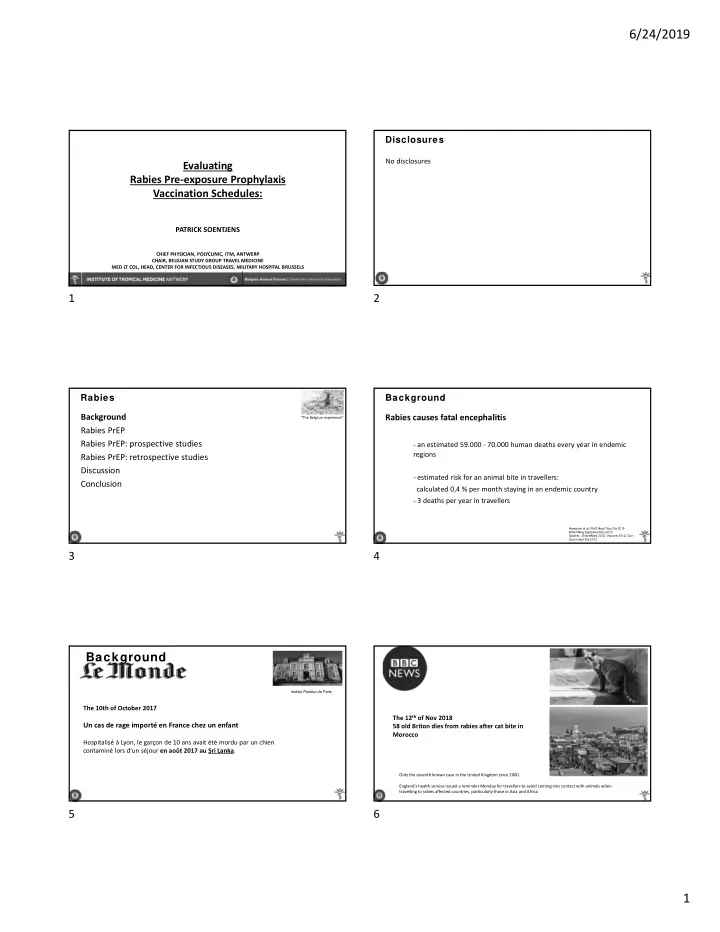
6/24/2019 Disclosures No disclosures Evaluating Rabies Pre exposure - - PDF document

6 24 2019
SMART_READER_LITE
LIVE PREVIEW

6/24/2019 Disclosures No disclosures Evaluating Rabies Pre exposure - - PDF document

6/24/2019 Disclosures No disclosures Evaluating Rabies Pre exposure Prophylaxis Vaccination Schedules: PATRICK SOENTJENS CHIEF PHYSICIAN, POLYCLINIC, ITM, ANTWERP CHAIR, BELGIAN STUDY GROUP TRAVEL MEDICINE MED LT COL, HEAD, CENTER FOR


slide-1
SLIDE 1

6/24/2019 1

Evaluating Rabies Pre‐exposure Prophylaxis Vaccination Schedules:

PATRICK SOENTJENS

CHIEF PHYSICIAN, POLYCLINIC, ITM, ANTWERP CHAIR, BELGIAN STUDY GROUP TRAVEL MEDICINE MED LT COL, HEAD, CENTER FOR INFECTIOUS DISEASES, MILITARY HOSPITAL BRUSSELS

No disclosures

Disclosures Background Rabies PrEP Rabies PrEP: prospective studies Rabies PrEP: retrospective studies Discussion Conclusion Rabies

“The Belgium experience”

Rabies causes fatal encephalitis

‐ an estimated 59.000 ‐ 70.000 human deaths every year in endemic regions ‐ estimated risk for an animal bite in travellers: calculated 0,4 % per month staying in an endemic country ‐ 3 deaths per year in travellers

Background

Hampson et al. PloS Negl Trop Dis 2015 WHO Wkly Epidemiol Rec 2010 Gautret: JTravelMed 2012; Vaccine 2012; Curr Opin Infect Dis 2012

5

Institut Pasteur de Paris

The 10th of October 2017

Un cas de rage importé en France chez un enfant

Hospitalisé à Lyon, le garçon de 10 ans avait été mordu par un chien contaminé lors d’un séjour en août 2017 au Sri Lanka.

Background

Only the seventh known case in the United Kingdom since 2000. England's health service issued a reminder Monday for travellers to avoid coming into contact with animals when travelling to rabies affected countries, particularly those in Asia and Africa

The 12th of Nov 2018 58 old Briton dies from rabies after cat bite in Morocco

1 2 3 4 5 6

slide-2
SLIDE 2

6/24/2019 2

The 6th of May 2019 Norwegian woman dies from rabies after Philippines puppy bite

Birgitte Kallestad, 24 year old, was on holiday with friends when they found the puppy on a street. She fell ill soon after returning to Norway, and died on Monday at the hospital where she worked.

Family statement of Brigitte the 15th of May at www.promed.org

"Our dear Birgitte loved animals. Our fear is that such fate may happen to others who have a warm heart like her. We want rabies vaccine to be included in the program for travellers to locations where the disease is present, and that people become more aware of the danger. If we manage to achieve this, the death of

  • ur sunbeam can save others. Warm greetings from the family."

Rabies risk during travel: low risk – animal bite: high risk Background

Steffen: J Travel Med 2015 and adapted 2018

Start PEP immediately

Rabies risk: prevention Increase awareness Avoid contact with street dogs, monkeys and other mammals Background

Shlim: J Travel Med 2019

Rabies risk: have a back‐up plan Travel insurance Background

Shlim: J Travel Med 2019

Rabies risk: start Rabies PEP procedure in time Washing ‐ Soap ‐ Desinfection Respective PEP schedule and HRIG Background

WHO report 2018

7 8 9 10 11 12

slide-3
SLIDE 3

6/24/2019 3

Rabies risk: difficulties with Human Rabies Immunoglobulins (HRIG) In time ‐ Availability ‐ Costs? Equine Rabies Immunoglobulins? Background Belgian Rabies PEP data 2017 with use of HRIG in BE

N = 75

  • 44 of the cases (58%) were female.
  • Mean age was 33 years (interquartile range 24 ‐ 51; range: 4 ‐ 85).
  • Mean time delay between exposure and the administered HRIG was 8.7 days:

‐ 9.6 days (IQR 2,5 ‐ 9) for abroad travel

‐ 6 days (IQR 1 ‐ 4) for inland bat‐related risks.

  • Mean time delay between exposure and the first administered dose of rabies

vaccine was 7.7 days: ‐ 8.3 days (IQR 0 ‐ 8,5) for abroad travel

‐ 6 days (IQR 1 ‐ 4) for inland bat‐related risks

Background

Soentjens et al Acta Clin Belgica 2019

Immunescence following Rabies PEP: research gaps

Belgian Rabies PEP data 2017 ITM N = 63 (of 75) One single patient had no response (RFFIT < 0.5 IU/mL) after a full 51IM PEP schedule with HRIG The timing of the vaccinations and the serology test were in accordance Age = 80 years Serology testing (RFFIT) is crucial in Rabies PEP when decreasing PrEP and PEP doses

Background

Soentjens et al Acta Clin Belgica 2019

Clin Infect Dis 2012

Concept BOOST Rabies pre‐ and postexposure prophylaxis (PEP without PrEP)

‘Adequate immune response = lifelong antibodies RFFIT > 0.5 IU/mL’

No PrEP schedule

RFFIT > 0.5 IU/ml WHO guideline

Risk cat III PEP IM schedule Naive B‐cells

Rabies PEP schedules in Belgium (2019)

Schedules D0 D3 D7 D14 D21 D28 D+10 Indications Rabies PEP after PrEP Schedule 1:

2 intramuscular njections / 2 visits 1 x 1 x No RFFIT Contact category II en III 4 intradermal injections / 1 visit 1 injection = 0.1 mL

Rabies PEP without previous PrEP Schedule 2:

4 intramuscular injections / 3 visits 2 x 1 x 1 x No RFFIT Contact category II Exception to do RFFIT on D31 if: ‐ vaccination schedule started

  • verseas

‐ in ‘vulnerable’ patients

Schedule 3:

5 intramuscular injections / 5 visits + Human rabies immunoglobulins (HRIG) 1 x 1 x 1 x 1 x 1 x RFFIT D38 Contact category III

Result RFFIT > 3.0 IU/ml

Result RFFIT > 5.0 IU/ml (if bat‐related or immunosuppression) 1 x PEP: post‐ exposure prophylaxis – PrEP: pre‐exposure prophylaxis – RFFIT: rabies rapid fluorescent focus inhibition test

RFFIT: rabies rapid fluorescent focus inhibition test is key in rabies prevention procedures

13 14 15 16 17 18

slide-4
SLIDE 4

6/24/2019 4

New BE guideline 2019: sparing HRIG HRIG only in wound ‐ same dosage (20 IU/kg) or less inject minimal 2 mL Rabies PEP 2019

https://www.itg.be/Files/docs/Reisgeneeskunde/PEP_Rabies_ENG.pdf

Concept BOOST Rabies pre‐ and postexposure prophylaxis (PEP without PrEP)

‘Adequate immune response = lifelong antibodies RFFIT > 0.5 IU/mL’

No PrEP schedule

RFFIT > 0.5 IU/ml WHO guideline

Risk cat III PEP schedule

RFFIT > 3.0 IU/ml BE guideline

Rabies risk: promote pre‐exposure vaccination Revised WHO recommendations for rabies pre‐exposure prophylaxis in travellers: avoid bumpy roads, select the highway! Background

Knopf, Steffen: J Travel Med 2019

Tackling the high rabies human case fatality rate To use newer practical regimens

‐ 1 deceased 10 y France ‐ 1 deceased 58 y UK ‐ 1 deceased 24 y Norway

Background

PrEP + PEP 2ID mL PrEP 2 0.4 mL PEP 1 0.4 mL Total visits 3 0.8 mL Intradermal

Background Rabies PrEP Rabies PrEP: prospective studies Rabies PrEP: retrospective studies Discussion Conclusion Rabies

“The Belgium experience”

New WHO publication since the 17th of April 2018: Technical Report

Rabies PrEP

Guidelines on PrEP and PEP

19 20 21 22 23 24

slide-5
SLIDE 5

6/24/2019 5

WHO publication of the 17th of Apr 2018: Promote intradermal (ID) schedules

‐ ID as effective as IM injection ‐ Technical guidance: ID technique is not difficult ‐ Use always single‐dose injections on two sites during each visit

But ID schedules are off‐label…

Background

=

WHO guidelines > 2‐visit regimen for rabies PrEP: 2ID or 2IM

Rabies PrEP

21IM 2²ID

WHO guidelines: BE guideline from 1st May 2018: two‐visit regimens

New Rabies PrEP regimens that are recommended in first line for individuals of all ages are: ‐ 2‐site ID vaccine administration on day 0 and 7

2²ID double dose 2x 0.1 ml on day 0 and day 7

‐ 1‐site IM vaccine administration on day 0 and 7

21IM single dose 1x ampoule (1ml) on day 0 and day 7

Rabies PrEP

Day 0 Day 7

Rabies PrEP completed, additional vaccines needed after bite / risk

WHO guidelines: 1‐visit regimen: 1ID or 1IM

Rabies PrEP

1²ID 11IM Preferred rabies PrEP schedule: two‐visit schedules Use a one visit rabies PrEP schedule in last‐minute travelers ‐ ID0.1ml

d 0 ID (double dose) > d X ID after travel (double dose)

‐ IM1.0 ml

d 0 IM > d X after travel

Rabies PrEP guideline in BE (from 1st of May 2018)

Changing the PrEP strategy from strictly 3 visits to 2 visits > to 1 visit as an option

Rabies PrEP completed, additional vaccines needed after bite / risk

Add stamp

Who is using this PrEP regimens? Off‐label

No guideline to use off‐label: optional by practitioner 2²ID Ireland?, Australia?, New Zealand? 21IM Germany Guideline to use off‐label 2²ID Belgium, The Netherlands, Canada, Japan, … 21IM Belgium, Denmark, The Netherlands, Canada,… 1²ID or 11IM Belgium,… Guidelines on 2IM + booster Adapted 31IM: 21IM + 11IM Switzerland Unchanged guidelines on 3IM + booster Adapted 31IM + booster 11IM UK, USA, Germany, France, Italy, Spain,…

25 26 27 28 29 30

slide-6
SLIDE 6

6/24/2019 6

Langedijck et al. Clin Infect Dis 2018

22 studies included in meta‐analysis

N Age Rabies PreP IM PEP IM Day 0 (‐ 3) RFFIT

≥ 0,5IU/ml

GMT

Mean IU/ml

Strady 2009 N = 274 42 years (12‐79) 33% F 2IM HDCV‐PVRV 2IM HDCV‐PVRV after 10 y 100%

35.6 D14

Vien 2008 N = 86 2 ‐ 4 m 50% F 2IM PVRV 2 months 1IM PVRV after 1 y 100%

35,0 D14

Rabies 2-visit IM: prime and boost

D0 D56 D0 D3 D7 D0 D0

N = 360 subjects 2IM N Age Rabies PreP ID PEP ID Day 0 ( ‐ 3) RFFIT

≥ 0,5IU/ml

GMT

Mean IU/ml

Kamoltham 2007 N = 84 5‐8 years F 46% PCECV 2ID 0,1 ml 1 year PCECV 2ID 0,1 ml

D7 96% D14 100%

D7 4.69 D14 10.76

Pengsaa 2009 N = 44 12‐18 months PCECV 2ID 0,1 ml 1 year PCECV 1ID 0,1ml

D7 100%

13.0

Wongsaroj 2013 N = 36 18‐24 years PVRV 2ID 2x0,1 ml 1 year PVRV 1ID 0,1 ml

D14 100%

14.38

PrEP rabies 2-visit ID: prime and boost

D28 D3 D0 D28 D0 D0 D0 D21 D0 D3 D0

N = 164 subjects 2ID N Age Rabies PreP ID % > 0.5 IU/ml GMT

Mean IU/ml

Mills 2011 N = 420

10‐65 years F: 54%

HDCV 2ID 0,1 ml

ELISA After D14 to D21

94,5%

No data

Lau 2013 N = 54

Years 10‐49 years F: 50%

PCECV 2ID 0,1 ml

ELISA After 21 days

94,4%

De Pijper 2018 N = 430

18‐48 years M: 97%

PVRV 2ID 2x0,1 ml

RFFIT After 14 days

99,3%

After 14 days 6.25 (80%) After 21 days 15.65 (20%)

Other rabies 2-visit ID: prime w ithout boost

D28 D0 D28 D0 D7 0,5 ml D0

N = 904 subjects 2ID

IM versus single-dose ID regimens

PrEP IM 3x 1.0 mL << >> ID 3x 0.1 ID d0 ‐ d7 ‐ d28 (single dose)

  • S. Recuenco et al. Vaccine 2017.

PrEP IM PrEP ID

31 32 33 34 35 36

slide-7
SLIDE 7

6/24/2019 7

IM versus single-dose ID regimens

PEP 1IM (1 mL) versus 1ID (0.1 mL) (single dose!)

  • S. Recuenco et al. Vaccine 2017.

PEP IM PEP ID

  • Those who spend long periods in at‐risk areas or in remote areas where no

medical assistance is available promptly.

  • Those who often travel to endemic regions or will do so frequently in the

future.

  • Travellers who undertake long cycle rides or joggers in endemic regions.
  • Children who go and live with their parents in endemic regions.
  • Those with an increased risk due to their profession or activities, such as

vets, foresters, veterinary students or bat protection volunteers.

  • Military personnel who go to endemic regions on missions.
  • Laboratory staff or experts who come into contact with the virus for

professional reasons (e.g. laboratory activities).

Recommendation of Belgian Superior Health Council: Preventive vaccination is recommended for the following people:

Rabies PrEP and PEP schedules (Belgium 2019)

Schedul e PrEP Volume Day Day 7 Day X Day Y Schedule PEP Volume Day Day 3 Day 7 Day 14‐21 Day 28 Total Volume

New standard PrEP ID (2 visits) with PEP ID (1 visit) 2²ID

4 x 0,1 mL

14ID

4 x 0,1 mL 0.8 mL

Alternative PrEP ID (1 visit + 1 visit X) with PEP ID (1 visit) in travellers 2²ID

4 x 0,1 mL

14ID

4 x 0,1 mL 0.8 mL

New standard PrEP IM (2 visits) with PEP IM (2 visits) 21IM

2 x 1.0 mL

21IM

2 x 1.0 mL 4.0 mL

Alternative PrEP ID (1 visit + 1 visit X) with PEP ID (1 visit) in travellers 11IM

1 x 1.0 mL 2 x 1.0 mL 4.0 mL

Standard PEP IM (3 visits) without MARIG 41IM

4 x 0.1 mL 4.0 mL

Standard PEP IM (5 visits) with MARIG 51IM + HRIG

5 x 1.0 mL 5.0 mL + 2 ‐ 8 mL + RFFIT RFFIT Rabies Fluorescent Focus Inhibition Test

Background Rabies PrEP Rabies PrEP: prospective studies Rabies PrEP: retrospective studies Discussion Conclusion Rabies

“The Belgium experience”

Rabies vaccination schedules in Belgian soldiers:

“it started as a small project”

Shortage of immunoglobulins

‐ Advise pre‐exposure vaccination in high risk or long‐term travelers

Shortage of vaccine

‐ Promote volume‐sparing intradermal vaccination

High cost of primary vaccination

‐ Promote low cost intradermal vaccination

Lack of preparation time

‐ Evaluate shorter schedules of intradermal pre‐exposure vaccination

Rationale to use simplified intradermal (ID) regimens

Lembo PlosNTD 2010 Wilde JTravel Med 2013; Bourhy Eurosurveil 2009 Khawlplod JTravelMed 2002 - 2007; Vaccine 2012 Mills JTravelMed 2011

37 38 39 40 41 42

slide-8
SLIDE 8

6/24/2019 8

Rationale for simplified ID regimens Intradermal Rabies PrEP in BE troops

ID injection by stimulating dendritic cells in the skin and lymph nodes Reduced dose ‐ volume ‐ 1/10th of 1 ml IM dose: 1 x 0.1 ml ID 0.1ID 11ID ‐ 1/5th of 1 ml IM dose: 2 x 0.1 ml ID 2x 0.1ID 1²ID Shortening priming schedules More than N = 10.000 subjects are vaccinated Number of visits Priming schedule

41ID: 4 visits: single shots of 0.1 ml 31ID: 3 visits: single shots of 0.1 ml 2²ID: 2 visits: two shots of 0.1 ml 1²ID: 1 visit: two shots of 0.1 ml

Reference centers for ID use for technical reasons??? ID technique = easy to learn ‐ always double‐dose ID regimens ‐ use syringes for diabetic use ‐ prepare 0,10 – 0,13 mL for each injection site ‐ inject always in both (fore)arms ‐ check the size of the papule (> 6 mm is fine, if not sure – revaccinate) ‐ add a stamp in the vaccination card (necessary due the different regimens used worldwide)

Technical problems w ith ID use

Prospective RCTs on ID Rabies PrEP and PEP schedules in BE Armed Forces

Healthy BE soldiers PrEP

Volume Day 0 Day 7 Day 28

% RFFIT

> 0.5 IU/mL

GMT PEP

Volume Day 0

% RFFIT

> 0.5 IU/mL Day 7

GM T RCT 1 N = 250 2²ID

4 x 0.1 mL

100% 13 11ID

1 x 0,1 mL

100% 37 N = 250 31ID

3 x 0.1 mL

100% 18 11ID

1 x 0.1 mL

100% 25 RCT 2 N = 151 1²ID

2 x 0.1 mL

83,5%

D14

1.3 14ID

4 x 0.1 mL

99,3% 20 N = 151 1²ID

2 x 0.1 mL

99,3% 14

ImiQ: application of topical Imiquimod at time of injection during 6 hours Intramuscular injection and rabies immunoglobulines Intradermal injection

  • P. Soentjens Clin Infect Dis 2018
  • P. Soentjens Clin Infect Dis 2019

43 44 45 46 47 48

slide-9
SLIDE 9

6/24/2019 9

Prospective RCTs on ID Rabies PrEP and PEP schedules in BE Armed Forces

Healthy BE soldiers PrEP

Volume Day 0 Day 7 Day 28

% RFFIT

> 0.5 IU/mL

GMT PEP

Volume Day 0

% RFFIT

> 0.5 IU/mL Day 7

GMT RCT 1 N = 250 2²ID

4 x 0.1 mL

100% 13 11ID

1 x 0,1 mL

100% 37 N = 250 31ID

3 x 0.1 mL

100% 18 11ID

1 x 0.1 mL

100% 25 RCT 2 N = 151 1²ID

2 x 0.1 mL

83%

D14

1.3 14ID

4 x 0.1 mL

99,3% 20 N = 151 1²ID

2 x 0.1 mL

99,3% 14

ImiQ: application of topical Imiquimod at time of injection during 6 hours Intramuscular injection and rabies immunoglobulines Intradermal injection

Prospective RCTs on ID Rabies PrEP and PEP schedules in BE Armed Forces

Healthy BE soldiers PrEP

Volume Day 0 Day 7 Day 28

% RFFIT

> 0.5 IU/mL

GMT PEP

Volume Day 0

% RFFIT

> 0.5 IU/mL Day 7

GM T RCT 1 N = 250 2²ID

4 x 0.1 mL

100% 13 11ID

1 x 0,1 mL

100% 37 N = 250 31ID

3 x 0.1 mL

100% 18 11ID

1 x 0.1 mL

100% 25 RCT 2 N = 151 1²ID

2 x 0.1 mL

83%

D14

1.3 14ID

4 x 0.1 mL

99,3% 20 N = 151 1²ID

2 x 0.1 mL

99,3% 14

ImiQ: application of topical Imiquimod at time of injection during 6 hours Intramuscular injection and rabies immunoglobulines Intradermal injection 50% VAX‐ID

Novosanis

VAX‐ID device

RCT3: 1²ID: Evaluating the VAX-ID™ device

Easier in use? More effective? Lesser pain?

Background Rabies PrEP Rabies PrEP: prospective studies Rabies PrEP: retrospective studies Discussion Conclusion Rabies

“The Belgium experience”

Retrospective studies on ID Rabies PrEP (and PEP) schedules in Belgian Armed Forces

BE soldiers PrEP

Volume Day Day 7 Day 28 Day 365

% RFFIT

> 0.5 IU/mL

% RFFIT

> 3.0 IU/mL

PEP BE soldiers

Volume Day

% RFFIT

> 0.5 IU/mL Day 7

% RFFIT

> 3.0 IU/mL

Retro 1 N= 881 41ID

4 x 0.1 mL

100%

mean = 145d range 7 – 1603

96,6% Retro 2 N= 489 31ID

3 x 0,1 mL

82%

Mean = 405d

35%

Mean = 405d

11ID N = 43

1 x 0.1 mL

100% Retro 3 N= 2112 31ID

3 x 0,1 mL

99,9% 83,9% Retro 4 N= 301 2²ID

2 x 2 x 0.1 mL

98,8% 81,7%

Intradermal injection of 0,1 mL of rabies vaccine

B.Damanet et al. CISTM 2019 N = 3783

Background Rabies PrEP Rabies PrEP: prospective studies Rabies PrEP: retrospective studies Discussion Conclusion Rabies

“The Belgium experience”

49 50 51 52 53 54

slide-10
SLIDE 10

6/24/2019 10

Discussion: schedule needs to be 100% effective Use a regimen that is 100% preventable Discussion

Among all the infectious diseases, rabies is the most easy to prevent’

Use a regimen that is 100% preventible Discussion

9IM PrEP PEP 9 Total visits 9

To use a regimen that is 100% preventable Discussion

9IM 5IM 3IM 6ID 6IM 5ID 5IM 4ID 4IM 3ID 3IM 3ID 3IM 2ID 2IM PrEP 4 3 2 2 1 1 PEP 9 5 3 2 2 2 1 2 1 Total visits 9 5 3 6 5 4 3 3 2

Use a regimen that is 100% preventable Discussion

4IM PrEP 2 PEP 2 Total visits 4 3ID PrEP 2 PEP 1 Total visits 3 Intradermal OK Intramuscular OK

Discussion: future studies

55 56 57 58 59 60

slide-11
SLIDE 11

6/24/2019 11

Subject ‐ Older age (> 50 years) ‐ Vulnerable population like immunosuppressed ‐ Children Booster studies after primary vaccination with some larger time delay Immunological studies: B‐ cell and T‐cell function Use of enhancers, like adjuvants Use of devices or patches

Future studies on 1²ID - 2²ID - 1IM - 2IM

Leo Vissers’ team Leiden (NL) 1²ID ‐ 2²ID ‐ 1IM ‐ 2IM B‐cell and T‐cell Older age

Discussion: long-lasting immunity

Persistance of Antibodies JTM 2007 Malerczyk Vaccine 2006 Suwansrinon Vaccine 2008 Brown Vaccine 2011 Fayaz N 15 118 89 26 IM or ID IM/ID PrEP IM/ID PrEP ID PrEP IM PEP RFFIT > 0,5 IU/ml 22% 100 % 100 % RFFIT > 0,5 IU/ml After booster 100% 1 x 1 mL IM 100% d0 0,1 mL ID d3 0,1 mL ID 100 % + 1 booster IM (65%) Time interval After PrEP/PEP 15 years 21 years 10 years 32 years

Discussion: increase in use 13 BE clinics: 2‐visit ID and IM regimen (mostly 2IM) 2 BE centers: 2‐visit ID rabies regimen Discussion: costs

61 62 63 64 65 66

slide-12
SLIDE 12

6/24/2019 12

Costs of 3IM – 2IM – 2²ID Discussion: vaccine volume Limited vaccine volume

Vaccine stock of every travel clinic = limited (related to pharmaceutical production = limited worldwide)

Travel clinic stock N= 1000 vaccines 1 ml Subjects reached by IM Subjects reached by ID 3‐visit 333 > 3000

Single dose/visit

2‐visit 500 > 2000

Double dose/visit

1‐visit (1000) (+/‐ 5000)

Double dose/visit

What are the barriers?

  • ID: off‐label ‐ difficult technique ‐ painful ‐ research on single‐visit

regimens

  • Vaccine: more stock ‐ cost ‐ more potent (single‐visit) ‐ no cold chain

‐ more production ‐ small incubator

  • Devices: needle‐free – others
  • Surveillance

Discussion

Off-label intradermal schedules for Rabies

71

Used since 1960 Recommended by WHO since 1984 Packaging containing 1/10 (0,1 ml), approved by the US FDA in 1984 but withdrawn Still recommended by WHO in 2013 Not recommended anymore by the UK and the US authorities Since 2018 recommended by WHO only as double-dose during each visit

67 68 69 70 71 72

slide-13
SLIDE 13

6/24/2019 13

Conclusion

‐ Have a plan for rabies: rabies low‐risk – rabies PEP procedures high risk ‐ Off‐label use is a regulatory barrier in some countries. ‐ The studies on two‐visit rabies PrEP regimens = highway

‐ Double‐dose single‐visit 1²ID and double‐dose two‐visit 2²ID are schedules, that are easy in use, safe, and at low cost. ‐ Single‐visit 1²ID PrEP schedule provides an adequate immune response 7 days after booster doses.

‐ Investment once in a lifetime!

Many thanks

Collaborators

Institute of Tropical Medicine Antwerp

Yven Van Herreweghe, PhD Natacha Herssens Bart Smekens Achilleas Tsoumanis Christophe Burm

Military Hospital Queen Astrid Brussels, Belgian Defense

Petra Andries Benjamin Damanet Katrien De Koninck Eric Dooms, MD Peter Vanbrabant, MD Mony Hing, MD Quentin Ledure, Pha Katrijn Ghoos, MD Sarah Djebara, MD

Scientific Institute of Public Health Brussels

Steven Van Gucht, Vet PhD Sanne Terryn, Vet PhD

73 74