$$ 60% of AVF created are not suitable for hemodialysis, N=877 - - PowerPoint PPT Presentation

60 of avf created are not suitable for hemodialysis n 877
SMART_READER_LITE
LIVE PREVIEW

$$ 60% of AVF created are not suitable for hemodialysis, N=877 - - PowerPoint PPT Presentation

Disclosures None Drug-Coated Balloons Will They Impact AVF Failure? Charles Eichler Professor, Department of Surgery Division of Vascular and Endovascular Surgery University of California San Francisco 4/15/2016 2 Presentation Title and/or


slide-1
SLIDE 1

[ADD PRESENTATION TITLE: INSERT TAB > HEADER & FOOTER > NOTES AND HANDOUTS] 4/15/2016 1

Drug-Coated Balloons

4/15/2016

Charles Eichler Professor, Department of Surgery Division of Vascular and Endovascular Surgery University of California San Francisco

Will They Impact AVF Failure?

Disclosures

None

2 Presentation Title and/or Sub Brand Name Here 4/15/2016

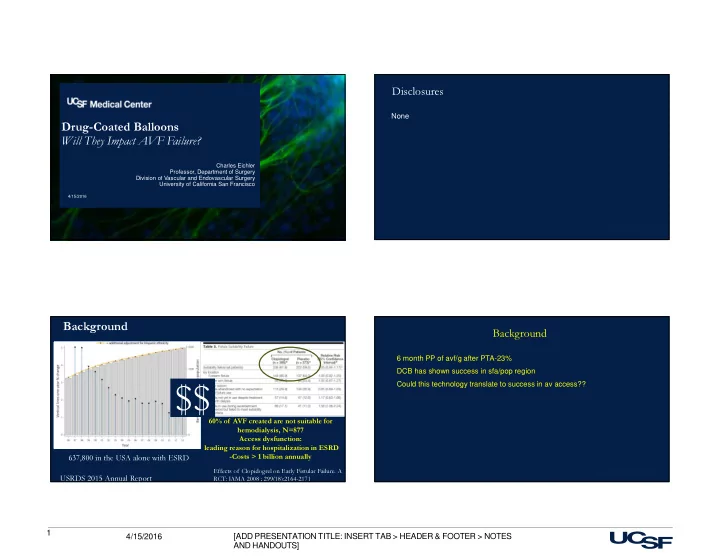
Background

60% of AVF created are not suitable for hemodialysis, N=877 Access dysfunction: leading reason for hospitalization in ESRD

  • Costs > 1 billion annually

Effects of Clopidogrel on Early Fistular Failure. A RCT: JAMA 2008 ; 299(18):2164-2171

637,800 in the USA alone with ESRD USRDS 2015 Annual Report

$$

Background

6 month PP of avf/g after PTA-23% DCB has shown success in sfa/pop region Could this technology translate to success in av access??

4/15/2016 4

slide-2
SLIDE 2

[ADD PRESENTATION TITLE: INSERT TAB > HEADER & FOOTER > NOTES AND HANDOUTS] 4/15/2016 2

Treatment of the failing AVF

Balloon angioplasty PTA denudes endothelial cells and tears the intima and media (perforation) Cutting balloons help to some extent Elastic recoil following balloon deflation Vonatanapase – pancreatic elastase Bare metal Stents Viabahn stent graft Offers marginally improved patency at 6 months. costly

Dolmatch, Ross and others. NEJM 362;6:2010

Failure Mode of AVF

Pre-existing vein disease Swing segment injury High shear stress, vortices, and eddy currents The net result of these injuries are tissue inflammation, growth factor production, matrix synthesis & cellular proliferation. Decreased vasorelaxing factors (nitric

  • xide)

Drug Coated Balloons

7

Current treatment produces more injury to the healing AVF resulting in increased cellular proliferation and high rates of restenosis Combining a high pressure balloon with the anti-proliferatve drug paclitaxel offers sufficient mechanical dilation of the venous stenosis with pharmacologic inhibition of proliferation resulting in increased AVF patency

Kinetochore Spindle apparatus during mitosis. Spindle is formed from microtubules

Microtubules Are Thermodynamically In A State Of Dynamic Instability

Life Between Catastrophe And Rescue

Microtubule formation is dependent on the GTP -> GDP energy associated with the β tubulin polymer Paclitaxel binds to the inside of β tubulin and prevents microtubule dissassembly

slide-3
SLIDE 3

[ADD PRESENTATION TITLE: INSERT TAB > HEADER & FOOTER > NOTES AND HANDOUTS] 4/15/2016 3

Polysorbate & Sorbitol

Excipient urea

Medtronic Im.Pact Admiral

BARD 035 Lutonix

Porcine IleoFemoral Artery Days 200 50 100 150 20 40 60 80 Paclitaxel Conc ration ng/mg) 60 90 120 150 180 0.001 0.01 0.1 1 10

PTX Concentration (ng/mg)

EC50Paclitaxel Time [Days] Detectable levels of drug in tissue over 180 days in both arms (therapy dose and safety margin). At 320 days, no quantifiable drug is identified in the targeted tissue area in nominal dose. Drug concentration levels in plasma are < 1/10 of that in tissue, drop 50% in 30 minutes, and not detectable after 48 hours. Detectable levels of drug in tissue over 180 days in both arms (therapy dose and safety margin). At 320 days, no quantifiable drug is identified in the targeted tissue area in nominal dose. Drug concentration levels in plasma are < 1/10 of that in tissue, drop 50% in 30 minutes, and not detectable after 48 hours.

Paclitaxel concentrations following DCB treatment of porcine iliac arteries. Unclear to the concentration in venous tissue at this time

Medtronic Data on file Nominal Dose 3X Safety Margin Dose

Existing Literature – Few Reports

  • Prospective randomized single-center DCB (n=20, IN.PACT Admiral) v PTA

(n=20) for treatment of failed AVF/Gs1

  • Prospectively enrolled consecutive patients (n=26) receiving DCB (IN.PACT

Admiral) for failed AVFs2

  • 11

4/15/2016

  • 1. Katsanos K, et al. J Endovasc Ther 19:263-72 (2012).
  • 2. Patanè D, et al. J Vasc Access 15:338-43 (2014).

12 Presentation Title and/or Sub Brand Name Here 4/15/2016

  • Goal. To compare the performance of

DCBs v. POBA for the treatment of venous stenosis of vascular access circuit in patients undergoing hemodialysis

Figure: Single patient treated with 7 x 80 mm DCB then 7 x 80 Dorado, top panel. Follow up fistulograms every 2 months for 6 months, bottom.

J Endovasc Ther 2012; 19:263-272
slide-4
SLIDE 4

[ADD PRESENTATION TITLE: INSERT TAB > HEADER & FOOTER > NOTES AND HANDOUTS] 4/15/2016 4

13 Presentation Title and/or Sub Brand Name Here 4/15/2016 14 Presentation Title and/or Sub Brand Name Here 4/15/2016

DCB improved target lesion and dialysis circuit primary patency Decreased repeat procedures 20% v. 65% P=0.002 No benefit to secondary patency High rate of DCB failure meaning that further dilation was necessary

J Endovasc Ther 2012; 19:263-272

15 Presentation Title and/or Sub Brand Name Here

Kitrou PM, et al., continued follow-up of the original report demonstrate higher TL 1° Patency in DCB arm v PTA arm (left), as well as for both AVGs (center, n=13) and AVFs (right, n=13).

  • 1. Kitrou PM, et al. Eur J Radiol 84:418-23 (2015).

12-mo 1° Patency: DCB 35% v PTA 5% (p<0.001) 12-mo 1° Patency: DCB 38% v PTA 0% (p=0.003) 12-mo 1° Patency: DCB 29% v PTA 14% (p=0.26)

Single center experience using DCB to treat failed radiocephalic AV shunts Prospective consecutive enrollment of 26 patients treated with DCB (IN.PACT Admiral) for failed AVFs

16 4/15/2016

  • 1. Patanè D, et al. J Vasc Access 15:338-43 (2014).
slide-5
SLIDE 5

[ADD PRESENTATION TITLE: INSERT TAB > HEADER & FOOTER > NOTES AND HANDOUTS] 4/15/2016 5

17 4/15/2016

  • 1. Patanè D, et al. J Vasc Access 15:338-43 (2014).

TL 1° Patency TL 2° Patency 6-mo 92.3% (24/26) 12-mo 90.9% (20/22) 100.0% (20/20) 24-mo 57.8% (11/19) 94.7% (18/19)

Review-upcoming in J of Vasc Access

6 published studies on 254 interventions 2 randomised and 4 cohort studies Wasting of the DEB reported in two studies-55% of patients At 6 mon, TL PP 70% to 97% for DCB vs 0% to 26% for PTA

18 Presentation Title and/or Sub Brand Name Here 4/15/2016

Looking Ahead

  • Data are limited reporting use of DCB for AVF/G restenosis
  • Only US RCT investigating DCB is ongoing (Bard Lutonix 035; enrollment

complete)

  • Existing device configurations directed to lower extremity intervention
  • Until larger series demonstrate cost-effectiveness, DCB configurations and

adoption for AVF/G revision may be limited

19 4/15/2016

Summary of Key Findings

Current literature landscape consists of single center prospective and retrospective studies Results are promising despite challenging application and patient profile Current devices studied are lower extremity devices used in AVF applications A need exists for larger, multicenter studies employing AVF-configured devices (>7mm diameter)

Cephalic vein stenosis in a patient on HD treated by a 6 mm x 80 mm 035 Impact

  • DCB. Treatment was 6 month ago and AVF functioning well with no restenosis
slide-6
SLIDE 6

[ADD PRESENTATION TITLE: INSERT TAB > HEADER & FOOTER > NOTES AND HANDOUTS] 4/15/2016 6

Thank you for your attention