7/11/2019 Objectives Understand the interactions between humans, - - PDF document

7 11 2019
SMART_READER_LITE
LIVE PREVIEW

7/11/2019 Objectives Understand the interactions between humans, - - PDF document

7/11/2019 Objectives Understand the interactions between humans, environment, and Clima te c ha ng e pathogens how temperature effects mosquito physiology & the e c o lo g y o f how climate data can be used to predict


slide-1
SLIDE 1

7/11/2019 1

Clima te c ha ng e & the e c o lo g y o f ve c to r-b o rne dise ase s

De sire e L a Be a ud, MD, MS Asso c ia te Pro fe sso r, Sta nfo rd Unive rsity

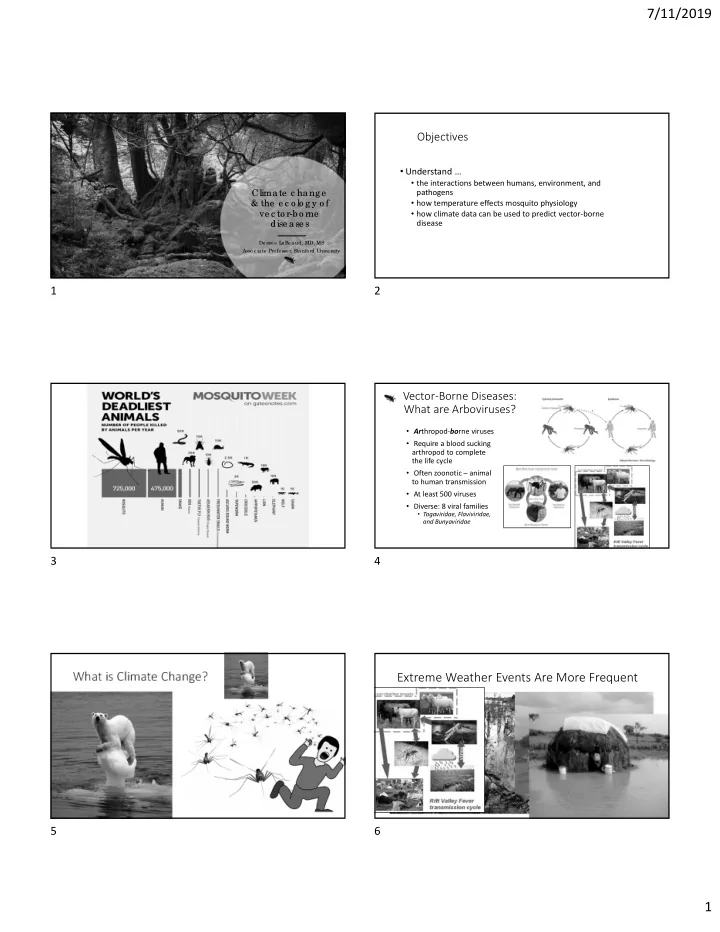
Objectives

  • Understand …
  • the interactions between humans, environment, and

pathogens

  • how temperature effects mosquito physiology
  • how climate data can be used to predict vector‐borne

disease

Vector‐Borne Diseases: What are Arboviruses?

  • Arthropod‐borne viruses
  • Require a blood sucking

arthropod to complete the life cycle

  • Often zoonotic – animal

to human transmission

  • At least 500 viruses
  • Diverse: 8 viral families
  • Togaviridae, Flaviviridae,

and Bunyaviridae

What is Climate Change?

Burning fossil fuels leads to increased temperature:

  • Sea level rise
  • Ice mass loss
  • Shifts in flower/plant

blooming

  • Alteration of mosquito

habitat

  • Extreme weather events
  • Warming temperatures

Extreme Weather Events Are More Frequent

1 2 3 4 5 6

slide-2
SLIDE 2

7/11/2019 2

Major Emerging and Reemerging Infectious Disease Outbreaks, 2002‐2015

National Academy of Medicine, 2016

Disease Emergence: Influences of Modern Life

Climate Change Natural Disasters Extreme Weather

Events

Reduced Capacity to

Sustain Clean Water

Urbanization Land Use Change:

Deforestation/Reforestation, Land Reclamation, Irrigation Projects

Military Activities/War Reduced/Ineffective Vector Control Increased Transportation

  • Chikungunya is spread by a day biting mosquito (Aedes aegypti) which

prefers to breed in man‐made plastic containers

  • 2004‐5 Kenyan chikungunya outbreak linked to drought
  • Unusually dry, warm conditions preceded the outbreaks, including the driest

since 1998 for some of the coastal regions

  • Infrequent replenishment of domestic water stores and elevated

temperatures may have facilitated transmission

  • Underscores the need for safe water storage during drought relief operations

Interactions between climate change and infectious diseases are complex and poorly understood

Chretien et al. AJTMH 2007

Nic o le No va , fro m Sho c ke t e t a l., in re vie w Nic o le No va , fro m Sho c ke t e t a l., in re vie w Nic o le No va , fro m Sho c ke t e t a l., in re vie w

7 8 9 10 11 12

slide-3
SLIDE 3

7/11/2019 3

How will climate change affect vector‐borne disease transmission?

“Wa rme r is sic ke r”

E pste in 2000

Many mo de ls (De ll e t al. 2011, T ho mas & Blanfo rd 2003, and many o the rs)

Mo sq uito physio lo g y

Many mo de ls

Glo b a l c ha ng e & tra nsmissio n suita b ility

T e mpe rature (C) 15 20 25 30 35 Re lative R0

Our approach

symme tric & a symme tric , line a r (fo r c o mpa riso n) F it physio lo g ic al re spo nse s with data

Our approach

symme tric & a symme tric , line a r (fo r c o mpa riso n) Calc ulate R0 vs. te mpe rature F it physio lo g ic al re spo nse s with data

13 14 15 16 17 18

slide-4
SLIDE 4

7/11/2019 4

Our approach

Validate with fie ld data symme tric & a symme tric , line a r (fo r c o mpa riso n) Calc ulate R0 vs. te mpe rature F it physio lo g ic al re spo nse s with data

Our approach

Validate with fie ld data symme tric & a symme tric , line a r (fo r c o mpa riso n) Calc ulate R0 vs. te mpe rature F it physio lo g ic al re spo nse s with data Pro je c t unde r future c limate

Temperature and Malaria

  • Biting Rate
  • Mosquito Infection Rate
  • Transmission competence
  • Parasite Development

Rate

  • Adult mosquito mortality

rate

  • Daily egg laying rate
  • Egg to adult Survival
  • Mosquito developmental

rate

Temperature Dependent Processes

Optimal temperature range for malaria lower than previously predicted

Mordecai, Erin A., et al. "Optimal temperature for malaria transmission is dramatically lower than previously predicted." Ecology letters 16.1 (2013): 22‐30.

Our Our st study: udy: Is the temperature effect predicted by this ecological model applicable to clinical malaria incidence? Fo Four Outpa Outpatien ient Si Sites in in Ke Kenya nya Children with Undifferentiated Febrile Illness n=5,8 n=5,833

Temperature, Rainfall and Humidity measured daily

19 20 21 22 23 24

slide-5
SLIDE 5

7/11/2019 5

Malaria Smear Positivity and Temperature Ranges at the Four Sites

83% 58% 50% 59%

Effect of 30‐day Mean Temperature on Smear Positivity at Four Clinical Sites

*controlling for rainfall, bednet use, sex, age, socioeconomic status

Shah MM et al.. Malaria smear positivity among Kenyan children peaks at intermediate temperatures as predicted by ecological

  • models. In print Parasites and Vectors.

Malaria Smear Positivity plotted alongside Relative Ro at Four Clinical Sites

Shah MM et al.. Malaria smear positivity among Kenyan children peaks at intermediate temperatures as predicted by ecological

  • models. In print Parasites and Vectors.

Climate change will shift bur burden of ma malaria laria

Ryan, Sadie J., et al. "Mapping physiological suitability limits for malaria in Africa under climate change." Vector‐Borne and Zoonotic Diseases 15.12 (2015): 718‐725. Ae de s ae gypti Ae de s albo pic tus

Dengue, Chikungunya, and Zika

CDC De ng ue Ma p

Aedes albopictus and DENV

Aedes aegypti and DENV

Mo rde c ai e t al., 2017 PL

  • S NT

D

25 26 27 28 29 30

slide-6
SLIDE 6

7/11/2019 6

R0 for DENV, CHIKV, ZIKV

Mo rde c ai e t al., 2017 PL

  • S NT

D validate d Mo rde c ai e t al., 2017 PL

  • S NT

D

Compared to previous models

Fo Four Outpa Outpatien ient Si Sites in in Ke Kenya nya Children with Undifferentiated Febrile Illness n=5,8 n=5,833

Temperature, Rainfall and Humidity measured daily

Non‐Malarial Fever and Temperature

Current climate conditions Aedes aegypti

Rya n e t a l Bio Rxiv

WHEN AND WHERE IS CLIMATE SUITABLE FOR TRANSMISSION?

Current climate conditions 2050 climate conditions Aedes aegypti

Rya n e t a l Bio Rxiv

WHEN AND WHERE IS CLIMATE SUITABLE FOR TRANSMISSION?

31 32 33 34 35 36

slide-7
SLIDE 7

7/11/2019 7

Reproductive Number Curves for Malaria and Dengue Virus

Mordecai EM, Sadie R, Caldwell J, Shah MM, LaBeaud AD. Climate change could shift disease burden from malaria to arboviruses in Africa. Nature Climate

  • Change. Under review.

Clima te c ha ng e ma y drive a shift fro m malar ia to dengue in Afric a

Mo rde c ai, Ryan, Caldwe ll, Shah, L aBe aud, in re vie w Nature Climate Chang e

Malaria De ng ue Curre nt 2050 2080

Will climate change shift disease burden across the world?

  • Non‐immune populations
  • Widespread competent

mosquito vectors

  • No rapid local testing currently
  • Limited physician knowledge

and clinical suspicion

  • Poor diagnostics
  • No treatments or vaccines

Challenges FOR the world Mitigating Arboviral Diseases

  • Infrastructure
  • Sustained mosquito control efforts are important to prevent outbreaks
  • Address research gaps
  • Better diagnostics, Vaccines, Targeted therapeutics
  • Disease tracking
  • Develop optimal scientific approaches to understanding the many

factors associated with climate change and infectious diseases

  • Improve the prediction of the spatial–temporal process of climate

change and the associated shifts in infectious diseases at various spatial and temporal scales

  • Establish locally effective early warning systems for the health effects
  • f evolving climate change

Innovative Approaches

  • Modelling temperature

patterns to predict mosquito breeding

Shocket et al, eLIFE, 2018

37 38 39 40 41 42

slide-8
SLIDE 8

7/11/2019 8

Mean temperature (°C) Relative humidity Rainfall (mm)

2013 2014 2015 2016 2017 32 22 27 90 60 30 80 20

Modeled mosquitoes Modeled disease cases

Model Inputs Model Outputs

Mo sq uito pre dic tio ns vs. o b se rva tio ns

Observed mosquitoes

30 20 10 15 25 5

Modeled mosquitoes

16k 10k 4k

2015 2016 2017 2018 2014 2019

Model Data 2015 2016 2017 2018 2015 2016 2017 2018

Forecasting vector abundance using climate data

El Niño year (wet) La Niña year (dry) Normal year

Huma n dise a se pre dic tio ns vs. o b se rva tio ns

Huma n Be ha vio r Ma tte rs!

43 44 45 46 47 48

slide-9
SLIDE 9

7/11/2019 9

Co nc lusio ns

  • Clima

Climate is important for determining where and when conditions are suitable for transmission

  • Climate change will exert a nuanced effect on vector‐borne disease

transmission depending on location

  • Climate change may promote a shift from malaria to arboviruses in

many parts of sub‐Saharan Africa

  • Mo

Mosquit uito micr microh

  • habit

itats and human human beha behavior vior can contribute to variation in transmission within sites with similar temperatures

Thank you for your attention!

49 50