7/22/2009 Fertilization in flowering plants happens through a - - PDF document

7 22 2009
SMART_READER_LITE
LIVE PREVIEW

7/22/2009 Fertilization in flowering plants happens through a - - PDF document

7/22/2009 Fertilization in flowering plants happens through a process called pollination. Pollination occurs when pollen grains Fertilization in Flowering Plants from the anther land on a stigma. Flowering plants generate pollen, ovules,


slide-1
SLIDE 1

7/22/2009 1 Fertilization in Flowering Plants

Flowering plants generate pollen,

  • vules, seeds, and fruit.

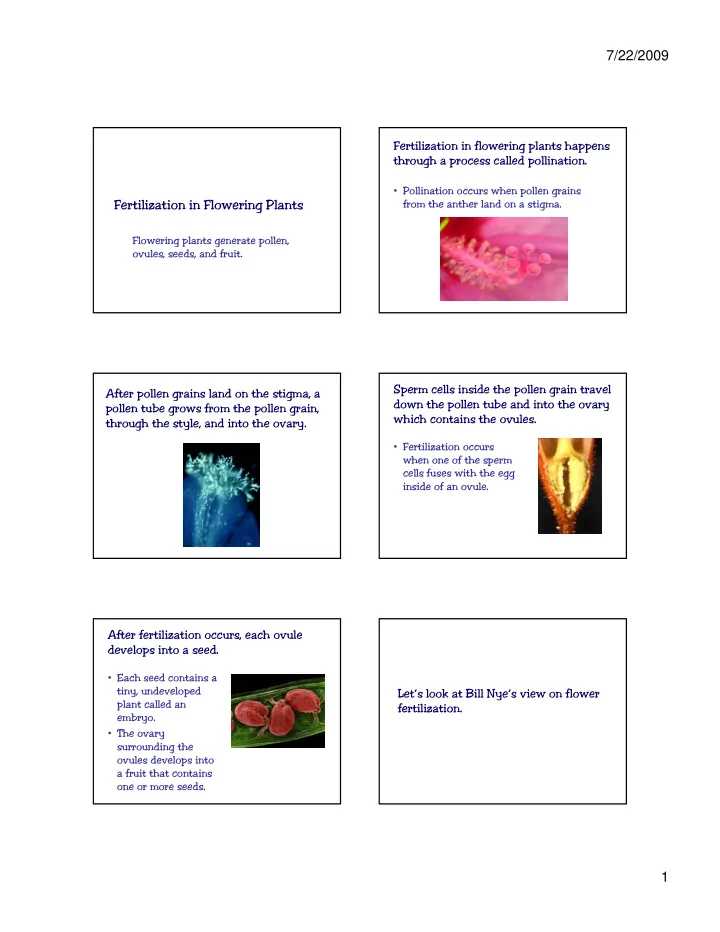
Fertilization in flowering plants happens through a process called pollination.

  • Pollination occurs when pollen grains

from the anther land on a stigma.

After pollen grains land on the stigma, a pollen tube grows from the pollen grain, through the style, and into the ovary. Sperm cells inside the pollen grain travel down the pollen tube and into the ovary which contains the ovules.

  • Fertilization occurs

when one of the sperm p cells fuses with the egg inside of an ovule.

After fertilization occurs, each ovule develops into a seed.

  • Each seed contains a

tiny, undeveloped plant called an embryo.

  • The ovary

surrounding the

  • vules develops into

a fruit that contains

  • ne or more seeds.

Let’s look at Bill Nye’s view on flower fertilization. fertilization.

slide-2
SLIDE 2

7/22/2009 2

Fertilization When you think of fruit, you may first think of oranges, grapes, and strawberries.

  • But there are other

examples you may not associate with not associate with being fruits.

  • For example, a

green bean is the fruit of the green bean plant.

A fruit is defined as a ripened ovary that contains angiosperm seeds.

  • The ovary develops into a

fruit at the same time the

  • vules develop into seeds.

p

  • As the fruit develops, it

swells and ripens.

  • The function of a fruit is to

hold and protect the seeds.

The simplest fruits consist of a single seed enclosed in a single ovary.

  • Grains like corn and

wheat fit this description.

  • In many grains, the
  • vary walls are so thin

that they fuse with the seed.

Each kernel of corn on a cob is actually an individual fruit!

  • In nuts like acorns and chestnuts, the ovary

hardens into a protective shell.

slide-3
SLIDE 3

7/22/2009 3

In fruits like peaches and cherries, the fruits are soft and fleshy and contain a single, stony seed.

  • Ovaries that contain

many ovules produce f a single fruit with many seeds.

Grapes with seeds and tomatoes are examples.

  • Legumes like beans and peas produce a

fruit called a pod that contains many seeds.

Most of the “fruit” of an apple is actually formed by the stem surrounding the ovary.

  • If you slice an apple in

half, you can see the b d b h boundary between the

  • vary wall and the

stem.

Germination

  • Once the fruit and

seeds are fully developed, the plant embryo inside of the embryo inside of the seed goes into a dormant (inactive) state.

Dormant seeds can often survive various harsh conditions like freezing temperatures and drought.

  • Some seeds require

extreme conditions to break their dormancy break their dormancy.

  • Forest fires for example,

burn the seed coats of some plant species and allow them to germinate.

Germination is the process of a seed sprouting and its growth into a young plant.

slide-4
SLIDE 4

7/22/2009 4

Seed dispersal—the scattering of seeds, is an important part of a seed plant’s life cycle.

  • In order to germinate, a

seed needs to be dropped into an environment with suitable conditions.

Because plants cannot move, they depend on other forces to help seeds find the right conditions.

  • These forces may include wind, water, or

animals animals.

  • Fruits have evolved many ways to aid in

seed dispersal.

Many seeds are dispersed directly into the air and rely on the wind to carry them.

  • Maple trees have

winged fruits that g carry their seeds from the parent plant.

Milkweed seeds have a tiny “umbrella” that allows them to drift over long distances. Coconuts are encased in a leathery fruit that floats over great distances on the

  • cean.

Fruits like grapes, strawberries, and raspberries have sweet, fleshy fruits that are eaten by animals.

  • The seeds pass, unharmed,

through the animal’s digestive system and are deposited in a new location.

slide-5
SLIDE 5

7/22/2009 5

Flower to Fruit