
101 | P a g e
- 7. Artificial neural networks
Introduction to neural networks
Despite struggling to understand intricacies of protein, cell, and network function within the brain, neuroscientists would agree on the following simplistic description of how the brain computes: Basic units called "neurons" work in parallel, each performing some computation on its inputs and passing the result to other neurons. This sounds trivial, but borrowing and simulating these essential features
- f the brain leads to a powerful computational tool called an artificial neural network. In studying
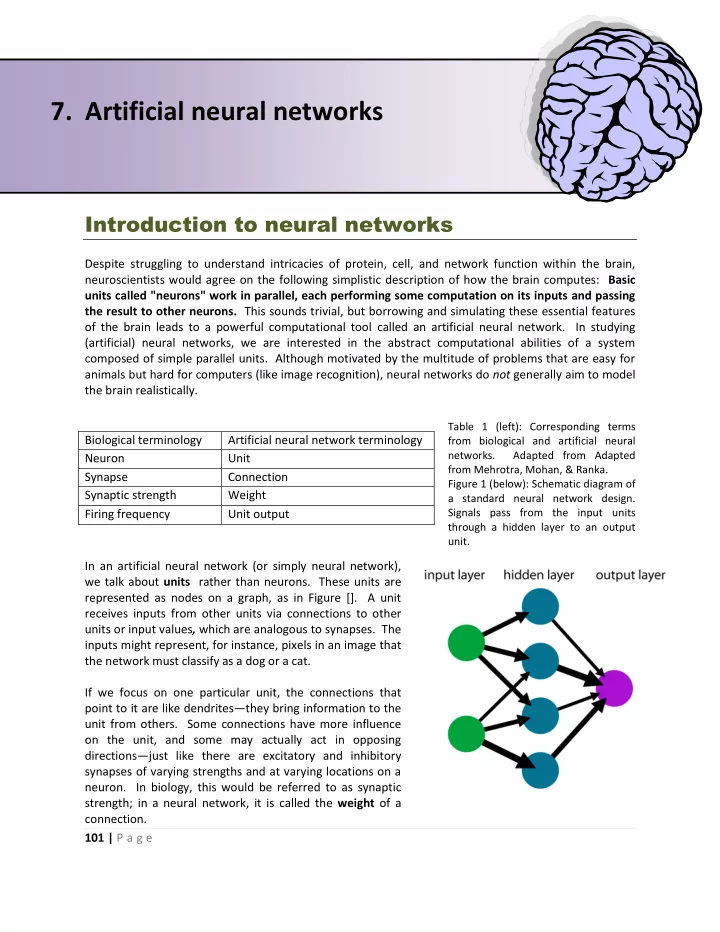
(artificial) neural networks, we are interested in the abstract computational abilities of a system composed of simple parallel units. Although motivated by the multitude of problems that are easy for animals but hard for computers (like image recognition), neural networks do not generally aim to model the brain realistically. In an artificial neural network (or simply neural network), we talk about units rather than neurons. These units are represented as nodes on a graph, as in Figure []. A unit receives inputs from other units via connections to other units or input values, which are analogous to synapses. The inputs might represent, for instance, pixels in an image that the network must classify as a dog or a cat. If we focus on one particular unit, the connections that point to it are like dendrites—they bring information to the unit from others. Some connections have more influence
- n the unit, and some may actually act in opposing
directions—just like there are excitatory and inhibitory synapses of varying strengths and at varying locations on a
- neuron. In biology, this would be referred to as synaptic
strength; in a neural network, it is called the weight of a connection. Biological terminology Artificial neural network terminology Neuron Unit Synapse Connection Synaptic strength Weight Firing frequency Unit output
Table 1 (left): Corresponding terms from biological and artificial neural
- networks. Adapted from Adapted
from Mehrotra, Mohan, & Ranka. Figure 1 (below): Schematic diagram of a standard neural network design. Signals pass from the input units through a hidden layer to an output unit.