8: Intro. to Turing Machines Problems that Computers Cannot Solve - - PDF document

8 intro to turing machines
SMART_READER_LITE
LIVE PREVIEW

8: Intro. to Turing Machines Problems that Computers Cannot Solve - - PDF document

8: Intro. to Turing Machines Problems that Computers Cannot Solve It is important to know whether a program is correct, namely that it does what we expect. It is easy to see that the following C program main() { printf(hello,


slide-1
SLIDE 1

8: Intro. to Turing Machines

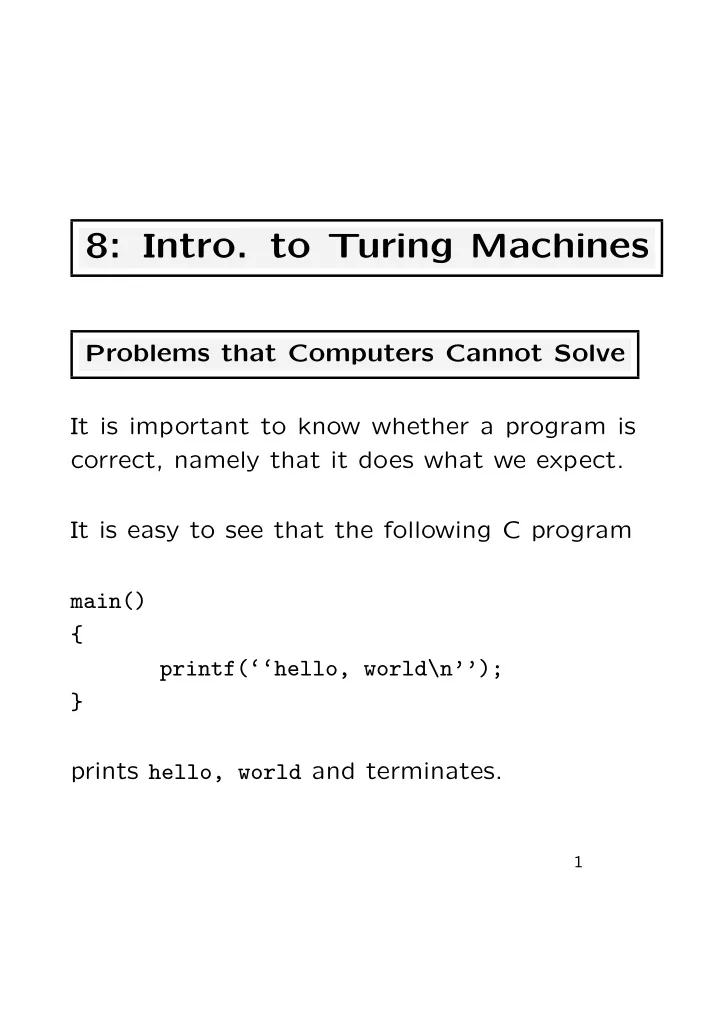
Problems that Computers Cannot Solve It is important to know whether a program is correct, namely that it does what we expect. It is easy to see that the following C program main() { printf(‘‘hello, world\n’’); } prints hello, world and terminates.

1

slide-2
SLIDE 2

But what about the program in Figure 8.2 on page 309 of the textbook?! Given an input n, it prints hello, world only if the equation xn + yn = zn has a solution where x, y, and z are integers. We know nowadays that it will print hello, world for n = 2, and loop forever for n > 2. It took mathematicians 300 years to prove this so-called “Fermat’s last theorem”. Can we expect to write a program H that solves the general problem of telling whether any given program P, on any given input I, eventually prints hello, world or not?

2

slide-3
SLIDE 3

The Hypothetical “hello, world” Tester H Proof by contradiction that H is impossible to

  • write. Suppose that H exists:

Hello-world tester H P I yes no

We modify the response no of H to hello, world, getting a program H1:

P I H1 yes hello, world

3

slide-4
SLIDE 4

We modify H1 to take P and I as a single input, getting a program H2:

H2 P yes hello, world

We provide H2 as input to H2:

H2 H2 yes hello, world

If H2 prints yes, then it should have printed hello, world. If H2 prints hello, world, then it should have printed yes. So H2 and hence H cannot exist. Hence we have an undecidable problem. It is similar to the language Ld we will see later.

4

slide-5
SLIDE 5

Undecidable Problems A problem is undecidable if no program can solve it. Here: problem = deciding on the membership

  • f a string in a language.

Languages over an alphabet are not enumer- able. Programs (finite strings over an alphabet) are enumerable: order them by length, and then lexicographically. Hence there are infinitely more languages than programs. Hence there must be undecidable problems (G¨

  • del,

1931).

5

slide-6
SLIDE 6

Problem Reduction If we already know problem P1 to be undecid- able, can we use this fact to show that another problem P2 is undecidable? Assume there exists a program that decides whether its input instance of problem P2 is or is not in the language of P2. Reduce the known undecidable problem P1 to P2: Convert instances of P1 into instances of P2 that have the same answer. But we would then have an algorithm for de- ciding P1! Contradiction. Hence the assumed program for deciding P2 does not exist and P2 is in fact undecidable. Thereby, we proved the statement “if P2 is decidable, then P1 is decidable” and exploited its contrapositive.

6

slide-7
SLIDE 7

Careful: To prove P2 undecidable, we must not reduce P2 to some known undecidable prob- lem P1 (by converting instances of P2 into in- stances of P1 that have the same answer), as we would then prove the vacuously true and thus useless statement “if P1 is decidable, then P2 is decidable”.

7

slide-8
SLIDE 8

Turing Machines (1936)

X 2 X i X n X 1 control Finite . . . B B B B . . .

A move of a Turing machine (TM) is a func- tion of the state of the finite control and the tape symbol just scanned. In one move, the Turing machine will:

  • 1. Change state.
  • 2. Write a tape symbol in the cell scanned.
  • 3. Move the tape head left or right.

8

slide-9
SLIDE 9

Formally, a Turing machine is a 7-tuple M = (Q, Σ, Γ, δ, q0, B, F) where:

  • Q is the finite set of states of the finite

control.

  • Σ is the finite set of input symbols.
  • Γ is the finite set of tape symbols; Σ ⊂ Γ.
  • δ : Q × Γ → Q × Γ × {L, R} is the transition

function, which is a partial function.

  • q0 ∈ Q is the start state.
  • B ∈ Γ is the blank symbol; B ∈ Σ.
  • F ⊆ Q is the set of final or accepting states.

9

slide-10
SLIDE 10

Instantaneous Descriptions for TMs A Turing machine changes its configuration upon each move. We use instantaneous descriptions (IDs) for describing such configurations. An instantaneous description is a string of the form X1X2 · · · Xi−1qXiXi+1 · · · Xn where

  • 1. q is the state of the Turing machine.
  • 2. The tape head is scanning the ith symbol

from the left.

  • 3. X1X2 · · · Xn is the portion of the tape be-

tween the leftmost and rightmost nonblanks.

10

slide-11
SLIDE 11

The Moves and Language of a TM We use ⊢

M to designate a move of a Turing

machine M from one ID to another. If δ(q, Xi) = (p, Y, L), then: X1X2 · · · Xi−1qXiXi+1 · · · Xn ⊢

M

X1X2 · · · Xi−2pXi−1Y Xi+1 · · · Xn If δ(q, Xi) = (p, Y, R), then: X1X2 · · · Xi−1qXiXi+1 · · · Xn ⊢

M

X1X2 · · · Xi−1Y pXi+1 · · · Xn The reflexive-transitive closure of ⊢

M is denoted

by

M.

A Turing machine M = (Q, Σ, Γ, δ, q0, B, F) ac- cepts the language L(M) = {w ∈ Σ∗ : q0w

M αpβ, p ∈ F, α, β ∈ Γ∗} 11

slide-12
SLIDE 12

Example: A TM for {0n1n : n ≥ 1}

M = ({q0, q1, q2, q3, q4}, {0, 1}, {0, 1, X, Y, B}, δ, q0, B, {q4})

where δ is given by the following table:

1 X Y B → q0 (q1, X, R) (q3, Y, R) q1 (q1, 0, R) (q2, Y, L) (q1, Y, R) q2 (q2, 0, L) (q0, X, R) (q2, Y, L) q3 (q3, Y, R) (q4, B, R) ⋆ q4

We can also represent M by the following tran- sition diagram:

/ Y Y / Y Y / Y Y / X / / X X / B B / Y 1 / Y Y / Start q q q q q

1 2 3 4

12

slide-13
SLIDE 13

Example: A TM With “Output” The following Turing machine computes m

.

− n = max(m − n, 0)

1 B → q0 (q1, B, R) (q5, B, R) q1 (q1, 0, R) (q2, 1, R) q2 (q1, 1, L) (q2, 1, R) (q4, B, L) q3 (q3, 0, L) (q3, 1, L) (q0, B, R) q4 (q4, 0, L) (q4, B, L) (q6, 0, R) q5 (q5, B, R) (q5, B, R) (q6, B, R) ⋆ q6

The transition diagram is as follows:

/ 1 1 / B 1 / B 1 / B / / 1 1 / B B / B B / / B 1 / B B / 0 / / 1 1 / B B Start q q q q q

1 2

q q 0 / 1

4 3 5 6

13

slide-14
SLIDE 14

Acceptance by Halting A Turing machine halts if it enters a state q, scanning a tape symbol X, and there is no move in this situation, i.e., δ(q, X) is undefined. We can always assume that a Turing machine halts if it accepts, as we can make δ(q, X) un- defined whenever q is an accepting state. Unfortunately, it is not always possible to re- quire that a Turing machine halts even if it does not accept. Recursive language: there is a TM, correspond- ing to the concept of algorithm, that halts eventually, whether it accepts or not. Recursively enumerable language: there is a TM that halts if the string is accepted. Decidable problem: there is an algorithm for solving it.

14

slide-15
SLIDE 15

Alternative Models for Turing Machines Turing-machine programming techniques: stor- age in the state, multiple tape tracks, subrou- tines, . . . Extensions: multiple tapes, non-determinism, . . . Restrictions: semi-infinite tape, multiple stacks, counters, . . . All these models are equivalent: they accept the recursively enumerable languages (Church- Turing thesis, 1936).

15

slide-16
SLIDE 16

Turing Machines and Computers Simulating a Turing machine by a computer: it suffices to have enough memory to simulate the infinite tape. Simulating a computer by a Turing machine: multiple tapes (memory, instruction counter, memory address, computer’s input file, and scratch) plus simulation of the instruction cy- cle. The simulating multitape Turing machine needs an amount of steps that is at most some poly- nomial, namely n3, in the number n of steps taken by the simulated computer. From now on: computer = Turing machine.

16

slide-17
SLIDE 17

9: Undecidability

Goal: Prove undecidable the recursively enu- merable language Lu consisting of pairs (M, w) such that:

  • M is a Turing machine (suitably coded, in

binary) with input alphabet {0, 1}.

  • w is a string of 0s and 1s.
  • M accepts input w.

If this problem with binary inputs is undecid- able, then surely the more general problem, where the Turing machines may have any al- phabet, is undecidable. First step: codify a Turing machine as a string

  • f 0s and 1s, and exhibit a language that is

not even recursively enumerable, namely Ld.

17

slide-18
SLIDE 18

Codes for Turing Machines We need to assign integers to all the binary strings so that each integer corresponds to one string and vice versa: ǫ is the first string, 0 the second, 1 the third, 00 the fourth, 01 the fifth, and so on. Equivalently, strings are ordered by length, and strings of equal length are ordered lexicograph- ically. We will refer to the ith string as wi. We now want to represent Turing machines with input alphabet {0, 1} by binary strings, so that we can identify Turing machines with integers and refer to the ith Turing machine as Mi.

18

slide-19
SLIDE 19

To represent a Turing machine M = (Q, {0, 1}, Γ, δ, q1, B, F} as a binary string, we must first assign integers to the states, tape symbols, and directions L and R:

  • Assume the states are q1, q2, . . . , qr for some
  • r. The start state is q1, and the only ac-

cepting state is q2.

  • Assume the tape symbols are X1, X2, . . . , Xs

for some s. Then: 0 = X1, 1 = X2, and B = X3.

  • L = D1 and R = D2.

19

slide-20
SLIDE 20

Encode the transition rule δ(qi, Xj) = (qk, Xℓ, Dm) by 0i10j10k10ℓ10m. Note that there are no two consecutive 1s. Encode an entire Turing machine by concate- nating, in any order, the codes Ci of its transi- tion rules, separated by 11: C111C211 · · · Cn−111Cn. Ex.: M = ({q1, q2, q3}, {0, 1}, {0, 1, B}, δ, q1, B, {q2}) where δ is defined by: δ(q1, 1) = (q3, 0, R), δ(q3, 0) = (q1, 1, R), δ(q3, 1) = (q2, 0, R), and δ(q3, B) = (q3, 1, L). Codes for the transition rules: 0100100010100 0001010100100 00010010010100 0001000100010010 Code for M: 010010001010011000101010010011 00010010010100110001000100010010

20

slide-21
SLIDE 21

Given a Turing machine M with code wi, we can now associate an integer to it: M is the ith Turing machine, referred to as Mi. Many integers do no correspond to any Turing machine at all. Examples: 11001 and 001110. If wi is not a valid TM code, then we shall take Mi to be the Turing machine (with one state and no transitions) that immediately halts on any input. Hence L(Mi) = ∅ if wi is not a valid TM code.

21

slide-22
SLIDE 22

The Diagonalisation Language Ld The diagonalisation language Ld is the set of strings wi such that wi ∈ L(Mi). That is, Ld contains all strings w such that the Turing machine M with code w does not accept w. Consider the matrix with Turing machine in- dices i in the rows and string indices j in the columns, where the cell for row i and column j tells whether Mi accepts wj, ”yes” being de- noted by 1 and ”no” by 0. The diagonal values tell whether Mi accepts wi. The strings of Ld correspond to the 0s of the diagonal. Is it possible that the diagonal complement is a row? No, because the diagonal complement disagrees with every row in some column. Hence Ld is not recursively enumerable and cannot be accepted by any Turing machine.

22

slide-23
SLIDE 23

Recursive Languages A language L is recursive if L = L(M) for some Turing machine M such that:

  • If w ∈ L, then M accepts w (and halts).
  • If w ∈ L, then M does not accept w but

eventually halts. Such a Turing machine corresponds to our in- formal notion of an ”algorithm”. The problem (of acceptance of L) is decidable if L is recursive, and undecidable otherwise.

23

slide-24
SLIDE 24

Classes of Languages

  • Recursive = decidable:

their Turing machine always halt.

  • Recursively enumerable but not recursive:

their Turing machines halt if they accept. Example: Lu.

  • Non recursively enumerable (non-RE):

there are no Turing machines for them. Example: Ld.

24

slide-25
SLIDE 25

Property of Recursive Languages The recursive languages are closed under com- plementation: Theorem 9.3: If L is a recursive language, then ¯ L is recursive. Proof: If L is recursive, then L = L(M) for some Turing machine M that always halts. Trans- form M into M′ such that M′ accepts what M does not accept, and vice versa. So M′ always halts and accepts ¯

  • L. Hence ¯

L is recursive. Consequence: If L is RE, but ¯ L is not RE, then L cannot be recursive.

25

slide-26
SLIDE 26

Property of RE Languages Theorem 9.4: If L and ¯ L are RE, then L is recursive (and so is ¯ L, by Theorem 9.3). Proof: Let L = L(M1) and ¯ L = L(M2). Con- struct a Turing machine M that simulates M1 and M2 in parallel (using two tapes and two heads). If the input to M is in L, then M1 accepts it and halts, hence M also accepts it and halts. If the input to M is not in L, then M2 accepts it and halts, hence M halts with-

  • ut accepting it. Hence M halts on every input

and L(M) = L, so L is recursive.

26

slide-27
SLIDE 27

L and ¯ L There are only four ways of placing L and ¯ L:

  • Both L and ¯

L are recursive.

  • Neither L nor ¯

L is RE.

  • L is RE but not recursive, and ¯

L is not RE.

  • ¯

L is RE but not recursive, and L is not RE. Indeed, it is impossible that one language (L

  • r ¯

L) is recursive and the other is in either of the other two classes (by Theorem 9.3). It is also impossible that both languages are RE but not recursive (by Theorem 9.4).

27

slide-28
SLIDE 28

The Universal Language The universal language Lu is the set of binary strings that encode a pair (M, w) (by putting 111 between the code for M and w) where w ∈ L(M). There is a Turing machine U, often called the universal Turing machine, such that Lu = L(U). It has three tapes: one for the code of (M, w),

  • ne for the code of the simulated tape of M,

and one for the code of the state of M. Thus U simulates M on w, and U accepts (M, w) if and only if M accepts w. Hence Lu is RE. Any Turing machine M may not halt when the input string w is not in the language, thus U will have the same behaviour as M on w. Hence Lu is RE but not recursive.

28

slide-29
SLIDE 29

The Halting Problem Given a Turing machine M, define H(M) to be the set of strings w such that M halts on input w, regardless of whether or not M accepts w. The halting problem is the set of pairs (M, w) such that w ∈ H(M). This problem (or lan- guage) also is recursively enumerable but not recursive.

29

slide-30
SLIDE 30

Closure Properties of Recursive Languages The recursive languages are closed under the following operations:

  • Union.
  • Intersection.
  • Concatenation.
  • Kleene closure.

30

slide-31
SLIDE 31

Closure Properties of RE Languages The recursively enumerable (RE) languages are closed under the following operations:

  • Union.
  • Intersection.
  • Concatenation.
  • Kleene closure.

31

slide-32
SLIDE 32

Recursive and RE Languages Given a recursive language and a recursively enumerable (RE) language:

  • Union: RE.
  • Intersection: RE.
  • Concatenation: RE.
  • Kleene closure: RE.
  • If L1 is recursive and L2 is RE,

then L2 − L1 is RE and L1 − L2 is not RE.

32

slide-33
SLIDE 33

Problem Reduction Recall ”Problem Reduction” of Chapter 8. If P1 reduces to P2, then P2 is at least as hard as P1. Theorem 9.7: If P1 reduces to P2, then:

  • If P1 is undecidable, then so is P2.
  • If P1 is non-RE, then so is P2.

33

slide-34
SLIDE 34

Examples of Undecidable Problems Theorem 9.11: All non-trivial properties of RE languages are undecidable. (Rice, 1953) All problems about Turing machines that in- volve only the language that the TM accepts are undecidable. Examples: Is the language accepted by the TM empty? Is the language accepted by the TM finite? Is the language accepted by the TM regular? Is the language accepted by the TM a CFL? Does the language accepted by the TM con- tain the string ”ab”? Does the language accepted by the TM con- tain all even numbers?

34

slide-35
SLIDE 35

Example of Decidable Problems Fortunately, not everything is undecidable! Some problems about the states of the Turing ma- chine, rather than about the language it ac- cepts, are decidable. Examples: Does the TM have five states? Is there an input such that the TM makes at least five moves?

35