
SLIDE 1
Isotope systematics
Generalities
- Isotopes of the same element exhibit identical chemical behavior. This statement appears to
be true for isotopes of heavy elements such as Sr, Nd, Pb, U but not true for isotopes of light elements such as H, C, O, S…. The assumption is made that isotopes such as 87Sr and 86Sr cannot be fractionated from each other by melting, crystallization or metamorphism. The
87Sr/86Sr ratio can only be changed by the passage of time as 87Rb decays or by some mixing
- process. Note, however, the Rb and Sr do show different chemical behavior.
- The ratio of the radiogenic isotope to a stable isotope of the same element, e.g., 87Sr/86Sr, in
a rock or mineral at the present day depends on everything that has happened to this particular piece of matter since the solid material of the solar system condensed from the nebula.
- The equations for radioactive decay are posted on the class website along with the
decay constants and initial (at 4.57 Ga) and present day whole earth values for isotopic systems widely used in petrogenetic modeling (see also next slide). A derivation of the isochron equation (given below) is also provided on the website
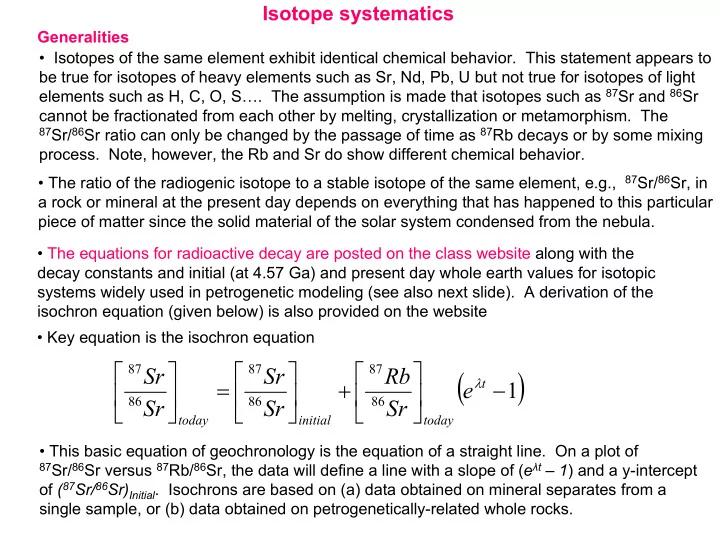
- Key equation is the isochron equation
( )
1
86 87 86 87 86 87
− + =
t today initial today
e Sr Rb Sr Sr Sr Sr
λ
- This basic equation of geochronology is the equation of a straight line. On a plot of
87Sr/86Sr versus 87Rb/86Sr, the data will define a line with a slope of (eλt – 1) and a y-intercept
- f (87Sr/86Sr)Initial. Isochrons are based on (a) data obtained on mineral separates from a