9/3/2019 General Documentation Requirements Physician Observation - - PDF document

▶
9 3 2019
SMART_READER_LITE
LIVE PREVIEW

9/3/2019 General Documentation Requirements Physician Observation - - PDF document

9/3/2019 General Documentation Requirements Physician Observation Timed/dated order to place in Reimbursement observation status A short treatment plan regarding the goals of observation Clinically appropriate progress notes


slide-1
SLIDE 1

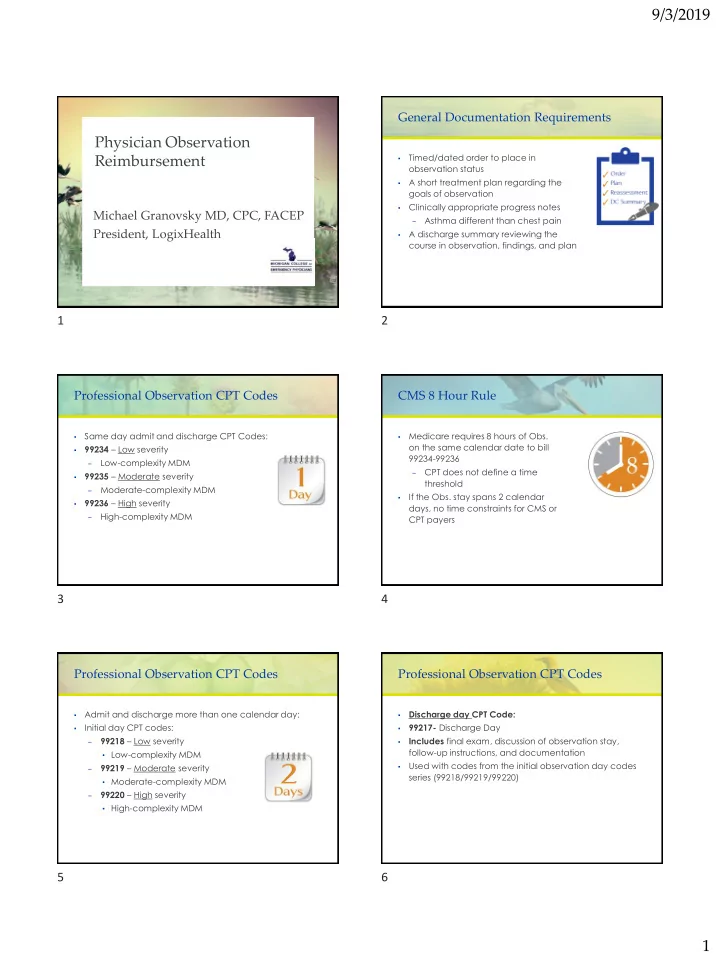
9/3/2019 1 Physician Observation Reimbursement

Michael Granovsky MD, CPC, FACEP President, LogixHealth

▪

Timed/dated order to place in

  • bservation status

▪

A short treatment plan regarding the goals of observation

▪

Clinically appropriate progress notes

‒

Asthma different than chest pain

▪

A discharge summary reviewing the course in observation, findings, and plan

General Documentation Requirements Professional Observation CPT Codes

▪

Same day admit and discharge CPT Codes:

▪

99234 – Low severity

‒

Low-complexity MDM

▪

99235 – Moderate severity

‒

Moderate-complexity MDM

▪

99236 – High severity

‒

High-complexity MDM

▪

Medicare requires 8 hours of Obs.

  • n the same calendar date to bill

99234-99236

‒

CPT does not define a time threshold

▪

If the Obs. stay spans 2 calendar days, no time constraints for CMS or CPT payers

CMS 8 Hour Rule Professional Observation CPT Codes

▪

Admit and discharge more than one calendar day:

▪

Initial day CPT codes:

‒

99218 – Low severity

  • Low-complexity MDM

‒

99219 – Moderate severity

  • Moderate-complexity MDM

‒

99220 – High severity

  • High-complexity MDM

▪

Discharge day CPT Code:

▪

99217- Discharge Day

▪

Includes final exam, discussion of observation stay, follow-up instructions, and documentation

▪

Used with codes from the initial observation day codes series (99218/99219/99220)

Professional Observation CPT Codes

1 2 3 4 5 6

slide-2
SLIDE 2

9/3/2019 2

Observation Level of Care Care All on the Same Day Care Covers Two Calendar Days 1 99234 99218 + 99217 2 99235 99219 + 99217 3 99236 99220 + 99217

Coding Scenarios Observation Services

▪

All but the lowest level Obs require very significant Hx and PE documentation

▪

Comprehensive Hx and PE: 99219/99220 & 99235/99236

‒

HPI: 4 elements

‒

PFSHx: 3 areas* (Requires Family Hx)

‒

ROS: 10 systems

‒

PE: 8 organ systems Obs services typically require a family history

▪

Beware overuse of macros for ROS and PE

Keys to Physician Documentation Summary Documentation Requirements

Level HPI ROS

PFSHx

PE

99234 4 2 1 5 99235 4 10 3 8 99236 4 10 3 8

Avoid Macro Over Use

Macro Over Use- They Really Mean It Provider Burden- Perhaps Some Help? Seema Verma Letter

We have heard repeatedly that a major source of burnout is the documentation burden associated with evaluation and management (E/M) coding, and that a change is long

  • verdue.

Clinicians find themselves having to perform and document clinical activity that may be of only marginal relevance to the visit, but is required in order to receive the level of payment that their effort deserves.

2019 Physician Final Rule/2020 Proposed No Change Obs Codes and ED Codes

▪

2019 and 2020 No changes to any E/M codes

▪

2021 office visit codes move away from the 1995 guidelines

‒

Time and Medical Decision Making (MDM)

▪

Collapsed payment level for new/established patient 2-4 removed from 2020 proposed rule NO CHANGE TO THE ED or OBS CODES “The proposed changes only apply to office/outpatient visit codes: CPT codes 99201 – 99215. We understand there are more unique issues to consider in other settings such as emergency department care. We may address sections of the E/M code set beyond the office/outpatient codes in future years.”

  • 2019 Physician Rule

7 8 9 10 11 12

slide-3
SLIDE 3

9/3/2019 3

CPT Code Typical Times CPT Code Typical Times 99234 40 minutes 99218 30 minutes 99235 50 minutes 99219 50 minutes 99236 55 minutes 99220 70 minutes

Observation Services: CPT Typical Times and MDM Highlights

Medical Decision Making for Obs Patients Obs treatment plan, differential diagnosis, Course in the unit and responses to treatment. Consults, review of labs and studies, review of old records Co-morbidites, neuro complaints, severe exacerbations

Physician Observation Payment

Same Day Obs Total RVU Over Midnight Obs Total RVU ED E/M Service Total RVU 99234 3.75 99217 2.06 99284 3.32 99235 4.77 99218 2.81 99285 4.89 99236 6.13 99219 3.83 99220 5.23

2019 RVU Values for Observation Services

99217 + 99220 = 7.29 RVUs Total 2020 Proposed Rule Obs RVUs stable*

Work RVUs Practice Expense RVUs +Liability Insurance RVUs Total RVUs for a given code

RVUTotal X Conv. Factor = Medicare Payment

2019/2020 RBRVS Equation 2019/2020 Conversion Factor Creeping Up

2018 $35.9996 2019 $36.0391 2020 $36.0896 (Proposed)

Payment Changes

2020 News Flash: ED RVU and Payment Increases

Code 2020 Payment 2019 Payment Change 99281 $23.10 $21.62 +1.48 99282 $44.39 $42.17 +2.22 99283 $67.85 $63.07 +4.78 99284 $121.62 $119.65 +1.97 99285 $178.28 $176.23 +2.05

13 14 15 16 17 18

slide-4
SLIDE 4

9/3/2019 4

$135.15 $171.91 $220.92 $175.51 $212.27 $262.72 99234 99235 99236 99285 99218/17 99219/17 99220/17

99285

Obs DOCUMENTATION & CODING 2019 Increases With Each E/M Level

$176

2019 Cost Of Hx and PE Downcodes

▪

2 downcodes: 99236 99234

‒

Loose 4.76 RVUs.

‒

$171.55

‒

39%

$441.84 $356.07 $270.30 $0.00 $100.00 $200.00 $300.00 $400.00 $500.00

99236 x2 1 Downcode 2 Downcodes

Obs Revenue

Obs Coding Methodology

▪

Most ED run Observation units see higher acuity patients

▪

Chest pain or clinically equivalent complexity is very common

▪

ED Observation E/M distribution influenced by pre-selected complexity

▪

No AMA CPT Appendix C Obs code vignettes CMS RUC database vignettes

▪

99234: 19 y.o. pregnant patient (9 weeks gestation) presents to the ED with vomiting X 2 days. The patient is admitted for observation and discharged later on the same day.

▪

99235: 48 y.o. presents with an asthma exacerbation in moderate distress.

▪

99236: 52 y.o. patient comes to the ED with chest pain.

Clinical Benchmarks of Patient Complexity

10.90% 27.30% 61.80% 0% 10% 20% 30% 40% 50% 60% 70% 99234 99235 99236

E Med Obs Codes Reported RUC Data Base Analysis

E Med Obs E/M Distribution

▪

Historically No clear direction re coding multi day mental health “borders” or “psych holds”

▪

CPT Behavioral Health Vignette:

‒

Agitated patient requires psychiatric admission

‒

No Beds and has a 3 day ED stay

▪

Asked CPT how to report a 3 day “psych hold” Official Answer

‒

Obs day 1 99218-99220

‒

Middle days 99224-99226

‒

Final day 99217

▪

5 day stay 4.89 RVUs 14.37 RVUs

News Flash! July CPT Assistant Update: Observation and Mental Health

July 2019 Volume 29 Issue 7 page 10

19 20 21 22 23 24

slide-5
SLIDE 5

9/3/2019 5

▪

Observation services continue to have a bright and growing future!

▪

Key areas of appropriate coding and documentation will drive the success of your units

▪

There is a strong trend towards emphasizing medical decision making

▪

Lots of good news- ED RVUs are going up, conversion factor is going up, Obs has an RVU advantage!

▪

After several years of advocacy mental health Observation services now recognized by CPT!

Conclusions Contact Information Michael Granovsky, MD, CPC, FACEP 781.280.1575 mgranovsky@logixhealth.com www.logixhealth.com

Facility Observation Reimbursement

Michael Granovsky MD, CPC, FACEP President, LogixHealth

▪ CMS Recovery Audit Contractors (RACs)

focusing on inpatient DRG payments vs. Observation status

▪ Hospitals under pressure to cut costs

‒

Global contracts/ACOs/directly insuring communities ▪ ED groups ideally suited to run efficient units

with short lengths of stay

‒

The masters of the throughput mindset!

Why Is Obs Important To Your Hospital Now?

▪ Medicare pays a fixed amount for inpatient

care

▪ Typically a large amount

‒

Much more than the observation payment

▪

Recent study calculated use of Obs instead of inpatient reduce CMS cost dramatically

▪

Average cost savings per patient = $1,572 ▪ Annual savings calculated: $3.1 Billion

DRG Economics OIG Report and Analysis: Compliance with the 2 Midnight Rule

▪

Hospitals were paid for a total of 1,074,267 short inpatient stays. In our review 39% were potentially inappropriate for payment because the claims did not meet CMS’s criteria for an appropriate short inpatient stay.

25 26 27 28 29 30

slide-6
SLIDE 6

9/3/2019 6

2019 RAC Contracts

* RAC Contact Info

▪

Complex Medicare Report

▪

Supplies hospital data related to potentially improper DRG payments

‒

Number of discharges per DRG

‒

Payments per DRG

‒

Length of stay per DRG

  • Highlights hospital LOS < 1 calendar day

‒

RAC focus for DRG take backs

Your Hospital’s DRG Profile: The Pepper Report

Selecting correct patients is key to the

  • perational success of an observation unit

▪

Select patients with diagnoses that have that have associated clinical protocols

▪

Expedite throughput

▪

Achieve decreased length of stay

▪

Reach a successful clinical endpoint

Patient Selection for Observation Services The Spectrum of Complexity

Easier

▪

Chest pain

▪

Abdominal pain

▪

Headache

▪

Cellulitis

▪

Pyelonephritis

▪

Asthma

▪

Dehydration

▪

Renal colic

▪

Hypoglycemia

▪

Allergic reaction

▪

Pharyngitis Harder

▪

Closed head injury

▪

Vertigo

▪

Hematuria

▪

Pancreatitis

▪

SOB

▪

CHF/COPD

▪

Back pain

‒

Non-ambulatory

▪

Extremes of age

▪

Mental Health

‒

Substance abuse

▪

40K ED with a 22% admission rate

▪

110 patients per day

▪

24 daily admissions

‒

30% qualified for Obs over first 6 months

‒

Average of 7 Obs patients per day

  • Chest pain, syncope, cellulitis, pyelo,

allergic reaction, Asthma, dehydration…

‒

10 bed unit ….fully occupied 28 days a month

‒

2,555 patients treated

‒

Average LOS decreased 16 hours

‒

Prior LOS for cohort 25 hours

Picking The Right Patients: Case Study - Community Hospital

▪

Typical nurse to patient ratio 1:5

▪

Physician coverage 1:12

▪

Fixed costs: Bed space, secretary, medication administration

‒

Minimum 6 bed CDU requires 36k ED feeder*

‒

Profitability optimized steady census of 12 daily

‒

Adjust your protocols to creep census up

▪

50k ED…137/day…34 admits…want 12 for obs

‒

5 chest pain + 2 GU (colic & pyelo)

‒

Need 5: dehydration/abd pain/asthma

Optimizing Unit Size for Profit

31 32 33 34 35 36

slide-7
SLIDE 7

9/3/2019 7

OPPS Regs

▪

Direct supervision: during the initiation of observation (immediately available)

▪

General Supervision: once the patient is deemed stable (overall control)

▪

CMS further stated: the provider could be an MD or NP/PA

Original Guidance 2011 OPPS 2019/2020 OPPS Rule no changes

Cost: Who Mans the Unit Inpatient and Outpatient Financial Construct

▪

Obs is an outpatient service covered under Medicare part B

▪

Concerned beneficiaries may pay more as outpatients than if they were admitted as inpatients

‒

80/20 co-insurance under part B

▪

Medicare Part A covers inpatient care, but with a substantial deductible

‒

Recurs more than once a year

‒

2019 Inpatient expense: deductible $1,364

▪

20% co pays add up for longer complex Obs stays

‒

Inpatient expense: Part A inpatient deductible $1,364

▪

SNF

‒

Obs stay…no qualifying SNF Medicare coverage

  • Typical stay starts at roughly $250 per day

‒

Qualifying inpatient stay spanning 3 nights

  • No patient SNF cost sharing for first 20 days
  • After 20 days co-payment is $168 per day

▪

Self administered meds- “uncovered service” - gross hospital charges are in play

Patient Financial Detail ACEP Now Syncope Cost Comparison: Inpatient vs Observation

ACEP Now: Baugh, Granovsky

Hospital Observation Payment

▪

Facility observation is a composite APC

▪

Requires a qualifying visit and 8 hours of facility time

▪

2019 Observation all visits potentially qualify

‒

99281-99285 (Type A ) or G0381- G0385 (Type B)

‒

99291

‒

G0463 (hospital outpatient clinic visit)

‒

G0379-(direct referral for observation)

2019/2020 Facility Charge Construct

2020 OPPS Proposed Rule: No Major observation changes: Current Obs coding rules continue. 2020 OPPS page 61/819

37 38 39 40 41 42

slide-8
SLIDE 8

9/3/2019 8

▪ Qualifying Visit 9928x, 99291, outpatient

clinic G0463

▪ 8 hours reported as units of G0378 (in the

units field)

▪ There must be a physician order for

  • bservation

▪ No T status procedure ▪ Continues for 2020 Proposed

2019/2020 Observation Facility Requirements

▪

CMS has continued to expand the concept of

  • utpatient packaging

‒

Comprehensive APCs

A C-APC is defined as a classification for the provision

  • f a primary service and all adjunctive services

provided to support the delivery of the primary service. We established C-APCs as a category broadly for OPPS payment and implemented 25 C-APCs beginning in CY 2015

  • 2016 OPPS 124/1221

▪

Observation C- APC 8011 active for 2019

‒

2020 OPPS Proposed construct continues

2019/2020 Observation: Comprehensive APC

▪

Everything! (Most: Labs, CT, US, procedures, IVF, Meds)

▪

Except (S.I. F, G, H, L and U)

‒

The following services are excluded from comprehensive APC packaging

  • Some Brachytherapy services (status indicator U)
  • Pass-through drugs, biologicals and devices (status indicators

G or H)

  • Corneal tissue, CRNA services, and hepatitis B vaccinations

(status indicator F)

  • Influenza and pneumococcal pneumonia vaccine services

(status indicator L)

  • Ambulance services
  • Mammography

What’s Included in the Observation Comprehensive APC? 2019 Observation Facility Payment

Year CMS Payment 2012 $720.64 2013 $798.47 2014 $1,199.00 2015 $1,234.22 2016 $2,174.14 2017 $2,221.70 2018 $2,349.66 2019 $2,386.80

$720.64 $798.47 $1,199.00 $1,234.22 $2,174.14 $2,21.70 $2,349.66 $2,386.80 $0.00 $500.00 $1,000.00 $1,500.00 $2,000.00 $2,500.00 $3,000.00 2012 2013 2014 2015 2016 2017 2018 2019

▪

Observation is a Comprehensive APC

  • mini DRG

▪

Bundling: Most Labs, ancillaries, radiology, procedures, hydration/injection/infusion “A C-APC is defined as a classification for the provision of a primary service and all adjunctive services provided to support the delivery of the primary service.”

  • 2019 OPPS page 73/1182

Observation Increased Payments in 2019 What's the Catch?

▪

Risks: overuse of observation

‒

Financial- lower payment to hospital vs. inpatient

‒

Loss of 3 day qualifying stay for SNF coverage

‒

Potential higher out-of-pocket expense for patients

▪

Risks: underuse of observation

‒

Inappropriate inpatient admissions - RAC target

‒

Short inpatient stays:

  • Decrease CMI
  • Hospital payment denials

The Obs Pendulum: Facility Financial Risk/Reward

43 44 45 46 47 48

slide-9
SLIDE 9

9/3/2019 9

▪

Observation services will be an expanding determinant

  • f our financial success

▪

Documentation and correct coding methodology drive the revenue per patient

▪

Focused patient selection, throughput and protocols

  • ptimize the economics

▪

Packaging of services will lead to resource use pressure and efficiency pressure!

▪

The ED throughput culture is ideally suited to maximize

  • bservation financial success

Conclusions Contact Information Michael Granovsky, MD, CPC, FACEP mgranovsky@logixhealth.com www.logixhealth.com Educational Appendix

Region States Websites Email Phone Number Region 1 Performant Recovery, Inc. CT, IN, KY, MA, ME, MI, NH, NY, OH, RI, and VT https://performantrac.com/ PROVIDERPORTAL.aspx info@Performantrac.com 1-866-201-0580 Region 2 Cotiviti, LLC AR, CO, IA, IL, KS, LA, MO, MN, MS, NE, NM, OK, TX, and WI https://Cotiviti.com/RAC RACInfo@Cotiviti.com 1-866-360-2507 Region 3 Cotiviti LLC AL, FL, GA, NC, SC, TN, VA, WV, Puerto Rico and U.S. Virgin Islands https://www.Cotiviti.com/RAC RACInfo@Cotiviti.com 1-866-360-2507 Region 4 HMS Federal Solutions AK, AZ, CA, DC, DE, HI, ID, MD, MT, ND, NJ, NV, OR, PA, SD, UT, WA, WY, Guam, American Samoa and Northern Marianas https://racinfo.hms.com/home .aspx racinfo@emailhms.com Part A: 1-877-350-7992 Part B: 1-877-350-7993 Region 5 DME/HHE/Performant Recovery, Inc. Nationwide for DMEPOS/HHA/Hos pice https://performantrac.com/ PROVIDERPORTAL.aspx info@Performantrac.com 1-866-201-0580

RAC Contact Information

Recovery Audit Contractors

Observation Services CPT Codes (Proposed CY 2020 Values)

CPT 2019 wRVU 2019 Total RVUs w2020 wRVU (proposed) 2020 Total RVUs (proposed) Total RVU % +/- 99217 (Observation Care Discharge) 1.28 2.06 1.28 2.03

  • 1.5%

99218 (Initial Observation Care) 1.92 2.81 1.92 2.84

+1.1%

99219 (Initial Observation Care) 2.60 3.83 2.60 3.86

+0.8%

99220 (Initial Observation Care) 3.46 5.23 3.56 5.19

  • 0.8%

99224 (Subsequent Observation Care) 0.76 1.12 0.76 1.12

No change

99225 (Subsequent Observation Care) 1.39 2.06 1.39 2.05

  • 0.5%

99226 (Subsequent Observation Care) 2.00 2.95 2.00 2.97

+0.7%

99234 (Observ/hosp same day) 2.56 3.75 2.56 3.77

+0.6%

99235 (Observ/hosp same day) 3.24 4.77 3.24 4.77

No change

99236 (Observ/hosp same day) 4.20 6.13 4.20 6.14

+0.2%

2020 Physician Proposed Rule Obs RVUs

▪

CMS requires that comprehensive observation histories have 3 of 3 PFSH elements rather than the 2 of 3 requirement for ED E/M codes Medicare 1995 DGs page 6

‒

May utilize the nurse’s notes but beware

  • Rarely document a Family Hx

“A review of all three history areas is required for services that by their nature include a comprehensive assessment

  • r reassessment of the patient.”

CMS PFSHx Observation Requirement

49 50 51 52 53 54

slide-10
SLIDE 10

9/3/2019 10

▪

Example 8 bed unit- mature program moderate protocols

▪

Physician Time

‒

10 minute of doc time per patient for morning rounds

‒

5-7 minutes for evening rounds

‒

ED doc responds prn as required over night

▪

APP Time

‒

1 hour per patient

‒

APP responds from the ED prn for minor issues More intensive protocols require increased staffing! DKA and PE patients don’t take care of them selves

Potential Profitability Staffing Metrics

“The final rule clarifies that the benchmark used in determining the expectation of a stay of at least two midnights begins when the beneficiary starts receiving services in the hospital. This would include outpatient care received while the beneficiary is in

  • bservation or is receiving services in the

emergency department, operating room, or

  • ther treatment area.”

How to Calculate the 2 days

2-Midnight Rule The Benchmark: “We are specifying that for those hospital stays in which the physician expects the beneficiary to require care that crosses 2 midnights and admits the beneficiary based upon that expectation, Medicare Part A payment is generally appropriate”

  • 2014 IPPS Final Rule 60/2225

The Presumption: “Inpatient hospital claims with lengths of stay greater than 2 midnights after the formal admission following the

  • rder will be presumed generally appropriate for Part A payment

and will not be the focus of medical review efforts.”

  • 2014 IPPS Final Rule 1726/2225

2-Midnight Rule: Key Definitions

▪

The Notice of Observation Treatment and Implication for Care Eligibility Act (NOTICE Act)requires hospitals to provide written and oral notice, within 36 hours, to patients who are in observation or other outpatient status for more than 24 hours

‒

Passed August 2nd, 2015 but they forgot to go through the paper work reduction process step so initially delayed

‒

Requires use of the Medicare Outpatient Observation Notice (MOON)

The Notice Act

▪

The MOON is a standardized notice to inform beneficiaries (including Medicare health plan enrollees) that they are an outpatient receiving observation services and are not an inpatient of the hospital or (CAH)

▪

All hospitals and critical access hospitals (CAHs) are required to provide the MOON beginning no later than March 8, 2017

MOON Basics

▪

When delivering the MOON, hospitals and CAHs are required to explain the notice and its content, document that an oral explanation was provided and answer all beneficiary questions to the best of their ability

▪

Signature of Patient or Representative: Have the patient or representative sign the notice to indicate that he or she has received it and understands its contents. If a representative’s signature is not legible, print the representative’s name by the signature

▪

Date/Time: Have the patient or representative place the date and time that he or she signed the notice

MOON Process

55 56 57 58 59 60

slide-11
SLIDE 11

9/3/2019 11

CMS Sample MOON

▪

Minimum size for an early profitable dedicated unit: 6 beds

‒

Fixed cost and nursing FTEs

▪

Typical Obs LOS 14 hours

▪

Max 1.3 bed turns per day

▪

Obs volume is 8 per day

▪

ED volume requirement to generate 8 Obs patients:

‒

8% qualify for Obs…ED daily census of 100

‒

36,500 patients per year

Minimum Number of Beds and Volume

▪

Being an outpatient may affect what you pay in a hospital:

▪

When you’re a hospital outpatient, your observation stay is covered under Medicare Part B.

▪

For Part B services, you generally pay: A copayment for each outpatient hospital service you get. Part B copayments may vary by type of service.

▪

20% of the Medicare-approved amount for most doctor services, after the Part B deductible

Patient 20% Co Pay SNF Not Covered

▪

If you need skilled nursing facility (SNF) care after you leave the hospital, Medicare Part A will only cover SNF care if you’ve had a 3-day minimum, medically necessary, inpatient hospital stay for a related illness or injury.

▪

An inpatient hospital stay begins the day the hospital admits you as an inpatient based on a doctor’s order and doesn’t include the day you’re discharged

▪

Medicare Part A generally doesn’t cover outpatient hospital services, like an observation stay. However, Part A will generally cover medically necessary inpatient services if the hospital admits you as an inpatient based

  • n a doctor’s order. In most cases, you’ll pay a one-time

deductible for all of your inpatient hospital services for the first 60 days you’re in a hospital.

Inpatient Part A Coverage and SNF Contact Information Michael Granovsky, MD, CPC, FACEP 781.280.1575 mgranovsky@logixhealth.com www.logixhealth.com

61 62 63 64 65 66