A Brief History of the World 1 CEN-5079: 11.April.2019 Network - - PowerPoint PPT Presentation

a brief history of the world
SMART_READER_LITE
LIVE PREVIEW

A Brief History of the World 1 CEN-5079: 11.April.2019 Network - - PowerPoint PPT Presentation

A Brief History of the World 1 CEN-5079: 11.April.2019 Network Security Lecture 10 2 CEN-5079: 11.April.2019 Why and Who Attack Networks ? Challenge : Hackers Money : Espionage Money : Organized Crime Ideology :


slide-1
SLIDE 1

CEN-5079: 11.April.2019

1
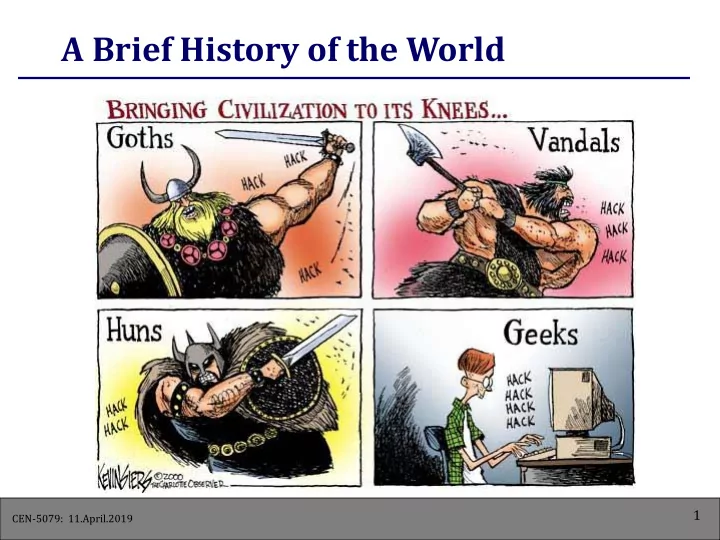
A Brief History of the World

slide-2
SLIDE 2

CEN-5079: 11.April.2019

2 Lecture 10

Network Security

slide-3
SLIDE 3

CEN-5079: 11.April.2019

3

  • Challenge

: Hackers

  • Money

: Espionage

  • Money

: Organized Crime

  • Ideology

: Hacktivists/Cyberterrorists

  • Revenge

: Insiders

Why and Who Attack Networks ?

slide-4
SLIDE 4

CEN-5079: 11.April.2019

4

  • Examples
  • Cult of the Dead Cow: demonstrate weaknesses to

strengthen security

  • Details
  • Few discover new vulnerabilities
  • Most simply try known problems on new systems
  • Motivated by thrill of access and status
  • Hacking community a strong meritocracy
  • Status is determined by level of competence

Challenge : Hackers

slide-5
SLIDE 5

CEN-5079: 11.April.2019

5

  • Examples
  • 2002: Princeton snoops on admission decisions at Yale
  • Obtain information on competing companies
  • Details
  • Intellectual property
  • CSI/FBI survey in 2005
  • IP loss estimated to $31 million
  • $350,000 per incident

Money : Espionage

slide-6
SLIDE 6

CEN-5079: 11.April.2019

6

  • Examples
  • October 2004: Shadowcrest
  • 28 people 7 countries (8 US states)
  • 1.5 million stolen credit card and bank numbers
  • January 2006: Jeanson James Ancheta
  • Infected 400,000 computers and rented them for use
  • Details
  • Criminal hackers usually have specific targets
  • Once penetrated act quickly and get out

Money : Organized Crime

slide-7
SLIDE 7

CEN-5079: 11.April.2019

7

  • Example
  • Code Red worm
  • Details:
  • Hacktivism
  • Web site defacements/parodies, redirects, denial-of-service

attacks, information theft, …

  • Cyberterrorism
  • Use Internet based attacks in terrorist activities
  • Acts of deliberate, large-scale disruption of computer networks

Ideology : Hacktivism/Cyberterror

slide-8
SLIDE 8

CEN-5079: 11.April.2019

8

  • Examples
  • Terry Childs – sysadmin in San Francisco
  • Changed passwd for FiberWAN – traffic for city govt
  • 4 years of prison
  • Roger Duronio – employee at UBS PainWebber
  • Placed logic bomb took down 2000 computers
  • Company couldn’t trade for weeks, $3.1 million losses
  • Wikileaks, Snowden, Bradley/Chelsey Manning
  • Access to DoD’s Secret Internet Protocol Router

Network and passed it to Wikileaks

  • ~750,000 classified, or unclassified but sensitive,

military and diplomatic documents

Revenge : Insiders

slide-9
SLIDE 9

CEN-5079: 11.April.2019

9

  • Details
  • Difficult to detect and prevent
  • Employees have access & systems knowledge
  • Insiders can
  • Capture data and give it to new employer/competitor
  • Place trojan horses and trapdoors to allow future access
  • Place logic bombs to harm company at a later time

Revenge : Insiders (cont’d)

slide-10
SLIDE 10

CEN-5079: 11.April.2019

10

  • Reconnaissance
  • Eavesdropping and Wiretapping
  • Impersonation
  • Message confidentiality threats
  • Web site vulnerabilities
  • DOS and DDOS

Intrusion Techniques

slide-11
SLIDE 11

CEN-5079: 11.April.2019

11

  • Port scan
  • For a given address find which ports respond
  • OS and application fingerprinting
  • Certain features and lack thereof can give away OS/apps

manufacturer and versions

  • Nmap: guess of the OS and version, what services are offered

Reconnaissance

slide-12
SLIDE 12

CEN-5079: 11.April.2019

12

  • Social engineering
  • Use social skills
  • Pretend to be someone else and ask for details
  • Run ipconfig - all
  • Intelligence
  • Dumpster diving
  • Eavesdropping
  • Blackmail
  • Bulletin boards and Chats

Reconnaissance (cont’d)

slide-13
SLIDE 13

CEN-5079: 11.April.2019

13

  • People can be just as dangerous as unprotected

computer systems

  • People can be manipulated to give up valuable

information

  • Bribed, threatened, harmed, tortured

Social Problems

slide-14
SLIDE 14

CEN-5079: 11.April.2019

14

  • Pretexting
  • Phishing
  • Baiting
  • Quid Pro Quo
  • Tailgating

Social Engineering

slide-15
SLIDE 15

CEN-5079: 11.April.2019

15

  • Example 1:
  • “Hi, I’m your AT&T rep, I’m stuck on a pole. I

need you to punch a bunch of buttons for me”

Pretexting

slide-16
SLIDE 16

CEN-5079: 11.April.2019

16

  • Example 2: Call in the middle of the night
  • “Have you been calling Egypt for the last six hours?”
  • “No”
  • “Well, we have a call that’s actually active right now,

it’s on your calling card and it’s to Egypt and as a matter of fact, you’ve got about $2000 worth of charges on your card and … read off your AT&T card number and PIN and then I’ll get rid of the charge for you”

Pretexting

slide-17
SLIDE 17

CEN-5079: 11.April.2019

17

  • E-mail
  • Appears to come from a legitimate business
  • Requests "verification" of information
  • Home address
  • Password, PIN, SSN, credit card number
  • Dire consequences if not provided
  • Contains a link to a fraudulent web page that

seems legitimate—with company logos and content

Phishing

slide-18
SLIDE 18

CEN-5079: 11.April.2019

18

  • Physical world Trojan horse/Virus
  • Attacker leaves a malware infected CD, flash drive

in public space

  • Write something appealing on front
  • "Executive Salary Summary Q1 2016“
  • Exploit finder curiosity

Baiting

slide-19
SLIDE 19

CEN-5079: 11.April.2019

19

  • Reconnaissance
  • Eavesdropping and Wiretapping
  • Impersonation
  • Message confidentiality threats
  • Web site vulnerabilities
  • DOS and DDOS

Intrusion Techniques

slide-20
SLIDE 20

CEN-5079: 11.April.2019

20

  • Cable
  • Packet sniffers
  • Inductance/radiation emitted, Cutting the cable
  • Satellite
  • Easily intercepted over large areas
  • Optical fiber
  • Harder to wiretap
  • Repeaters, splices and taps are vulnerable
  • Wireless
  • Easy to intercept, steal service and disrupt/interfere

Wiretapping

slide-21
SLIDE 21

CEN-5079: 11.April.2019

21

  • Recall how Ethernet works …
  • When someone wants to send a packet to someone

else

  • Put the bits on the wire with the destination MAC

address

  • Other hosts are listening on the wire to detect for

collisions …

  • It couldn’t get any easier to figure out what data is

being transmitted over the network!

Packet Sniffing

slide-22
SLIDE 22

CEN-5079: 11.April.2019

22

  • This works for wireless too!
  • In fact, it works for any broadcast-based medium
  • What kind of data is of interest
  • Answer:
  • Anything in plain text
  • Passwords are the most popular

Packet Sniffing (cont’d)

slide-23
SLIDE 23

CEN-5079: 11.April.2019

23

  • Reconnaissance
  • Eavesdropping and Wiretapping
  • Impersonation
  • Message confidentiality threats
  • Web site vulnerabilities
  • DOS and DDOS

Intrusion Techniques

slide-24
SLIDE 24

CEN-5079: 11.April.2019

24

  • Access the system by pretending to be an

authenticated user

  • Password guessing/capture
  • Spoofing

Impersonation

slide-25
SLIDE 25

CEN-5079: 11.April.2019

25

  • Very common attack
  • Attacker knows a login (from email/web page etc)
  • Attempts to guess password for it
  • Defaults, short passwords, common word searches
  • User info (variations on names, birthday, phone, common

words/interests)

  • Exhaustively searching all possible passwords
  • Check by login or against stolen password file
  • Success depends on password chosen by user
  • Surveys show many users choose poorly

Password Guessing

slide-26
SLIDE 26

CEN-5079: 11.April.2019

26

  • Watch over shoulder as password is entered
  • Use a trojan program to collect
  • Monitor an insecure network login
  • E.g. telnet, FTP, web, email

Password Capture

slide-27
SLIDE 27

CEN-5079: 11.April.2019

27

  • Monitor an insecure network login
  • Example: Microsoft LAN Manager
  • Hash of passwd was transmitted, not passwd
  • At most 14 characters
  • Split in blocks of 7 chars, each with a different hash !
  • If 7 chars or less, second hash is of nulls
  • If 8 chars, second hash is of single char
  • Vulnerable to brute force attacks

Password Capture using Sniffing

slide-28
SLIDE 28

CEN-5079: 11.April.2019

28

  • SSH, not Telnet
  • Many people still use Telnet and send their password in the clear

(use PuTTY instead!)

  • Now that I have told you this, please do not exploit this information
  • Packet sniffing is, by the way, prohibited by Computing Services
  • HTTP over SSL
  • Especially when making purchases with credit cards!
  • SFTP, not FTP
  • Unless you really don’t care about the password or data
  • IPSec
  • Provides network-layer confidentiality

Password Collection Protection

slide-29
SLIDE 29

CEN-5079: 11.April.2019

29

  • Pretend to be someone else
  • Masquerade
  • Session Hijacking
  • Man-In-the-Middle-Attack

Spoofing

slide-30
SLIDE 30

CEN-5079: 11.April.2019

30

  • One host pretends to be someone else
  • Easy to confuse names or mistype
  • Example: BlueBank vs Blue-Bank (masquerade)
  • 1. Blue-Bank copies web page of BlueBank
  • 2. Attracts customers of BlueBank
  • Phishing, Ads, Spam, etc …
  • 3. Ask customer to enter account name and passwd
  • 4. Optional: redirect connection to BlueBank
  • Try https://www.sonicwall.com/phishing/ to test

your phishing nose

Masquarade

slide-31
SLIDE 31

CEN-5079: 11.April.2019

31

  • Intercept and carry on session begun by another

entity

  • Example:
  • Administrator uses telnet to login to privileged account
  • Attacker intrudes in the communication and passes

commands as if on behalf of admin

  • Man-In-The-Middle Attack
  • Similar, but…
  • Attacker needs to participate since session start

Session Hijack vs. MitMA

slide-32
SLIDE 32

CEN-5079: 11.April.2019

32

  • Reconnaissance
  • Eavesdropping and Wiretapping
  • Impersonation
  • Message confidentiality threats
  • Web site vulnerabilities
  • DOS and DDOS

Intrusion Techniques

slide-33
SLIDE 33

CEN-5079: 11.April.2019

33

  • Misdelivery
  • Mistyping the destination address
  • Exposure
  • Packets are exposed over wires and in buffers at
  • Switches, gateways, routers, …
  • Traffic Flow Analysis
  • The existence of communication may help infer

information

Message Confidentiality Threats

slide-34
SLIDE 34

CEN-5079: 11.April.2019

34

  • Reconnaissance
  • Eavesdropping and Wiretapping
  • Impersonation
  • Message confidentiality threats
  • Web site vulnerabilities
  • DOS and DDOS

Intrusion Techniques

slide-35
SLIDE 35

CEN-5079: 11.April.2019

35

  • Anyone has access to the code of a web page
  • Also the order in which pages are accessed
  • Example vulnerabilities:
  • Web site defacement
  • Buffer overflows

Web Site Vulnerabilities

slide-36
SLIDE 36

CEN-5079: 11.April.2019

36

  • Attack on a website that changes the visual

appearance of the site

Web Site Defacement

United Nations website 

slide-37
SLIDE 37

CEN-5079: 11.April.2019

37

  • Work exactly like standard buffer overflows
  • Feed web site program more data than expected
  • Overflow into neighboring code and data

Buffer Overflows

slide-38
SLIDE 38

CEN-5079: 11.April.2019

38

  • Reconnaissance
  • Eavesdropping and Wiretapping
  • Impersonation
  • Message confidentiality threats
  • Web site vulnerabilities
  • DOS and DDOS

Intrusion Techniques

slide-39
SLIDE 39

CEN-5079: 11.April.2019

39

  • Make a network service unusable, usually by
  • verloading the server or network
  • Many different kinds of DoS attacks
  • SYN flooding
  • SMURF
  • Distributed attacks

Denial of Service

slide-40
SLIDE 40

CEN-5079: 11.April.2019

40

  • SYN: Client sends a SYN to the server
  • The segment sequence number is a random value A
  • SYN-ACK: Server replies with a SYN-ACK.
  • The acknowledgment number is set to one more than the received

sequence number (A + 1)

  • The sequence number that the server chooses for the packet is

another random number B

  • ACK: Client sends an ACK back to the server.
  • The acknowledgement number is set to one more than the received

sequence number B + 1

  • The sequence number is set to the received acknowledgement

value A + 1

TCP Three Way Handshake

slide-41
SLIDE 41

CEN-5079: 11.April.2019

41

  • Send SYN packets with fake source address
  • Why?
  • Server responds with SYN+ACK and keeps state

about TCP half-open connection

  • Eventually, server memory exhausted with state
  • Fake source address: packets are hard to trace
  • Solution: use “SYN cookies”

SYN Flooding Attack

slide-42
SLIDE 42

CEN-5079: 11.April.2019

42

  • In response to a SYN, create a special “cookie” for

the connection, and forget everything else

  • Let:
  • t = timestamp
  • m = maximum segment size (MSS) value that the server

would have stored in the SYN queue entry

  • s = HK(t, IPsrv, portsrv, IPcli, portcli)
  • SYN Cookie: initial sequence number B
  • First 5 bits: t mod 32
  • Next 3 bits: an encoded value representing m
  • Final 24 bits: s mod (some prime of 24 bits)

SYN Cookies

slide-43
SLIDE 43

CEN-5079: 11.April.2019

43

  • ACK: Client sends an ACK back to the server.
  • The acknowledgement number is set to one more than the received

sequence number N = B + 1

  • The server performs the following operations:
  • Break N-1 into t, m, s fields (by length)
  • Check the value t against the current time to see if the

connection is expired

  • Compare s == HK(t, IPsrv, portsrv, IPcli, portcli) ?
  • Decode m from the 3-bit encoding in the SYN Cookie
  • Reconstruct the SYN queue entry

SYN Cookies

slide-44
SLIDE 44

CEN-5079: 11.April.2019

44

Smurf Attack

slide-45
SLIDE 45

CEN-5079: 11.April.2019

45

  • ICMP echo request (ping) traffic to IP broadcast address
  • Source IP address of a broadcast ping is spoofed - victim
  • Large number of machines respond back to victim,
  • verloading it

Smurf Attack

slide-46
SLIDE 46

CEN-5079: 11.April.2019

46 Internet Perpetrator Victim

ICMP echo (spoofed source address of victim) Sent to IP broadcast address ICMP echo reply

Smurf Attack - ICMP

slide-47
SLIDE 47

CEN-5079: 11.April.2019

47

  • 1. Configure individual hosts and routers not to

respond to ping requests or broadcasts.

  • 2. Configure routers not to forward packets

directed to broadcast addresses.

Smurf Attack Defenses

slide-48
SLIDE 48

CEN-5079: 11.April.2019

48

  • Same as regular DoS, but on a larger scale
  • Example: Sub7Server Trojan and IRC bots
  • Infect a large number of machines with a “zombie”

program

  • Zombie program logs into an IRC (Internet Relay Chat)

channel and awaits commands

  • Bot command: !p4 207.71.92.193
  • Result: runs ping.exe 207.71.92.193 -l 65500 -n

10000

  • Sends 10,000 64k packets to the host (655MB!)

Distributed Denial of Service (DDoD)

slide-49
SLIDE 49

CEN-5079: 11.April.2019

49

  • July 19, 2001: over 359,000 computers infected with

Code-Red in less than 14 hours

  • Used a known buffer exploit in Microsoft IIS
  • Internet Information Server – webserver
  • Damages estimated in excess of $2.6 billion
  • Launched a DDOS attack against www1.whitehouse.gov

from the 20th to the 28th of every month!

  • Spent the rest of its time infecting other hosts

Mini Case Study – Code Red

slide-50
SLIDE 50

CEN-5079: 11.April.2019

50

  • Intrusion Detection
  • Blacklisting and Firewalls
  • CloudFlare

Defenses against DDoS

slide-51
SLIDE 51

CEN-5079: 11.April.2019

51

No CloudFlare

Without CloudFlare

allen.com server IP: 1.1.1.1

When visitor types allen.com

  • Browser contacts DNS
  • Gets back 1.1.1.1
  • Sends request to 1.1.1.1
slide-52
SLIDE 52

CEN-5079: 11.April.2019

52

CloudFlare: sits between the visitor and the website it protects

With CloudFlare

slide-53
SLIDE 53

CEN-5079: 11.April.2019

53

  • Has (collaborates with) data centers around the world
  • For the initial DNS request: route the request to the

data center closest to visitor

  • The result: IP in the CloudFlare data center closest to visitor
  • Not 1.1.1.1, but 99.99.99.99
  • Visitor makes request to 99.99.99.99 (not 1.1.1.1)

CloudFlare

slide-54
SLIDE 54

CEN-5079: 11.April.2019

54

  • CloudFlare edge servers (IP 99.99.99.99 address)
  • Receive the request for the protected website
  • Analyze the traffic before sending to protected website
  • Verify if the visitor appears to be a threat based on
  • The visitor's IP address (blacklisting/firewall)
  • Requested resources
  • Payload posted (malware, buffer overflow, SQL injection, etc)
  • Frequency of requests

CloudFlare

slide-55
SLIDE 55

CEN-5079: 11.April.2019

55

  • Speed up the response time
  • Cache parts of websites that are static in CloudFlare

servers

  • Images, CSS, and JavaScript
  • Do not cache HTML (to not mess up dynamic pages)

CloudFlare Caching

slide-56
SLIDE 56

CEN-5079: 11.April.2019

56

  • If the visitor is not a threat
  • Front server checks the request against the cache
  • Serve from cache if found
  • Otherwise, request page (from IP 99.99.99.99 to the
  • riginal webpage (1.1.1.1)

CloudFlare Request Handling

slide-57
SLIDE 57

CEN-5079: 11.April.2019

57

  • Only CloudFlare knows the IP of webserver (1.1.1.1)
  • CloudFlare protects multiple clients (webservers)
  • Sees many attacks and attackers
  • Can build more efficient blacklists
  • Can use machine learning to detect existing and new

attacks (similar to intrusion detection systems)

CloudFlare Advantage