A briefing for APSE Members DRIVER CERTIFICATE OF COMPETENCE (DCPC) - - PowerPoint PPT Presentation

a briefing for apse members driver certificate of
SMART_READER_LITE
LIVE PREVIEW

A briefing for APSE Members DRIVER CERTIFICATE OF COMPETENCE (DCPC) - - PowerPoint PPT Presentation

A briefing for APSE Members DRIVER CERTIFICATE OF COMPETENCE (DCPC) 2009 EU Directive 2003/59. The sector skills council for the Freight Logistics Industries Objectives of the Directive Improve Road Safety - public interest Savings for


slide-1
SLIDE 1

The sector skills council for the Freight Logistics Industries

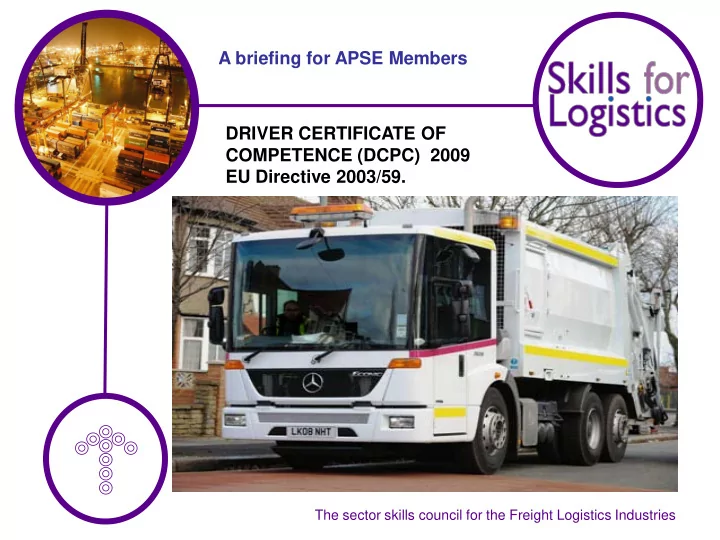
DRIVER CERTIFICATE OF COMPETENCE (DCPC) 2009 EU Directive 2003/59. A briefing for APSE Members
slide-2
SLIDE 2

Objectives of the Directive

  • Improve Road Safety -public interest
  • Savings for the industries – the industries
  • Safer bus and lorry drivers – the industries and

public interest

  • More economic and environmentally aware

professional drivers – the industries and the environment

  • Improvement in the professional image of the

industries – the industries

  • Younger people attracted by the modern nature
  • f the profession – recruitment to the industries
slide-3
SLIDE 3

Who is affected?

  • New lorry and bus drivers (min age 18yrs)
  • 51,000 entrants each year
  • Existing lorry and bus drivers
  • 430,000 Lorry
  • 166,000 Bus

Remember, Category C1 (3.5t to 7.5t) drivers as are LGV drivers subject to Vocational Licensing. Not all Vocationally Licensed Drivers will need a CPC

slide-4
SLIDE 4

The Directive requires Member States to

  • Provide for an initial qualification for new drivers which

means longer driving tests and more tests if a Certificate

  • f Competence (CPC) is needed for the job.
  • Make arrangements for periodic training for existing

drivers( 35 hours training over 5years,starting from 2009 for you).

  • Provide tangible evidence of certification. You will have

another Driver card in your pocket and don’t lose it!

slide-5
SLIDE 5

Exemptions(from CPC)

  • Drivers of vehicles with authorised

maximum speed of <45kph

  • Armed forces, fire, police
  • Drivers of vehicles being road tested
  • Emergency services
  • Drivers of vehicles being used for lessons
  • Incidental drivers eg;scaffolder,welder,etc
slide-6
SLIDE 6

The Initial Qualification

  • No EU regulation of training (i.e.: no minimum training

hours for new drivers before taking tests).

  • 6 Hours total objective and subjective testing
  • Theory test( under consultation at moment)
  • 2 parts - 4 hours duration
  • 100 Multiple choice questions/19 HP clips (licence acquisition

test) – 2.5 hours

  • 3 case studies - 1.5 hours(for drivers taking CPC)
  • Practical test
  • 2 parts – 2 hours duration
  • A driving test with “show me, tell me” (on road licence

acquisition test) – 1.5 hours

  • A practical test of vehicle safety - 0.5 hours minimum duration

(for drivers taking CPC)

slide-7
SLIDE 7

A Modular Approach

C1,C,C+E For a New Driver from 2009. Module 1 Theory Test Module 2 3 Case Studies Module 3 Driving Test Module 4 CPC Practical Test Driving Licence

  • nly

* *

Full CPC

* * * *

Upgrade to CPC

* *

slide-8
SLIDE 8

Periodic Training for existing drivers

slide-9
SLIDE 9

Arrangements for Periodic Training for existing drivers

  • Acquired rights – existing drivers don’t need to take an

initial qualification to enter into the system

  • 5 yearly periodic training cycle starts 2009 for current

Drivers.

  • 35 hours approved training
  • Blocks of not less than 7 hours training
  • Training based on revision and expansion of the

syllabus

  • Focus on safety and fuel economy
  • Training which will benefit the industries
  • Training to suit individual requirements
slide-10
SLIDE 10

Delivering Periodic Training

  • The Sector Skills Councils are in the lead –

Go Skills and Skills for Logistics

  • DSA(Driving Standards Agency) will retain

its regulatory role

  • Training organisations must be accredited
  • Trainers must be accredited
  • Training courses must be accredited
  • Training materials must be approved
slide-11
SLIDE 11

Provide tangible evidence for certification

  • Code on driving licence
  • Driver qualification card( must be carried)
  • Evidence of NVT status(CPC via an NVQ)
  • Driver’s must have evidence of periodic training

undertaken(certificate for each 7 hour course)

  • National database of driver’s training
  • Database of approved training courses and

trainers

slide-12
SLIDE 12

DCPC training subjects-examples:

  • Safe and efficient driving techniques
  • Legislation updates
  • Emergency procedures
  • Transport workplace safety
  • Transport economics
  • Environment
  • Dangerous Goods Transport
  • Security
  • Customer care
  • Image of industry
  • Health
slide-13
SLIDE 13

Key Dates

  • November 2005 –February 2006 : Public

consultation - Complete

  • 10 September 2006 : Transposition into GB and

NI law

  • 10 September 2008 : Initial qualification for bus

and coach drivers

  • 10 September 2009 : Initial qualification for lorry

drivers

  • 2008/2009 : start of 5 year period of

recertification for bus and lorry drivers

slide-14
SLIDE 14

Young Driver Scheme?

The Young Driver Scheme will not be required as minimum age for LGV drivers will be lowered to 18 years of age from 2009.

slide-15
SLIDE 15

Licences Categories covered by the new training rules: D1 D D+E C1 C C+E

slide-16
SLIDE 16

WWW.SKILLSFORLOGISTICS.ORG