A DECam and LSST microlensing survey of intermediate mass black hole - - PowerPoint PPT Presentation

a decam and lsst microlensing survey of intermediate mass
SMART_READER_LITE
LIVE PREVIEW

A DECam and LSST microlensing survey of intermediate mass black hole - - PowerPoint PPT Presentation

A DECam and LSST microlensing survey of intermediate mass black hole dark matter U.S. Cosmic Visions: New Ideas in Dark Matter Will Dawson 1 , Mark Ammons 1 , Tim Axelrod 2 , George Chapline 1 , Alex Drlica-Wagner 3 , 2017 March 24 Nathan


slide-1
SLIDE 1

LLNL-PRES-727265

This work was performed under the auspices of the U.S. Department of Energy by Lawrence Livermore National Laboratory under contract DE-AC52-07NA27344. Lawrence Livermore National Security, LLC

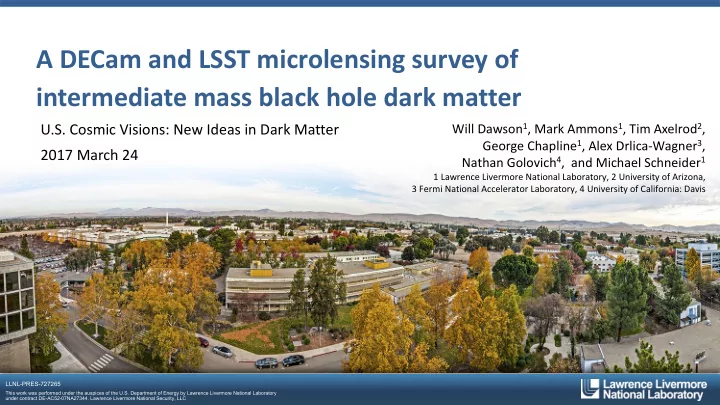
A DECam and LSST microlensing survey of intermediate mass black hole dark matter

U.S. Cosmic Visions: New Ideas in Dark Matter 2017 March 24

Will Dawson1, Mark Ammons1, Tim Axelrod2, George Chapline1, Alex Drlica-Wagner3, Nathan Golovich4, and Michael Schneider1

1 Lawrence Livermore National Laboratory, 2 University of Arizona, 3 Fermi National Accelerator Laboratory, 4 University of California: Davis

slide-2
SLIDE 2

LLNL-PRES-727265

2

What you might not know about MACHOs could SHOCK YOU!

slide-3
SLIDE 3

LLNL-PRES-727265

3

Massive MACHO Constraints circ. 2008 Completely ruled out massive MACHOs as Dark Matter

§ Microlensing

— Alcock et al. 2001 — Tisserand et al. 2007

§ CMB

— Ricotti, Ostriker, & Mack 2008

§ Wide Binary

— Yoo et al. 2004

§ Other constraints at masses ≳ 10$M⨀

slide-4
SLIDE 4

LLNL-PRES-727265

4

Massive MACHO Constraints circ. 2008 Completely ruled out massive MACHOs as Dark Matter

§ Microlensing

— Alcock et al. 2001 — Tisserand et al. 2007

§ CMB

— Ricotti, Ostriker, & Mack 2008

§ Wide Binary

— Yoo et al. 2004

§ Other constraints at masses ≳ 10$M⨀

Complex assumptions and astrophysics involved

slide-5
SLIDE 5

LLNL-PRES-727265

5

Massive MACHO Constraints circ. 2016 As assumptions and systematics explored constraints loosened

§ Microlensing

— Alcock et al. 2001 — Tisserand et al. 2007

§ CMB

— Ali-Haïmoud & Kamionkowski 2016

§ Wide Binary

— Quinn et al. 2009

"The limits that Ricotti and I reached for BH numbers were far to severe.”

  • Ostriker
slide-6
SLIDE 6

LLNL-PRES-727265

6

Because of limits in understanding of astrophysics still just order of magnitude estimate

§ Microlensing

— Alcock et al. 2001 — Tisserand et al. 2007

§ CMB

— Ali-Haïmoud & Kamionkowski 2016

§ Wide Binary

— Quinn et al. 2009

"The limits that Ricotti and I reached for BH numbers were far to severe.”

  • Ostriker
slide-7
SLIDE 7

LLNL-PRES-727265

7

The latest astrophysical constraint from dwarf galaxies and star clusters

§ Microlensing

— Alcock et al. 2001 — Tisserand et al. 2007

§ CMB

— Ali-Haïmoud & Kamionkowski 2016

§ Wide Binary

— Quinn et al. 2009

§ Dwarf Galaxies

— Brandt 2016, & Li et al. 2017

slide-8
SLIDE 8

LLNL-PRES-727265

8

The dwarf galaxy constraint is reliant on several astrophysical assumptions, likely to be wrong

§ No central massive black hole

— Kilizman et al. 2017 found 2200M⨀black hole

at the center of a star cluster

— Li et al. 2017 show factor of ~30 decrease in

constraint if 1500 M⨀ black hole in center § Delta function IM MACHO mass function

— If broader distribution that extends to ∼ M⨀

(Carr et al. 2016) then result completely invalidated § Eridanus II cluster assumed to be at center of

the dark matter halo

§ Satellites assumed to have had same mass for

10 billion years

— Crnojevic et al. 2016 note evidence for tidal

stripping due to Milky Way

Complex assumptions and astrophysics involved

slide-9
SLIDE 9

LLNL-PRES-727265

9

Microlensing is the closet thing we have to a direct measurement

§ We know there are black holes in this

mass range.

— Extensive primordial black hole

literature: from Chapline (1976) to Carr et al. (2016). § Rather than tackle an array of

astrophysics we prefer a direct measurement.

§ Microlensing is the most direct way of

constraining this parameter space.

OGLE III 2016 LIGO 2015 47 Tucanae 2017 Extend Existing MACHO Constraints

slide-10
SLIDE 10

LLNL-PRES-727265

10

§ Objective

— Confirm or reject primordial black holes (> 10𝑁⊙)

as the predominant form of dark matter § Method

— Near Term: A multi-band low cadence DOE DECam

microlensing survey of Milky Way Bulge

  • LLNL investing with LDRD now to verify plan via

simulations — Long Term: LSST microlensing survey of the Milky

Way and its local group

  • Follow-up JWST, and 30 m class telescope astrometric

microlensing measurements — DOE is 96% of the way there: leverages DOE

investments in DECam, DECam survey computation, and LSST

How do we discover or rule out primordial black holes as dark matter

DECam LSST

slide-11
SLIDE 11

LLNL-PRES-727265

11

Gravitational microlensing basics

Observer Source Image - Image + Lens

θ 𝐸0 𝐸01 𝐸1

Einstein Radius Lens Source Image+ Image8

𝜄:

slide-12
SLIDE 12

LLNL-PRES-727265

12

Total magnification is what is measured

Lens Source Image+ Image8 Total magnification:

𝜈 ≡ 𝜈= + 𝜈8 𝜄:

slide-13
SLIDE 13

LLNL-PRES-727265

13

Microlensing Basics

Gaudi Black Hole – Observer Frame

slide-14
SLIDE 14

LLNL-PRES-727265

14

Microlensing is achromatic. Powerful discriminator. Motivates multi-band microlensing survey.

Guy et al. 2007 Alcock et al. 1995 Microlensing signal does not vary with color! Typically astrophysical variable sources vary with color. Supernova

slide-15
SLIDE 15

LLNL-PRES-727265

15

Existing microlensing constraints only go up to

§ Why did they stop at ~30M⨀?

slide-16
SLIDE 16

LLNL-PRES-727265

16

Previous surveys were limited by survey length relative to event time-scale and detection methods.

Magellanic Clouds MW Bulge 𝒖E 𝒖E

slide-17
SLIDE 17

LLNL-PRES-727265

17

Statistical Ensembles

17 Expected number of events (assuming all have same timescale)

Average dark matter density at Dd Number of monitored stars Timescale of lensing event Timescale of Survey

Paczynski 1986, 1996

Optical Depth

slide-18
SLIDE 18

LLNL-PRES-727265

18

Time-scale of microlensing events. For high mass MACHOs MW Bulge is better.

Magellanic Clouds MW Bulge

slide-19
SLIDE 19

LLNL-PRES-727265

19

Parallax: Multi-year lensing events detected on order of 6 months

Gould & Horne 2013 Source Star

slide-20
SLIDE 20

LLNL-PRES-727265

20

Parallactic effect first discovered at LLNL Enables even short baseline surveys detect IM MACHOs

MACHO Survey (1995)

slide-21
SLIDE 21

LLNL-PRES-727265

21

Recent OGLE III parallax events

Wyrzkowski et al. 2016

9.3 M⨀ Black Hole 1.0 M⨀ Neutron Star ~8 years

slide-22
SLIDE 22

LLNL-PRES-727265

22

Can have a significant and secure detection of multi-year event with 6 months of data!

Wyrzkowski et al. 2016

9.3 M⨀ Black Hole 1.0 M⨀ Neutron Star ~8 years Significant event detection in 6 months.

slide-23
SLIDE 23

LLNL-PRES-727265

23

Parallax fundamentally changes the MACHO constraint game. Can constrain all mass ranges ≳ 𝟐𝟏 M⨀ with same survey!

23 Expected number of events (assuming all have same timescale)

Average matter density at Dd Number of monitored stars Timescale of lensing event Timescale of Survey

Paczynski 1986, 1996

Optical Depth

From 10’s of years to ~6 months!

slide-24
SLIDE 24

LLNL-PRES-727265

24

Microlensing parallax constraint on black hole mass

§ Parallactic signal is a strong function of

mass

— Without the parallax you basically have

no constraint on the lens mass. § However there is still a degeneracy

between lens mass and lens distance.

§ With an ensemble can place tighter

constraints on the population mass spectrum, by utilizing our knowledge of the MW dark matter halo density function.

Wyrzkowski et al. 2016

OGLE Black Hole

slide-25
SLIDE 25

LLNL-PRES-727265

25

Microlensing also affects the astrometry of the source star

§ We can break the mass – lens

distance degeneracy by measuring the microlensing astrometric signal

§ Current Keck (Lu et al.) and

HST (Kains et al.) studies underway to measure astrometric shifts

25 Gaudi Relative Centroid Shift

slide-26
SLIDE 26

LLNL-PRES-727265

26

Astrometric follow-up is easily facilitated

Lu et al. 2016

Time Since Closest Approach

Max astrometric shift occurs before/after peak magnification.

Gaudi

slide-27
SLIDE 27

LLNL-PRES-727265

27

Parallax + Astrometric Microlensing = Tight Mass Constraint

m q p p l =

  • =

q s = p l

  • p

p

  • p

p ^ p p p =

  • ^
  • m

q p p l =

  • =

q s = p l

  • p

p

  • p

p ^ p p p =

  • ^
  • Yee 2015
slide-28
SLIDE 28

LLNL-PRES-727265

28

Parallax + Astrometric Microlensing = Tight Mass Constraint

m q p p l =

  • =

q s = p l

  • p

p

  • p

p ^ p p p =

  • ^
  • m

q p p l =

  • =

q s = p l

  • p

p

  • p

p ^ p p p =

  • ^
  • Yee 2015

If primordial BHs make up dark matter, then measuring their mass spectrum will be especially exciting because it will tell us something about the fundamental physics of the Big Bang.

slide-29
SLIDE 29

LLNL-PRES-727265

29

Ability to resolve multiple lensed images

§ Potential to resolve multiple images

from IM MACHO events! MW Bulge Adaptive Optics Resolution

slide-30
SLIDE 30

LLNL-PRES-727265

30

§ Model a microlensing survey off DOE supported DECaLS

— DECam imaging survey — Survey time through NOAO — Data analysis on LLNL and FNAL computing — Project effort funded through DOE

§ Building to and supplementing the LSST microlensing survey

— LSST is currently not optimized for microlensing science — LSST will survey the Milky Way Galaxy, but not as much as the extragalactic fields.

Need to supplement the survey with DECam microlensing survey

What are we actually proposing

slide-31
SLIDE 31

LLNL-PRES-727265

31

Proposing a 5 year DECam MACHO Survey Influence and bridge to LSST

LSST Survey Starts

DECam MACHO Survey LSST Survey Strategy Determined LSST Survey Schedule

slide-32
SLIDE 32

LLNL-PRES-727265

32

Survey Footprint

ESO/S. Brunier

𝑩 ≈ 𝝆𝟐𝟔∘𝟑 = 𝟖𝟏𝟏 sq sq.de

  • deg. ≈ 𝟑𝟏𝟏 DE

DECam am Po Pointings

slide-33
SLIDE 33

LLNL-PRES-727265

33

§ 10s limiting magnitude of 23.3

— 70 s in g; 130 s in r = 200 s per g & r epoch

§ ~500 Million stars § 13 hours per g & r epoch § 4 nights per month § 8 months per year § 5 years § ~60 measurements per year per star

Survey Numbers

≈ 100 black hole microlensing events (if all dark matter)

slide-34
SLIDE 34

LLNL-PRES-727265

34

§ Old

— Detect based off complete rise and fall — Photometry from difference imaging

§ Modern computation enables better new

ways

— Maximum likelihood parallactic event

detection (see e.g. Dawson, Schneider, & Kamath 2016)

— Bayesian image analysis to forward model

variability (Schneider & Dawson in prep)

— Leverage experience with first weak lensing

measurement through galactic plane (Dawson et al. 2015; Jee et al. 2015)

Algorithm focus

slide-35
SLIDE 35

LLNL-PRES-727265

35

Leveraging existing DOE investments in pipeline development: LLNL will develop the Level 3 microlensing plugin

  • M. Juric

Leverage existing DECam & LSST pipeline investments We develop the Level 3 microlensing analysis plugin

slide-36
SLIDE 36

LLNL-PRES-727265

36

Item Investment DECam ~$50 M LSST ~$175 M DECam data reduction FNAL Computing

DOE has already invested in the vast majority of the needed resources

Office of Science Current Investment

Item Investment Staff Support 0.5 FTE Postdoc 1 FTE Microlensing analysis LLNL Computing

LLNL Current Investment

Item Investment

  • Obs. Travel

8 runs/year

  • Univ. Summer Salary

2 months/year Postdocs 2 FTE

  • Grad. Student

2 FTE

New Investment LLNL and FNAL will contribute staff support.

slide-37
SLIDE 37

LLNL-PRES-727265

37

§ A direct measurement of black hole MACHOs via microlensing

— Shortcut astrophysical complications of other methods

§ DOE 96% of the way there. Leveraging:

— DECam & LSST — LLNL & FNAL computing — Current investments by DOE labs

§ DECam 5 year survey

— ≈ 100 black hole microlensing events if all dark matter

§ Measure the mass of each black hole with parallax and astrometry

— Black hole mass spectrum could give insight into fundamental physics of the big bang.

Summary

slide-38
SLIDE 38
slide-39
SLIDE 39

LLNL-PRES-727265

39

Microlensing Basics

Einstein Radius

𝛾

Observer Source Image 1 Lens

θ 𝐸0 𝐸01 𝐸1

Convenient coord. system

slide-40
SLIDE 40

LLNL-PRES-727265

40

Microlensing Basics 𝛾

Observer Source Image 2 Image 1 Lens

θ 𝐸0 𝐸01 𝐸1

Solving the lensing equation: 2 solutions… 2 images

slide-41
SLIDE 41

LLNL-PRES-727265

41

Microlensing Basics

Observer Source Image 2 Image 1 Lens

θ 𝐸0 𝐸01 𝐸1

Einstein Radius

slide-42
SLIDE 42

LLNL-PRES-727265

42

Microlensing Basics

Magnification of the two images: Lens Source Image+ Image8

𝜄:

slide-43
SLIDE 43

LLNL-PRES-727265

43

Microlensing Basics

Magnification of the two images: Total magnification:

𝜈 ≡ 𝜈= + 𝜈8

Lens Source Image+ Image8

𝜄:

slide-44
SLIDE 44

LLNL-PRES-727265

44

Statistical Ensembles

44 Optical Depth

Average matter density at Dd

Expected number of events (assuming all have same timescale)

Number of monitored stars Timescale of lensing event Timescale of Survey

Paczynski 1986, 1996

slide-45
SLIDE 45

LLNL-PRES-727265

45

Microlensing parallax also provides constraint on black hole mass

§ Parallactic signal is a strong function of

mass

— Without the parallax you basically have

no constraint on the lens mass.

slide-46
SLIDE 46

LLNL-PRES-727265

46

§ Parallax means no high mass limit to the constraining power of a microlensing survey § Parallax provides constraint on the black hole mass

— Despite degeneracies with lens distance, powerful for an ensemble

§ Parallactic + astrometric = tight mass constraints § New telescopes can resolve the multiple images § Achromatic, parallax, and astrometric microlensing signals are extremely powerful

Method Summary

slide-47
SLIDE 47

LLNL-PRES-727265

47

OGLE III 2016 LIGO 2015 47 Tucanae 2017 Extend Existing MACHO Constraints

slide-48
SLIDE 48

LLNL-PRES-727265

48

We have experience in dense environment survey planning and analysis

Dawson et al. 2015 Jee, Stroe, Dawson et al. 2015 First weak lensing measurement through the galactic plane.