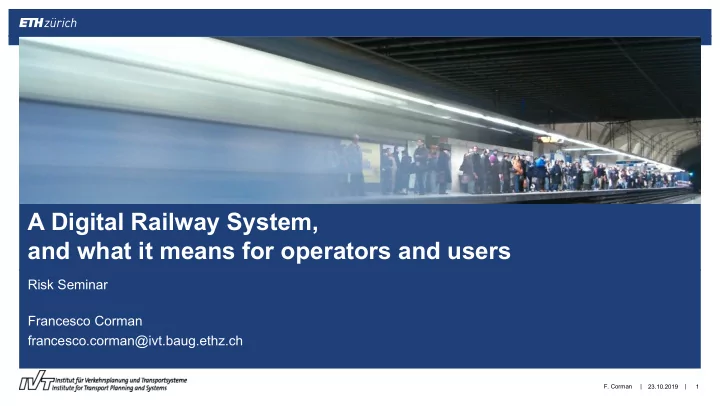
A Digital Railway System, and what it means for operators and users - - PowerPoint PPT Presentation

a digital railway system and what it means for operators
SMART_READER_LITE
LIVE PREVIEW

A Digital Railway System, and what it means for operators and users - - PowerPoint PPT Presentation

A Digital Railway System, and what it means for operators and users Risk Seminar Francesco Corman francesco.corman@ivt.baug.ethz.ch F. Corman | | 23.10.2019 1 Overall concept of this slides Risk = probability x intensity x exposure x


slide-1
SLIDE 1

| |

Risk Seminar Francesco Corman francesco.corman@ivt.baug.ethz.ch

23.10.2019 1

A Digital Railway System, and what it means for operators and users

  • F. Corman
slide-2
SLIDE 2

| |

Digitalization enables accurate quantification/ feedback/ control/ shift

Overall concept of this slides

23.10.2019

  • F. Corman

2

Risk/uncertainty with high probability, small exposure-vulnerability Risk/uncertainty with smaller probability, larger exposure-vulnerability Risk = probability x intensity x exposure x vulnerability

slide-3
SLIDE 3

| |

Challenges in railway systems

  • Infrastructure capacity is money intensive, inflexible, slow to build, in large steps
  • Operations tightly constrained and interrelated, with small operative margins
  • Variability in operations causes delay propagation to traffic, impacting passengers
  • Increasing traffic worsens performance, amplifying delay propagation
  • Increasing quality expectations, passengers, competition; economic efficiency
  • F. Corman

3 23.10.2019

slide-4
SLIDE 4

| |

  • F. Corman

4

Utilization rate [train km per track km] Punctuality = Quality

Railway network currently used extensively and with high quality

[Dutch Railways NS, 2018]

23.10.2019

slide-5
SLIDE 5

| |

Delays in Switzerland exist (Graffagnino et al 2012)

  • F. Corman

5 23.10.2019

  • Instability due to many

controllable/incontrollable internal/external factors

slide-6
SLIDE 6

| |

Massive growth expected vulnerability to instability

  • F. Corman

6

Public Transport/Railway 51% growth 20102040 In 2040, compared to 2010: +37% ton km +25 % passenger km +28% population increase +46% economy increase

2040 [Federal Statistic Office, BFS OFS Pocket Statistics 2018] [Federal Office for Spatial Development ARE OFDT, Perspective 2040]

23.10.2019

slide-7
SLIDE 7

| |

Potential from digitalization

  • F. Corman

7

?

Understand Delay phenomena Fusing unreliable GPS with reliable track-based data Predict Determining values for future phenomena Identifying future situations Optimize Deciding against possible situations

?

Digital railway system

23.10.2019

10

01

0 2 3

01

00 @#

slide-8
SLIDE 8

| |

How to get there? Need to shifts risks/uncertainties

23.10.2019

  • F. Corman

8

Train safety Train movement Traffic management Infrastructure Planning Timetable Planning Delay management

Where is a train? Where is a train? Where should a train be? Where should a train be? Where will a train be? Where will a train be? Where should all trains be? Where should all trains be? Where do passengers want trains to be? Where do passengers want trains to be? How to make it possible for trains to be where they should? How to make it possible for trains to be where they should?

slide-9
SLIDE 9

| |

How to get there? Need to shifts risks/uncertainties

23.10.2019

  • F. Corman

9

Train safety Train movement Traffic management Infrastructure Planning Timetable Planning Delay management Positioning Risk = probability x intensity x exposure x vulnerability high low high low

slide-10
SLIDE 10

| |

Understand - positioning

  • Impact of bad data collection: positioning of trains, GPS signaling system

23.10.2019

  • F. Corman

10

Fusing power data with speed reduces position uncertainty in GPS blackout areas to operationally useful levels Fusing power data with speed reduces position uncertainty in GPS blackout areas to operationally useful levels

Sessa, P.G., De Martinis, V., Corman, F (2019) CACAIE Position estimate, no measure Position estimate, power measured

slide-11
SLIDE 11

| |

Systemic risks – the example of fully automated train operations

  • Railway has very high safety already
  • Control of speed and variability less variations, increased punctuality
  • High precision control as enabler of reduction of margins  increased capacity
  • Risks of shutdown of system whenever a human-acceptable,

but machine-unacceptable situation appears

  • Ultimately, reliability or performance could decrease

(e.g. over protective advanced signaling systems)

23.10.2019

  • F. Corman

11

slide-12
SLIDE 12

| |

How to get there? Need to shifts risks/uncertainties

23.10.2019

  • F. Corman

12

Train safety Train movement Traffic management Infrastructure Planning Timetable Planning Delay management Traffic operations Risk = probability x intensity x exposure x vulnerability low to high low high low-medium

slide-13
SLIDE 13

| |

We have little clue whether delays will increase/decrease with time

  • F. Corman

13

Accuracy of weather forecast 6 days in 2010, better than 2 days in 1970 [Deutscher Wetterdienst] % Accurate predictions

2 days, 4 days, 6 days ahead

23.10.2019

  • Railway operations and delays are interrelated stochastic processes,

but most often considered as deterministic process

slide-14
SLIDE 14

| |

Predictions – impact into decisions affecting future traffic

  • “Things are almost constant”
  • Adjusting operating plan, departures,

train crossings, transfers

  • Resource allocation – drivers, vehicles
  • Passengers might take wrong services,
  • r face delays
  • Bayesian network approaches might help

not only predict, but also understand

23.10.2019

  • F. Corman

14

Büchel, Corman ( 2020) TRBoard Corman Kecman ( 2017) TRC

slide-15
SLIDE 15

| |

Reassigning capacity in real time: Railway traffic control

  • F. Corman

15

Based on a current network state, determine traffic control actions (retiming; reordering, rerouting, cancelling,…) e.g. should the yellow train overtake the blue? which proactively reduce delays and delay propagation, in a short computation time

?

time time

} arrival time

 delay

} arrival time

 delay

23.10.2019

slide-16
SLIDE 16

| |

State of practice potential of decision support

  • F. Corman

16 23.10.2019

slide-17
SLIDE 17

| |

High probability, small vulnerability: delays Alternative Graph Approach for optimization

23.10.2019

  • F. Corman

17

Traffic Control Algorithms: Optimized Orders First In First Out Rule-based Keep the Timetable Order

Variation in observed delays decreases Variation in observed delays decreases

Corman et al ( 2011) TPT

slide-18
SLIDE 18

| |

Bringing passengers into the picture - delays

  • Compliance
  • Information availability

and dissemination

  • Real time information
  • n passengers
  • Existence of suboptimal

User Equilibria

23.10.2019

  • F. Corman

18

Corman et al; (2016) TR part E

Delaying trains instead of passengers: 12% shorter travel time vs timetable Delaying trains instead of passengers: 12% shorter travel time vs timetable

slide-19
SLIDE 19

| |

Small probability, larger vulnerability: disruptions

23.10.2019

  • F. Corman

19

2012 2013 2014 2015

Rastatt Tunnel disruption, august- October 2017-DB AG Amount of events classified as disruption, Dutch Network [Corman]

Marra, Corman 2020 TRBoard

Disruptions, Dutch network

slide-20
SLIDE 20

| |

Passengers as a key aspect in disruptions

  • Agent-based models

estimate passenger evaluation

  • f disruption
  • Modelling different information

availability strategies

  • Variability in impact
  • Further potential to decrease

impact changes by managing the system

23.10.2019

  • F. Corman

20

Best reactive information only slightly worse than proactive information Best reactive information only slightly worse than proactive information reactive information one order of magnitude better than no information reactive information one order of magnitude better than no information

Leng, Corman CASPT 2018

slide-21
SLIDE 21

| |

How to get there? Planning for uncertainty

23.10.2019

  • F. Corman

21

Train safety Train movement Traffic management Infrastructure Planning Timetable Planning Delay management Planning Risk = probability x intensity x exposure x vulnerability low low-medium high low-medium

slide-22
SLIDE 22

| |

Switzerland typically investing heavily in hardware – railway infrastructure very expensive and long time to delivery

  • STEP Ausbau Schritte 2035 : 11 Billion CHF for new infrastructure
  • F. Corman

22

[Federal Office for Transport BAV-OFT, 2017]

23.10.2019

slide-23
SLIDE 23

| |

Investing in timetable planning? In demand management?

  • Digitalization allows better quantification of

performance of plans regarding the demand

  • How much risks in transport performance

we can manage by just a better software?

  • How much risks in capacity/transport performance

we can manage by changing demand patterns? E.g. reducing peak demand

23.10.2019

  • F. Corman

23

Amstutz 2019

slide-24
SLIDE 24

| |

Digitalization enables accurate quantification/ feedback/ control/ shift

Conclusion - Overall concept of this slides

23.10.2019

  • F. Corman

24

Risk/uncertainty with high probability, small exposure-vulnerability Risk/uncertainty with smaller probability, larger exposure-vulnerability Risk = probability x intensity x exposure x vulnerability

slide-25
SLIDE 25

| |

Risk Seminar Francesco Corman francesco.corman@ivt.baug.ethz.ch

23.10.2019 25

A Digital Railway System, and what it means for operators and users

  • F. Corman