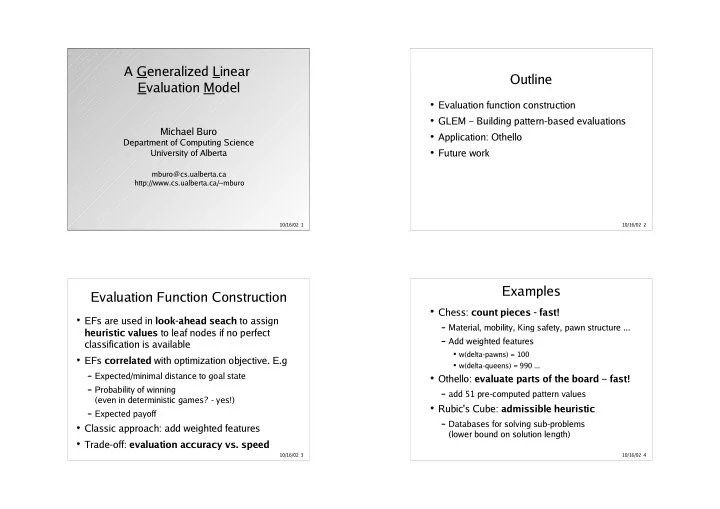
A Generalized Linear Outline Evaluation Model Evaluation function - - PowerPoint PPT Presentation

a generalized linear outline evaluation model
SMART_READER_LITE
LIVE PREVIEW

A Generalized Linear Outline Evaluation Model Evaluation function - - PowerPoint PPT Presentation

A Generalized Linear Outline Evaluation Model Evaluation function construction GLEM Building pattern-based evaluations Michael Buro


slide-1
SLIDE 1

10/16/02 1

A Generalized Linear Evaluation Model

Michael Buro

Department of Computing Science University of Alberta

mburo@cs.ualberta.ca http://www.cs.ualberta.ca/~mburo

10/16/02 2

Outline

  • Evaluation function construction
  • GLEM – Building pattern-based evaluations
  • Application: Othello
  • Future work

10/16/02 3

Evaluation Function Construction

  • EFs are used in look-ahead seach to assign

heuristic values to leaf nodes if no perfect classification is available

  • EFs correlated with optimization objective. E.g

Expected/minimal distance to goal state

Probability of winning (even in deterministic games? - yes!)

Expected payoff

  • Classic approach: add weighted features
  • Trade-off: evaluation accuracy vs. speed

10/16/02 4

Examples

  • Chess: count pieces - fast!

Material, mobility, King safety, pawn structure ...

Add weighted features

w(delta-pawns) = 100

w(delta-queens) = 990 ...

  • Othello: evaluate parts of the board – fast!

add 51 pre-computed pattern values

  • Rubic's Cube: admissible heuristic

Databases for solving sub-problems (lower bound on solution length)

slide-2
SLIDE 2

10/16/02 5

Two Problems

  • Where do features come from?

Usually provided by human experts

What if there are no experts?

What if the expert can't explain the feature s/he is using?

What if human experts are weak in absolute terms?

  • How to combine features?

Linear, non-linear? What structure?

How to assign weights to features?

Search in Function Space : Very Hard!

10/16/02 6

Genetic Programming

  • Breed LISP expressions (trees)

Atoms refer to state representation or provided features

  • Maintain a pool of expressions
  • Let the best ones generate offspring

(“cross-over”, “mutation”)

  • Remove weak performers
  • Iterate

10/16/02 7

Hybrid Approach

  • Start with (simple) features

(could be raw state representation)

  • Select evaluation model

(e.g. linear, ANN, decision trees)

  • Grow new features by combining previously

generated features

  • Select new relevant features
  • Optimize numerical parameters
  • Iterate if not satisfied

10/16/02 8

GLEM

  • Start with binary features

(as simple as “Is a black King on A1?”)

  • Grow feature conjunctions
  • Combine relevant features linearly
  • Apply monotone squashing function

to model saturation

  • Optimize feature weights using linear

regression

slide-3
SLIDE 3

10/16/02 9

Conjunctions

  • Complete, can represent perfect evaluation
  • Fast evaluation
  • “only” 2^n feature combinations
  • Natural non-linear feature interaction. E.g.

F1 : (Black King on 8th rank)

F2 : (White rook on 7th rank)

F1 not correlated with winning

F2 somewhat correlated with winning

F1 & F2 much more correlated with winning

10/16/02 10

Top Level: Linear + Squashing

  • Fast evaluation
  • Efficient weight optimization

(Gradient based algorithms find global optimum)

  • No need to apply squashing function during

game-tree search: monotone!

10/16/02 11

Generating Conjunctions

  • Over-fitting?

(good fit on training data, but poor generalization)

  • Ad hoc solution: Generate conjunctions that

appear at least N times in the training set:

Inductive algorithm, length 1,2,3...

  • Post processing: remove conjunctions that are

not correlated with winning

  • Future work:

generate maximal conjunctions fast

smarter handling of rare conjunctions

10/16/02 12

Parameter Optimization

  • Generate lots of training samples:

(state, evaluation)

  • Generate conjunctions
  • Solve large (linear) regression problem

regression takes care of feature correlation!

  • Boot-strapping: iterate
slide-4
SLIDE 4

10/16/02 13

Application: Othello

10/16/02 14

Patterns

10/16/02 15

Fast Evaluation

10/16/02 16

Logistello's Evaluation Function

  • 13 game stages (every 4 discs)
  • Sum of 51 precomputed pattern value

Fast! 1.4 million evaluations/sec on Athlon 1666 MHz

  • 1.5 million weights
  • 17 million training positions
  • Least squares takes 6 hours
slide-5
SLIDE 5

10/16/02 17

Future Work

  • Better solution for rare configurations

Weight bound depending on # of occurrence

  • Automated pattern search
  • Efficient implementation of large sparse

patterns

  • Non-linear top-level combinations
  • Other applications: ataxx, backgammon,

LOA, go ...