AGrowingProblem? JudithPederson DouglasW.Christel - - PowerPoint PPT Presentation

a growing problem
SMART_READER_LITE
LIVE PREVIEW

AGrowingProblem? JudithPederson DouglasW.Christel - - PowerPoint PPT Presentation

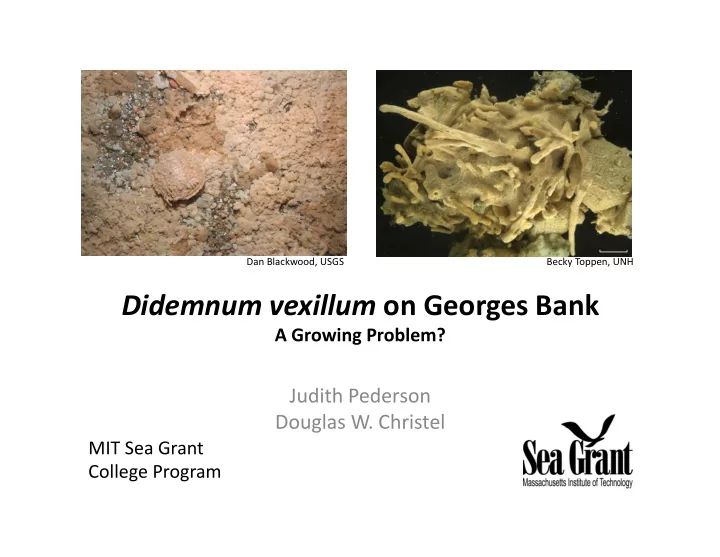
DanBlackwood,USGS BeckyToppen,UNH Didemnum vexillum onGeorgesBank AGrowingProblem? JudithPederson DouglasW.Christel MITSeaGrant CollegeProgram


slide-1
SLIDE 1

Didemnum
vexillum
on
Georges
Bank


A
Growing
Problem?


Judith
Pederson
 Douglas
W.
Christel


MIT
Sea
Grant

 College
Program


Dan
Blackwood,
USGS
 Becky
Toppen,
UNH

slide-2
SLIDE 2

Purpose
of
Survey


  • 1. Find
out
what
fishermen
know
about
Didemnum

  • Where
it
is
found
on
Georges
Bank

  • How
it
spreads

  • How
it
affects
other
species
and
vessel
operaLons

  • 2. IdenLfy
potenLal
ways
to
minimize
impacts

  • 3. Improve
public
educaLon
about
this
species


Dan
Blackwood,
USGS
 Dan
Blackwood,
USGS


slide-3
SLIDE 3

What
Is
Didemnum?


  • A
sea
squirt,
or


tunicate


  • Filter‐feeder

  • Forms
colonies


with
other
sea
 squirts


  • Tan,
pink
or
yellow


in
color


  • Non‐naLve
species

slide-4
SLIDE 4

It
Is
Not
“Monkey
Dung”


  • Monkey
dung
is
a
sponge;
Didemnum
is
a
sea
squirt

  • Monkey
dung
is
bright
yellow;
Didemnum
is
more
pink
in
color

  • Monkey
dung
has
fewer
siphon
holes
or
cloacal
bumps


  • Monkey
dung
sLcks
together
beWer;
Didemnum
will
crumble


Monkey
Dung


hWp://habcam.whoi.edu


Didemnum


Larry
Harris,
UNH


slide-5
SLIDE 5

Didemnum
Preferences


Hard
surfaces

 (starts
on
undersides)


  • Vessel
hulls

  • Rocks/cobble

  • Lobster
traps


Moderate
temperatures
 (10‐25°C,
or
50‐77°F)


  • Dies
back
in
winter,
but
can


survive
cold
temperatures


Depths
up
to
70m
(230’,
35
fa)
 Cannot
tolerate
fresh
water


J.
Dijkstra

 Gretchen
Lambert


slide-6
SLIDE 6

ReproducLon
and
Predators


ReproducNon


  • Sexual
reproducLon

  • Asexual
budding

  • Colony
fragmentaLon


Predators


  • Periwinkle
snails

  • Sea
urchins

  • Some
fish
species


Dan
Blackwood,
USGS


slide-7
SLIDE 7

BoWom
Types
on
Georges
Bank


C.
Adams.MITSG


slide-8
SLIDE 8

Where
Has
It
Been
Found?


Northern
Edge


Page
ValenLne,
USGS


slide-9
SLIDE 9

Causes
of
Movement


Mostly
human‐oriented


  • Ballast
water

  • Hull
fouling

  • Aquaculture

  • Breaking
up
colonies


– Anchoring
 – Trawling/dredging
 – Using
lobster
traps
in
mulLple
areas


  • Other
sources?


Ashley
CouWs,
USGS
 Gordon
King,
USGS
 Gretchen
Lambert


slide-10
SLIDE 10

PotenLal
Problems


Fast‐growing
colonies
blanket
boWom
surfaces


Dan
Blackwood,
USGS


slide-11
SLIDE 11

PotenLal
Problems


Overgrows
naNve
species,
including
scallops,
mussels,
worms


  • Reduces
food
available
for
groundfish
and
lobsters

  • May
reduce
movement
of
scallops


Reduces
larval
recruitment


  • Overgrows
habitats
used
as
nurseries/predator
avoidance

  • May
prevent
scallops
from
seWling
on
the
boWom


Increased
labor
costs
for
vessel
and
aquaculture
operaNons


  • May
increase
Lme
to
shuck
scallops

  • May
increase
need
to
clean
gear


Reduced
yield
of
seafood


  • May
slow
growth
rates
for
groundfish

  • May
reduce
survivability
of
shellfish


Other
issues
we’ve
missed?


Dan
Blackwood,
USGS


slide-12
SLIDE 12

Possible
MiLgaLon
Measures


Fish
more
in
areas
where
found
 Close
areas
where
found
 Clean
hulls/gear
more
frequently


  • Scrape
hulls
at
least
once
a
year

  • Clean
traps
frequently
or
reduce
soak
Lmes

  • Treat
traps
in
warm/hot
freshwater
before
sebng


Minimize
use
of
gear
in
other
areas

 Discard
scallop
shells
where
dredging
occurred
 Any
other
ideas?


www.derm.qld.gov.au


slide-13
SLIDE 13

Thank
You!


Your
input
is
very
helpful
to
our
research.


  • Increases
our
knowledge
of
species
interacLons

  • Puts
issues
into
perspecLve

  • Helps
refine
research
quesLons

  • IdenLfies
pracLcal
soluLons


Contact
informaNon:

Dr.
Judith
Pederson


  • Telephone:

617‐252‐1741

  • Email:

jpederso@mit.edu

  • Website:

hWp://seagrant.mit.edu