A Large Variety of Writing Instruments: Students had no ideas on - - PowerPoint PPT Presentation

a large variety of writing instruments
SMART_READER_LITE
LIVE PREVIEW

A Large Variety of Writing Instruments: Students had no ideas on - - PowerPoint PPT Presentation

TRIZ Future Conference 2010 Report of the Seminar Class for 2nd year students of Faculty of Informatics Held by The Europen TRIZ Association (ETRIA) April to July, 2010 (1st semester): 90 minutes 14 = 21 hrs. 10 students. A Large Variety of


slide-1
SLIDE 1

A Large Variety of Writing Instruments:

Studying the Evolution of Technologies in Familiar Items

November 3 - 5, 2010 University of Belgamo, Italy

Toru Nakagawa (Osaka Gakuin Univ., Japan), Kurumi Nakatani (Osaka Gakuin Univ., 2nd Yr. Student),

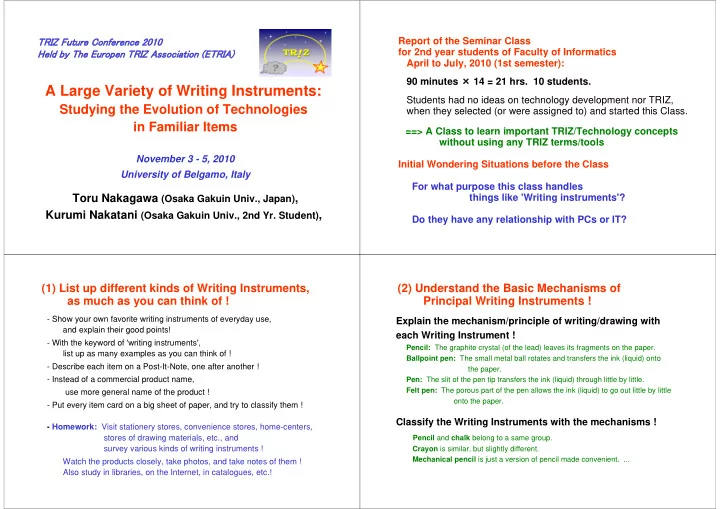
TRIZ Future Conference 2010 Held by The Europen TRIZ Association (ETRIA) Report of the Seminar Class for 2nd year students of Faculty of Informatics April to July, 2010 (1st semester): 90 minutes × 14 = 21 hrs. 10 students. Students had no ideas on technology development nor TRIZ, when they selected (or were assigned to) and started this Class. ==> A Class to learn important TRIZ/Technology concepts without using any TRIZ terms/tools Initial Wondering Situations before the Class For what purpose this class handles things like 'Writing instruments'? Do they have any relationship with PCs or IT?

(1) List up different kinds of Writing Instruments, as much as you can think of !

  • Show your own favorite writing instruments of everyday use,

and explain their good points!

  • With the keyword of 'writing instruments',

list up as many examples as you can think of !

  • Describe each item on a Post-It-Note, one after another !
  • Instead of a commercial product name,

use more general name of the product !

  • Put every item card on a big sheet of paper, and try to classify them !
  • Homework: Visit stationery stores, convenience stores, home-centers,

stores of drawing materials, etc., and survey various kinds of writing instruments ! Watch the products closely, take photos, and take notes of them ! Also study in libraries, on the Internet, in catalogues, etc.!

(2) Understand the Basic Mechanisms of Principal Writing Instruments !

Explain the mechanism/principle of writing/drawing with each Writing Instrument !

Pencil: The graphite crystal (of the lead) leaves its fragments on the paper. Ballpoint pen: The small metal ball rotates and transfers the ink (liquid) onto the paper. Pen: The slit of the pen tip transfers the ink (liquid) through little by little. Felt pen: The porous part of the pen allows the ink (liquid) to go out little by little

  • nto the paper.

Classify the Writing Instruments with the mechanisms !

Pencil and chalk belong to a same group. Crayon is similar, but slightly different. Mechanical pencil is just a version of pencil made convenient. ...

slide-2
SLIDE 2

(3) Writing Instruments and auxiliary tools for Writing /Drawing

Instruments for Writing/Drawing anything on something are members of Writing Instruments

Writing brush → Paintbrush → Brush → Roller → Spray → ・・・ Wood stick to write on the ground → Spatula → Carving knife → Chisel for gold work → ・・・

==> We are interested in all the Methods for Writing/Drawing anything on something Among stationery, there are various auxiliary instruments besides Writing Instruments.

E.g. Paper, Eraser, Ruler, Compasses, Drawing table, Templates, ・・・ E.g. Lead refill, Ink, Paint, ・・・

==> Writing Instruments are at the core position of the system/environment for Writing/Drawing

  • 'Color brush' [calligraphy-brush]

カラーブラッシュ〈カリグラフィーブラッシュ〉 (みずみずしく色鮮やかな発色のカラーインキと毛筆が一つになって 柔らかな線の表現や水彩表現ができ、広い面もスムースに塗れる カラー筆ペンです。) 画像参照:http://www.pentel.co.jp/product/

  • Roller (Drawing/Writing Instruments, where a cylindrical roller is turned

while ink (or paint) is applied with its soft porous side material.) □ Drawing/Writing Instruments, where ink/paint is applied

with brush made of many thin hairs

  • Paint brush

(先端全体が細く尖ることはない)

  • Brush (先端の毛が横幅広く植えられていて、太く、広く、描く/書く)

(4) Descriptions of Various Writing Instruments

□ Drawing/Writing Instruments, where ink is applied with a soft porous end

  • Felt Pen

○ 油性フェルトペン (インクが油性であるもの。) ○ 水性フェルトペン (インクが水溶性であるもの) (耐水性の水性サインペン) ◇ 蛍光ペン

  • 'Paman'

トラディオ・プラマン (インキがなくなる最後までみずみずしく書けます。) 画像参照: http://www.pentel.co.jp/product/

  • 'Line Marker'

e-line2 (線を引くための筆記具。文字などの上にかぶせるように線を引くと、 その下の部分が透けて見えるような、さまざまな色のフェルトペン。) 画像参照:http://www.pentel.co.jp/product/

  • 'Bush-Pen' (筆先が尖っていて、筆先全体が柔軟な多孔質材料でできている)

◇ふたやく筆ペン(PILOT) (墨とうす墨の二色の筆ペン) 画像参照:PILOTホームページ (http://www.pilot.co.jp/products/pen/sign_marker/fude_pen/ futayaku_keityou/index.html)

(A part of Joint Report by the Class members)

(5) Table 1. Variety of Writing Instruments

Glasswork

Puts a material inside the medium

Dry etching Injects a gaseous material Spray Injects a liquid material Spray for wall painting Injects a fluid material Injects a powder (solid) material

Injects a material (powder/fluid/liquid/ gas)

Painting brush, Brush, Writing brush Ink is applied with a brush composed of many thin hairs Oil-based ink felt pen, Water- based ink felt pen, Highlighter pen Felt pen, Brush pen, Roller Ink is applied with a soft porous end Multiple colour ball-pint pen, Multi-function pen Pen, Fountain pen, Drawing pen, Ball-point pen Ink is applied with a solid end

Adds a liquid (ink, etc.)

Painting spatula, Painting brush, Roller

Adds a fluid

Line marker on a tennis court

Adds a solid/powder

'Coopee' Colour pencil, Crayon, Crayon pastel, solid paste 'Kurutoga' mechanical pencil Chalk, Charcoal, Pencil, Mechanical pencil solid (crystal/powder)

Leaves a part of itself as a trace

Laser Wood stick, Stone, Knife, Carving knife

Gives a damage

Extensions Examples Mechanism in detail Mechanism (Classified with Mechanism) (Summary)

(6) Think of Various Usages of Writing Instruments !

・ First, tell any instances of usage of Writing Instruments !

Taking a note, Writing a document, Drawing a picture, Writing one's name on a cloth, Drawing a cartoon, Decorating a glass window, Carrying around to take a note, ・・・

・ Pick up any Writing Instrument and think 'What purpose was it made for?' ! ・ Write the various usages one by one on a Post-It-Note ! ・ Think how we can classify the various usages themselves ! ==> What to write/draw? On Which to write/draw? How to write/draw? ... these are the important aspects.

slide-3
SLIDE 3

(7) Classify Various Usages of Writing Instruments !

・ What: Pictures, Drawings, Characters

(In the human history: Pictures --> Drawings --> Characters) (We say: Draw/paint a picture. <----> Write a character. Draw/write/make a drawing.)

・ On Which: Ground, Wall, Board, Clothes, Paper, Stone, Ceramics, Glass, Metal, Plastics,

These are arranged roughly in the historical order

・ How: How about the results:

Multi-coloured, clear, in the same thickness, ・・・

How about the writing process:

Without getting tired, easy and convenient, without getting dirty, ・・・

(8) Table 2. Variety of Writing Instruments

'Solid marke r' Spray Pencil, Mechanical pencil, Fountain pen, Felt pen, Ball-point pen Felt pen Chalk Brush Wood stick

Chara cters

Painting brush Carving knife Carving knife, Stone

Drawi ngs

Spray Painting brush, Crayon, Crayon pastel Paintin g brush, Pattern printing , Dying Painting brush, Brush, Spray, Roller Spray, Brush, Roller Wood stick, stone

Pictur es

Plasti cs Metal Glas s Cera mics Ston e Paper Cloth es Board Wall Groun d On Which What (classified with the Usage) (Summary)

(9) Evaluate Various Methods of Writing/Drawing for Different Usages !

  • Puts a material

inside the medium ▲ ▲ ▲ ▲ ▲

  • Injects a material

(powder/fluid/liquid /gas) ▲ ▲

  • Adds a liquid (ink,

etc.)

▲ ▲

  • Adds a fluid

▲ ▲ ▲ ▲

▲ ▲ ▲ ▲ Adds a solid/powder ▲ ▲

  • Leaves a part of

itself as a trace ▲ ▲ ▲ ▲

▲ Gives a damage

Plasti cs Stee l Glass Cera mics Sto ne Pape r Cloth es Board Wall Grou nd On Which Methods

Evaluation levels :

Papers are especially highly developed among the media on which to write/draw.

(10) Think of 'Writing Instruments' in A Wider Sense !

・ We have so far assumed (without knowing) the cases to write/draw something one by one. ・ What do we use when we write/draw same elements

  • r same things many times repetitively?

Seals, Personal seals, Rubber stamps, Block print, Printing, ・・・ Types, Typewriter, Keyboard, Word processor, Personal Computer, ・・・ Carbon copy, Photograph, Copying, ・・・

==> Now you see a huge new areas of Evolution

  • f Writing/Drawing Instruments !!!
slide-4
SLIDE 4

(11) Recognize the Process of Writing/Drawing !

Ordinary process of Writing: Process of Writing with PC:

Information in my mind Information written on a paper

Write

Read Myself or somebody

==> Writing Instruments are requested as both Input and Output devices, simultaneously.

Information in my mind Information in a working file

Input

  • n PC

Save

  • n PC

Information in a saved file Information in a received file Transfer

  • n a net

Display

  • n PC

Information

  • n a display of PC

Read

==> Writing = Inputting and Outputting, simultaneously

For what purpose this class handles things like 'Writing Instruments'?

(12) Resolution of the Initial Questions:

To study the evolution of technologies not through lectures given by words but through our own activities of studying familiar items.

Do they have any relationship with PCs or IT?

PCs may be seen as far-extended Writing Instruments. Study of Writing Instruments may be useful when we think about Input and Output devices of PCs or IT. Basic concepts of Evolution of Technology are applicable to Information Technology (IT) as well as to Writing Instruments.

(13) Students Learned through This Class:

  • Our images about Writing Instruments have changed/extended.

Formerly: Writing Instruments = Tools to write on papers.

  • Things around us have hidden records of evolution of technologies.
  • Ex. An extension of pens was the invention of fountain pens.

The drawbacks of frequent shortage of ink triggered the invention.

  • Clarifying needs and purposes inspires further development.
  • Lessons learned with the cases of Writing Instruments will be

useful in the study of IT and Informatics, and many other.

Various machines must have similar mechanisms of evolution of technology. Various methods which we learned and used in this class will be useful in our further study in IT and Informatics.

(14) Conclusion

  • This is a model of teaching TRIZ concepts

without using TRIZ terms and TRIZ tools.

  • Attracting interests by using familiar items,

and stimulating ideas about mechanisms, technlogy development, technology evolution, etc.

  • No formal knowledge of systems, engineering,

development process, etc. are assumed. ==> Practicable also for kids

slide-5
SLIDE 5

Members of Seminar IIA Class (Prof. Toru Nakagawa) 2nd year students, Faculty of Informatics, Osaka Gakuin University April - September, 2010

Masaru Buro Mutsuki Noguchi Kurumi Nakatani Ayaka Ushijima Akihiro Meguri Takashi Yasui Susumu Uemura Ryohei Asada Remma Inada Kazuma Matsuse