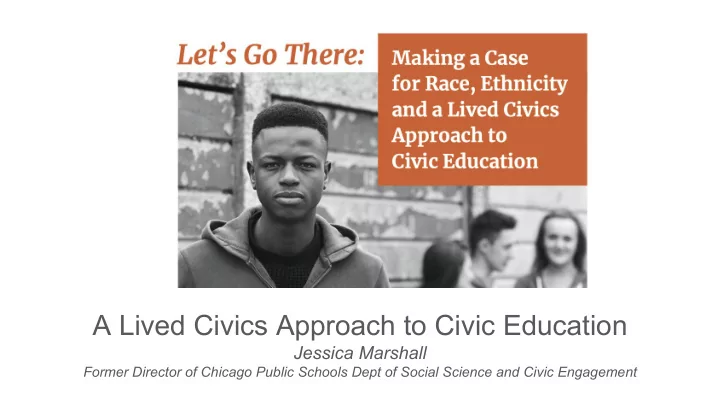
A Lived Civics Approach to Civic Education Jessica Marshall Former - - PowerPoint PPT Presentation

a lived civics approach to civic education
SMART_READER_LITE
LIVE PREVIEW

A Lived Civics Approach to Civic Education Jessica Marshall Former - - PowerPoint PPT Presentation

A Lived Civics Approach to Civic Education Jessica Marshall Former Director of Chicago Public Schools Dept of Social Science and Civic Engagement You should be able to tell your story about yourself and not allow other people to make that


slide-1
SLIDE 1

A Lived Civics Approach to Civic Education

Jessica Marshall

Former Director of Chicago Public Schools Dept of Social Science and Civic Engagement

slide-2
SLIDE 2

“You should be able to tell your story about yourself and not allow other people to make that perception for you.” “As a teacher, you’re not here to teach your opinion and so you can’t force your students to have your opinion. You can’t grade the students on maintaining your opinion, that’s not what you’re there to do….the connection that the teacher has with the students is a lot more important than the curriculum.” “Just give space to have the conversations. Because the best thing about that class was not the curriculum... the most important thing was that every single day we had real conversations about what was going on in the world and how it affected us.” “If you’re White and teaching a class and you are in like a predominantly Black neighborhood teaching about civics, you need to let the students speak on their experiences in the community and community organize around that.”

Young People Told Us….

slide-3
SLIDE 3

Lived Civics Principles

  • Young people, especially young people of color, have political knowledge and

expertise that must be acknowledged, respected, and examined in civics classrooms.

  • Curriculum must be constructed and developed with race, identity and lived

experiences positioned as central to the learning of civics, politics and government.

  • Educators must use instructional approaches that recognize ways that power

and oppression operate in classrooms and how these dynamics impact youth engagement with civics course content.

  • Consistent, meaningful and reflective professional learning for educators and

youth workers are critical to supporting Lived Civics classrooms.

slide-4
SLIDE 4

Reflections for Educators (and all of us)

  • How does my practice and the curriculum I implement acknowledge what students are

bringing to the classroom and honor their lived experiences, critical analysis and commentary?

  • Do students have an opportunity to question and interrogate traditional structures and

power dynamics both in the classroom and beyond?

  • How do I facilitate conversations that are difficult for me or for my students? How do I invite

students to identify issues and themes that are critical to them but might be outside of my

  • wn comfort zone?
  • How have I explored my own positioning and experiences relative to race, identity and

power and how that shapes what I do and who I am in the classroom?

slide-5
SLIDE 5

Lived Civics Action Steps

  • Broaden conversation and build bridges
  • Develop a community of practice to deepen understanding of Lived Civics

practice

  • Invest in development pipeline of scholars and practitioners
  • Develop policy to expand opportunity for Lived Civics implementation