A Method of Searching for Origins of Cosmic Rays correcting for - - PowerPoint PPT Presentation

a method of searching for origins of cosmic rays
SMART_READER_LITE
LIVE PREVIEW

A Method of Searching for Origins of Cosmic Rays correcting for - - PowerPoint PPT Presentation

A Method of Searching for Origins of Cosmic Rays correcting for Galactic Field Deflections and Charge Composition Martin Erdmann, Gero Mller, Martin Urban , Marcus Wirtz martin.urban@rwth-aachen.de Current status Source Searches The Pierre


slide-1
SLIDE 1

martin.urban@rwth-aachen.de

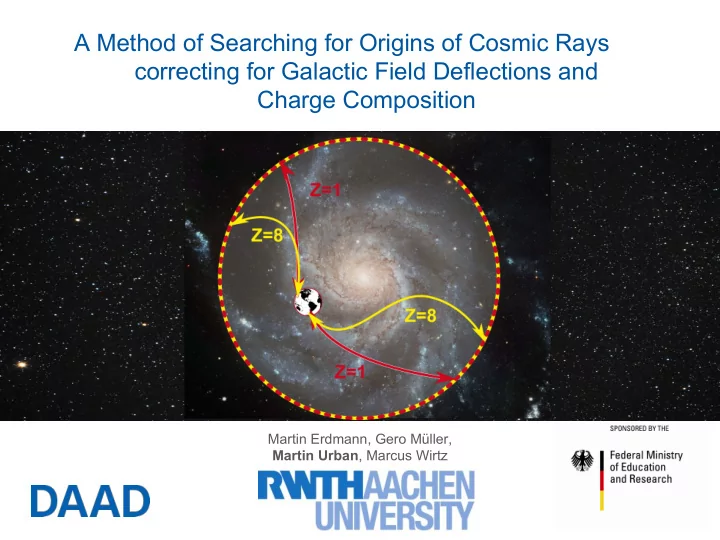
A Method of Searching for Origins of Cosmic Rays correcting for Galactic Field Deflections and Charge Composition

Martin Erdmann, Gero Müller, Martin Urban, Marcus Wirtz
slide-2
SLIDE 2

martin.urban@rwth-aachen.de

Current status

2 Source Searches Composition

The Pierre Auger Collaboration, 2015, ApJ, 804 The Pierre Auger Collaboration, 2015,POS(ICRC 2015) 420

Separate Analyses → Point source searches → Large scale anisotropy → Mass composition UHECRs

slide-3
SLIDE 3

martin.urban@rwth-aachen.de

Motivation

3 Source Searches UHECRs Composition Galactic magnetic field allows for unified analysis Galactic Magnetic Field Spectrometer

The Pierre Auger Collaboration, 2015,POS(ICRC 2015) 420 The Pierre Auger Collaboration, 2015, ApJ, 804

slide-4
SLIDE 4

martin.urban@rwth-aachen.de

Galactic Magnetic Field Correction

4

10Ne at 50 EeV 5Be at 50 EeV 1H at 50 EeV

■ Magnetic field models tuned to Faraday rotation and synchrotron emission measurements ■ Cosmic rays with different rigidities R=E/Z arrive on Earth at different directions

  • Source directions can only be found at edge of galaxy
  • Magnetic field corrections depend on cosmic ray charges

■ Correction of deflections in magnetic field using a probabilistic approach

slide-5
SLIDE 5

martin.urban@rwth-aachen.de

Analysis Strategy

5

slide-6
SLIDE 6

martin.urban@rwth-aachen.de

Monte Carlo Simulation

Monte Carlo simulation

Energy spectrum with E-2.6 Signal fraction: fs = 15 % Most abundant charges: H, He, C, N, O Sources: M87, Cen A & Fornax A smearing: ઠ = 3° Rigidity R=E/Z needed for projection to edge of galaxy, but charge? → Assign equal probability for each charge to each cosmic ray 6

slide-7
SLIDE 7

martin.urban@rwth-aachen.de

Projection to the edge of the galaxy

Galactic magnetic field ■ Regular field by Jansson and Farrar ■ Lensing technique

(H.-P. Bretz et al., 2014, Astropart.Phys. 54 110–117)

  • Probability to observe cosmic rays
  • riginating from (φ,θ) at the Galaxy

at direction (φ’,θ’) on Earth

  • Rigidity dependent

■ Transposed lens to project to edge

  • f galaxy

7

slide-8
SLIDE 8

martin.urban@rwth-aachen.de

Cluster identification

8

Superimposed maps (rigidities) 1000 isotropic simulations

→ accept only directions exceeding 90% quantile probability of orign [A.U]

probability in pixel [A.U]

slide-9
SLIDE 9

martin.urban@rwth-aachen.de

Clusters and expected arrival directions

Search for directions with high arrival probability

DBSCAN algorithmus (Ester, M. et al. (1996) KDD-96)

Use cluster centers as source candidates

Calculate expected arrival directions

  • n Earth using GMF

Standard point source search with likelihood ratio

< 90 %

9

slide-10
SLIDE 10

martin.urban@rwth-aachen.de

Likelihood analysis

anticipated signal fraction smearing to account for random fields signal distribution background distribution cosmic ray direction

  • n Earth

Model: Isotropy scenario excluded 10

slide-11
SLIDE 11

martin.urban@rwth-aachen.de

Charge determination

Update charge probabilities using projected source directions

11

Cosmic Ray E=80 EeV → C = E / R = 8

Zfit: most probable charge ■ Charge resolution of ± 2.31

slide-12
SLIDE 12

martin.urban@rwth-aachen.de

Repeat analysis with updated rigidity distributions ■ Sources directions

  • improved directional reconstruction
  • Additional (unwanted) source candidate

■ Improved charge resolution ± 1.65

Iterative Procedure

12

slide-13
SLIDE 13

martin.urban@rwth-aachen.de

Conclusion and Outlook

13

■ Method to identify source candidates by charge dependent corrections for deflections in GMF

  • Search for extragalactic directions
  • Evaluation of validity by likelihood ratio method
  • Cosmic ray charge resolution ≈ ± 2

■ Comparison of different magnetic field models ■ Inclusion of uncertainties, i.e. energy, direction ■ Application to data

slide-14
SLIDE 14

martin.urban@rwth-aachen.de

14

Backup

slide-15
SLIDE 15

martin.urban@rwth-aachen.de

Magnetic Field Lenses

■ Backtracking anti-protons from Earth to edge of galaxy

  • Using HEALPix scheme with nside=64
  • 175 rigidity bins between 1017.00 eV and 1020.49 eV with bin width log10(R/V)=0.02

■ Matrices projecting a probability distribution from edge of galaxy on Earth ■ Transposed lens answers question how probable cosmic rays at direction (φ, θ) on earth originate from direction (φ’, θ’) at edge of galaxy

15 pixel on Earth pixel at galaxy

slide-16
SLIDE 16

martin.urban@rwth-aachen.de

Lens Examples for log10R = 18.7 and log10R=19.7

16

slide-17
SLIDE 17

martin.urban@rwth-aachen.de

Galactic Magnetic Field - Cosmic Ray Flux

17

slide-18
SLIDE 18

martin.urban@rwth-aachen.de

Galactic Magnetic Field: Mean Deflections

18 JF12 PT11

slide-19
SLIDE 19

martin.urban@rwth-aachen.de

Galactic Magnetic Fields: Deflection Variances

19 JF12 PT11

slide-20
SLIDE 20

martin.urban@rwth-aachen.de

Results for 5 % signal fraction

20 20