A NEW CONCEPT OF FABRICATION OF SANDWICH PANELS WITH TRUSS-LIKE - - PDF document

a new concept of fabrication of sandwich panels with
SMART_READER_LITE
LIVE PREVIEW

A NEW CONCEPT OF FABRICATION OF SANDWICH PANELS WITH TRUSS-LIKE - - PDF document

18 TH INTERNATIONAL CONFERENCE ON COMPOSITE MATERIALS A NEW CONCEPT OF FABRICATION OF SANDWICH PANELS WITH TRUSS-LIKE CELLULAR CORES H. Kwak 1 , A. Kim 1 , H. Lee 1 , H. Hurr 2 , B. Lee 3 , J. Byun 4 , K. Kang 1 * 1 Department of Mechanical


slide-1
SLIDE 1

18TH INTERNATIONAL CONFERENCE ON COMPOSITE MATERIALS

  • 1. Introduction

Sandwich panels consisting of two high strength face sheets and a low density core such as honeycomb or foam have been regarded as an ideal design because of the advantage of high strength and stiffness to weight ratio. Mostly a sandwich panel is fabricated by adhesively bonding of face sheets on two sides of a core. And the sandwich panel is vulnerable to face-core debonding, which results in limit of its applications to heavy duty loading, particularly, fatigue loading [1]. There is the other kind of sandwich fabrication

  • techniques. Two faces are connected to each other

by lot of yarns in the core, which are interwoven with the faces. The most well-known fabrication technique stems from the traditional velvet weaving. Face sheets and core are integrally formed at a single weaving process. The products are called Integrally Woven Sandwiches, Woven Sandwich Fabric, Woven Textile Sandwich, or Distance Fabrics [2, 3]. These techniques provide high resistance against face-core debonding, and enable mass-production. However, in general, the strength under compression

  • r shear is significantly lower than adhesively

bonded sandwiches, because all the yarns in the core are vertically arranged and curved [4]. In this work, a new fabrication technique of sandwich panels which have good resistance against face-core debonding as well as high compressive and shear strength is introduced. The validity is evaluated through experiments with the specimens prepared according to the new technique and comparative analytic solution.

  • 2. Technical Concept

The new technique is based on stitching of yarns

  • r prepreg between two face sheets. Through

repeating the regular stitching with an interval in three or four directions in 3D space, octahedral /Kagome or pyramidal/diamond truss-like cellular core which provides the high strength under compression or shear is constructed. By adjusting the stitching interval with respect to the core height, multi-layered truss structure can be obtained. For stitching, the conventional sewing machine like Singer machine can be used to enhance its mass

  • productivity. Fig. 1 shows schematic views of two

kinds of sandwich panels fabricated by this

  • technique. For even higher strength, additional in-

plane nets or fabrics can be inserted between two

  • faces. Fig. 2 shows three examples of various

sandwich panel obtained by changing the number of layers and additional in-plane nets or fabrics. Fig. 2

  • shows. Fig. 3 shows a schematic view with five

layered core.

  • 3. Experiments

3.1 Specimen Design In this work, the sandwich specimens with pyramidal truss-like cellular core are analyzed. See

  • Fig. 3 for a unit cell of this core. The effective

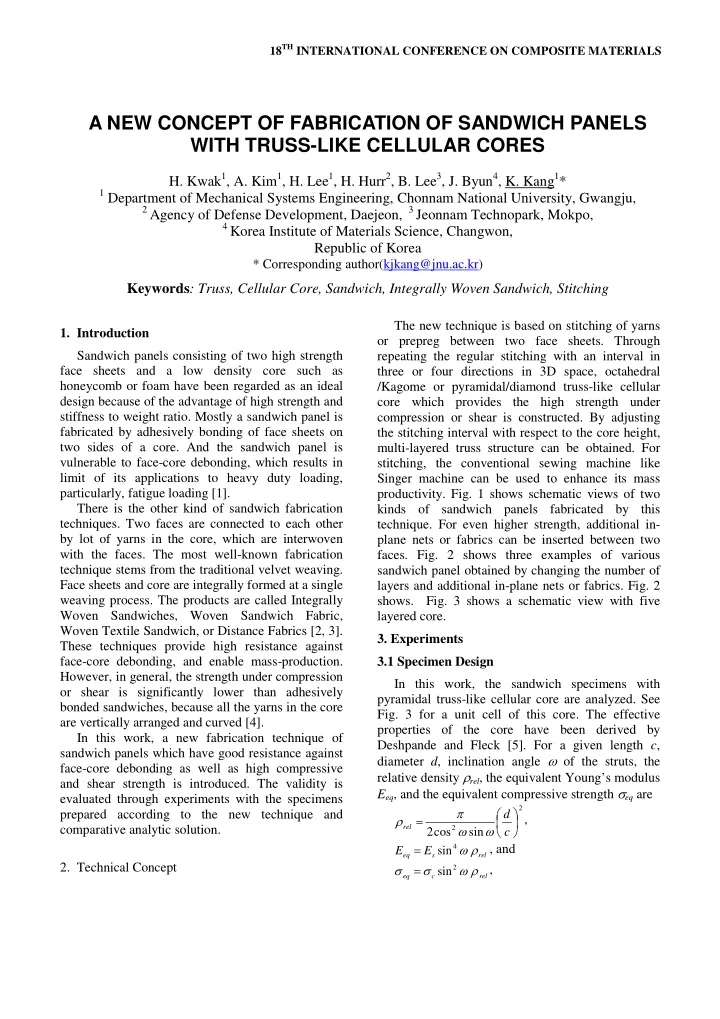
properties of the core have been derived by Deshpande and Fleck [5]. For a given length c, diameter d, inclination angle ω of the struts, the relative density ρrel, the equivalent Young’s modulus Eeq, and the equivalent compressive strength σeq are

2 2

sin cos 2       = c d

rel

ω ω π ρ

,

rel s eq

E E ρ ω sin 4 =

, and

rel c eq

ρ ω σ σ sin 2 =

,

A NEW CONCEPT OF FABRICATION OF SANDWICH PANELS WITH TRUSS-LIKE CELLULAR CORES

  • H. Kwak1, A. Kim1, H. Lee1, H. Hurr2, B. Lee3, J. Byun4, K. Kang1*

1 Department of Mechanical Systems Engineering, Chonnam National University, Gwangju, 2 Agency of Defense Development, Daejeon, 3 Jeonnam Technopark, Mokpo, 4 Korea Institute of Materials Science, Changwon,

Republic of Korea

* Corresponding author(kjkang@jnu.ac.kr)

Keywords: Truss, Cellular Core, Sandwich, Integrally Woven Sandwich, Stitching

slide-2
SLIDE 2

2

respectively, where Es and σc are Young’s modulus and critical strength of the struts in axial direction,

  • respectively. In these equations, it is shown that all

the properties are proportional to a square of the slenderness ratio d/c. Therefore, d/c should be determined first for design of the core. In order to

  • btain the highest strength per weight, one must

perform experiment for compressive strength of struts themselves. According to the authors’ experience, the failure mode of a single strut with clamped ends under axial compression varies from global Euler buckling to micro buckling (i.e., kinking), and the optimum value of d/c is found at the transition. Based on the value of d/c, the stitching interval and core height are designed. 3.2 Specimen Preparation Glass fiber yarns, ECD450 1/0 1.0Z, from AGY (Aiken, South Carolina, USA), were used to compose the cores. GFRP plates (SUECO Advanced Materials Co., Ulsan, Korea) of 1mm thick were used as the face sheets. The yarns were 30 times folded to obtain 6K filaments and used to sew manually the upper and lower face sheets fixed a steel frame through predrilled holes. Sewing was performed in the four directions of out-of-plane elements of a pyramidal truss, as shown in Figs. 4 and 5. Then, epoxy resin (E 206, Konishi Co., Japan) was sprayed on the cores with the yarns kept

  • stretched. Before the “wet” assemblies for all the

types of cores were cured, they were placed in a vacuum chamber and degassed-and-gassed three times in order to enhance infiltration of the resin, and to remove any bubbles in the wet assemblies. Each wet assembly was periodically rotated until it solidified so as to evenly distribute the resin in the interior space of the core. The assemblies were fully cured at 120oC for 2 hr and the frames were removed from the assembly. Finally, another GFRP plate was put on each face sheet with epoxy tapes between them and then cured. Fig. 6 shows a sample of the finished sandwiches. The core had three layers of truss structures and the external dimensions were approximately 100 mm by 100 mm by 40 mm in width, length, and height, respectively. In all the specimens, the length of the struts composing the pyramid-like truss structure was kept constant at c = 10 mm. 3.3 Compression Tests Compression tests were performed using an electric-hydraulic material test system (Instron 880, Instron, USA). The specimens were compressed between two steel circular compression platens at a displacement rate of 0.01 mm/s. Displacement

  • ccurring in the specimen was measured by an

extensometer installed between the platens. Two digital cameras were used to monitor the deformation of the specimen and the relative displacement between the two coupons during the

  • test. Unloading was performed near the initial yield

point during each test. The equivalent Young’s moduli were measured from the load-displacement data down to 40% of the load level from the unloading starting point.

  • 4. Results and Discussion
  • Fig. 7 shows the load-displacement curves

measured from the compression tests. By dividing the peak force by the net area, the compressive strengths were calculated to be 2.16 and 1.84 MPa. The density calculated for the unit cell was 0.035 g/cm3. The strength and density are compared with conventional sandwich cores in Table 1. The specific strength is higher than the

  • ther

conventional cores, which justifies this work. Fig. 8 shows four images taken during the test of the second specimen. The numbers of the images are indicated in the load-displacement curve in Fig. 7. The image of number (3) reveals break of struts along a horizontal plane across the core. It is seen that the surrounding struts which were longer than those in the middle area were elastically buckled in the very early stage (see the image (2)). If the strength had been calculated by dividing the peak force by total area contacted with the core, the strength would be much lower. Because, near the sides of the specimens, many struts are not perfect in the form of truss, the struts can never carry the load expected for those perfect in the form of truss particularly when the core height is larger than the strut length. Therefore, additional study should be performed to explore the effect of geometric parameters on the strength and stiffness as well as resistance against core-face debonding in the future.

slide-3
SLIDE 3

3 PAPER TITLE

  • 5. Conclusions

i) A new fabrication technique of sandwich panels which have good resistance against face-core debonding as well as high compressive and shear strength was introduced. ii) Using glass fiber yarns and GFRP plates, the sandwich specimens with the pyramid-like truss cores were fabricated and tested under compressive loading. iii) The compressive strength per density of the specimens were higher than those of conventional cores. Acknowledgements This study was supported by the 2006 National Research Laboratory program of the Korea Science & Engineering Foundation (R0A-2006-000-10249- 0). The authors are grateful to Mr. Min-Gun Lee for helping the experiments. References

[1] T. Bitzer “Honeycomb Technology”, Chapman & Hall, London, 2001. [2] K. Drechsler, J. Brandt, F.J. Arendts “Integrally woven sandwich structures”. Proc ECCM-3, Bordeaux, p. 365–371, 1989. [3] I. Verpoest, Y. Bonte, M. Wevers, P. de Meester, P. Declercq “2.5D- and 3D-fabrics for delamination resistant composite structures”. Proc European SAMPE, Milano, Italy, p. 13–21, 1988. [4] A.W. van Vuure, J.A. Ivens, I. Verpoest “Mechanical properties of composite panels based on woven sandwich-fabric preforms”. Composites A, Vol. 31, p. 671-680, 2000. [5] V.S. Deshpande, N.A. Fleck “Collapse of truss core sandwich beams in 3-point bending”. Int. J. Solids and Struc. Vol.38, p.6275-6305, 2001.

Fig.1. Schematic views of two kinds of sandwich panels fabricated by the new technique. Fig.2. Side views of various sandwich panels

  • btained by changing numbers of layers and

additional in-plane nets or fabrics.

slide-4
SLIDE 4

4

Fig.3. A schematic view with five layered pyramidal core. Fig.4. Unit cell of the core and an equivalent pyramidal truss with the dimensions. Fig.6. A sample of the all composite sandwiches with a pyramid-like truss Fig.5. Process to fabricate a pyramid-like truss core by sewing yarns in four different directions through upper and lower face sheets.

slide-5
SLIDE 5

5 PAPER TITLE

  • Fig. 7. Load-displacement curves measured from the

compression tests.

Table 1. Compressive strength and density of various sandwich cores compared with the new core. Strength (MPa) Density (g/cm3 ) Strength /Density Aluminium honeycomb 2.07 0.0477 43.4 Nomax honeycomb 2.24 0.0481 46.6 Fiberglass honeycomb 2.83 0.0481 58.9 Integrally Woven Sandwiches 2.16 0.0352 61.4

Fig.8. A sample of the all composite sandwiches with a pyramid-like truss