A New Generation of Handheld Laser Scanning (HLS) for Geotechnical - - PowerPoint PPT Presentation
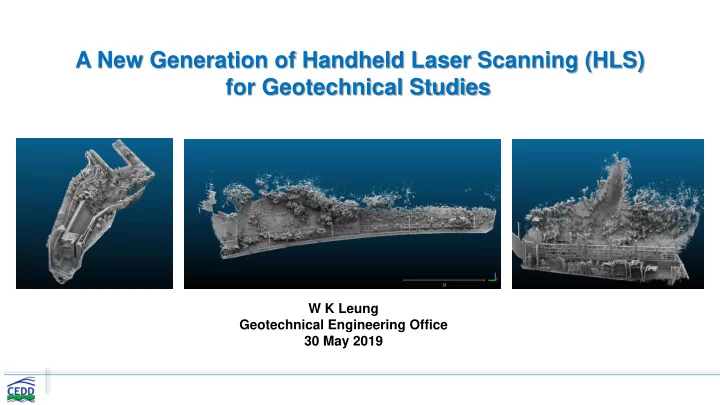
A New Generation of Handheld Laser Scanning (HLS) for Geotechnical Studies W K Leung Geotechnical Engineering Office 30 May 2019 Remote Sensing Techniques Photogrammetry (Aerial Unmanned Aerial Air-borne Light Detection and Photographs,
Remote Sensing Techniques
2
Unmanned Aerial Vehicles (UAV) Air-borne Light Detection and Ranging (LiDAR) Photogrammetry (Aerial Photographs, Satellite Imagery) Terrestrial Laser Scanning (TLS) Mobile Laser Scanning (MLS) Handheld Laser Scanning (HLS) InSAR
First return from tree top (non-ground point) Second return from branches (non-ground point) Last return from ground (ground point) 1st (and only) return from ground
Light Detection And Ranging (LiDAR)
3
Handheld Laser Scanner (Previous Model)
4
Laser Scanner Head Data-logger Spring
Handheld Laser Scanner (Current Model)
Cable Camera Laser Scanner Head Battery Data- logger
- Measurement range: 30 m or 100 m
- 300,000 measurement points/second
- Scan range noise: 10 - 30 mm
5
Data Acquisition
SLAM – Simultaneous localisation and mapping:
- 2-D time of flight of laser pulses
- Inertia measurement unit at scanner head to give the
- rientation
- Mapping using the point cloud captured in the previous
5 seconds
- Use features on the environment to register data
- Output - Point cloud & trajectory
- Align the data without the need for external control to
produce a highly accurate 3-D point cloud of the area surveyed
6
Control upper and lower cap
- f point cloud
Data Review
Real-time images through smartphone or tablet
7
8
- 3-D models (DSM & DTM)
- Site records
- Plotting of cross-sections, dimension
measurement & volume estimation
Capabilities of HLS
9
After urgent repair works
Applications: Emergency Landslide Mapping
Before urgent repair works
10
HLS for mapping of natural terrain landslides: Supplement the data collected by UAV, especially at landslide trail where there are vegetation. For site measurements and record of channelization ratio
Rigid Barrier at Pokfulam Road (Feature No. 11SW-A/ND52)
11
Applications: Mapping of As-built Condition Applications: Tree dimensions
12
88°/160° 87°/329° 68°/236° Laser Scanning Point Cloud Joint Measurement Plane Fitting
Applications: Rock Joint Mapping
13
- At least 3 reference points
- Only required if actual location is important
Method for Geo-referencing
No Rain Light Rain Medium Rain
Accuracy Checks
- Weather Check
(Feature No. 11NW-D/C 90)
14
Daytime
15
Night time
Accuracy Checks - Brightness Check (Feature No. 11SW-D/C465)
16
Accuracy Checks - Dimension Check (t-test)
Site Setting
- No. of
Scans
Natural Terrain 3 Rigid Barrier 2 Flexible Barrier 2 Retaining Wall 2 Soil Slope (Hard Surface) 1 Soil Slope (Vegetated Surface) 2 Rock Slope 2 Garden 3 Seminar Room 1 Tunnel 2
TOTAL 20
17
Dimension Checks (Daytime VS Night time)
The percentage error of the 20 scans in daytime (3 measurements per scan): 1.54, 1.28, 0.76, 0.74, 0.73, 0.89, 0.25, 0.70, 1.54, 0.31, 1.65, 1.10, 0.70, 1.20, 0.67, 0.23, 0.91, 1.11, 0.47, 0.94 The percentage error of the 20 scans in night time (3 measurements per scan): 2.71, 1.73, 0.87, 0.33, 1.09, 0.90, 0.56, 0.92, 1.45, 0.96, 0.47, 0.77, 0.78, 0.40, 0.53, 0.63, 1.21, 0.72, 0.49, 1.02
t-test
H0 (Null hypothesis): the % error for daytime and night time are NOT significantly different. H1 (Alternative hypothesis): the % error for daytime and night time are significantly different. Degree of freedom: (20-1) + (20-1) = 38 Critical value (5% significance level) = 2.024 t-value = 0.266 t-value < critical value
Null hypothesis is NOT rejected !
Similar statistical analysis carried
- ut for scanning under fine
weather and rainy weather. t-test suggested that there was no significant variation in the percentage errors.
Conclusion: HLS performs equally well under different brightness and weather conditions.
18
Key Advantages of HLS
peedy Quick for data review and processing andy Lightweight and easy to carry ccurate Adequate for most geotechnical applications
- bust
Able to be used at night time and in raining conditions
- rtable
Applicable to remote sites/difficult terrain
- Emergency inspection and landslide mapping
- Projects requiring 3-D models and topographic data
- Unauthorised works (e.g. capturing of field situation)
- Site progress, amount of excavation/filling
- As-built construction records (e.g. completed LPMit
works)
- Rock joint measurement
- Coupled with other remote sensing techniques, for
example, photogrammetry, UAV etc.
19
Potential Application Areas
Speedy Handy Accurate Robust P
- rtable
20