A Pause for A Thought: A Pause for A Thought: it was said in 1979 - - PowerPoint PPT Presentation

a pause for a thought a pause for a thought
SMART_READER_LITE
LIVE PREVIEW

A Pause for A Thought: A Pause for A Thought: it was said in 1979 - - PowerPoint PPT Presentation

A Pause for A Thought: A Pause for A Thought: it was said in 1979 Today's car differs from those of the immediate post Today's car differs from those of the immediate post- -war war years on a number of counts. It is cheaper,


slide-1
SLIDE 1

A Pause for A Thought: A Pause for A Thought:

it was said in 1979…

“ “Today's car differs from those of the immediate post Today's car differs from those of the immediate post-

  • war

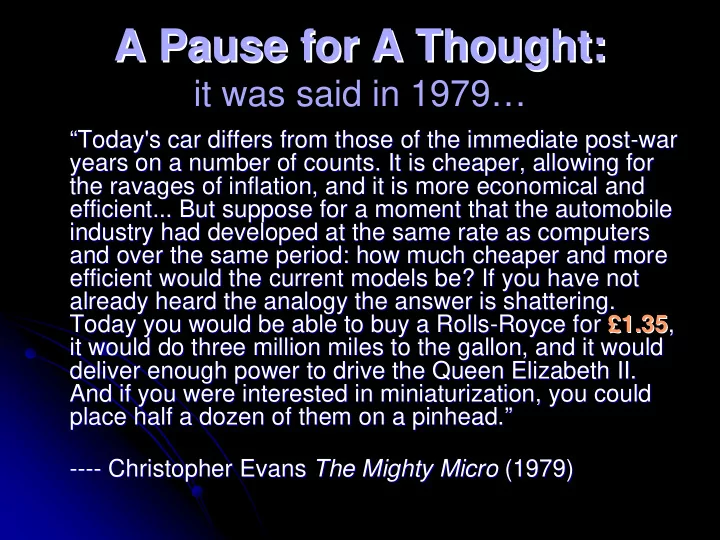
war years on a number of counts. It is cheaper, allowing for years on a number of counts. It is cheaper, allowing for the ravages of inflation, and it is more economical and the ravages of inflation, and it is more economical and efficient... But suppose for a moment that the automobile efficient... But suppose for a moment that the automobile industry had developed at the same rate as computers industry had developed at the same rate as computers and over the same period: how much cheaper and more and over the same period: how much cheaper and more efficient would the current models be? If you have not efficient would the current models be? If you have not already heard the analogy the answer is shattering. already heard the analogy the answer is shattering. Today you would be able to buy a Rolls Today you would be able to buy a Rolls-

  • Royce for

Royce for £ £1.35 1.35, , it would do three million miles to the gallon, and it would it would do three million miles to the gallon, and it would deliver enough power to drive the Queen Elizabeth II. deliver enough power to drive the Queen Elizabeth II. And if you were interested in miniaturization, you could And if you were interested in miniaturization, you could place half a dozen of them on a pinhead. place half a dozen of them on a pinhead.” ”

  • --- Christopher Evans

Christopher Evans The Mighty Micro The Mighty Micro (1979) (1979)

slide-2
SLIDE 2

Innovation vs Culture Innovation vs Culture

Media Media ․ ․ Media Technology Media Technology ․ ․ Man Man

劉志强 LIU, Zhi-Qiang

ZQ.LIU@cityu.edu.hk

媒體計算组 Media Computing Group (MCG) 創意媒體學院 School of Creative Media (SCM) 香港城市大學 City University of Hong Kong

Tuesday, March 24, 2009 Hong Kong Baptist University

slide-3
SLIDE 3

Being Entertained Being Entertained

Art and Entertainment have been part of human

development;

They have been evolving along with the

advancement of technology;

They stimulate our sensory systems by

predominantly:

Sound; Imagery.

slide-4
SLIDE 4

Media Platforms: Media Platforms:

What has technology brought us with? What has technology brought us with? Traditionally we have

Books, newspapers, magazines; Films: cinemas; Radios; TVs; Phones: good old telephones, mobile phones.

slide-5
SLIDE 5

Five Most Successful Media Five Most Successful Media Platforms Platforms

Paper; Radio; Television; Films; Phone with a wire.

slide-6
SLIDE 6

Why and How? Why and How?

Technologically these platforms are certainly not high, but, why are they so successful? To answer this, we must understand:

How do we use these media platforms? How are the media contents presented on these

platforms? and

Their relevance to the physical characteristics of the

human.

slide-7
SLIDE 7

The Importance of Dimension The Importance of Dimension and Resolution and Resolution

Humans have a finite dimension. Humans can only perceive things within a range:

resolution.

In media system and content designs, we must

follow the two basic principles:

Maximum perceptive comfort; Least cognitive effort.

slide-8
SLIDE 8

Maximum Perceptive Comfort Maximum Perceptive Comfort

Perceiving media contents is normally a leisure or intellectual activity which demands a maximum level of comfort in the perceptive process; that is, the media contents must be delivered well within human’s perceptive range.

slide-9
SLIDE 9

Least Cognitive Effort Least Cognitive Effort

Perceiving media contents should require the

least cognitive effort, which would leave the brain more time and energy to interpret (appreciate) the contents -- the audience would leave the cinema and demand a refund if the pictures are hard to see.

Neglecting the human factor will result in failure

in business and unsustainable technological development.

slide-10
SLIDE 10

The Factor of HDHR The Factor of HDHR

All the five successful media platforms satisfy the two essential human factors:

HDHR

(Human Dimension and Human Resolution)

slide-11
SLIDE 11

Human Resolution Human Resolution

Human’s perceptive ability is limited by resolutions within which media contents can be perceived to a degree. Primarily we are dealing with two such resolutions:

Audio signal (HZ and magnitude) Visual signal (HZ, magnitude, and phase)

slide-12
SLIDE 12

New Media Platforms: New Media Platforms: More More Gadgets

Gadgets

We are now in an era of ever changing digital gadgets of varied dimensions and resolutions:

PCs, notebooks, PDAs, and palm (hand-held) PCs; Games: Xbox, PlayStation, N-gage, etc. Cameras: Traditional: Nikon F5 Digital: Nikon D3, Canon 5D, Canon 300D Miniature: Canon IXUS, Nikon CoolPix SQ… DVcams: Sony, Panasonic, Sharp…

slide-13
SLIDE 13

Features of New Media Features of New Media

Multimedia, multifunction media platforms

Computers, Wireless, mobile devices

Interactivity:

Video/Web games; Human-machine interface; Virtual environments

slide-14
SLIDE 14

Apple iPhone with a 3.5in screen promises to do just about anything that you do on your computer, plus of course, being pocket sized…

  • h, yes, almost forgot,

a shaver, a beer bottle, and a money machine (woo, very attempting!), that is, if you believe it….

slide-15
SLIDE 15

Features of New Media Features of New Media

High-speed internetworking

The Internet; Wireless communications

High-speed, high-capacity memory High-speed microprocessors

slide-16
SLIDE 16

Features of New Media Features of New Media

New displays New audio/video formats Artificial Intelligence in media

systems and productions

Virtual, intelligent avatars Mass media participation

slide-17
SLIDE 17

How far have we gone How far have we gone technically technically? ?

Computing Speed; Communications networks; Memory devices; New display devices.

slide-18
SLIDE 18

How far have we gone How far have we gone technically technically? ?

Wireless Standards: WAP, Bluetooth,

IEEE 802.1x, etc.;

Artificial/Machine Intelligence; Pattern Recognition techniques; What are missing in all these?

slide-19
SLIDE 19

Portability, Mobility and Portability, Mobility and Perceptibility Perceptibility

Portability and mobility of media devices are the result of our desire for

pervasive accessibility to media contents and

information;

being connected all the time any where; creating and manipulating media contents.

But, we are limited by

  • ur perceptive ability and physical dimension.
slide-20
SLIDE 20

Portability, Mobility and Portability, Mobility and Perceptibility Perceptibility

Portability and mobility require that all devices

be made small and light enough for people to carry;

However, small devices will result in low

resolution that makes it harder for people to perceive the delivered media contents; which leads to Unsustainable/unviable business and market, which is one of the essential challenges in the new media era.

slide-21
SLIDE 21

Mobility vs Utility Mobility vs Utility

Numerous mobile devices have been rushed to

the market everyday;

All seem to claim doing miracles: Phone; SMS; Games; Camera; Browser; A PC too… 除了针灸…except acupuncture! Are they really that useful? You be the judge!

slide-22
SLIDE 22

All All-

  • in

in-

  • One Gadgets?

One Gadgets?

It was predicted that by the end of 2005, U.S. consumers would have trashed some 130 million cellphones and another mountain of old PDAs, MP3 players, and game consoles. To solve this problem some researchers have proposed to build a wireless multimedia device whose hardware and software can be easily altered or upgraded so it never becomes

  • bsolete and can do everything in just one

gadget….

slide-23
SLIDE 23

Epilogue Epilogue

( (后语 后语) )

slide-24
SLIDE 24

What are we missing here? What are we missing here?

Where is the media content? How to make the user pay? No more a single “Killer Application” as that for

telephone, broadcasting radio, and TV; that era has long gone!

The power of a public data network is its ability

to support many applications.

slide-25
SLIDE 25

Are We Entertained? Are We Entertained?

In all the excitement, one important

thing has to be considered: Human Resolution and Human Dimension (HRHD).

Without appropriate HRHD, media

systems and contents will not be able to deliver the promised entertainment/information value; think about watching a movie from a mobile phone.

slide-26
SLIDE 26

Time to Think Time to Think

Terminal Velocity: Technologically we

Technologically we are at the final stage of speed as are at the final stage of speed as according to Moore according to Moore’ ’s law, in the next few s law, in the next few years, the chip will hit the physical limit. years, the chip will hit the physical limit.

Terminal Coverage: We are now able to

We are now able to reach virtually anywhere and anyone on reach virtually anywhere and anyone on the Earth the Earth--

  • -the world is completely covered.

the world is completely covered.

slide-27
SLIDE 27

Time to Think Time to Think

The Nobel Prize Laureate in Literature, Eugenio Montale (1970) said: "... we no longer live in a modern era, but in a new Middle Ages whose characteristics we cannot yet make out. ..... The era lies before us does not allow for short-term predictions, and to speak of a new Middle Ages is to speak equivocally at best. If the future sees the ultimate triumph of technico- scientific reason, even accompanied by the weak correctives which sociology can devise, the new Middle Ages will be nothing but a new barbarousness. But in such a case it would be wrong to speak of them as 'medieval,' for the Middle Ages were not merely barbarous, nor were they bereft of science or devoid of art. To speak of a new Middle Ages, then, could seem a far from pessimistic hypothesis to the man who does not believe that the thread of reason can unwind ad infinitum; and yet an entirely new barbarousness is possible, a stifling and distortion of the very idea of civilization and culture." Remember the Renaissance followed the Middle Ages.

slide-28
SLIDE 28

Time to Think Time to Think

  • During the last decade, technology has been running

During the last decade, technology has been running faster than we could think. faster than we could think.

  • With the stabilization of processor speed (physicists still

With the stabilization of processor speed (physicists still try hard, but it try hard, but it’ ’s unlikely that we will see more s unlikely that we will see more advancement in the horizon) in the next decade, we will advancement in the horizon) in the next decade, we will have time to contemplate and create to unleash the full have time to contemplate and create to unleash the full potential of the technology. potential of the technology.

  • I

I’ ’d think that the stage has been set for a d think that the stage has been set for a

New Renaissance New Renaissance

this time we must take our natural environment into serious consideration because we are running

  • ut of it faster than we think.