A lthough coagulation disturbances h av e b een d e w ho enjoyed - - PDF document

a
SMART_READER_LITE
LIVE PREVIEW

A lthough coagulation disturbances h av e b een d e w ho enjoyed - - PDF document

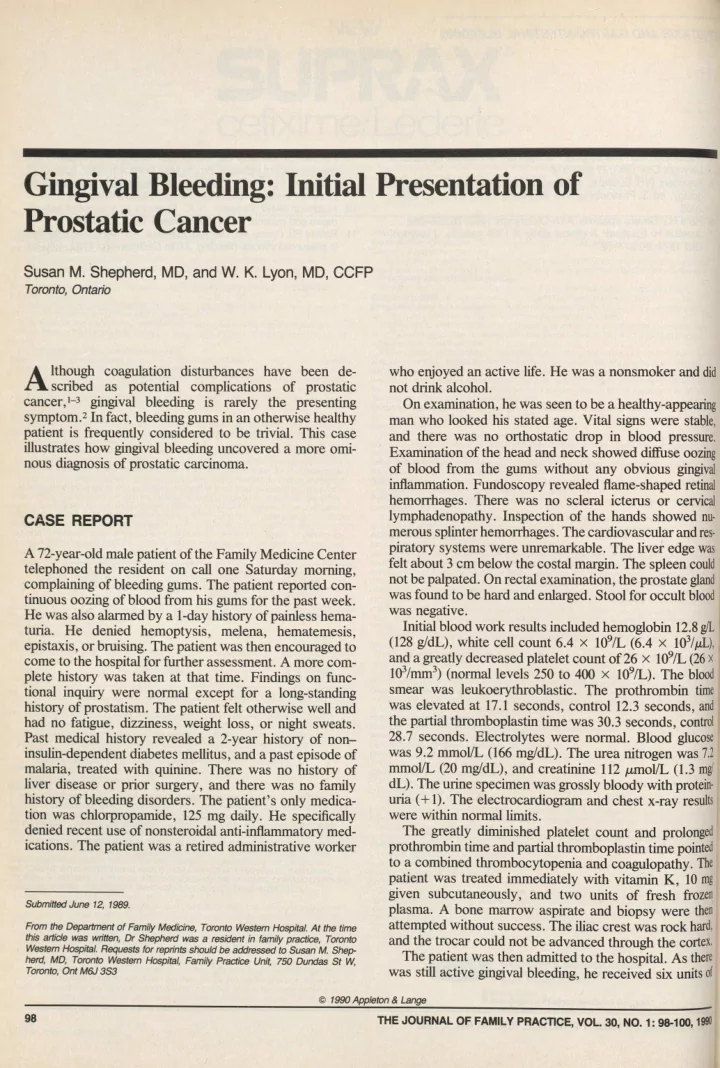
Gingival Bleeding: Initial Presentation of Prostatic Cancer Susan M. Shepherd, MD, and W. K. Lyon, MD, CCFP Toronto, Ontario A lthough coagulation disturbances h av e b een d e w ho enjoyed an active life. H e w as a n o n sm o k er and


slide-1
SLIDE 1

Gingival Bleeding: Initial Presentation of Prostatic Cancer

Susan M. Shepherd, MD, and W. K. Lyon, MD, CCFP

Toronto, Ontario

A

lthough coagulation disturbances h av e b een d e­ scribed as potential com plications

  • f prostatic

c a n c e r,1

  • 3 gingival bleeding is rarely the presenting

sy m p to m .2 In fact, bleeding gum s in an otherw ise healthy patien t is frequently considered to b e trivial. T his case illustrates ho w gingival bleeding u n co v ered a m o re om i­ n ous diagnosis o f p ro static carcinom a.

CASE REPORT

A 72-year-old m ale p atien t o f the F am ily M edicine C en ter telephoned the resid en t o n call one S atu rd ay m orning, com plaining o f bleeding gum s. T h e patien t rep o rted co n ­ tinuous oozing o f blood from his gum s fo r the p a st w eek. H e w as also alarm ed b y a 1-day history o f painless hem a­

  • turia. H e denied hem optysis, m elena, hem atem esis,

epistaxis, o r bruising. T h e patien t w as th en en couraged to com e to the hospital fo r fu rth e r assessm en t. A m o re co m ­ plete h istory w as tak en at th a t tim e. Findings o n func­ tional inquiry w ere norm al ex cep t fo r a long-standing history o f p rostatism . T he patien t felt o th erw ise w ell and had no fatigue, dizziness, w eight loss, o r night sw eats. P ast m edical history rev ealed a 2-y ear h istory o f non­ insulin-dependent diabetes m ellitus, an d a p ast episode o f m alaria, treated w ith quinine. T h ere w as no history o f liver disease o r p rio r surgery, and th ere w as no fam ily history o f bleeding disorders. T h e p atien t’s only m edica­ tion w as chlorpropam ide, 125 m g daily. H e specifically denied recen t u se o f nonsteroidal anti-inflam m atory m ed­

  • ications. T h e patien t w as a retired adm inistrative w o rk er

Submitted June 12, 1989. From the Department of Family Medicine, Toronto Western Hospital. At the time this article was written, Dr Shepherd was a resident in family practice, Toronto Western Hospital. Requests for reprints should be addressed to Susan M. Shep­ herd, MD, Toronto Western Hospital, Family Practice Unit, 750 Dundas St W, Toronto, Ont M6J 3S3

w ho enjoyed an active life. H e w as a n o n sm o k er and did n o t drink alcohol. O n exam ination, h e w as seen to b e a healthy-appearing m an w h o looked his stated age. V ital signs w e re stable, and th ere w as n o orth o static d ro p in b lo o d pressure. E xam ination o f th e head an d n eck sh o w ed diffuse oozing

  • f blood from the gum s w ith o u t an y obvious gingival

inflam m ation. F u n d o sco p y rev ealed flam e-shaped retinal hem orrhages. T h ere w as no scleral icteru s o r cervical lym phadenopathy. In sp ectio n o f th e h an d s show ed nu­ m erous splinter hem orrhages. T h e card io v ascu lar and res­ p iratory system s w ere unrem ark ab le. T h e liver edge was felt about 3 cm below th e co stal m argin. T h e spleen could not b e palpated. O n rectal exam ination, th e p ro state gland w as fo und to be h ard and enlarged. S tool fo r o ccu lt blood w as negative. Initial blood w o rk results included hem oglobin 12.8 g/L (128 g/dL), w hite cell count 6.4 x 10⁹/L (6.4 x 10³//uL), and a greatly d ecreased platelet co u n t o f 26 x 109/L (26 x 103/m m 3) (norm al levels 250 to 400 x 109/L ). T h e blood sm ear w as leukoerythroblastic. T h e p ro th ro m b in time w as elevated at 17.1 seconds, co n tro l 12.3 seconds, and the partial thro m boplastin tim e w as 30.3 seconds, control 28.7 seconds. E lectro ly tes w ere norm al. B lood glucose w as 9.2 m m ol/L (166 m g/dL). T h e u re a nitro gen w as 7.2 m m ol/L (20 m g/dL), and creatinine 112 p,m ol/L (1.3 mg/ dL ). T h e urine specim en w as grossly b loody w ith protein­ uria (+ 1). T he electrocardiogram an d ch e st x -ray results w ere w ithin norm al lim its. T he greatly dim inished platelet co u n t a n d prolonged prothrom bin tim e and partial throm boplastin tim e pointed to a com bined th ro m b o cy to p en ia an d coagulopathy. The patien t w as trea ted im m ediately w ith vitam in K , 10 m g given subcutaneously, an d tw o units o f fresh frozen plasm a. A bone m arrow aspirate an d bio p sy w ere then attem pted w ithout success. T he iliac c rest w as ro c k hard, and the tro ca r could n o t b e ad v an ced through th e cortex. T he patien t w as th en adm itted to th e hospital. A s there w as still active gingival bleeding, h e receiv ed six units of

1990 Appleton & Lange

98 THE JOURNAL OF FAMILY PRACTICE, VOL. 30, NO. 1: 98-100,1990

slide-2
SLIDE 2

g in g iv a l b l e e d in g a n d p r o s t a t ic c a n c e r

  • platelets. T he p latelet co u n t ro se to 88 x 109/L (88 x 103

mm3). Further investigations initially fo cu sed o n th e liver. A n ultrasonogram o f th e ab d o m en sh o w ed a large liver th at was norm al in tex tu re w ith no splenom egaly o r evidence

  • f retroperitoneal ly m p h ad en o p ath y .

Laboratory exam in atio n o f th e blood rev ealed asp arate am inotransferase 0.62 /xkat/L (37 U /L ) (norm al level 0.66 jLikat/L; 40 U /L ), alanine am in o tran sferase 0.27 /xkat/L (16 U/L) (norm al level 0.66 /xkat/L; 40 U /L ) gam m a-glutam yl- transferase 0.62 /xkat/L (37 U /L ) (norm al levels 0.15 to 0.72 /xkat/L; 9 to 43 U /L ) alkaline p h o sp h atase 10.25 /xkat/L (615 U /L ) (norm al levels 0.33 to 1.67 /xkat/L; 20 to 100 U /L), total p ro tein 61 g/L (6.1 g/dL ) (norm al levels 60 to 76 g/L; 6.0 to 7.6 g/dL ), an d album in 33 g/L (3.3 g/dL) (normal levels 39 to 50 g/L ; 3.9 to 5.0 g/dL). It w as concluded th at th e liv er w as n o t th e cau se o f th e bleeding. Investigation th en ce n te red o n blood coagulation. T he fibrinogen level w as d ec rea sed to 0.75 to 1.0 g/L (75 to 100 mg/dL) control 2.5 g/L (250 m g/dL). T h e throm bin tim e was 13.8 seconds, co n tro l 10.6 seconds. F ibrin degrada­ tion products w e re elev ated to 40 to 80 /xg/m L (norm al levels 10 /xg/mL). T h e hem atologic p ictu re w as th at o f acute dissem inated in trav ascu lar coagulation. Finally, th e u n su ccessfu l b o n e m arro w biopsy attem p t and grossly elev ated alkaline p h o sp h atase level p ro m p ted an x-ray exam ination o f th e pelvis, w hich sh o w ed areas o f very dense bone th a t w ere tho u g h t to re p resen t o steo b las­ tic bone lesions. A b o n e scan rev ealed m arkedly in­ creased activity in th e spine, ribs, an d h um erus suggestive

  • f m etastases. T h e acid p h o sp h atase level w as elev ated at

1300 nkat/L (78 U /L ) (norm al level < 1 1 8 nkat/L ; < 7.1 U/L), and the p ro static acid p h o sp h atase w as likew ise elevated at 1075 n k at/L (64.5 U /L ) (norm al level < 2 0 nkat/L; < 1 .2 U /L ), leading to a p resu m p tiv e diagnosis o f prostatic cancer. The patien t’s co u rse in hospital w as th a t o f continued slow gingival bleeding. H e began passing blood clots through the u reth ra, a condition th a t eventually p ro ­ gressed to urinary reten tio n , necessitating continuous bladder irrigation. H is hem oglobin d ro p p ed to 85 g/L (8.5 g/dL). H e w as tran sfu sed w ith p ack ed red blood cells and cryoprecipate. C ystoscopic exam ination revealed a large, m ildly o b ­ structed p ro state an d a norm al bladder. A transperineal biopsy specim en w as rep o rted to be negative fo r m alig­ nant cells. A re p eat p ro static biopsy w as planned fo r a confirmed tissue diagnosis, b u t th e risk o f bleeding w as felt to be too great. T h e final diagnosis w as still presu m ed to be advanced m etastatic p ro static carcinom a. T he p a­ tient w as th en started o n diethylstilbestrol, 1 m g by mouth, three tim es a day. S hortly after starting this th er­ apy, all bleeding ceased an d th e pro th ro m b in tim e re ­ tu rn ed to norm al. T he patien t w as th en discharged hom e in satisfactory condition.

DISCUSSION

S everal rep o rts in th e literatu re h av e d escrib ed an associ­ ation b etw een c a n cer o f the p ro state and dissem inated in trav ascu lar co ag u latio n ,1

  • 3 b u t bleeding is a rare initial

p resen tatio n o f p ro static carcinom a. It h as b een estim ated th a t approxim ately 13% o f p atien ts w ith p ro static carci­ n om a h av e chronic d issem in ated in trav ascu lar coag­ ulation,4 w hich usually m anifests sim ply as abnorm al co ­ agulation values in an asy m p to m atic patient. A cute dissem inated in trav ascu lar coagulation in a patien t w ith p ro static carcin o m a h as b een m o st com m only en co u n ­ tered in a clinical setting asso ciated w ith sepsis, instru­ m entation, radiation, o r ch e m o th e ra p y .1 In this case th ere w as no such identifiable triggering m echanism . T h e pathogenesis o f ac u te dissem inated intravascular coagulation is believed to involve th e liberation o f th ro m ­ boplastins p ro d u ced b y the tu m o r cells, w ith resultant activation o f the extrinsic coagulation p ath w ay . T his co u rse eventually leads to a co nsum ptive coagulopathy w ith th ro m b o cy to p en ia and rem oval o f coagulation fac­ tors from the circulation. T h e fibrinolytic p ath w ay is sec­

  • ndarily activated w ith th e co n v ersio n o f plasm inogen to

plasm in. P lasm in serves to inactivate several clotting fac­ to rs an d pro m o tes th e b reak d o w n o f fibrinogen and fibrin to fibrin degradation p ro d u cts, w hich ev en fu rth e r inhibit

  • coagulation. T h e com bination o f th ro m b o cy to p en ia, defi­

cient clotting facto rs, hypofibrinogenem ia, and circulating fibrin degradation p ro d u cts results in a bleeding diathesis. Initially, th e patien t presenting w ith dissem inated in tra­ v ascu lar coagulation should b e stabilized w ith rep lace­ m en t o f the n ecessary blood co m p o n en ts. U ltim ately, th e essential principle is to trea t th e underlying disease p ro ­

  • cess. H orm onal th era p y h as long b een th e traditional

treatm en t fo r m etastastic c a n cer o f th e p ro state. H igh- dose intravenous diethylstilbestro l h as b een successful in treating dissem inated in trav ascu lar coagulation o f acu te

  • n set in several patients w ith w id esp read c a n cer o f the

p ro state.5 In this case rep o rt it is interesting to n o te th at th e p atien t’s bleeding stopped afte r stan d ard oral d o ses o f diethylstilbestrol. M ore recently, ketoconazole, an antifungal agent, has been fo und to b e extrem ely effective in reversing acute dissem inated in trav ascu lar coagulation in p atien ts w ith prostatic ca n cer.6-7 T he standard treatm en t regim en is a dose o f 400 m g given orally ev ery 8 hours. T he drug exerts its antiandrogenic effects b y inhibiting a n en zy m e in the testo stero n e synthetic p ath w ay . K eto co n azo le has a dis­ tinct advantage o v er diethylstilbestro l in th at th e form er

t h e JOURNAL OF FAMILY PRACTICE, VOL. 30, NO. 1,1990

99

slide-3
SLIDE 3

GINGIVAL BLEEDING AND PROSTATIC CANCER drug red u ces testo stero n e to c a strate levels w ithin 48 h ours co m p ared w ith 2 w eek s fo r diethylstilbestrol. K eto- conazole, h o w ev er, is indicated only fo r the em ergency treatm en t o f acu te dissem inated coagulation in patients w ith p ro static can cer, as long-term effects include hypo- adrenalism and elevation o f liver enzym es.

CONCLUSIONS

This case illustrates how an initial com plaint o f gingival bleeding rep resen ted an acu te coagulopathy apparently triggered b y an underlying p ro static carcinom a. It w as im p o rtan t to recognize an d trea t th e responsible disorder to stop the bleeding. F u rth erm o re, the case em phasizes th e p oint th at b en e ath a seem ingly straightforw ard co m ­ plaint can lurk a com plex and serious disease process.

References

  • 1. Pergament ML, Swaim WR, Blackard CE: Disseminated intravascular

coagulation in the urologic patient. J Urol 1976; 116:1-7

  • 2. Grignon D, Turnbull Dl, Lohmann RC: Carcinoma of the prostate

presenting as acute disseminated intravascular coagulation. Can M e d Assoc J 1986; 135:775-776

  • 3. Spector Jl, Zimbler H: Carcinoma of the prostate presenting as a

cute disseminated intravascular coagulation, letter. Can Med Assoc J 1987; 136:570

  • 4. Peck SD, Reiquam CW: Disseminated intravascular coagulation in

cancer patients: Supportive evidence. Cancer 1973; 31:1114

  • 5. Goldenberg SL, Fenster NH, PerlerZ, McLoughlin MG: Disseminated

intravascular coagulation in carcinoma of prostate: Role of estrogen

  • therapy. Urology 1983; 22:130-132
  • 6. Lift MR, Bell WR, Lepor HA: Disseminated intravascular coagulation

in prostatic carcinoma reversed by ketoconazole. JAMA 1987; 2 5 8 : 1361-1362

  • 7. Lowe FC, Somers WJ: The use of ketoconazole in the emergency

management of disseminated intravascular coagulation due to m eta­ static prostatic cancer. J Urol 1987; 137:1000-1002 100 THE JOURNAL OF FAMILY PRACTICE, VOL. 30, NO. 1,1990