A Proposed Regulation under The Water Rights Act . . . . . . . . . - - PowerPoint PPT Presentation

a proposed regulation under the water rights act
SMART_READER_LITE
LIVE PREVIEW

A Proposed Regulation under The Water Rights Act . . . . . . . . . - - PowerPoint PPT Presentation

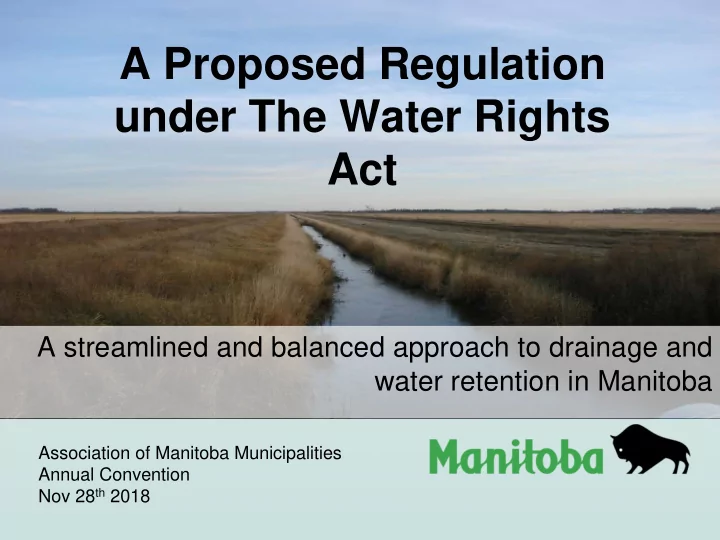
A Proposed Regulation under The Water Rights Act . . . . . . . . . . . . . . . . . . . . . . . . . . . . . . . A streamlined and balanced approach to drainage and water retention in Manitoba Association of Manitoba Municipalities Annual


slide-1
SLIDE 1

. . . . . . . . . . . . . . . . . . . . . . . . . . . . . . .

A Proposed Regulation under The Water Rights Act

A streamlined and balanced approach to drainage and water retention in Manitoba

Association of Manitoba Municipalities Annual Convention Nov 28th 2018

slide-2
SLIDE 2

WATER

ER RIGHT GHTS ACT CT - 1988

The Water Rights Act states that no person shall control water

  • r construct, establish or maintain any water control works

unless he or she has a valid and subsisting licence to do so.

  • Proponent submits application and a $25 fee
  • Departments reviews and assesses each application

individually

  • Project sites are inspected
  • Licence is issued or denied
  • If issued, and the applicant proceeds with construction of

the project.

slide-3
SLIDE 3

ROYAL ASSENT ON JUNE 4, 2018

  • Support a new streamlined and strengthened provincial drainage

regulatory regime and modernize inspection and enforcement tools including enhanced offence and penalty provisions.

EXPECTED OUTCOMES OF NEW REGULATORY FRAMEWORK

– streamline ine applications and approvals – provide consis istent nt regulatory regimes for drainage and water control works and compensation for wetland loss and alteration – redu duce red t d tape pe for low risk and low impact projects – increase flexib ibilit ity of requirements for downstream approvals, and – provide stronger er l linkages es between watershed plans and land use decision-making

The he S Sust ustainable W e Water ershed eds s Act

Bill 7 7

slide-4
SLIDE 4

Propos

  • sed

ed R Regulati tion

  • n

The proposed regulation sets out details to allow the amendments to the Act to come into force Highlights of the Proposed Regulation:

  • Exemptions to The Water Rights Act
  • Registration Process, Projects and Fees
  • Licenced Process, Projects and Fees
  • Landowner Approvals
  • Wetland Mitigation and Compensation
slide-5
SLIDE 5

Exemptions

The following projects would not require authorization under The Water Rights Act:

  • Culvert replacements with no change in

culvert size or invert elevation

  • Drainage and water retention projects that

require a license under The Environment Act

  • Water control works in urban areas where

the proposed works do not:

– drain Class 3, 4, or 5 wetlands or – outlet to outlying rural areas

slide-6
SLIDE 6

Licen ensing P Proces ess

If f a project d does not m meet t the c criteria

  • f
  • f a reg

egis istrable le p project or

  • r

requ quirem ements o s of one o e of the he six c classes. ses.  Focus is on higher risk projects  Drainage of Class 3, 4 and 5 wetlands  Shorter wait times as lower risk projects are fast-tracked

Registratio ion P n Process

A projec ect i is register ered ed if i it meets t the c he criter eria and a nd associated ed requ equiremen ents f s for the s he six c classes sses

  • f
  • f w

wor

  • rks:
  • A. Minor surface drain construction
  • B. Agricultural subsurface tile drain

construction

  • C. Water control works for new crossings
  • D. Minor culvert changes
  • E. Wetland enhancement and restoration
  • F. Small dam construction

 Focus on lower risk projects  14 day approval

Reg egis istratio tion ver versus Licens nsing

slide-7
SLIDE 7

Licen ensing P Proces ess

If f a project d does not m meet t the c criteria

  • f
  • f a reg

egis istrable le p project or

  • r

requ quirem ements o s of one o e of the he six c classes. ses.  Focus is on higher risk projects  Drainage of Class 3, 4 and 5 wetlands  Shorter wait times as lower risk projects are fast-tracked  Application Fe n Fee $500 ( (can b n bundl ndle projec ects) s)

Registratio ion P n Process

A projec ect i is register ered ed if i it meets t the c he criter eria and a nd associated ed requ equiremen ents f s for the s he six c classes sses

  • f
  • f w

wor

  • rks:
  • A. Minor surface drain construction
  • B. Agricultural subsurface tile drain

construction

  • C. Water control works for new crossings
  • D. Minor culvert changes
  • E. Wetland enhancement and restoration
  • F. Small dam construction

 Focus on lower risk projects  14 day approval  Appl pplication F Fee e $100 ( 0 (can b bun undle e projec ects) s)

Reg egis istratio tion ver versus Licens nsing

slide-8
SLIDE 8

Reg egis istrable le P Proje ject cts

The following projects types are not eligible for registration:

  • Class 3, 4 or 5 wetland loss or alteration
  • Class 6 or 7 soil or unimproved organic soil drainage
  • Water transfer between watersheds
  • Negative impacts on fish spawning, rearing, or

passage

  • Inconsistency with an approved watershed plan
  • Violation of conservation agreement restrictions
slide-9
SLIDE 9

Regist strable P e Projec jects

Clas ass o

  • f Works

Requirem emen ents Clas ass A – Mi Minor r surfa face dra rain con

  • nstru

ruction

  • n

Construction of surface drains with a depth not exceeding 12 inches below natural prairie.  Project does not result in the drainage of Class 6, 7 or unimproved organic soils. Clas ass B B – Agricultural subsurface tile d drain c constr tructi tion Construction of subsurface tile drains and all associated water control works that have a drainage coefficient of equal to

  • r less than 3/8 inch (metric)
  • ver a 24-hour period on

agricultural lands.  Project must be designed by a tile drainage installer that has taken an approved course  Cannot be located within 50 metre of a prescribed wetland  Average depth of the

  • lateral pipe cannot exceed 36”
  • header pipe cannot exceed 60”

 All outlets are equipped with control devices  Project does not result in the drainage of Class 6, 7 or unimproved organic soils.

slide-10
SLIDE 10

Clas ass o

  • f Works

Requirem emen ents Clas ass C C – New A Access Crossings Construction of water control works related to new access crossings that do not constrict water flow.  Shows size of immediate upstream and downstream culverts  Demonstrates that culvert in the approach will:

  • Be equal in size to the largest culvert

immediately upstream or downstream

  • Have an invert elevation at the bottom of the

drain Clas ass D D – Mi Minor c

  • r culvert

rt c changes Replacing an existing culvert by no more than 15% increase in hydraulic capacity and no change to the invert elevation of the culvert.  Must include a pre-construction topographical survey that shows location, size, and invert elevation of existing culverts

Regist strable P e Projec jects

slide-11
SLIDE 11

Clas ass o

  • f Works

Requirem emen ents Clas ass E E – Wetland e enhancement a t and restor

  • ration
  • n

Works that restore a wetland that had previously been drained or increase the size of an existing wetland, that are not more than 1 m in height and retain less than 25 acre-feet of water.  Must include a pre-construction survey of the site that shows the maximum flooded area  Any associated landowner approvals including

  • Those who may be flooded by the project
  • Those immediately downstream who may see a

reduction in water flow as a result of the dam Clas ass F F – Small d dam construction Construction of dams less than 2.5 m in height that retain less than 25 acre- feet of water.  Must include a pre-construction survey of the site  A design plan approved by a professional engineer

  • r other certified agent, that:
  • Demonstrates the dam will accommodate a

1:100 year flood event, and

  • Shows the maximum flooded area

 Any associated landowner approvals including

  • Those who may be flooded by the project
  • Those immediately downstream who may see a

reduction in water flow as a result of the dam

Regist strable P e Projec jects
slide-12
SLIDE 12

Lice cence ce

  • Hydraulic capacity of culvert is

increased by 20%

  • Invert elevation is lower than existing

culvert does es n not mee eet r reg egistration requi quirements

  • Applicant submits a complete

application form and fee  Project can be LICE CENCE CED  Shorter wait times as lower risk projects are fast-tracked

Regi gistrati tion

  • Hydraulic capacity of culvert is increased

by 10 %

  • no change to the invert elevation of the

culvert Mino nor C Cul ulvert U Upg pgrade (Class D D)

  • Applicant provides a pre-construction

survey that shows location, size, and invert elevation of existing culverts

  • Applicant submits a complete

application form and fee  Project can be REG EGISTER ERED  Applicant receives registration certificate within 14 days

Exa xample – Culver vert Up Upgrade

NOTE: It is proposed that culvert upgrades with no change in culvert size or invert elevation would not require authorization - exemption

slide-13
SLIDE 13

Downstr tream Ap Approva vals

Re Registratio ion Pr n Process Written approval is required from:

  • the applicable municipality or local authority, and
  • the landowner immediately downstream of the project, OR if written

approval cannot be obtained, a written exemption from an officer confirming the applicant is not required to obtain other landowner approval. Lice Licence Proce

  • cess

When the application is submitted, the officer will assess the site and provide the proponent with a list of significantly affected landowners Written Approval is required from:

  • the applicable municipality or local authority, and
  • signoff from those landowners that are deemed to be significantly

affected by the department

slide-14
SLIDE 14

No N Net et Los Loss of

  • f W

Wetl etland Benef efit its A Approa

  • ach
  • New provision sets a requirement to

restore wetland benefits where a licencee is authorized to drain a prescribed class of wetlands (The Sustainable Watersheds Act – Section 5)

  • Requirements to compensate for

prescribed wetland drainage in the proposed regulation

  • Amount of offset required is likely to

vary depending on the type on the type

  • f restoration or enhancement work

being done

  • The approach is based on mitigation

hierarchy of avoidance, minimization, compensation

slide-15
SLIDE 15

Pres escrib ibed W Wetla etlands

Class asses 1 s 1 an and 2 2 - Ephe phemeral and t nd temporary w wetla land nds These wetlands usually hold surface water caused by snowmelt or precipitation for less than one month during years with normal moisture

  • conditions. Land may be cultivated and seeded in drier years.

Classes es 3, 3, 4 4 an and 5 5 – Sea easonal, s sem emi-pe permanent a and pe nd permane nent wetland nds These wetlands usually hold surface water caused by snowmelt or precipitation for one month or more during years with normal moisture

  • conditions. Land may be dry by midsummer or hold surface water

throughout the growing season. Class 3, 4 and 5s will be prescribed and therefore require compensation if altered or lost

slide-16
SLIDE 16

Action Restore or enlarge an existing wetland Enhance an existing wetland (including upland habitat)

(*includes permanent protection)

Permanent protection of a wetland Ratio 2:1 3:1 3:1 Ratios indicate the required surface area of wetland restoration or enhancement compared to the surface area of wetland loss or alteration.

Meth ethods a and R Ratio tios

Restoration

  • Restore a previously existing wetland

Enhancement

  • Increase the size of a wetland
  • Improve the benefits associated with a wetland (including upland habitat)

and provide permanent legal protection

  • Provide permanent legal protection of a wetland
slide-17
SLIDE 17

Mitigation P Process PAY PURCHASE PERFORM

If proponent wishes to proceed with a project that impacts a class 3, 4, or 5 wetland, a compensation process will follow:

  • Applicant seeks licence to drain a prescribed wetland
  • Officer inspects wetland to confirm size and classification of wetland
  • Landowner may choose from 3 compensation options or may choose not

to drain the wetland

slide-18
SLIDE 18

Compensation Options

PAY PAY for wetland restoration or enhancement (Cost per acre)

The applicant may pay an approved organization to restore or enhance wetlands based

  • n the surface area of lost or altered wetlands.

Payment is calculated with this formula: Required Payment = Area of wetland impacted x 2 x $6,000 Example: 2 acre Class 3 wetland, RP = 2 x 2 x $6,000 Required Payment is $24,000

slide-19
SLIDE 19

Compensation Options

PURCH CHASE a project for wetland restoration or enhancement

The applicant may pay an approved organization to restore or enhance specific wetlands based on a negotiated price. The surface area of restored or enhanced wetlands must correspond with the applicable compensation ratio. Following officer inspection of the wetland to be drained, the applicant and the service provider must provide an agreed to plan that specifies the wetland compensation and the cost. Required Compensation = Area of wetland lost or altered x compensation ratio

Example: 2 acre Class 3 wetland, Service provider can restore a 4 acre wetland for a negotiated price

slide-20
SLIDE 20

Compensation Options

PERF RFORM RM wetland restoration, enhancement, or protection

The applicant may perform wetland restoration or enhancement. The surface area of restored or enhanced wetlands must correspond with the applicable compensation ratio. Following officer inspection of the wetland undergoing loss or alteration, the applicant must submit a written proposal that specifies the wetland compensation actions. The director must approve the proposal and an officer inspects the restoration project.

Example: 2 acre Class 3 wetland, Proponent can enhance and protect 6 acres of wetland and upland habitat on own property.

slide-21
SLIDE 21

Next Steps

  • Public Consultation Period (45 days)

http://devweb46.intranet.mbgov.ca/conservatio n/consultations/index.html

  • Assess comments
  • Finalize and register regulations, proclaim Act

amendments

slide-22
SLIDE 22

. . . . . . . . . . . . . . . . . . . . . . . . . . . . . . .

Modernizing Manitoba’s Conservation Districts Program

The Evolution of Conservation Districts into Watershed Districts

Association of Manitoba Municipalities Annual Convention Nov 28th 2018

slide-23
SLIDE 23

What is a Conservation District?

A partnership between municipal and provincial governments to work together through local boards to manage land and water resources in a sustainable manner through locally delivered programs, outreach and education.

Local Decision Making Knowledge and Watershed Based Incentive Programming Partnerships and Coordinated Action

SHARED GOVERNANCE MODEL

slide-24
SLIDE 24

18 Conservation Districts 104 Municipal Members $5.3 M Provincial Grant $1.7 M Municipal Levy $3.2 M External- NGO, federal $10.2 M Program Budget Four Infrastructure Districts Over 80 employees (40 FT)

Conservation District Program

slide-25
SLIDE 25

Water Retention Crossing replacement Drain maintenance

Improve Surface Water Management

slide-26
SLIDE 26

Safeguard Drinking Water

Wellhead Remediation Source Water and Well Water Testing Sealing abandoned wells

slide-27
SLIDE 27

Fish habitat enhancement Conservation agreements

Protect and Restore Habitat

Wetland protection and restoration Tree planting and shelterbelts

slide-28
SLIDE 28

Community rain garden Youth education and water festivals

Build Capacity in Local Watersheds

Producer education

slide-29
SLIDE 29

Improve Water Quality

Grassed waterway Manure management Streambank Stabilization Riparian Area Management and off-stream watering system

slide-30
SLIDE 30

Support Sustainable Communities

Sustainable community food production Native prairie establishment Community tree planting

slide-31
SLIDE 31

26 plans initiated, of which:

  • 22 completed
  • 4 in development

Coordinate Action through Watershed Planning

slide-32
SLIDE 32

1. Align districts to watersheds 2. Refresh the program mandate 3. Amend legislation 4. Modernize funding models 5. Enhance watershed planning

Modernizing Manitoba’s CD Program

slide-33
SLIDE 33

Future Boundaries of Watershed Districts

slide-34
SLIDE 34

Why Watersheds?

slide-35
SLIDE 35

Program Funding Model

  • 3:1 provincial-municipal funding ratio
  • Access to additional funding sources
  • Three tiered funding approach:

– Tier 1: Administration and operation – Tier 2: Conservation programming – Tier 3: Infrastructure programming

  • Funding is linked to outcomes / return on investment
  • Streamlined provincial reporting
slide-36
SLIDE 36

Legislation Amendments

  • Bill 7 – The Sustainable Watersheds Act

received Royal Assent on June 4, 2018

  • Amends four acts including The

Conservation Districts Act

  • Change name of the Act to The Watershed

Districts Act

  • Proclaimed on January 1, 2020
slide-37
SLIDE 37

Highlights of Legislation Amendments

  • Supports name and boundary changes
  • Enables partnerships with non-municipal

entities such as Indigenous communities

  • New provisions for board membership and

committees

  • Enhances flexibility in municipal funding
  • Formalizes formation and withdrawal

processes

slide-38
SLIDE 38

Timeline and Next Steps

November - December 2018

  • Presentation at AMM, MCDA conference
  • Draft proposals for each watershed district

January – March 2019

  • Present draft proposal to districts and

municipalities, finalize proposals

  • Seek municipal approval of proposals

March – September 2019

  • Draft regulations for The Watershed Districts

Act, public consultation January 1, 2020

  • Proclamation of Bill 7 - The Sustainable

Watersheds Act, aligns with boundary and name changes

slide-39
SLIDE 39

Watershed District Proposals

  • District Name
  • District and Subdistrict Boundaries
  • Mandate
  • Municipal Appointments and Funding
  • Any other relevant information to support the

transition Current municipal members will be asked to review and sign off on proposals at their February or March council

  • meetings. Deadline is March 31, 2019.
slide-40
SLIDE 40

For more information

https://www.gov.mb.ca/sd/consultations/index.html www.manitobawatersheds.ca