SLIDE 1
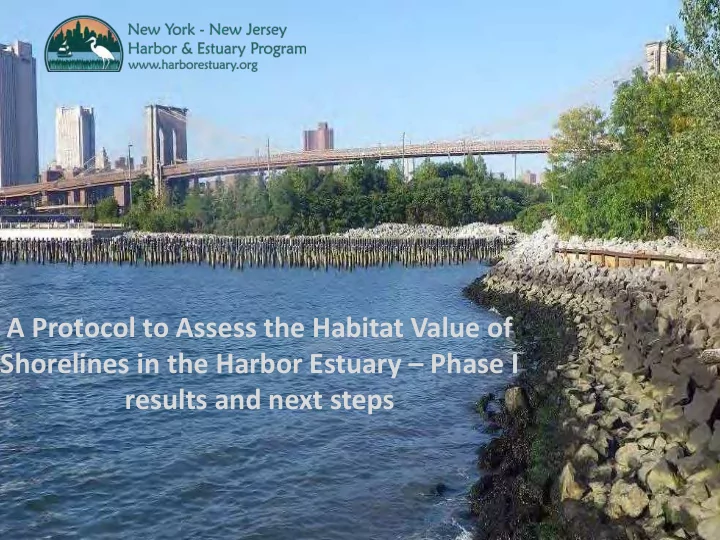
A Protocol to Assess the Habitat Value of Shorelines in the Harbor Estuary – Phase I results and next steps
SLIDE 2
Objective: a repeatable means of comparison between shoreline stabilization methods in an urban estuary
Repeatable and safe Relatively easy and
inexpensive
Standard comparison across
a range of urban conditions
SLIDE 3 Urban s shorel eline a assess sessme ment: t: basic design
Water quality Encrusting algae Sessile
invertebrates
Mobile
invertebrates
Bivalves Fish Photoquadrats Abiotic
conditions
SLIDE 4 Shorelines surveyed
West Harlem Piers (3) Harlem River Park (1) Randalls Island (2) 1 2 3 4 5 6
SLIDE 5
Urban shoreline assessment: challenges
Seawall without crevices Riprap with crevices
SLIDE 6
Urban shoreline assessment: invertebrate colonization device
Standard surface
area and submergence duration
Steel crab trap Enclosed netting and
brick - microhabitats
Settlement plates for
sessile invertebrates
PVC piping to
stabilize device
SLIDE 7
Deployment
Water level at low spring tide
SLIDE 8 Preliminary data: mobile invertebrates
Stress = 0.09, based on Bray-Curtis dissimilarity matrix of untransformed mobile invertebrate community data Boulder riprap Concrete seawall (control) Gabion basket Stone Wall
1 2 3 4 5
SLIDE 10 Public Access Assessment 2015
10
SLIDE 11 Public Access Assessment: objectives
11
Understand current
access and stewardship capacity; target resources toward need.
Document progress
toward goals.
Provide public
information about access and stewardship.
SLIDE 12
Where is public access and what does it look like?
6.8 million people live
within .5 miles of the coastline
41,070 acres of public
access
63% accessible 37% inaccessible (2%
homeland security zones)
SLIDE 13
Where is access most needed?
12 high need reaches 55% persons of color 35% youth (under 14) 3% population growth $67,766 median household
income
SLIDE 14 Reach analysis
Reach Population Communities of color (%) Median household income Youth population (%) Growth (%) Harbor-wide Bronx North Manhattan/Harlem River Flushing Bay and Creek Rockaway East Upper Passaic Lower Passaic/Newark Bay/Bayonne Lower Hackensack Elizabeth River/Arthur Kill (NJ) Kill Van Kull/Staten Island North Shore Raritan River Mouth/Upper Raritan Bay Mid-Raritan Bound Brook
Coming soon!
SLIDE 15 Reach analysis
Reach Linear accessibility (% of total) Density of people to accessible waterfront acres Acres of public access Harbor-wide Bronx North Manhattan/Harlem River Flushing Bay and Creek Rockaway East Upper Passaic Lower Passaic/Newark Bay/Bayonne Lower Hackensack Elizabeth River/Arthur Kill (NJ) Kill Van Kull/Staten Island North Shore Raritan River Mouth/Upper Raritan Bay Mid-Raritan Bound Brook
Coming soon!
SLIDE 16
ACTION AGENDA / CCMP REVISION PROPOSED SCOPE AND TIMELINE
SLIDE 17 Obj Objectives s
17
- Conduct a series of public listening sessions to
ensure stakeholder input for the 2016-2020 Action Agenda as well as the scope of the CCMP revision.
- Prepare a broad, risk-based climate change
vulnerability assessment of HEP’s current and potential future goals.
- Identify various financial options for the
implementation of the Action Agenda priorities.
- Produce the 2016-2020 Action Agenda identifying HEP
priorities for the next five years, including the scope and purpose of the CCMP revision and next State of Estuary report.
SLIDE 18 Ke Key Role les a and d Responsibiliti ties
18
Policy & Management Committees
- Guide Effort
- Approve Scope of Work, Draft and
Final Documents
- MC Members Lead Work Groups
Work Groups
- Convene five by-invitation forums
- Water quality, restoration, public
access, sediment, education
- Builds on existing groups/projects
Citizens Advisory Committee
- Members Convene 15 -20 Place
Based Listening Sessions
- Broad agenda around clean water
benefits / vulnerability to climate change
- Meetings are oriented toward
watersheds or reaches
- Builds on existing meetings
Science & Technical Advisory Committee
- Network is part of work groups
- Special meetings to refine scope
- f State of the Estuary and CCMP
- Effort ties to HRF 2017 Call for
Proposals
SLIDE 19 Outpu tputs
19
CCMP Revision Outline (per EPA)
existing and draft CCMP
- State of the Estuary
- HEP’s program structure
- CCMP Actions:
Stated goals/problems, Probable causes and sources Measurable objectives Monitoring approach
- Finance strategy
- Public Review Process
Action Agenda Outline
- Mission Statement/Intro
- Overall Climate Vulnerability
- Overall CCMP Scope
- Goals/Priority Actions
Water Quality Habitat Restoration Public Access Sediment/Port Public Education
SLIDE 20
Time imeli line
SLIDE 21 Ques estions f for the the RW RWG
21
Focus
What Are Key Questions Relative to Current or
Prospective HEP Goals/What Will be The Drivers For This Process?
What Are Key Questions/Drivers Related to
Climate Vulnerability?
What Are Key Questions/Drivers Related to
Financing?
Process
Connection to CRP Adoption Integration with Restoration Conference/RWG
Agenda