
SLIDE 1
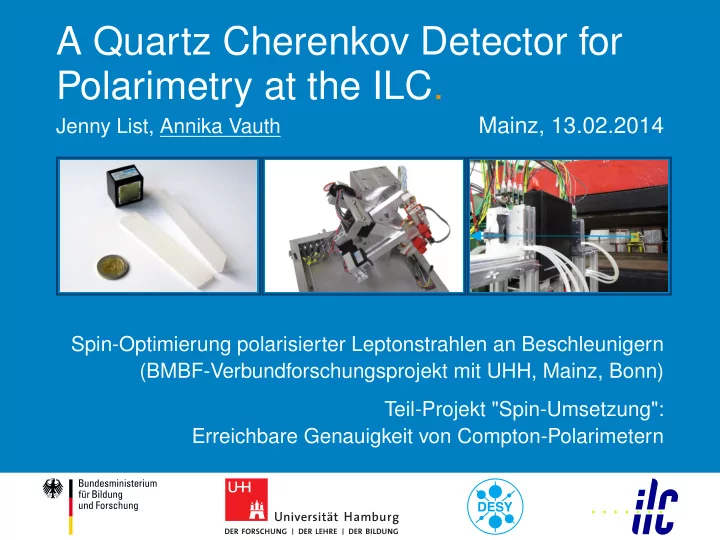
A Quartz Cherenkov Detector for Polarimetry at the ILC. Mainz, - - PowerPoint PPT Presentation
A Quartz Cherenkov Detector for Polarimetry at the ILC. Mainz, 13.02.2014 Jenny List, Annika Vauth Spin-Optimierung polarisierter Leptonstrahlen an Beschleunigern (BMBF-Verbundforschungsprojekt mit UHH, Mainz, Bonn) Teil-Projekt
ILC Polarimetry Design Application Conclusion
Quartz Detector for ILC Polarimetry | A. Vauth | Mainz, 13.02.14 | 0/19
ILC Polarimetry Design Application Conclusion
Quartz Detector for ILC Polarimetry | A. Vauth | Mainz, 13.02.14 | 1/19
ILC Polarimetry Design Application Conclusion
1650m 1 5 m
e⁻ e⁺
e⁺e⁻ collisions ③ upstream polarimeter ① downstream polarimeter ① spin tracking ②
Quartz Detector for ILC Polarimetry | A. Vauth | Mainz, 13.02.14 | 1/19
ILC Polarimetry Design Application Conclusion
24 cm 45.6 GeV Laser IP Dipole Dipole Dipole Dipole total length: ~75 m IP e⁺/e⁻ Čerenkov detector 250 GeV
Quartz Detector for ILC Polarimetry | A. Vauth | Mainz, 13.02.14 | 2/19
ILC Polarimetry Design Application Conclusion
50 100 150 200 250 0.0 1.0 2.0 3.0 4.0 5.0
σ
Energy of the Compton−scattered electrons [GeV] [mbarn/GeV] Compton λ Pe = +1
(same)
λ Pe = −1
(opposite) Quartz Detector for ILC Polarimetry | A. Vauth | Mainz, 13.02.14 | 3/19
ILC Polarimetry Design Application Conclusion
50 100 150 200 250 0.0 1.0 2.0 3.0 4.0 5.0
σ
Energy of the Compton−scattered electrons [GeV] [mbarn/GeV] Compton λ Pe = +1
(same)
λ Pe = −1
(opposite)
N++N−
Quartz Detector for ILC Polarimetry | A. Vauth | Mainz, 13.02.14 | 3/19
ILC Polarimetry Design Application Conclusion
Quartz Detector for ILC Polarimetry | A. Vauth | Mainz, 13.02.14 | 4/19
ILC Polarimetry Design Application Conclusion
e⁻ beam Čerenkov photons Photomultiplier LED calibration system gas-filled Al-channel
Quartz Detector for ILC Polarimetry | A. Vauth | Mainz, 13.02.14 | 5/19
ILC Polarimetry Design Application Conclusion
Quartz Detector for ILC Polarimetry | A. Vauth | Mainz, 13.02.14 | 5/19
ILC Polarimetry Design Application Conclusion
Quartz Detector for ILC Polarimetry | A. Vauth | Mainz, 13.02.14 | 5/19
ILC Polarimetry Design Application Conclusion
Quartz Detector for ILC Polarimetry | A. Vauth | Mainz, 13.02.14 | 6/19
ILC Polarimetry Design Application Conclusion
e.g. for 15 e− per detector channel: 200 photons per e−
PMT gain
detector signal number of events N⁻ N⁺
Quartz Detector for ILC Polarimetry | A. Vauth | Mainz, 13.02.14 | 6/19
ILC Polarimetry Design Application Conclusion
e.g. for 15 e− per detector channel: 200 photons per e−
◮ refractive index n≈1.45 (for comparision: n(C4F10) = 1.0014) ◮ Cherenkov angle θc ≈ 46◦ ◮ Cherenkov threshold Ethr ≈ 0.9 MeV
Quartz Detector for ILC Polarimetry | A. Vauth | Mainz, 13.02.14 | 6/19
ILC Polarimetry Design Application Conclusion
e⁺/e⁻ e⁺/e⁻ PMT Side view top view PMT
Cherenkov photons quartz block PMT e⁺/e⁻ beam angle
Quartz Detector for ILC Polarimetry | A. Vauth | Mainz, 13.02.14 | 7/19
ILC Polarimetry Design Application Conclusion
e⁺/e⁻ e⁺/e⁻ PMT Side view top view PMT
◮ Fused silica blocks ◮ photomultiplier (PMT)
◮ coupled with optical
◮ different surface
Cherenkov photons quartz block PMT e⁺/e⁻ beam angle
Quartz Detector for ILC Polarimetry | A. Vauth | Mainz, 13.02.14 | 7/19
ILC Polarimetry Design Application Conclusion
(length, height and angle chosen so that distance between electrons and PMT is 3 cm):
quarz halflength [mm] 20 40 60 80 100 120 140
y
α 30 35 40 45 50 55 60 500 1000 1500 2000 2500
photon hits for different simulated geometries
Quartz Detector for ILC Polarimetry | A. Vauth | Mainz, 13.02.14 | 8/19
ILC Polarimetry Design Application Conclusion
quartz bars PMT adjustable angle adjustable angle
Quartz channels Photo- cathode 18 mm
◮ channels: quartz bars
◮ using photomultipliers with four
◮ angle w.r.t. beam axis:
Quartz Detector for ILC Polarimetry | A. Vauth | Mainz, 13.02.14 | 9/19
ILC Polarimetry Design Application Conclusion
Quartz Detector for ILC Polarimetry | A. Vauth | Mainz, 13.02.14 | 9/19
ILC Polarimetry Design Application Conclusion
Quartz Detector for ILC Polarimetry | A. Vauth | Mainz, 13.02.14 | 10/19
ILC Polarimetry Design Application Conclusion
◮ Test detector signal for single
◮ Compare light output to
◮ Study detector response for
Quartz Detector for ILC Polarimetry | A. Vauth | Mainz, 13.02.14 | 10/19
ILC Polarimetry Design Application Conclusion
◮ Angle of the quartz bars: controlled with stepping motor ◮ Movement of the whole detector: used testbeam x-y table
Beam Trigger Scintillators T r i g g e r L
i c U n i t Pulse Generator z x y Q D C Delay Signal G a t e x-y table
◮ Trigger: coincidence of four scintillators ◮ Generate QDC (charge digitizer) gate on trigger signal ◮ Delay photomultiplier signal long enough to fall inside gate
Quartz Detector for ILC Polarimetry | A. Vauth | Mainz, 13.02.14 | 11/19
ILC Polarimetry Design Application Conclusion
Cherenkov photons e⁻
Anode 2 Anode 1
run 0875
QDC bins above pedestal
50 100 150 200
events
500 1000 1500 2000
Example: QDC signal for both anodes on one quartz channel top anode bottom anode
Quartz Detector for ILC Polarimetry | A. Vauth | Mainz, 13.02.14 | 12/19
ILC Polarimetry Design Application Conclusion
Cherenkov photons e⁻
Anode 2 Anode 1
detector x-position [mm]
60 70 80 90 100
signal events
100 200 300 3 10 ×
◮ x=5 mm wide channels ◮ scan across x-direction → determine beam spot size
Quartz Detector for ILC Polarimetry | A. Vauth | Mainz, 13.02.14 | 13/19
ILC Polarimetry Design Application Conclusion
Cherenkov photons e⁻
Anode 2 Anode 1
detector x-position [mm]
60 70 80 90 100
signal events
100 200 300 3 10 ×
35 mm ~13 mm
Quartz Detector for ILC Polarimetry | A. Vauth | Mainz, 13.02.14 | 13/19
ILC Polarimetry Design Application Conclusion
Cherenkov photons e⁻
Anode 2 Anode 1
350 700
combined anode 2 anode 1 angle to incident electron photon hits
30 40 50 60
Quartz Detector for ILC Polarimetry | A. Vauth | Mainz, 13.02.14 | 14/19
ILC Polarimetry Design Application Conclusion
Cherenkov photons e⁻
Anode 2 Anode 1
angle to incident electron
30 40 50 60
6
electrons / 10
50 100 150
Anode 2 Anode 1 Combined
Quartz Detector for ILC Polarimetry | A. Vauth | Mainz, 13.02.14 | 15/19
ILC Polarimetry Design Application Conclusion
(from Compton electrons to spectrum at the charge-to-digital converter (QDC))
QDC bin 500 1000 1500 2000 2500 entries 50 100 150 200
input: 14 Compton electrons 100 photons per C. e⁻ fitted: 14.01 ± 0.01 C. e⁻
Quartz Detector for ILC Polarimetry | A. Vauth | Mainz, 13.02.14 | 16/19
ILC Polarimetry Design Application Conclusion
(80 % polarsation, 3 mm wide detector channels)
detector channel 20 40 60 mean electrons / event 10 20
Simulation: 60 channels 3 mm width 80% polarisation
laser left laser right
Quartz Detector for ILC Polarimetry | A. Vauth | Mainz, 13.02.14 | 17/19
ILC Polarimetry Design Application Conclusion
Quartz Detector for ILC Polarimetry | A. Vauth | Mainz, 13.02.14 | 18/19
ILC Polarimetry Design Application Conclusion
◮ Option for polarimeter detector: quartz as Cherenkov medium ◮ Prototype designed, constructed & and tested at DESY II testbeam:
◮ Test detector signal for single electrons
◮ Study detector response for different angles
and positions
Qualitative agreement with simulation, more detailed alignment work in progress
◮ Study application on full polarisation measurement
Quartz Detector for ILC Polarimetry | A. Vauth | Mainz, 13.02.14 | 18/19
ILC Polarimetry Design Application Conclusion
◮ scale calibration from e+e− collision data ◮ spin tracking and understanding of collision effects ◮ upstream (UP) and downstream (DP) polarimeters
◮ UP: time resolution ◮ DP: collision effects ◮ combined: cross-check, lumi-weighted polarisation @ IP
◮ site specific studies ◮ detectors: prototypes → full-scale, DAQ, ...
Quartz Detector for ILC Polarimetry | A. Vauth | Mainz, 13.02.14 | 19/19