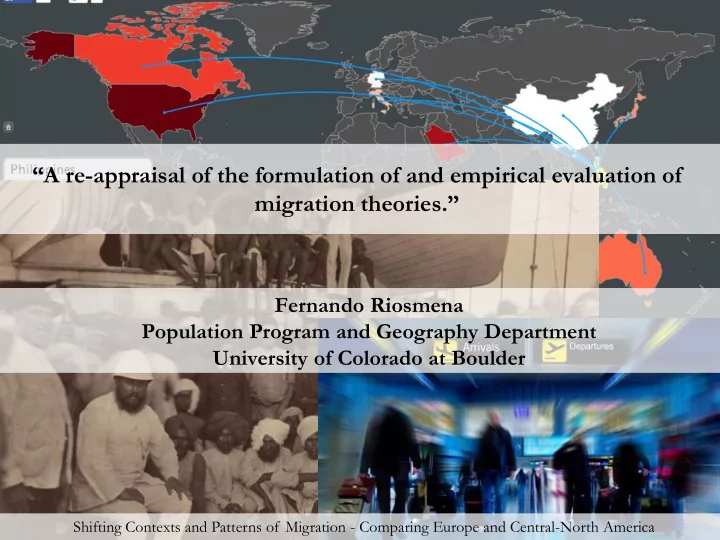
SLIDE 1
Fernando Riosmena Population Program and Geography Department University of Colorado at Boulder
“A re-appraisal of the formulation of and empirical evaluation of migration theories.”
Shifting Contexts and Patterns of Migration - Comparing Europe and Central-North America
SLIDE 2
A new Era of transnational migrations (& transnationalism)?
Slowdown in Mexico-US, continued migration/displacement from NTCA Still, large Mexico–U.S. flows driven by as many –if not more varied– motivations
than previously, incl. to some extent violence & climate-related migration
Three ‘caging’ effects in Mesoamerica-US migration dynamics Reduced (voluntary) return from US Forced/voluntary return migrant “resettlement” not in original sending areas, but
in Mexican borderlands & main urban centers
Larger, slower, more multifaceted transit migrations across L. America that are
becoming “slow-floating,” more settled
SLIDE 3 First caging effect in Mexico – U.S. migration: reduced voluntary return by people otherwise presumably willing to circulate
Source: Massey, D.S., Durand, J. and Pren, K. 2015. “Border Enforcement and Return Migration by Documented and Undocumented Mexicans.” Journal of Ethnic and Migration Studies 41(7):1015-1040.
SLIDE 4 Second caging effect in (Mexico – US) migration: deportees (& their relatives) not settling in original sending communities, but disproportionately doing so in the Borderlands & in major cities.
Source: Giorguli-Saucedo & Gutiérrez(2012) based on 2000 & 2010 Mexican Census data.
SLIDE 5 Second caging effect in (Mexico – US) migration: deportees (& their relatives) not settling in original sending communities, but disproportionately doing so in the Borderlands & in major cities.
Source: Giorguli-Saucedo & Gutiérrez(2012) based on 2000 & 2010 Mexican Census data.
SLIDE 6 Third caging effect in L. America – U.S. migration: longer, more multifaceted transit with settlement “along the way.”
Source: Fernández Casanueva & Rodríguez (2016).
SLIDE 7
Migration studies for a new Era
These changing dynamics, plus… …increasingly heterogeneous multi-staged migrations… …asynchronous migration transitions across places… …More complex migration systems… …highlight/exacerbate substantive & methodological challenges in… …measurement of migration, …its drivers, & …translocal & transnational social spaces it creates
SLIDE 8
Migration studies for a new Era
Methodologically,… …how to capture some of these migrations at all/much more substantially? …how to capture them in all of their complexity? Substantively,… Better formulation & empirical test of migration theories Stronger links between international, forced, & internal migration studies Stronger theoretical & empirical links between classical migration theories (e.g., in
Population Studies) & (anthro-/sociological) literature on transnationalism
SLIDE 9
Migration studies for a new Era: substantive challenges
Shifting Contexts and Patterns of Migration - Comparing Europe and Central-North America.
SLIDE 10
- 1. In light of caging effects: how to assess validity of theories when
people are settling when/where they did not mean to, or not returning when they would have otherwise given their initial migration motivations?
Shifting Contexts and Patterns of Migration - Comparing Europe and Central-North America.
SLIDE 11 (1st caging effect in Mexico – U.S. migration complicates understanding of whether e.g., NELM is less relevant today…)
Source: Massey, D.S., Durand, J. and Pren, K. 2015. “Border Enforcement and Return Migration by Documented and Undocumented Mexicans.” Journal of Ethnic and Migration Studies 41(7):1015-1040.
SLIDE 12
16
SLIDE 13
Theories explaining the initiation of flows: location and social complexity scale
Neoclassical Individuals Families Broader social structures New economics of labor migration Markets Institutions Networks World-systems Segmented labor market New economics of labor migration (decision sphere) Neoclassical (decision sphere) Historical- structural
Social complexity scale Factors in sending areas Factors in destinations
SLIDE 14
Source: Pries (2001)
Three caging effects may also question relevance of intended motivations & time horizon of migration on the formation of particular transnational social spaces
SLIDE 15
- 2. To better understand decline in Mexico-US migration, theories of
the “perpetuation/continuation” of migration need to be reformulated to consider ways in which prior migration generates feedbacks that contribute to a subsequent decline in flows
Shifting Contexts and Patterns of Migration - Comparing Europe and Central-North America.
SLIDE 16 Economic slowdown as a result of the global financial crisis was a major catalyzer for slowdown in Mexico-US migration…
550 600 650 700 750 800 850 900 950 5 10 15 20 25 30 2005/2 2005/3 2005/4 2006/1 2006/2 2006/3 2006/4 2007/1 2007/2 2007/3 2007/4 2008/1 2008/2 2008/3 2008/4 2009/1 2009/2 2009/3 2009/4 2010/1 2010/2 2010/3 2010/4 2011/1 2011/2 2011/3 2011/4 2012/1 2012/2 2012/3 2012/4 2013/1 2013/2 2013/3 2013/4 2014/1 2014/2 2014/3 2014/4 2015/1 2015/2 2015/3
Job Gains in construction in the U.S. International out-migration
Source: Villarreal (2017) based on ENOE data.
SLIDE 17
…besides other possible latent factors in (some) sending areas, including demographic, economic, and ideational change.
Source: Hanson & McIntosh (2010)
SLIDE 18
…besides other possible latent factors in (some) sending areas, including demographic, economic, and ideational change.
Source: Hanson & McIntosh (2010)
SLIDE 19
However, clear possibility of negative, migration-fueled social multipliers (including those operating through immigration policy)…
Source: Massey, D.S. and Pren, K. 2012. “Unintended Consequences of US Immigration Policy: Explaining the Post-1965 Surge from Latin America.” Population and Development Review 38(1):1-29.
SLIDE 20
Theories explaining cumulative causation of flows (all migration-fueled): location & spatial scale
Social capital theory (CC) Network expansion Institutional theory CA: migration culture Social labeling Δ origin-destination wage gaps *Cumulative causation Individuals Families Broader social structures Markets Institutions Networks
Social scale Factors in sending areas Factors in destinations
Land use changes → inequality, “displacement”
SLIDE 21
Other possible mechanisms of negative cumulative causation
The limits of social capital In resources, and thus in growth of “sources” e.g., due to worse opportunities in destinations (& negative externalities) (Bauer 2008; De Haas 2010; Menjívar 2000; Portes 1998) Other mechanisms that explain declines, sometimes migration-fueled Closing of wage gaps, better market & institutional functioning Lower inequality in sending areas (e.g., due to redistributive policies, programs) Positive social multipliers of migration on sending community development Weakening of “culture of migration” (e.g., by shifts in youth aspirations) Biggest challenge to identify these mechanisms and role of migration therein
35
SLIDE 22
- 3. Better understanding of contemporary (rise &) decline in Mexico-
US migration (and in nations that have not approached to net zero) may advance theoretical formulation & empirical testing of migration stages/transitions
Shifting Contexts and Patterns of Migration - Comparing Europe and Central-North America.
SLIDE 23
A broader theoretical & empirical vision could contribute to a better systematic understanding of the migration “life cycle”
Source: de Haas, H. (2010) The Internal Dynamics of Migration Processes: A Theoretical Inquiry, Journal of Ethnic and Migration Studies, 36:10, 1587-1617
SLIDE 24 Also need to improve knowledge
- f factors leading to “takeoff” of
migration at local, micro-regional, national, and regional scales
Source: Lindstrom, D. & A. López Ramírez. (2010). Pioneers and Followers: Migrant Selectivity and the Development of U.S. Migration Streams in Latin
- America. Annals of the American Academy of Political and
Social Sciences. 630:53-77.
SLIDE 25 39
Source: De Haas, H. (2010). Migration transitions: a theoretical and empirical inquiry into the developmental drivers of international
Paper No. 24. Oxford: International Migration Institute.
This inquiry would benefit from being done in conjunction with that trying to understand transition of (nations) from being countries of emigration to being destinations (for nationals & foreigners)
?
SLIDE 26
- 4. Era of extended transit calls for stronger theoretical and empirical
integration between international and internal migration studies.
Shifting Contexts and Patterns of Migration - Comparing Europe and Central-North America.
SLIDE 27
Source King, R. & R. Skeldon. (2010) “'Mind the Gap!' Integrating Approaches to Internal and International Migration.” Journal of Ethnic and Migration Studies. p. 1-28.
SLIDE 28
- 5. Eras of decline, deportation, & extended transit call for better
theoretical & empirical integration between (quantitative) international migration theory testing & transnationalism scholarship
Shifting Contexts and Patterns of Migration - Comparing Europe and Central-North America.
SLIDE 29 Some areas of cross-pollination with clear potential
Clear relation between transnational social spaces & cumulative causation But when are transnational social spaces created by ~massive flows? Are they always? More (quantitative) empirical work on understanding formation (& decline)
- f different (migration-driven) transnational space constellations
Is deportee nonreturn to original sending areas expanding or contracting
transnational social spaces created by original emigration out of these places?
What is extended transit doing to transnational social spaces?
SLIDE 30
Thank you.
Shifting Contexts and Patterns of Migration - Comparing Europe and Central-North America.