A Reality Check on Health Information Privacy: How should we - - PDF document

a reality check on health information privacy how should
SMART_READER_LITE
LIVE PREVIEW

A Reality Check on Health Information Privacy: How should we - - PDF document

A Reality Check on Health Information Privacy: How should we understand re-identification risks under HIPAA? Daniel C. Barth-Jones, M.P.H., Ph.D. Assist ant Professor of Clinical Epidemiology, Mailman S chool of Public Healt h Columbia


slide-1
SLIDE 1

1

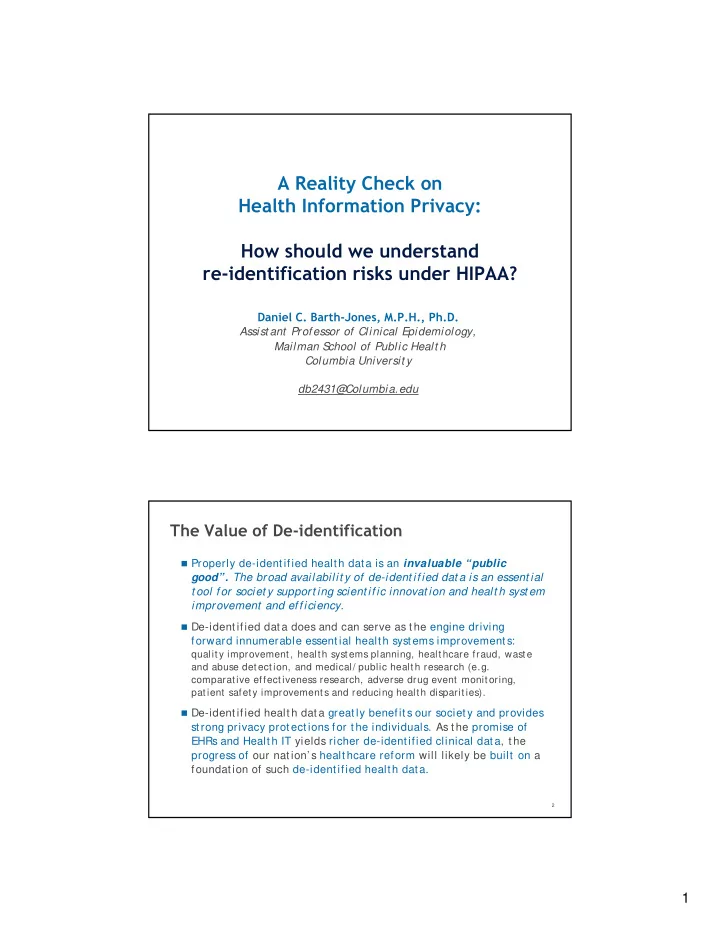
A Reality Check on Health Information Privacy: How should we understand re-identification risks under HIPAA?

Daniel C. Barth-Jones, M.P.H., Ph.D. Assist ant Professor of Clinical Epidemiology, Mailman S chool of Public Healt h Columbia Universit y db2431@ Columbia.edu

 Properly de-identified health data is an invaluable “public

good”. The broad availabilit y of de-ident ified dat a is an essent ial t ool for societ y support ing scient ific innovat ion and healt h syst em improvement and efficiency

The Value of De-identification

improvement and efficiency.

 De-identified data does and can serve as the engine driving

forward innumerable essential health systems improvements:

quality improvement, health systems planning, healthcare fraud, waste and abuse detection, and medical/ public health research (e.g. comparative effectiveness research, adverse drug event monitoring, patient safety improvements and reducing health disparities).  De identified health data greatly benefits our society and provides

2

 De-identified health data greatly benefits our society and provides

strong privacy protections for the individuals. As the promise of EHRs and Health IT yields richer de-identified clinical data, the progress of our nation’ s healthcare reform will likely be built on a foundation of such de-identified health data.

slide-2
SLIDE 2

2

ion

Complete Protection

Bad Decisions / B d S i

The Inconvenient Truth:

  • sure Protect

Trade-Off between Information Quality and Privacy Protection

Ideal Situation (Perfect Information & Perfect Protection)

Unfortunately, not achievable due to Bad Science Poor Privacy Protection

Information Disclo

Privacy Protection

due to mathematical constraints

Optimal Precision, Lack of Bias No Protection

3

No Information

Misconceptions about HIPAA De-identified Data:

“It doesn’t work… ” “ easy, cheap, powerful re-identification”

(Ohm, 2009 “ Broken Promises of Privacy” ) *Pre-HIPAA Re-identification Risks {Zip5, Birth date, Gender} Able to id tif 87% 63% f US P l ti identify 87%

  • 63%
  • f US

Population (S

weeney, 2000, Golle, 2006)

 Reality: HIPAA compliant de-identification provides important

privacy protections

— S afe harbor re-identification risks have been more recently estimated at 0.04%(4 in 10,000) (S

weeney, NCVHS Testimony, 2007)

— Safe Harbor de-identification provides protections that have been estimated to be a minimum of 400 to 1000 times more protective

  • f privacy than permitting direct PHI access.

(Benitez & Malin, JAMIA, 2010)

 Reality: Under HIPAA de-identification requirements, re-

identification is expensive and time-consuming to conduct, requires serious computer/ mathematical skills, is rarely successful, and uncertain as to whether it has actually succeeded

4

slide-3
SLIDE 3

3

Misconceptions about HIPAA De-identified Data: “ It works perfect ly and permanent ly… ”

 Reality:

—Perfect de-identification is not possible Perfect de identification is not possible —De-identifying does not free data from all possible subsequent privacy concerns —Data is never permanently “ de-identified” … (There is no guarantee that de-identified data will remain de-identified regardless of what you do to it after it is de-identified.) —S imply collapsing your coding categories until the data is “ k-anonymous” without considering the impact on statistical accuracy and utility can make the data unsuitable for many statistical analyses

5

Myth of the “Perfect Population Register” and importance of “Data Divergence”

 The critical part of re-identification efforts that is

virtually never tested by disclosure scientists is assumption of a perfect population register.

 Probabilistic record linkage has some capacity to dealing

with errors and inconsistencies in the linking data between the sample and the population caused by “ data

divergence” :

— Time dynamics in the variables (e.g. changing Zip Codes when individuals move), — Missing and Incomplete data and — Keystroke or other coding errors in either dataset,

 But the links created by probabilistic record linkage are

subj ect to uncertainty. The data intruder is never really certain that the correct persons have been re-identified.

6

slide-4
SLIDE 4

4

Identification Spectrum

Fully Identified No Information

Totally Safe,

De- Identified “Breach Safe” LDS

  • Protected Health Information (PHI)
  • Limited Data Set (LDS

) §164.514(e)

  • Eliminate 16 Direct Identifiers (Name Address S

S N etc )

Research, Public Health, Healthcare Operations Useful for Breach Avoidance

But Useless Treatment, Payment, Operations

Any Purpose Permitted Uses:

  • Eliminate 16 Direct Identifiers (Name, Address, S

S N, etc.)

  • LDS w/o 5-digit Zip & Date of Birth (LDS
  • “ Breach S

afe” ) 8/24/09 FedReg

  • Eliminate 16 Direct Identifiers and Zip5, DoB
  • Safe Harbor De-identified Data Set (SHDDS) §164.514(b)(2)
  • Eliminate 18 Identifiers (including Geo < 3 digit Zip, All Dates except Yr)
  • Statistically De-identified Data Sets (SDDS) §164.514(b)(1)
  • Verified “very small” Risk of Re-identification

7

 “ Risk is very small…

” “ th t th i f ti ld b d”

HIPAA Statistical De-identification Conditions

— “ that the information could be used” … — “ alone or in combination with other reasonably available information”… , — “ by an anticipated recipient”… — “ to identify an individual”…

8

slide-5
SLIDE 5

5

Statistically De-identified Data Sets (SDDSs)

 S

t at ist ical De-ident ificat ion often can be used to release some of the safe harbor “ prohibited identifiers” provided that the risk of re-identification is “very small”. that the risk of re identification is very small .

 For example, more detailed geography, dat es of service

  • r encrypt ion codes could possibly be used within

statistical de-identified data based on statistical disclosure analyses showing that the risks are very small.

 However, disclosure analyses must be conducted to

9

assess risks of re-identification

(e.g., encrypted data with strong statistical associations to unencrypted data can pose important re-identification risks)

Information Explosion -

Rapid Increase in Publically Available Data

 Any information which is a “ mat t er of public

record” or “ reasonably available” in data sets record or reasonably available in data sets which contain actual identifiers should be considered a quasi-identifier under the HIPAA definition for statistical de-identification.

 The amount of data that will need to be

considered “ reasonably available” quasi- identifiers should only be expected to increase identifiers should only be expected to increase due to the dramatic expansion of public records which are freely available via the internet or inexpensively purchased data from marketing data vendors.

10

slide-6
SLIDE 6

6

Successful Solutions:

Balancing Disclosure Risk and Statistical Accuracy

 When appropriately implemented, statistical de-

identification seeks to protect and balance two vitally important societal interests: p — 1) Protection of the privacy of individuals in healthcare data sets, (Disclosure or Identification Risk), and — 2) Preserving the utility and accuracy of statistical analyses performed with de-identified data (Loss of Information).

 Limiting disclosure inevitably reduces the quality of  Limiting disclosure inevitably reduces the quality of

statistical information to some degree, but the appropriate disclosure control methods result in small information losses while substantially reducing identifiability.

11

 Essential Re-identification and S

tatistical Disclosure Concepts — Record Linkage

Essential Re-identification Concepts

g — Linkage Keys (Quasi-identifiers) — S ample Uniques and Populat ion Uniques

 S

traightforward Methods for Controlling Re- identification Risk — Decreasing Uniques:

 by Reducing Key Resolutions  by Increasing Reporting Population S

izes

 Understanding challenges for reporting geographies

12

slide-7
SLIDE 7

7

Record Linkage

Population Register (w/ IDs)

Record Linkage is achieved by matching records in separate data sets that have a common “ Key” or set

  • f data fields.

Name Address Gender Age (Y

  • B)

Dx Codes

Px Codes

...

Gender Age (Y

  • B)

...

Population Register (w/ IDs)

(e.g. Voter Registration)

S l

Revealed Data Identifiers Quasi- Identifiers (Keys)

Sample Data file

13

Quasi-identifiers

While individual fields may not be identifying by themselves, the contents of several fields in combination may be sufficient to result in identification, the set of y , fields in the Key is called the set of Quasi-identifiers. Fields that should be considered part of a Quasi- identifier are those variables which would be likely to

Gender Age Ethnic Group Marital S tatus Geo- graphy Name Address

^------- Quasi-identifiers ---------^

identifier are those variables which would be likely to exist in “ reasonably available” data sets along with actual identifiers (names, etc.). Note that this includes even fields that are not “ PHI” .

14

slide-8
SLIDE 8

8

Key Resolution

Key “ resolut ion” increases with: 1) the number of matching fields available 2) the level of detail within these fields (e g Age in 2) the level of detail within these fields. (e.g. Age in Y ears versus complete Birth Date: Month, Day, Y ear)

Name Address Gender

Full DoB

Ethnic Group

Dx

Px

Gender

Full Ethnic

Marital S tatus Marital Geo- graphy Geo-

Codes Codes

Gender

DoB Group

S tatus graphy

15

Sample and Population Uniques

When only one person with a particular set of

characteristics exists within a given data set (typically referred to as the sample data set) (typically referred to as the sample data set), such an individual is referred to as a “ Sample Unique” .

When only one person with a particular set of

characteristics exists within the entire population or within a defined area such an population or within a defined area, such an individual is referred to as a “ Population Unique” .

16

slide-9
SLIDE 9

9

Measuring Disclosure Risks

Population Uniques

Sample Uniques

Potential Links

Sample Records

Population Records

(Healthcare

Data Set)

(e.g.,

Voter Registration List)

17

Records that are unique in the sample but which aren’ t unique in the population, would match with more than one record in the population, and only have a probability of being identified Only records that are unique in the sample and the population are at clear risk of being identified with exact linkage

Linkage Risks Population Uniques

S ample Uniques Links S ample Records

Population Records

Records that are not unique in the sample cannot be unique in the population and, thus, aren’ t at definitive risk of being identified Records that are not in the sample also aren’ t at risk of being identified

18

slide-10
SLIDE 10

10

Estimating Disclosure Risks

We can determine the Sample Uniques quite easily from the sample data

Links / Sample Records indicates

the risk of record linkage.

Population Uniques

Sample Uniques Links

For many characteristics, the likelihood of

Sample Records

Population Uniqueness can be estimated from statistical models of the US Census data

19

 A large number of methods have been developed

to reduce re-identification risks.

 These methods range widely in their statistical

Reducing Disclosure Risks

sophistication and complexity.

 As a practical issue, many of the more

sophisticated methods are also quite logistically complicated to implement in frequently updated data sets (i.e., data streams).

 Most of these more sophisticated disclosure

p control methods involve distorting the original data in order to reduce the re-identification risks while also preserving the statistical utility of the data.

20

slide-11
SLIDE 11

11

 Reducing Key Resolut ion will both reduce the

proportion of S ample Uniques in the data set (or data stream) and the probability that an individual is Population Unique with regard to the

Basic Solutions: Reducing Key Resolutions

p U q g re-identification key.

 Key Resolution can be reduced either by:

—Reducing the number of Quasi-identifiers that are released (i.e., restrict number of variables reported),

  • r by
  • r by

—Reducing the number of categories or values within a Quasi-Identifier (e.g., report Year of Birth rather than complete birth date).

21

 Another easily implemented solution for reducing

di l i k i i l t i i t f

Basic Solutions:

Increasing the Population Sizes of Geographic Reporting Units

disclosure risks is simply to impose a requirement for minimum population sizes within any geographic reporting units.

 Example: the S

afe Harbor provision specifies that the only geographic units smaller than the S tate that are reportable under safe harbor de-identification are 3-digit Zip Codes containing populations of more than 20 000 individuals containing populations of more than 20,000 individuals.

 However, statistical disclosure risk analyses should be

conducted in order to assure that appropriate thresholds have been selected and that these thresholds will result in very small disclosure risks for the specific key resolutions

  • f the set of variables which are to be reported.

22

slide-12
SLIDE 12

12

 Using larger population sizes for geographic

reporting areas is an important method of controlling disclosure risks because increasing the

Basic Solutions:

Increasing Sizes of Reporting Units, cont’d.

controlling disclosure risks because increasing the reporting population size decreases the probability of an individual being unique within the reporting area and, thus, the risk of re- identification.

 Ideally, any method for restricting the reporting

f hi i f ti h ld ll ti

  • f geographic information should allow reporting
  • n all (or most) of the population, but the level of

geographic resolution would be scaled to the underlying population density to control disclosure risks.

23

Balancing Disclosure Risk/Statistical Accuracy

Balancing disclosure risks and statistical accuracy is essential because some popular de-identification methods (e.g., k-anonymity) can unnecessarily, and

  • ften undetectably degrade the accuracy of de
  • ften undetectably, degrade the accuracy of de-

identified data for multivariate statistical analyses or data mining (distorting variance-covariance matrixes, masking heterogeneous sub-groups which have been collapsed in generalization protections).

This problem is well-understood by statisticians and computer scientists, but not as well recognized and computer scientists, but not as well recognized and integrated within public policy.

Poorly conducted de-identification can lead to “bad science” and “bad decisions”.

Reference: “On k-Anonymity and the Curse of Dimensionality” by C. Aggarwal

http://www.vldb2005.org/program/paper/fri/p901-aggarwal.pdf

24

slide-13
SLIDE 13

13

 The S

tatistical De-identification provision’ s “very small” risk threshold should take into account the entire data release context, including assessment of:

Re-identification Risks in Context:

— The anticipated recipients and the technical, physical and administrative safeguards and agreements that help to assure that re- identification attempts will be unlikely, detectable and unsuccessful, — The motivations, costs, effort required and

25

, , ff q necessary skills required to undertake a re- identification attempt.

 S

t at ist ical de-ident ificat ion offers pract ical solut ions for preserving valuable Dat e and Geographic Informat ion

 The broad availabilit y of de-ident ified dat a is an essent ial t ool

De-identification Offers Important Solutions

support ing scient ific innovat ion and healt h syst em improvement and efficiency.

 De-identified data serves as the engine driving forward innumerable

essential health systems improvements: quality improvement, health

systems planning, healthcare fraud, waste and abuse detection, and medical/ public health research (e.g. comparative effectiveness research, adverse drug event monitoring, patient safety improvements and reducing health disparities)

26

health disparities).  De-identified health data greatly benefits our society while providing

strong privacy protections for individuals.

slide-14
SLIDE 14

14

Daniel C. Barth-Jones, M.P.H., Ph.D. Assist ant Professor of Clinical Epidemiology, Mailman S chool of Public Healt h Columbia Universit y Adj unct Assist ant Professor Prevent ion Research Cent er Depart ment of Pediat rics S chool of Medicine Wayne S t at e Universit y db2431@ Columbia edu db2431@ Columbia.edu dbj ones@ med.wayne.edu